
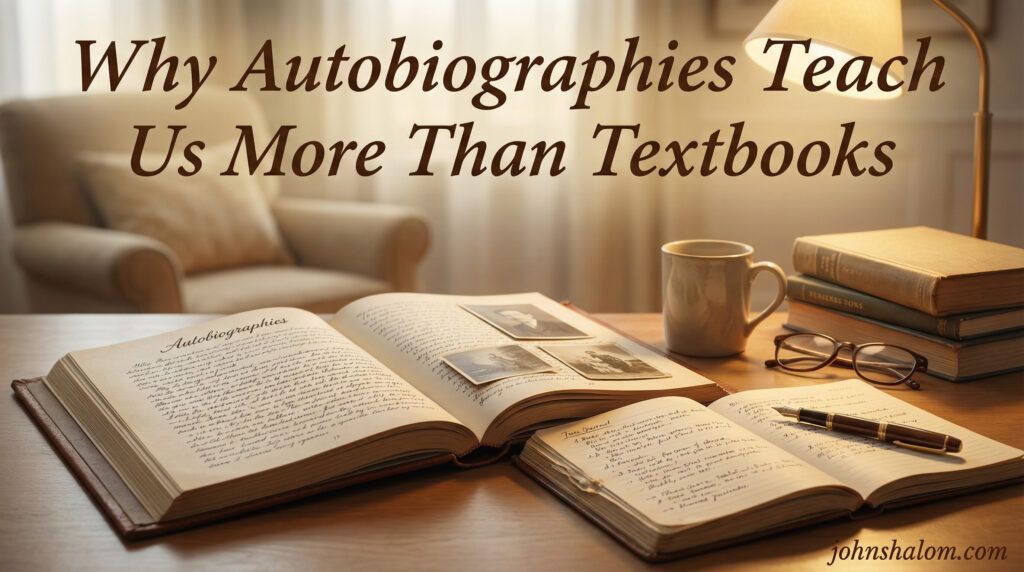
Textbooks give us facts, dates, and definitions. They act as the structural bones of formal education, providing the necessary organization for classrooms and national examinations.
Yet a skeleton alone does not welcome you to sit down and listen. It lacks warmth, emotion, and human breath.
Autobiographies add the living flesh, tears, laughter, and personal scars to historical records. They show real human beings wrestling with fear, failure, spiritual faith, and second chances.
Growing up between war and severe hunger along the Sobat River in South Sudan, I never saw my personal life reflected in traditional history textbooks. Official books recorded troop movements and political treaties, but they missed the human hearts living through those years.
When I began reading personal life stories, I discovered my own experiences on the page. Across the world, major educational systems approach history differently.
The United States relies heavily on commercial textbook publishing that often prioritizes standardized test metrics. China uses centralized state-approved curricula to build national political unity.
In South Sudan and across Africa, personal memoirs and oral testimonies bridge the gap between official records and living truth, turning cold facts into lasting human wisdom.
Key Takeaways
- Bones vs. Heart: Textbooks supply structural data, while autobiographies deliver emotional truth and personal connection.
- Global Learning Contrast: Western systems focus on standardized testing and Chinese models emphasize state narratives, but African memoirs preserve lived human experiences.
- Resilience in Hardship: Personal stories show how individuals navigate war, poverty, and loss through courage and faith.
- Inspiring Real Change: Reading how others overcome personal failure encourages readers to transform their own challenges into positive contributions.
TL;DR
Textbooks supply the necessary facts and dates for formal education, functioning like a skeleton. Autobiographies bring that skeleton to life by sharing personal struggles, triumphs, and emotional truths. By combining personal life stories with historical facts, readers in South Sudan and across the world gain deeper wisdom and inspiration for daily living.
Textbooks as the Necessary Skeleton of Learning
When I was a student, traditional textbooks felt like heavy concrete blocks. They filled our school bags with endless lists of names, dates, and official definitions.
Do I respect historical textbooks? Absolutely. They provide structural organization, help educators design lesson plans, and make standardized academic testing possible.
Without structural bones, a human body collapses. Without clear educational records, classrooms fall into confusion.
However, structure alone rarely moves the human heart. You do not invite friends to admire a bare skeleton in your living room; it offers no warmth or personal connection.
Autobiographies as Living Flesh and Moral Truth
Autobiographies deliver the emotional heartbeat that brings historical facts to life. Opening a good memoir in a quiet classroom feels like opening a window to let in fresh air.
History ceases to be a distant sentence about a conflict breaking out in a specific year. It becomes a barefoot boy running through the morning grass when gunfire erupts at dawn.
When you read Nelson Mandela’s memoir, a standard textbook might summarize his life in two brief sentences regarding his twenty-seven years in prison. His personal story reveals much more.
You feel the cold stone of his cell, the glare of the rock quarry under the afternoon sun, and the quiet spiritual struggle to forgive those who mistreated him.
You may eventually forget the exact year a specific law was passed. You will never forget the image of an elder breaking stones on Robben Island while holding onto hope for his people.
Global Educational Approaches: U.S., China, and Africa
Different global societies utilize historical records to shape citizen identity in distinct ways.
In the United States, school districts rely heavily on private textbook publishers. This commercial model often stresses individual achievement and technical data aimed at passing standardized college entry examinations.
In China, historical education is centrally managed by the state. The curriculum focuses on national unity, political continuity, and collective economic progress, keeping individual memoirs aligned with state goals.
African educational systems must blend accurate historical facts with our rich heritage of personal storytelling. Preserving individual memoirs ensures that community history remains grounded in human dignity.
| Region | Primary Educational Focus | View of History | Impact on the Learner |
| United States | Commercial textbooks & testing | Academic data & individual achievement | Technical knowledge with mixed personal connection |
| China | State-standardized curriculum | Collective national progress & unity | Strong political alignment & civic duty |
| Africa / South Sudan | Personal memoirs & oral history | Living human experience & ancestral wisdom | Deep emotional connection & moral resilience |
Finding Personal Identity Among Historical Pages
During the height of conflict in South Sudan, my daily life felt fragmented. Our family moved constantly, fleeing danger and searching for basic security.
No neat chapter title in a school book explained my personal uncertainty. I wondered if anyone else had ever experienced such confusion.
Then I encountered the written life story of a refugee. He described walking vast distances across dry country with empty hands but a determined spirit.
He wrote about the sound of distant shelling, the burning thirst, the small jokes people shared to maintain sanity, and how mothers shared their remaining food with young children.
I stopped reading in the middle of a page. I realized that an author I had never met had walked the exact road I was traveling.
That personal story gave me deep comfort. No statistical report on displaced populations could ever replace the healing power of that shared human experience.
If you are interested in documenting your own journey, explore our complete resource on How to Write Your Life Story: A Complete Guide to Autobiography Writing
.
Surviving Conflict: Memory Beyond Public Statistics
As a youth, I experienced several close encounters with grave danger near Nasir and along the Sobat corridor. I lived through nights in wet swamps and endured hunger that made basic survival difficult.
I also watched my elder brother, Biel, march away to join the liberation movement in 1989, never to return home.
For years, those memories remained heavy inside my heart. Standard history books covered the conflict using casualty numbers, major offenses, and peace treaties.
To our family, war was not a neat timeline of military strategies. It was a vacant chair at the dinner table and decades of quiet mourning.
Reading and writing personal memoirs helped me process that grief. I discovered that writing down pain transforms a heavy burden into a guiding light for future generations.
Textbooks recorded that many citizens perished. Autobiographies revealed how a single family lives through loss and retains their faith.
Lessons Textbooks Cannot Teach Digital Readers
While academic texts deliver raw information, personal memoirs reveal human character. Life stories excel at teaching lessons that standard manuals overlook:
1. Failure as a Constructive Teacher
Academic books often present success as a straight line from problem to solution. Autobiographies reveal the sleepless nights, wrong choices, and painful mistakes that precede genuine achievement.
2. Emotional Truth That Endures
No chart can convey the taste of triumph after repeated defeat or the deep humility of public failure. Personal stories allow readers to walk alongside an author through their darkest hours toward recovery.
3. Ethics Tested in Real Life
Ethics manuals list abstract moral rules. Autobiographies show a living person standing at a real crossroads, forced to choose between honesty and self-preservation.
4. Humor as a Survival Tool
Humor appears in the most unexpected places within personal memoirs. Displaced families and weary travelers use gentle laughter to maintain courage during difficult times.
Humorous Reality: History Books Versus Personal Memoirs
Consider the difference in how facts are communicated between academic texts and personal memoirs:
Academic Textbook: “In 1776, the Declaration of Independence was officially signed in Philadelphia.”
Personal Autobiography: “I watched John Hancock sign his name so large on the parchment that I thought the king in London could easily read it without his spectacles.”
The academic sentence delivers a necessary historical fact. The personal sentence provides a vivid scene, human emotion, and a warm smile.
History becomes vibrant when a real human being says, “I stood right there, this is what I saw, and this is how it felt.”
Building a National Curriculum for South Sudanese Youth
If I were tasked with designing an updated educational curriculum, I would retain basic textbooks for structure while adding rich personal memoirs.
Students should read the life stories of global figures alongside local heroes. They need to learn about local farmers who maintained absolute honesty, teachers who kept rural schools open during war, and mothers who raised families against all odds.
Our youth must understand that courage, spiritual faith, and integrity are active realities within our own communities.
When young people read local autobiographies, they realize that heroic character walked on our own soil.
I share more insights regarding my personal writing journey and educational reflections on my Wealthy Affiliate Blog
.
Reflection Questions
- Which personal memoir has made the deepest impact on your life, and what specific lesson from it do you still remember?
- How can parents and teachers incorporate personal life stories into daily instruction to make history more engaging for children?
- What is one major personal challenge you have overcome that could serve as an encouraging chapter in an autobiography for future generations?
- How does reading personal life stories alter your understanding of major national events compared to reading news reports?
- In what ways can African writers use autobiographical storytelling to preserve cultural wisdom for international readers?
FAQs
- Are textbooks still necessary if autobiographies provide better personal connection?Yes. Textbooks provide essential structural organization, chronological timelines, and foundational facts. Autobiographies complement textbooks by adding human emotion, personal perspective, and moral context. Both are required for a complete education.
- Why do readers tend to remember autobiographies longer than academic textbooks?Human memory is naturally structured around stories, relationships, and emotional connections rather than isolated data points. When readers empathize with an author’s lived experiences, the historical facts associated with that story remain memorable.
- How can schools balance standard historical facts with personal memoirs?Educators can pair historical textbook units with corresponding memoirs. For example, studying a specific historical era can include both the official timeline from the textbook and a personal biography written by someone who lived through that period.
- Do you need to be a famous political figure to write a meaningful autobiography?No. Highly impactful life stories are frequently written by everyday citizens, including nurses, teachers, farmers, and community leaders. Authentic personal experiences and honest life lessons offer immense value to readers regardless of the author’s public status.
- How does reading autobiographies benefit youth living in post-conflict regions?Autobiographies demonstrate that hardship does not define a person’s entire future. By reading how others navigated poverty, loss, and social disruption, young readers gain practical hope, emotional resilience, and the confidence to rebuild their communities.
Conclusion
Education must do more than fill minds with historical facts and examination answers; it must form human character and inspire the heart.
While Western commercial models focus on standardized test preparation and Chinese educational policy stresses state-directed national unity, African communities can offer a model grounded in personal truth and living memory.
Textbooks supply the necessary skeleton of knowledge, but autobiographies provide the living spirit that brings history to life.
By reading, preserving, and writing our own life stories, we ensure that past struggles yield wisdom, build national unity, and guide future generations toward a peaceful future.
Hello John!
This really hit home for me because I’ve always learned way more from real people’s stories than from dry textbook facts, and you nailed why that is. Autobiographies just stick differently — you’re not just absorbing information, you’re feeling the choices, the mistakes, the growth, and the human messiness behind it all, which makes the lessons actually land. I’ve noticed that the books that stay with me longest are the ones where the author is honest about the hard parts, not just the polished success story, and this article reminded me why those stories shape how we think and relate to the world in a way textbooks rarely do.
Angela M 🙂
Angela, thank you. And I agree with you. A real story enters the mind and the body, not only the head. A textbook can tell you what happened, but an autobiography shows you what it cost, what it changed, and what the person had to carry while learning it.
I also like what you said about honesty. The hard parts are usually where the lesson is hiding. When an author tells the truth about fear, pride, regret, or confusion, the reader feels less alone. That is why those books stay with us. They do not just teach information. They train judgment, empathy, and courage.
Is there one autobiography you still remember clearly years later, the kind that quietly changed how you think or live?