TL; DR
We live in a time when “busy” has become a status symbol. People brag about long hours, full calendars, and sleepless nights as if exhaustion proves importance. Yet behind many of these stories are children who feel ignored, spouses who feel lonely, and homes that feel more like guest houses than places of belonging. Work is important. Hustle has its season. But when work swallows the home, both suffer.
Real balance is not about equal hours for office and family. It is about honest priorities and full presence. When you are working, work with focus. When you are home, be home with your mind, not only your body.
Balance grows through small choices: shared meals without phones, honest conversations about limits, weekly rest, and the courage to say no to some opportunities so you can say yes to the people you love. In the end, no job can replace a father, a mother, a spouse, or a present human being. Hustle may impress people for a season. Presence builds a life that still matters when the emails stop.
The Idol of Busyness
In today’s world, hustle has become a religion. Some people pray at the altar of busyness. They measure their value by how tired they are. They say, “I am so busy,” with the same pride others once used for, “I helped someone today.”
You see it everywhere. People answer messages at midnight. They brag about never taking leave. They drink coffee like it is a fuel for survival. At work they are praised for “sacrifice.” At home they are ghosts who sleep, shower, and disappear again.
I once asked a friend how life was going. He answered one word: “Busy.” I wanted to reply, “Busy doing what? Growing? Loving? Serving? Or just running like a chicken with no head?” But I kept quiet and listened. Behind his proud “busy” was a tired man with no time for his children.
Busyness is not the same as fruit. A hamster runs all day in a wheel. It looks impressive, but the cage never moves.
Present Body, Absent Heart
Many people think they balance work and home just because they sleep at home. The body is present. The mind is not.
A father sits in the living room, but his eyes are on his phone. A mother comes back from work, but her thoughts remain in the office. Children tell stories about their day, but nobody is really listening. People share a house, but not a life.
Children notice. They may not know how to explain it, but they feel it. “Dad is here, but he is far.” “Mum is home, but she is not with us.”
My mother had very little by modern standards. No office job. No laptop. No salary at the end of the month. But when she sat with us, we knew we had her. Her ears, her eyes, her laughter. That presence fed us more deeply than any meal.
The Comedy Of Trying To Juggle Everything
Of course, trying to balance work and home can also be very funny, if you are willing to laugh.
I once tried to help with cooking while drafting an article in my head. I stirred the beans with one hand and stirred ideas with the other. By the time my mind finished the introduction, the pot had finished its journey too. Burnt beans. Ruined pot. Smoke like a political rally.
My wife laughed and said, “Next time decide: are you feeding people or feeding the paper?”
That moment was embarrassing and instructive. It reminded me that you cannot give your best attention to two demanding things at once. Something will burn. A pot. A child’s story. Your own health.
Humor helps us see our limits without hating ourselves. When we can laugh at our failed juggling acts, we are more likely to adjust than to deny.
Why Balance Matters For Nations, Not Just Families
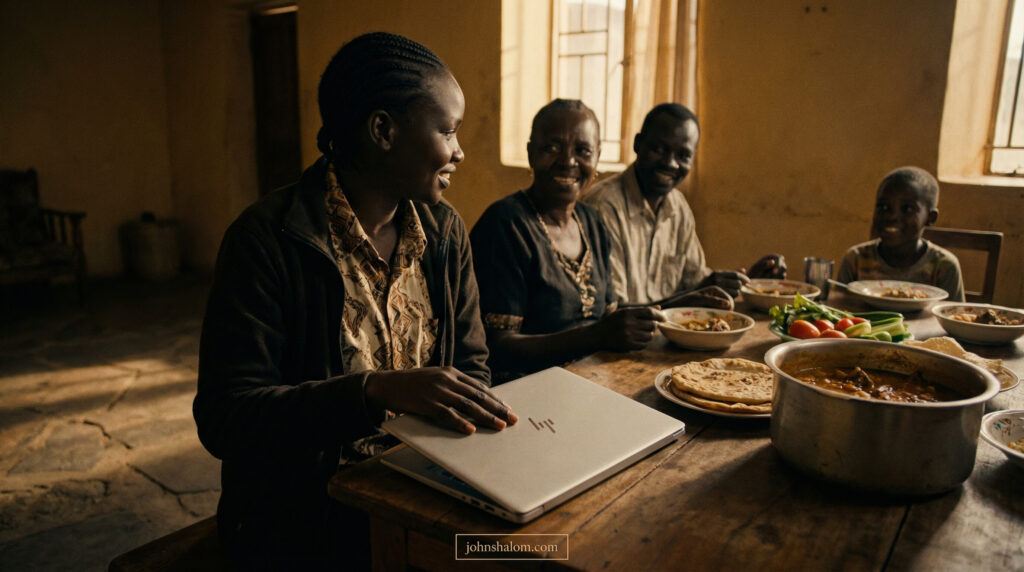
We like to speak of development in terms of roads, offices, and buildings. But a nation is not built only in ministries or boardrooms. It is built in kitchens, on mats, around small tables, under trees, on phone calls between tired parents and hopeful children.
Work pays the bills. Home shapes the people.
A teacher who goes home and listens to her children is doing double nation-building. An engineer who helps with homework, a nurse who attends a school meeting, a shopkeeper who makes time for family prayers—these are quiet builders of society.
My mother used to say, “A house without laughter is poorer than a house without cows.” I did not fully understand as a boy. Now I see. You can have a good salary and still be bankrupt in joy. You can have a big job and a tiny family life. That poverty is harder to heal than a low income.
Lessons From Nature
Nature respects rhythm. The sun does its work by day. The moon watches by night. The sea waves move in and out. There is planting time and harvest time. Time for rain. Time for dry ground.
Nothing in creation works twenty-four hours a day without rest. Even rivers slow down in some seasons.
Yet humans behave as if we can edit the design. We shorten sleep, ignore meals, skip rest days, and expect our minds and bodies to perform like machines. Then we are surprised by stress, sickness, and broken relationships.
If the Creator built rhythm into the world, maybe we should pay attention. Balance is not laziness. It is obedience to the way life is wired.
The Shortness Of Life
When my elder brother died in the 1989 Nasir battle, he was young. He never became a father. He never grew old enough to complain about “work stress” or “meeting fatigue.” His life ended before the usual adult problems even began.
That loss marked me. It reminded me that life is not a guarantee. You can plan for retirement and never reach it. You can build a career and lose it in a war, a crisis, or a sudden illness.
When people boast about their hustle, I sometimes think about my brother and others who would have loved just one more day with those they cherished. Not one more day at the office. One more day around the fire. One more silly story with siblings. One more hug.
You might also like: The Ultimate Guide to Political Journalism: Ethics, Challenges, and Impact in the Modern World
Nobody on their deathbed wishes for more emails answered. They wish for more time with people. If work steals all that time while you are healthy, what will you have left when your body finally says, “Enough”?
What Balance Really Means
Balance does not mean a perfect split, like eight hours work, eight hours family, eight hours sleep, calculated like a maths problem. Life is not that clean. There are seasons. Some days the office will demand more. Some days the family will. Some seasons are heavy. Others are light.
True balance means this:
- You are honest about your priorities, not just your deadlines.
- You give your full self wherever you are.
- You refuse to build your success on the quiet suffering of your own home.
At work, focus. Do your best. Serve well. Do not waste hours and then complain that the job is keeping you from family.
At home, arrive. Put the phone aside for a while. Listen to the bad jokes. Hear the boring school stories. Play a simple game. Share a meal slowly. That is also real life.
Rituals That Protect The Home
Balance grows from habits, not from big speeches about “family first.”
Some simple practices can protect home life, even in the age of hustle:
- Shared meals without screens
Decide that at least one meal a day—maybe dinner—will be phone-free. No scrolling. No TV. Just faces, voices, and food. Even thirty minutes of undistracted presence can repair a day of absence. - A “home arrival” ritual
When you return from work, give your family the first ten or fifteen minutes. Greet everyone. Ask a few questions. Hug your children. Later you can change clothes, check messages, and do other things. Those first minutes declare what matters. - Work boundaries on your phone
Not every message is urgent. Decide what time you stop answering work calls, except for real emergencies. If your employer or clients own your attention every evening and every weekend, you have traded your home for a handset. - Weekly rest
Even if you cannot take a full day, create a weekly time for deeper rest. It might be half a day on a weekend. No work calls. No work emails. Just worship, family, friends, sleep, or quiet thinking. Rest is not a reward. It is fuel. - Honest family meetings
Sometimes the people at home will feel neglected long before you notice. Give them permission to say so. A simple question like, “Have I been too absent this month?” can open a doorway to truth. It may hurt to hear, but it is better than pretending everything is fine until it breaks.
The Special Struggle Of The Provider
Many fathers and mothers carry heavy financial pressure. They are not working late for fun. They are working late so children can eat and study. In tough economies, balance is not an easy conversation.
If that is your story, do not let guilt crush you. You are doing your best. But even in hardship, small forms of presence matter. A five-minute story before sleep. A short prayer. A daily joke. A simple message to a child saying, “I am proud of you.”
Provision is more than money. It is also time, blessing, and attention. Children who grow up poor but loved are often stronger than children who grow up rich but emotionally abandoned.
Employers, Systems, And Culture
Balance is not only a personal issue. Workplaces and cultures can make it easier or harder.
Some employers demand endless availability. Some governments and institutions ignore the needs of parents. Some cultures praise the man who is always “on the move” while quietly pitying the one who chooses to be home with his children.
If you are in leadership, you can influence this. You can:
- Avoid sending non-urgent messages late at night.
- Respect days off.
- Encourage staff to take leave.
- Praise good work, not just long hours.
When leaders model balance, workers feel permission to be human. That, in the long run, produces better performance, fewer breakdowns, and healthier communities.
When The Hustle Is At Home
For some people, especially those living in rural areas or in fragile settings, “work” and “home” are the same place. Fields, cooking, childcare, livestock, fetching water, caring for elders—all of it happens in and around the home.
In such cases, balance means something slightly different. It may mean:
- Letting children play, not only assigning chores.
- Sitting to talk, even when there is still work left for tomorrow.
- Remembering that you are not only a worker. You are also a soul that needs rest and joy.
My grandmother worked like this. Her life was one long list of tasks. But she still found moments to sit, tell stories, and laugh. She did not have “weekends,” but she created small islands of peace inside hard days. Those moments gave us childhood, not just survival.
The Silent Warning Signs
How do you know if work has swallowed your home? Some signs:
- You know your boss’s mood better than your children’s.
- You answer work messages faster than you answer your spouse.
- You are always “too tired” for family, but somehow never too tired for one more work task.
- Home feels like a place to recharge your phone, not your heart.
If these patterns sound familiar, do not condemn yourself. See them as a warning, like smoke from a far field. Something is burning. Better to respond now than when only ashes remain.
Choosing Presence While You Still Can
We do not control the length of our lives. We do control many of our daily choices.
You may have to work long hours in some seasons. You may carry heavy duties for a time. But whatever your situation, you can still ask: “Where can I be more present, even in small ways?”
Sometimes it is as simple as putting your phone face down during a conversation. Or asking a child one more question. Or standing up from the screen and going to sit with your spouse for fifteen minutes.
Work and home do not have to be enemies. Both are holy. Both are part of calling. But if you must sacrifice something, do not sacrifice the people who will cry at your funeral for the people who will replace you in a week.
If you would like to know more about my path as a writer, including the struggles, lessons, and small signs of progress along the way, you can read the full story on my Wealthy Affiliate blog here: https://my.wealthyaffiliate.com/johnmaluth/blog
FAQs
- Why do so many people confuse busyness with real productivity?
Because busyness is visible and easy to measure. You can count hours, emails, meetings, and trips. Real productivity is quieter. It shows in long-term results, solid relationships, and inner peace. Many people choose the visible over the meaningful. They fear being seen as “idle,” so they fill every space with activity, even when that activity adds little value. - What is a funny “failed juggling” moment that can teach about balance?
Imagine trying to cook and work at the same time, only to end up with burnt food and a smoked kitchen. Or answering a serious work call while a child in the background loudly asks for the toilet. These moments are embarrassing at first, but they reveal the truth: attention has limits. We are not built to give our best to everything at once. Laughing at these failures can push us to set wiser boundaries. - How can families create small rituals to protect time together in the age of hustle?
Families can start with simple habits: one shared meal without phones each day, a weekly walk, a story time before bed, a short prayer or reflection together in the evening, or a fixed “no work calls” hour. These rituals do not need to be grand. They just need to be consistent. Over time, they tell every member, “You matter. This home matters.” - What wisdom from elders can help us remember that home matters as much as work?
Many elders remind us that people outlive projects. A common thread in their wisdom is simple: “Money comes and goes. People do not.” They speak from experience of loss, war, illness, and change. My own mother’s saying, “A house without laughter is poorer than a house without cows,” is one such line. It teaches that joy and connection are a deeper kind of wealth than any salary. - If today were your last day, would you be remembered more for your work or your presence at home?
This question is not meant to condemn but to wake us up. Most people are remembered for how they loved, not for how they worked. If you died today, your co-workers might mourn, but the office would eventually move on. Your family, however, would live with your absence forever. Thinking about this does not mean you should quit your job. It means you should bring your heart back home while you still have time.