TL; DR:
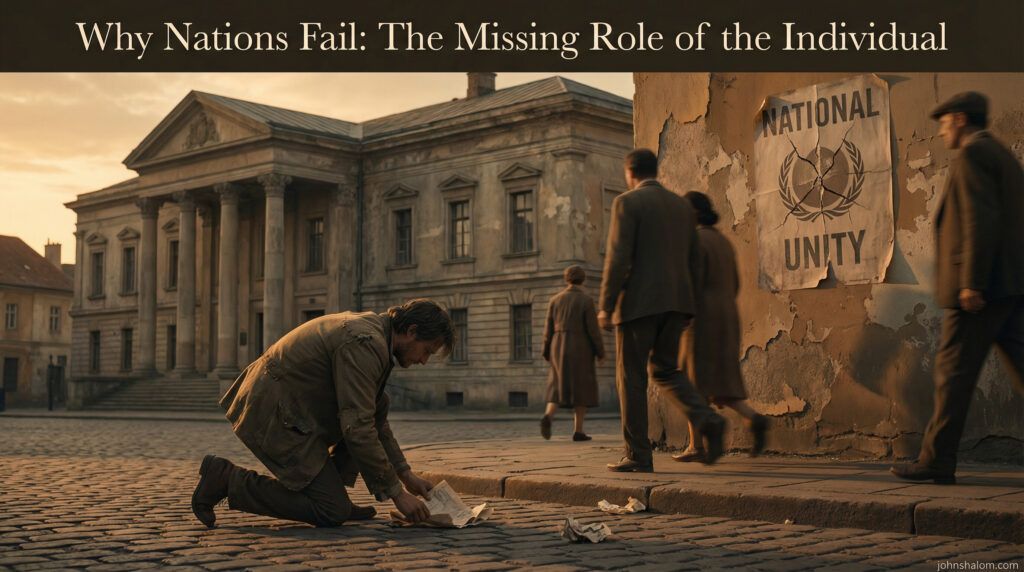
When nations fail, people usually blame leaders, foreign powers, or history. These forces matter, but they are not the whole story. Nations are made of individuals, not only institutions. Every time a citizen pays a bribe, abuses power, stays silent about obvious wrongs, or refuses to work with honesty and care, they add one small stone to the wall of national failure. The good news is that the opposite is also true.
When enough individuals choose truth over lies, service over selfishness, and courage over fear, they begin to shift the direction of their country. Laws, constitutions, and peace agreements are needed, but without responsible individuals behind them, they are just paper. The missing role in many national stories is the ordinary person who decides, “I will live differently, starting where I stand.”
Introduction: Who Do We Blame When Nations Collapse?
1.1 The usual suspects
When a country struggles with war, corruption, hunger, and weak services, public discussion often turns to the same list of suspects:
- Bad leaders who love power more than people.
- Foreign governments and companies that exploit weakness.
- Colonial history and unfair borders.
- Global economic forces that keep poor countries down.
All of these are real. I have seen their effects in South Sudan and across Africa, in headlines and in daily life. However, focusing only on them can hide another powerful actor: the ordinary citizen.
1.2 The missing mirror
It is easier to look through the window at others than into the mirror at ourselves. Yet every failed road, stolen fund, broken peace deal, or weak institution is also connected to thousands of small personal choices:
- Someone wrote a fake report.
- Someone did not show up to work.
- Someone pulled a trigger.
- Someone stayed silent when they knew the truth.
If we ignore the role of the individual, we tell a half story about national failure and we blind ourselves to one of the most realistic paths to change.
What Does It Mean When a Nation “Fails”?
2.1 Failure in real life, not just in reports
For ordinary people, a failing or fragile nation looks like:
- Hospitals without medicines and staff.
- Schools that exist on paper but not in reality.
- Roads that break and stay broken.
- Police and soldiers who frighten people instead of protecting them.
- Courts that listen to money and connections more than to truth.
Behind each of these, you will usually find both bad systems and bad personal decisions.
2.2 Systems need people to work
We speak of “systems” as if they were separate beasts, but systems are people in agreement. A ministry is not a building; it is the people who work in it. A court is not only laws; it is judges, clerks, lawyers, and witnesses.
When these people are careless, afraid, or corrupt, the system fails, even if the written rules are good. When they are honest, brave, and disciplined, the system can improve, even if the rules are imperfect.
Why We Ignore the Individual in National Discussions
3.1 Blame is easier than responsibility
If I say, “The problem is the president, the generals, or foreign powers,” I feel powerless but also innocent. If I say, “The problem includes how I live, vote, work, obey, and speak,” then I must change something in myself.
Human beings naturally avoid that pressure. It hurts our pride. It exposes our hidden comfort in the current situation, even when we say we hate it.
3.2 The myth of the big saviour
Many citizens secretly wait for one strong leader, a new party, or a foreign rescue to fix everything. This story sells in campaigns and speeches, but it rarely works in practice. No leader can carry a whole nation if citizens refuse to act responsibly.
Without citizens who live by conscience, even honest leaders quickly find themselves surrounded by pressure to compromise.
The Quiet Power of the Ordinary Citizen
4.1 Small actions that grow into national patterns
Think of these everyday choices:
- Paying a bribe to skip a queue or pass an exam.
- Selling expired drugs because profit matters more than life.
- Misusing office time and resources.
- Spreading hate speech on social media.
- Voting for a person only because they are “our tribe” or because they gave us a small gift.
Each of these can feel small in the moment, but multiplied by thousands or millions of people, they form the real culture of a nation.
4.2 The government inside you
Self-discipline and conscience form a kind of inner government. If that inner government is weak, no external law can fully control you. You will always look for ways around the rules.
If that inner government is strong, you will often do what is right even when you could get away with doing wrong. Nations fail when too many people carry weak inner governments.
You might also like: The Ultimate Guide to Political Journalism: Ethics, Challenges, and Impact in the Modern World
Real Barriers Individuals Face
5.1 Fear and insecurity
We must be honest. It is hard to act bravely in a setting where:
- Whistleblowers lose jobs or lives.
- Honest workers are punished while corrupt ones are promoted.
- Security forces are feared.
Fear pushes individuals into self-protection. They say, “Let me just survive; change is too costly.” This fear is understandable, but if it wins completely, failure grows.
5.2 Poverty and pressure
Poverty adds another weight. When a civil servant is underpaid, a bribe may appear as “school fees.” When a business owner struggles, tax avoidance looks like survival. Families, clans, and communities often pressure individuals in office to “use the position” for them.
These realities do not excuse wrongdoing, but they help explain why it is so common. Any call to individual responsibility must acknowledge these pressures honestly.
5.3 Trauma and hopelessness
People who have known war, displacement, and loss may feel that nothing they do matters. They have seen peace agreements collapse and promises broken. Hopelessness then becomes a quiet poison, killing motivation to act for the common good.
Why the Individual Still Matters, Even in Hard Settings
6.1 Faith and moral agency
From a faith view, each person is more than a victim of circumstances. We are moral agents who must one day answer to God for our choices. That does not remove the guilt of oppressive leaders or foreign exploiters, but it adds another layer:
- What did I do with the light I had.
- How did I treat those around me when I had some power.
- Did I follow my conscience or bury it.
This sense of accountability can give courage even in difficult systems.
6.2 M = {B, D²} for nations
Meaning = {Being, Doing²}. This is true for individuals and, through them, for nations.
Being: Who we are, in character and values, as citizens and leaders.
Doing²: The actions we repeat again and again.
A nation’s real being is revealed in the patterns of its people, not in slogans. When enough individuals let God reshape their being and then repeat different actions, slowly the national pattern shifts.
Examples of Individual Choices that Change National Direction
7.1 In the home
- A parent decides not to teach children hatred for other tribes, but instead teaches fairness and empathy.
- A family chooses not to justify cheating or violence, even if “everyone does it.”
These choices shape future voters, workers, and leaders.
7.2 At work
- A doctor or nurse refuses to sell medicines that should be free.
- A teacher truly teaches the syllabus instead of just selling notes and grades.
- A clerk refuses to fake documents for friends.
These individuals may suffer short term loss, but over time they change expectations in their workplaces.
7.3 In public and online spaces
- A citizen refuses to spread unverified rumours that stir fear.
- A youth group chooses peaceful protest and civic education instead of violence.
- Writers and artists tell honest stories that challenge corruption and prejudice.
These actions shape the moral climate in which leaders operate.
Practical Steps for Individuals Who Want Their Nation to Succeed
8.1 Strengthen your inner government
- Clarify your values before God. Write them down.
- Ask where you regularly break those values.
- Choose one area, such as honesty at work or refusal to pay bribes, and commit to change.
- Pray for strength and ask a trusted friend to keep you accountable.
8.2 Live clean in one clear area, then expand
You may not be able to fix everything at once. Decide on one area where you will be known as a person who does not compromise, for example:
- Money handling.
- Truth telling.
- Treatment of people under your power.
Once that area is solid, expand to others.
8.3 Use your small influence
You have influence somewhere:
- In your family.
- Among colleagues.
- In church or community groups.
- On your social media.
Use that influence to encourage honesty, respect, and responsible citizenship. Challenge hateful or corrupt thinking gently but firmly.
8.4 Support those who act well, not only those who speak well
When you see leaders, civil servants, or business people who act with integrity, support them. Vote for them if you can. Speak well of them. Defend them when they are unfairly attacked.
This makes it slightly less lonely to be honest in public life.
Conclusion: Nations Fail When Individuals Stop Caring
Nations do not fail only because a few people at the top are bad. They also fail when millions of individuals decide, quietly, that their own conscience and responsibility do not matter.
You and I cannot control presidents, generals, or foreign companies. We can control how we live, work, speak, give, and resist. Every honest act, every refused bribe, every fair decision, every moment of courage is a small push against national failure.
If enough individuals make those choices repeatedly, they become more than small. They become the hidden foundation of a different country. The missing role of the individual can become the restoring role of the individual, starting with you.
If you would like to know more about my path as a writer, including the struggles, lessons, and small signs of progress along the way, you can read the full story on my Wealthy Affiliate blog here: https://my.wealthyaffiliate.com/johnmaluth/blog
FAQS
Q1: Are leaders not the main reason nations fail?
A: Leaders have huge influence and carry heavy responsibility. However, they come from the same society as everyone else. When citizens accept corruption, hate, and lies, it becomes easier for leaders to behave the same way without pressure to change.
Q2: What can one honest person do in a very corrupt system?
A: One person cannot fix everything, but one honest life can protect some people from harm, keep certain spaces clean, and inspire others to act. Over time, several such individuals can change expectations in offices, communities, and institutions.
Q3: Is it fair to talk about individual responsibility when people are poor and afraid?
A: It is important to recognise fear and poverty as real pressures. At the same time, people still make choices within those limits. The call is not to ignore suffering, but to encourage the best possible choices even in hard conditions.
Q4: How does faith strengthen individual responsibility for the nation?
A: Faith reminds you that God sees your actions, even when others do not. It gives you a higher reason to act justly, to love your neighbour, and to refuse evil, because you answer to God, not only to bosses or leaders.
Q5: Where should I begin if I feel overwhelmed by my country’s problems?
A: Begin where you have real control: your own life, family, and work. Choose one area to clean up, one person to help, one injustice to resist, and one good habit to grow. That is small, but it is real, and it is the only honest starting point for national change.