TL; DR:
South Sudan’s future will not be decided by leaders alone or citizens alone. It will be shaped by how those in office understand power and by how ordinary people understand citizenship. If leadership is treated as personal property and citizenship as silent survival, the country will stay fragile.
If leadership is treated as service and citizenship as active responsibility, change becomes possible, even in a hard environment. This article invites both leaders and citizens in South Sudan, and anyone watching from other countries, to rethink their daily roles. The starting point is simple: character first, then systems, then shared habits that match what we say we believe.
Introduction: Leadership, Citizenship, and a Young Nation
1.1 A young flag, old questions
South Sudan is still a young country on the world map, but the questions it faces are old.
Who leads, and how.
Who belongs, and on what basis.
Who takes responsibility when things go wrong.
I grew up along the Sobat River under another flag, long before Juba became a capital. Later, I watched my people celebrate independence, and I also watched us return to war, mistrust, and fear. Those journeys taught me a clear lesson: leadership without real citizenship is unstable, and citizenship without honest leadership is discouraged and tired. We need both.
1.2 Why this matters for more than politics
When we hear “leadership and citizenship,” we often think only of high offices and voting days. Yet we meet these two words every day: in a classroom, at a clinic, in a local church, in a police station, in a family.
Leadership is simply influence with responsibility.
Citizenship is belonging with duties.
If we rethink both at ground level in South Sudan, we can slowly change what they look like at the national level too.
What Is Leadership Really For?
2.1 Beyond titles and motorcades
Many people think leadership means:
- Having a title or rank.
- Giving orders.
- Receiving respect and benefits.
But the deeper purpose of leadership is to protect, guide, and organise people for the common good. A leader is a steward, not a small king. Power arrives with a trust attached to it.
You can see the difference clearly during a crisis. A leader who loves comfort disappears or uses the crisis to strengthen his position. A leader who understands trust appears, listens, takes risks, and sometimes loses sleep or popularity for the sake of the people.
2.2 M = {B, D²} for leaders
Meaning = {Being, Doing²}. For a leader, this is very sharp.
Being: Who you are when nobody watches. Your character, fears, values, and secret choices.
Doing²: What you do repeatedly with your power. Who you appoint, what you allow, what you ignore, what you reward.
A leader can speak beautiful words, but their repeated actions tell the truth about their being. Over time, that truth shapes a whole institution, not just their own life.
What Is Citizenship in a Place Like South Sudan?
3.1 More than a card or a flag
Citizenship is not only holding a national ID or cheering the national team. It is the way you live in your shared home. A citizen who understands their role:
- Knows basic rights and duties.
- Cares about more than their own clan or family.
- Follows fair rules and challenges unfair ones.
- Takes part in community life, not only private survival.
In a fragile state, many people feel citizenship is a joke. “What has this country done for me,” they ask. That pain is real. But if we give up on citizenship completely, we leave the project of nation building only in the hands of those who already have power. That is dangerous.
3.2 Layers of belonging
A South Sudanese citizen usually belongs at several levels:
- Family and clan.
- Tribe or community.
- Church or mosque.
- Nation.
The question is not whether these layers exist, but which one controls your choices when they clash. Responsible citizenship does not kill tribal identity. It asks that, under God, you also care about the wider community of citizens who share your rivers, roads, and future.
Where Leadership and Citizenship Currently Clash
4.1 The follower culture
In many spaces, citizens in South Sudan are treated as followers, not partners. The message is simple:
“Wait for orders. Wait for aid. Wait for the next big man. Do not ask hard questions. Do not organise yourselves unless it is for our campaign.”
This attitude keeps citizens weak and leaders unchallenged. It encourages silence when people should speak, and dependency when people could act.
4.2 The strongman expectation
At the same time, many citizens secretly expect one strongman to fix everything. When a leader appears firm and generous to his own group, people say, “This is our person.” They may ignore clear signs of selfishness, corruption, or cruelty.
This creates a painful circle:
Citizens raise strongmen.
Strongmen weaken institutions.
Institutions fail citizens.
Citizens ask for another strongman.
Breaking this circle requires new expectations on both sides.
4.3 Blame without self-examination
When things go wrong, leaders blame citizens: “Our people are lazy, tribal, difficult.” Citizens blame leaders: “They are thieves, liars, killers.” Foreigners are blamed, neighbours are blamed, history is blamed.
Blame has its place, but if it never leads to self-examination, nothing changes. Leaders must ask, “What have we done with power.” Citizens must ask, “How have we used our small power.”
You might also like: How to Write Your Life Story: A Complete Guide to Autobiography Writing
Rethinking Leadership for South Sudan’s Future
5.1 Leaders as servants, not owners
If leadership is a trust, not property, then:
- Public offices belong to the people, not to families or parties.
- A leader can be questioned without the country collapsing.
- Leaving office after a term is not shameful; it is honourable.
In practice, this means:
- Transparent hiring, not only appointments by favour.
- Clear records of public money and projects.
- Real consequences for misuse of power, even for “big names.”
5.2 New models of leadership formation
South Sudan does not lack brave people or intelligent people. But we often lack spaces where leaders can grow in character before receiving big power.
Such spaces include:
- Churches and faith groups that teach integrity in leadership, not only miracles and prosperity.
- Schools and universities that reward honesty and hard work, not cheating.
- Community organisations that give young people real responsibilities and real feedback.
If we keep training young people only in how to obey or how to fight, we should not be surprised when they repeat that pattern once they hold office.
5.3 Listening as a leadership habit
Many leaders in fragile settings learn to talk more than they listen. They fear that listening to criticism will weaken their authority. The truth is the opposite.
A leader who listens to citizens, civil servants, women, youth, and faith leaders receives information that can save lives, time, and resources. Listening does not mean obeying every voice. It means taking people seriously enough to hear them before deciding.
Rethinking Citizenship for South Sudan’s Future
6.1 From passive victims to active agents
Citizens in South Sudan have suffered much. Many have lived in camps, walked long distances for water, seen loved ones killed, or lost their homes more than once. It is easy in such a setting to feel like a permanent victim.
Yet, if we see ourselves only as victims, we surrender our remaining power. We forget that we still choose how we:
- Raise our children.
- Treat neighbours from other tribes.
- Vote or stay home.
- Respond to lies and hate speech.
Active citizenship begins when people say, “We have been hurt, but we still have choices today, and those choices matter.”
6.2 Everyday practices of citizenship
Citizenship is expressed in simple, repeated actions:
- Respecting fair rules, such as traffic laws, not only when police are present.
- Refusing to pay or demand bribes where you can safely resist.
- Asking questions at community meetings instead of only clapping.
- Joining local groups that solve problems, such as water, rubbish, or youth unemployment.
These acts look small compared to national crises, but together they shift the culture from passivity to participation.
6.3 Citizenship beyond elections
In South Sudan, like many countries, politics is often reduced to election seasons. People focus on rallies, slogans, and promises, then return to silence after results are announced or postponed.
Real citizenship continues between elections. It includes:
- Monitoring how resources are used.
- Engaging local authorities.
- Supporting independent voices that expose abuse.
- Building peace across community lines at the local level.
How Leaders and Citizens Can Meet in the Middle
7.1 Shared language of duty
Both leaders and citizens must rediscover the language of duty, not only rights and benefits.
Leaders’ duty: to serve fairly, protect lives, and use power for the common good.
Citizens’ duty: to obey just laws, pay fair taxes, and hold leaders accountable without violence.
When both sides take duty seriously, trust has a chance to grow again.
7.2 Local success stories
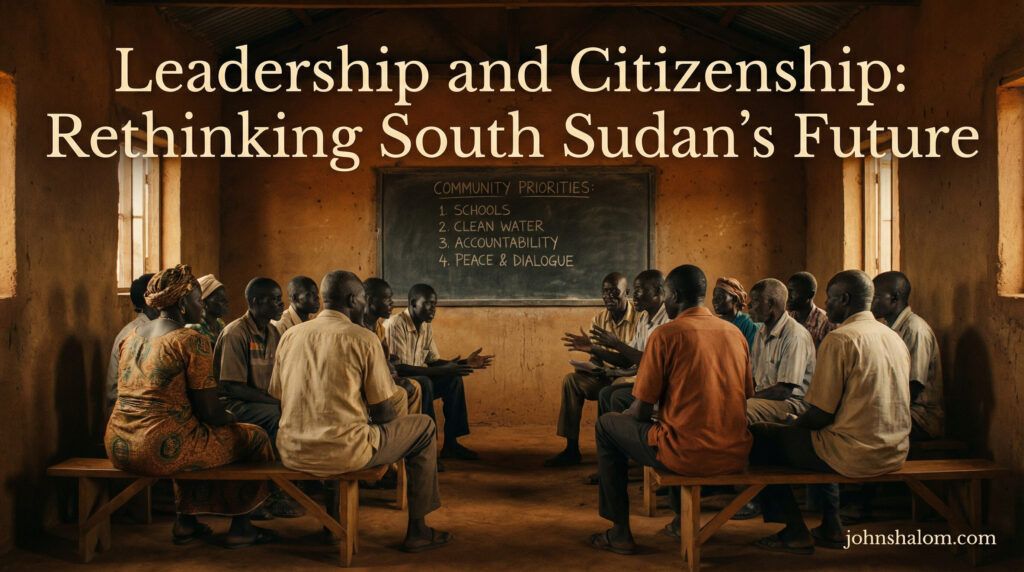
Across South Sudan there are quiet success stories: chiefs who mediated conflicts, women’s groups who reduced violence at home, local officials who handled funds honestly, young people who started community schools or clean-up projects.
These stories rarely appear on front pages, but they show what is possible when leadership and citizenship meet each other in good faith. We need to tell these stories more often, in churches, schools, and media, so that people see real examples, not only failures.
7.3 Faith communities as bridges
Churches and other faith bodies are among the few places where different tribes, classes, and ages still sit together. This makes them key spaces for:
- Teaching that leaders and citizens alike answer to God.
- Modelling shared leadership, not only one-man control.
- Practising forgiveness and truth-telling.
If faith communities avoid hard topics, they leave leadership and citizenship to be shaped only by fear and power. If they engage wisely, they can be bridges between people and authorities.
A Personal Reflection: From Complaining to Contributing
As a writer and citizen, I have spent many hours criticising what is wrong in South Sudan. Some of that criticism is needed and right. But there came a point when I had to ask myself: “Apart from my articles, what am I doing differently in my own circles.”
Am I using power in my small roles with integrity.
Am I raising my children and students to be better citizens.
Am I ready to work with people I disagree with for the sake of the country.
These questions are uncomfortable, but they keep me honest. I believe each of us needs similar questions. The future of South Sudan, and any other fragile nation, will not be saved by writings alone, or by one strong leader. It will be shaped by many small circles where people choose to live the values they expect from others.
Conclusion: A Shared Road Ahead
Leadership and citizenship in South Sudan need to be reimagined, not only discussed. Leaders must stop treating offices as private property. Citizens must stop seeing themselves as powerless spectators.
We cannot change history. We cannot erase pain. But we can choose what kind of leaders we become, in big offices or small ones, and what kind of citizens we train in our homes, churches, and schools.
If more leaders see power as a trust, and more citizens see their voice and choices as real tools, then the story of South Sudan does not have to end in failure. The same is true for any country walking this hard road.
The road forward begins with one honest sentence: “My country’s future is also my responsibility.”
If you would like to know more about my path as a writer, including the struggles, lessons, and small signs of progress along the way, you can read the full story on my Wealthy Affiliate blog here: https://my.wealthyaffiliate.com/johnmaluth/blog
FAQS
Q1: Are leaders or citizens more important for South Sudan’s future?
A: Both matter. Leaders have wider reach and carry heavy responsibility, but citizens shape the culture that chooses and judges leaders. Long-term change needs both honest leadership and active citizenship.
Q2: What can an ordinary citizen do in such a fragile setting?
A: Start where you stand. Live honestly at work, resist hatred, ask questions in meetings, raise your children to respect others, and support truthful voices. These small acts add up over time.
Q3: How can leaders in South Sudan build trust with citizens again?
A: By being transparent with resources, listening carefully, punishing clear abuses even among their own allies, and keeping promises in visible ways. Trust grows slowly from repeated fair actions.
Q4: What role can churches and faith groups play in this change?
A: They can teach that both leaders and citizens answer to God, model shared leadership, encourage repentance and forgiveness, and speak clearly against injustice, even when it is unpopular.
Q5: How does this apply outside South Sudan?
A: Many countries face similar issues of weak institutions, tribal politics, and discouraged citizens. The same principles apply: leadership as service, citizenship as active responsibility, and a shared commitment to truth and human dignity above narrow group interests.