
TL; DR:
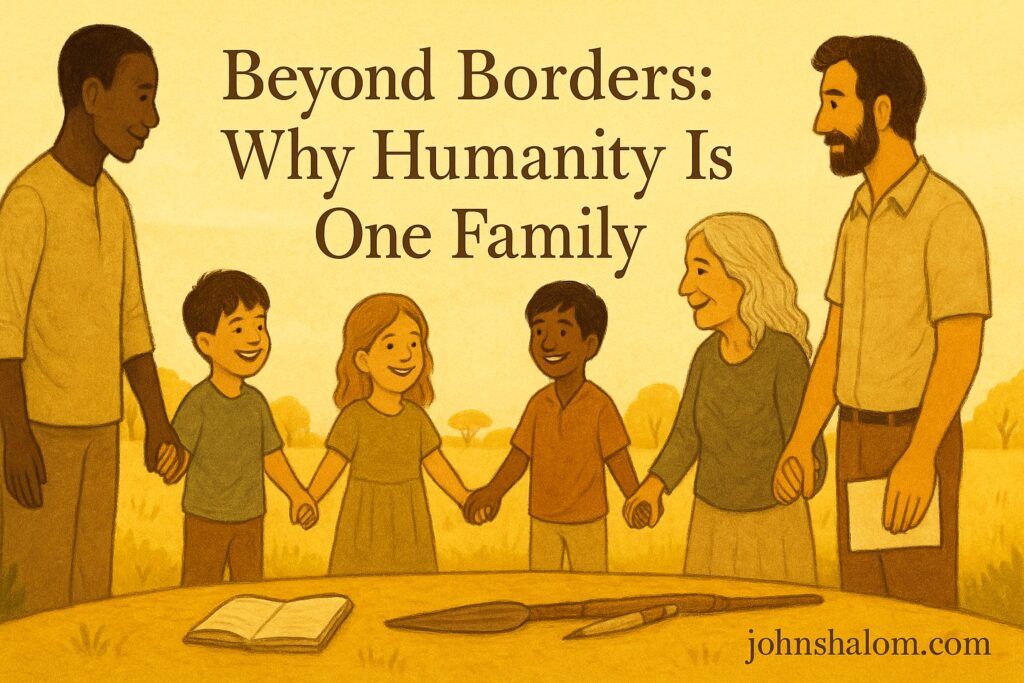
We are born into specific families, tribes, and countries, but we all share the same basic story: breathing the same air, fearing death, longing for love, and needing hope. Borders, flags, and languages are real and important, yet they do not erase our shared humanity. When we forget this, we turn identity into a weapon and treat strangers as less valuable.
When we remember it, we begin to see enemies as neighbours we have not met yet, and foreigners as relatives who grew up in a different house. Seeing humanity as one family does not mean ignoring justice or difference. It means we measure policies, words, and actions by a simple question: Does this honour or crush the human being in front of me.
Introduction: Born Somewhere, Belonging Everywhere
1.1 A boy by the Sobat, a writer on the web
I was born near the Sobat River, in a place many people on earth will never see on a map. My world was cows, mudfish, hunger, bullets, songs, and stories about “our people.”
Today, I write to readers who may be in Juba, Nairobi, London, New York, or a village I have never heard of. Between those two pictures, one truth has become stronger for me: I am a son of a particular people, but I am also a member of a much larger family called humanity.
That second truth does not cancel the first. It stretches it.
1.2 Why this question matters now
We live in a time of sharp borders, both physical and mental. Countries tighten visas. Communities guard their resources. Online spaces are full of anger against “them,” whoever “they” are.
At the same time, diseases, climate shocks, wars, and markets cross borders easily. So do ideas, technologies, and lies. We can hurt each other faster than ever. We can also help each other faster than ever.
If we forget that humanity is one family, we will use these new tools mainly to protect our small group and harm others. If we remember, we have a chance to use them to serve and protect life.
What Does It Mean That Humanity Is One Family?
2.1 Shared body, shared limits
Whatever our tribe or passport, our bodies work in the same simple ways:
- We breathe the same air.
- We need clean water and food.
- We bleed when cut and cry when deeply hurt.
- We become weak and die.
This is a kind of equality that no title or status can change. A general and a street vendor can both be destroyed by the same virus, bullet, or hunger. When policies ignore this shared physical reality, some groups suffer first, but damage spreads eventually.
2.2 Shared inner life
Beyond the body, we share inner realities:
- The desire to be seen and respected.
- The fear of rejection and failure.
- The need for love, friendship, and belonging.
- Questions about meaning, God, and death.
You can see these in a child in a cattle camp, a teenager in a crowded city, or an old woman in a foreign nursing home. Circumstances change the surface story, but the inner questions are very similar.
2.3 A shared Source
For people of faith, humanity as one family is not only an idea. It is rooted in creation. If one God made all people in His image, then every human being carries a reflection of Him. That means:
- No tribe is closer to God by blood.
- No race was created to rule others as if they were animals.
- Every person you meet stands under the same sky of God’s judgment and mercy as you.
This truth, if taken seriously, cuts the root of many prideful stories we tell about ourselves.
Why Borders, Tribes, and Nations Still Matter
3.1 Order and responsibility
Saying humanity is one family does not mean we should remove all borders overnight. Borders help organise responsibility. Governments need a clear area to serve and protect. Communities need defined spaces to manage land and resources.
The problem is not having borders. The problem is treating borders as reasons to ignore suffering on the other side, or as tools to dehumanise people who cross them.
3.2 The gift of local identity
Tribes and nations give us:
- Language and culture.
- Shared stories, songs, and memories.
- A sense of place and history.
These are good gifts. They make life rich. The challenge is to enjoy them without turning them into gods. Your tribe can be your home without being your idol. Your nation can be important without being ultimate.
3.3 Layers of belonging
You can hold several layers of belonging at once:
- Family: “This is my immediate home.”
- Tribe or community: “These are my people.”
- Nation: “This is our shared country.”
- Humanity: “These are my fellow human beings.”
Problems start when we cut off the wider circles and pretend only the inner one matters.
How We Forget That Humanity Is One Family
4.1 Pain and fear
Communities that have suffered war, displacement, or oppression often shrink their circle of concern. When you have been hurt, it feels safer to trust only “your own.”
I have seen this in South Sudan and in other stories from the continent and the world. Trauma tells you: “No one cares about you. Protect your group at all costs.” That voice is understandable, but if it completely guides us, we pass our wounds to the next generation.
4.2 Politics and profit
Powerful people know that fear is a useful tool. It is easier to control citizens when they are afraid of other groups. It is easier to justify bad actions if you call them necessary for security.
Businesses also sometimes treat humans as numbers. Profits come before lives. Land, minerals, and markets become more important than the people living on them. When we accept this thinking, we quietly agree that some members of the human family are disposable.
4.3 Stories that divide
Every group has stories about enemies, betrayal, and past harm. Some of these stories are true and need to be remembered. The danger is when we tell only those stories, without any stories of cooperation, shared suffering, or shared hope.
If a child grows up hearing only about “what they did to us,” that child will struggle to see members of that group as fellow humans later.
Why Seeing Humanity as One Family Matters
5.1 For justice
If we treat others as less human, we will accept injustice against them more easily. But if we see even our enemies as relatives we are deeply angry with, not as animals, it becomes harder to justify cruelty.
Seeing humanity as one family does not mean ignoring crimes. It means we seek justice without delight in another’s pain, and we avoid punishing whole groups for the actions of some.
5.2 For peace
Most peace processes fail when only leaders and borders are discussed, while hearts remain full of hate. Remembering shared humanity helps us design peace that goes beyond signing documents.
It reminds us to ask:
- What will happen to children on both sides.
- How do we restore trust, not just silence guns.
- How do we heal memories, not only redraw lines.
5.3 For daily life
This idea is not only for diplomats. It touches daily life:
- How you treat a cleaner, guard, or street vendor.
- How you react to a refugee in your neighbourhood.
- How you speak about other races, tribes, and countries at home.
Every act of kindness or cruelty is a statement about how you see the human family.
You might also like: The Ultimate Guide to Political Journalism: Ethics, Challenges, and Impact in the Modern World
Practical Ways to Live as if Humanity Is One Family
6.1 Watch your language
Decide that your mouth will not deny the family bond. Avoid:
- Animal names for whole groups.
- Jokes that reduce others to their worst examples.
- Statements like “those people are not human.”
Choose instead:
- To say “people from that community” rather than “those animals.”
- To name specific wrongdoers instead of blaming whole populations.
- To remember that every group includes both sinners and peacemakers.
6.2 Let your prayers and thoughts cross borders
If you pray, widen your prayers:
- Include other tribes and nations, not only your own.
- Pray for children in war zones you will never visit.
- Pray for leaders you did not choose and peoples you do not fully understand.
Even in private thought, this changes your heart. It reminds you that God’s concern is larger than your local circle.
6.3 Build at least a few deep cross-border relationships
This can be:
- Across tribes in your own country.
- Across countries through work, church, or online groups.
- Across economic classes in your city.
Share meals, stories, and questions. Let real human faces replace the shadows created by rumours.
6.4 Let your work reflect human family values
Whatever your job, you can ask:
- Does my work protect life or harm it.
- Does it treat some people as disposable.
- Can I make at least one decision this month that puts human dignity above profit or convenience.
You may not control everything, but you likely control something.
When Global Problems Show Our Shared Family
7.1 Disease and health
COVID-19, Ebola, and other diseases have shown how easily sickness crosses borders. A virus does not ask for your tribe, passport, or title. It simply moves along human contact.
This could frighten us into hiding, or it can remind us that health systems in one region matter for people far away. Helping another country control a disease is not charity only; it is family care.
7.2 Climate and environment
Floods, droughts, and heat waves ignore borders. Smoke from one country’s fires travels into the lungs of people in another land. Poorer communities usually suffer first and most.
If we see humanity as one family, we stop thinking of environmental care as a luxury. It becomes part of loving our distant relatives and our grandchildren at the same time.
7.3 War and migration
When war breaks out in one place, people move. Refugees cross lines desperate for safety. Host communities face pressure and fear.
If we think only in narrow terms, we see refugees as a problem to remove. If we remember the human family, we see them as relatives in crisis. That does not remove the need for order and planning, but it changes the tone: from fear to shared responsibility.
Faith, M = {B, D²}, and the Human Family
8.1 Being: who we are, really
If our deepest being is that we are children of God and members of one human family, then certain actions simply do not fit that identity:
- Torture.
- Trafficking.
- Calling for the destruction of whole peoples.
They are lies about who we are and who they are. They deny the family truth.
8.2 Doing²: repeated actions that build or break family
Our repeated actions either confirm or deny this family idea.
We confirm it when we:
- Tell stories that humanise others.
- Share resources across group lines.
- Stand against injustice even when victims are not “our people.”
We deny it when we:
- Benefit from systems that crush others and do not care.
- Celebrate when “the other side” suffers.
- Teach children to fear or hate entire groups.
Meaning, at both personal and global levels, grows when our being and doing match the truth that we belong to one human family.
Conclusion: From Small Circles to a Wider “We”
You and I cannot remove all borders or end all wars. We cannot design global policies by ourselves. But we can decide what “we” means in our own hearts and in our daily speech.
If “we” means only my clan, everyone else becomes a tool or a threat.
If “we” grows to include neighbours, citizens, and finally the wider human family, our choices begin to honour life beyond our own small circle.
Seeing humanity as one family does not solve every problem. It does something simpler but important. It changes the starting point. Instead of asking, “What can I get for my group,” we begin to ask, “How can my group live well without crushing others, and how can we share the burden of keeping this human family alive.”
That question, asked often enough by enough people, can soften hearts, shape policies, and slowly change how we live together on this shared earth.
If you would like to know more about my path as a writer, including the struggles, lessons, and small signs of progress along the way, you can read the full story on my Wealthy Affiliate blog here: https://my.wealthyaffiliate.com/johnmaluth/blog
FAQS
Q1: If humanity is one family, why are there so many conflicts and divisions?
A: Because humans also carry fear, selfishness, and sin. We often misuse identity to gain power or protect ourselves. The idea that we are one family is true, but it must be chosen and practised, not only stated.
Q2: Does seeing humanity as one family mean I should ignore my tribe or nation?
A: No. You can still love your tribe and country. It simply means you do not use that love to justify injustice or hatred against others. You place tribe and nation under a higher loyalty to human dignity.
Q3: How can ordinary people live this truth in daily life?
A: By watching their language about other groups, building friendships beyond their own community, supporting fair treatment for all, and raising children to see others as human beings first, not as enemies.
Q4: What role does faith play in this idea of one human family?
A: Faith teaches that all people are created by God and bear His image. For Christians, every tribe and nation is invited into one body in Christ. This gives a strong reason to love, forgive, and seek justice beyond group lines.
Q5: Is this idea realistic in places with deep ethnic or political wounds?
A: It is difficult, but still necessary. In such places, starting small is key: honest stories, small acts of kindness across lines, fair treatment in local settings, and consistent teaching that even an enemy remains a human being. Over time, these small steps can open doors that hatred has kept closed for years.

We have so many here in our country who love to stoke this fear for their own gain – you are exactly right. It is all about power and greed. But we don’t all have to fall into that trap. Working to welcome the immigrants who value their life here is worthwhile and important. Thanks for this very in-depth article. I would like to hear more about your personal journey.
Hi Don,
Thank you so much for your thoughtful comment and for taking the time to read the article.
I appreciate your point that we don’t all have to fall into the trap of fear, power, and greed. I believe every one of us has a choice to respond with understanding, compassion, and a recognition of our shared humanity. That’s where lasting change begins.
Thank you as well for your interest in my personal journey. Much of what I write is shaped by my own experiences growing up in South Sudan, living through conflict, displacement, and hardship, while also witnessing extraordinary resilience, kindness, and hope. Those experiences convinced me that the things which unite us as human beings are far greater than the differences that divide us. That’s one of the main reasons I continue writing about our common humanity.
I truly appreciate your encouragement, and I hope to share more of my personal story in future articles. Thank you again for contributing so thoughtfully to the conversation.
This article really touched me. When you mention you are writing this for someone across the world. I am sitting here as a human being . Vietnamese background born in Australia. Driving trucks.
With the amount of things going on in the world right now. Its good to realise, why is everyone chasing fame & power & corruption when we literally share the same experience. The human experience. We are all one and we should live in peace and harmony. Serving and lifting one another up regardless of our background and where we came from.
Hi Richie,
Thank you for such a heartfelt comment. It means a great deal to know that the article connected with you across cultures and continents.
I was especially touched by your words about being of Vietnamese background, born in Australia, and reading the article as simply a fellow human being. That’s exactly the message I hoped to convey. Before anything else, we share the same humanity, with many of the same hopes, struggles, dreams, and desire to belong.
I also appreciate your reflection on fame, power, and corruption. It’s a timely reminder that our greatest legacy isn’t found in status but in how we treat one another. When we choose kindness, service, and mutual respect, we contribute to a better future for everyone.
Thank you again for taking the time to share your perspective. I wish you all the best with your website, your work, and your journey. May we all continue to build bridges rather than walls.