
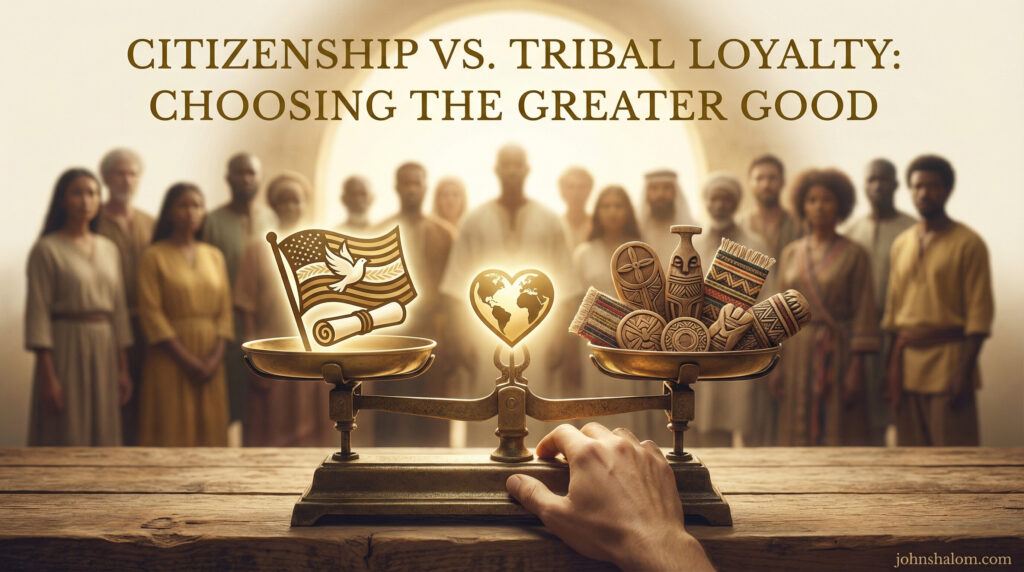
TL;DR
For many of us, tribe is our first and most powerful identity. It feeds us, protects us, and gives us a surname, a language, and a sense of belonging. Citizenship often feels distant, like something written on paper in a far city. Yet if we only stay loyal to tribe and ignore the wider community, we slowly destroy the very nation that could protect all tribes.
I grew up along the Sobat River as a village boy who first knew himself as a son of a clan and a tribe. Later, through war, displacement, and work with people from many backgrounds, I learned that citizenship does not cancel tribal loyalty, it stretches it. My tribe is my root, but my country is my tree. If I choose tribe against the nation every time, I cut the tree that carries or sits on my own root.
Growing Up As “Just A Tribesman”
As a boy, I did not know words like “citizen,” “constitution,” or “national anthem.” I knew cows, uncles, fishing spears, and whoever shared their food when hunger came. My world was small and clear.
Your tribe fed you, warned you, and if necessary, beat you into behaving.
Your tribe taught you which side of the river was “ours” and which side was “theirs.”
I remember listening to elders under the stars along the Sobat. They rarely spoke about “Sudan” or “South Sudan” as political units. They spoke about sections, clans, and old grievances. For me, being a good boy meant honoring our people and not shaming our name. That was my first idea of citizenship, but it was tribal citizenship.
Tribal Loyalty: Our First School
The first classroom is not the one with chalkboards. It is the family hut or compound. That is where we learn our first laws.
I learned early that if you fought a cousin, the issue was serious. If you insulted an elder, it was like insulting the entire family. When my father corrected me, he did not say, “Do not do this, it is against state law.” He said, “Do not do this, it is against who we are.”
One day, I got into a quarrel with boys from another section. The details are small now, but I remember the feeling very clearly. When some older boys from my side arrived, they did not ask, “Who is right?” They asked, “Which one is ours?” Once they knew that, the rest was simple. They stood with me. The truth of the matter was secondary.
That is the power and danger of tribal loyalty. It gives you a sense of security, yet it can also blind you.
When The Nation Entered The Story
The idea of “nation” walked into my life through war.
In 1989, my elder brother, Biel, went to fight. He did not go because of a small family quarrel. He went because people were talking about liberation, freedom, and a new South Sudan. As a younger boy, I did not fully understand. I only saw my brother leaving with a rifle and not returning.
For a long time, his death lived in my heart as a family grief. Later, as I grew and read more, I began to see his story as bigger than our home. He had not died protecting only our cattle. He had died in a struggle that carried many tribes, many villages, many mothers’ tears.
It was one of my first clear lessons that there is something larger than tribe. That “larger thing” is what we call citizenship.
Citizenship: The Bigger Picture
Citizenship asks you to widen your circle of loyalty. It invites you to say, “I am Nuer, Dinka, Shilluk, Bari, Anyuak, plus I am South Sudanese.” It does not erase the first part, it adds the second.
For many of us, that is difficult.
Tribe feels real. You can touch it.
Nation often feels like an invisible promise, sometimes honored, sometimes broken.
I still remember the first time I held an official document with my South Sudanese identity attached. There was a strange feeling. This paper said that I belonged not only to a clan, but to a country. It meant I had rights and responsibilities beyond my river and my cattle history.
Citizenship is like a bigger table where you eat not only with your relatives but with strangers who may have once been enemies. If everyone only eats with their tribe, the national table stays empty, and the whole country starves.
When Tribal Loyalty Became A Cage
Tribal loyalty, without citizenship, can become a prison.
I once watched two young men from different tribes argue over a football match. At first, it was about a penalty. Within minutes, the ball disappeared from the conversation. Now they were attacking each other’s people, histories, and mothers. The argument was no longer about football, it was about tribe.
I have seen the same thing in more painful ways. In the early 1990s, when conflict erupted between Lou Nuer and Jikany Nuer, bullets flew and people ran. As a boy, I learned that these were “our people” and those were “their people,” even though we all spoke related languages and suffered the same hunger and rain.
Tribal loyalty without wider vision is like a goat tied to a short rope. It keeps running in circles, kicking up dust, but never moves forward. You feel strong defending your own, yet the bigger house we share is crumbling.
The Wisdom Of Citizenship
Citizenship says something different. It says:
“Yes, love your tribe, but also love the neighbor from another tribe, because she queues with you at the clinic and he pays taxes with you. You all suffer when the hospital has no medicine. You all benefit when there is real peace.”
Citizenship is not betrayal of tribe. It is an expansion of loyalty.
My tribe is my root.
My nation is my tree.
Without roots, the tree falls.
Without the tree, the root dries up and dies.
I have tasted this in my work life. When I serve in organizations like Yo’ Care South Sudan, I do not ask patients or colleagues, “Which tribe are you?” before deciding how to treat them. In those moments, citizenship takes the front seat. The question is simple: “What is good for all of us here?”
My Brother’s Lesson In Blood
My brother Biel’s death in 1989 is not a story that fades. I carry it with me when I write, preach, or think about this nation.
He could have chosen the small safety of staying with our cattle and our home area. Instead, he walked into a larger story and paid the highest price. He did not fight only for his clan. He fought for a future where all tribes could stand under one flag without fear of being erased.
You might also like: The Ultimate Guide to Political Journalism: Ethics, Challenges, and Impact in the Modern World
Sometimes I ask myself: what would our politics look like if more leaders thought like that? If they saw their positions not as chances to feed their own side first, but as ways to honor those who died for a country, not for one tribe only?
His sacrifice keeps calling me upward, away from small tribal thinking toward something larger and more costly.
The Enemies Of Citizenship
There are powerful enemies that try to keep us chained to narrow tribal loyalty. I have met four of them.
- Tribal politics
These are leaders who use our pain and history to pull us around like goats on ropes. They speak about “our people” as if they alone love them, while they quietly build their own empires. - Ignorance
This is when we never ask, “What is best for the nation?” but only, “What is best for my side?” I have caught this in my own heart many times. It takes effort to think bigger than our immediate circle. - Fear
Fear whispers, “If you do not cling to your tribe, you will be left with nothing.” Given how many times tribes have been attacked, displaced, or betrayed, this fear is understandable, but it is still dangerous. - History of conflict
Old wounds whisper, “Never trust them.” Stories of killings and betrayals pass from father to son, mother to daughter. Unless someone interrupts the story with citizenship and forgiveness, the hatred simply changes hands and continues. - Walking Between Two Fires: Tribe And Nation
My own life has been a bit of a bridge and a battlefield.
I was born among people who followed Nuer customs. Later, I moved to a Dinka area and received the name “Monyjok” from a respected elder. My very name now carries both worlds. When I travel, some see me as “one of us,” others see me as “one of them,” and sometimes I am both in the same day.
This in-between life has been painful at times, but it has also been a gift. It forces me to see that no tribe is purely angelic or purely evil. All carry beauty and brokenness. It reminds me that citizenship asks us to build a home large enough for all these histories to sit together without killing each other.
Tribal loyalty teaches me to honor my ancestors.
Citizenship teaches me to honor my neighbors.
I need both if I want to live honestly.
Humor As Medicine For Tribal Tension
Sometimes our only relief is to laugh at the madness we have created.
I once joked with a friend from another tribe that if we ever became presidents, the first thing we would do is rename the ministries:
“Ministry of My Tribe First.”
“Ministry of Who-Cares-About-You.”
We laughed, but the laughter had a bitter taste. It felt like we were describing how some leaders already behave. That joke reminded me that if we cannot even laugh about our tribal selfishness, we will only cry about its consequences.
Humor does not solve tribalism, but it can open a small door in a hard heart. It lets us admit, “We have gone too far,” without immediately raising our defenses.
Choosing The Greater Good
At the end of the day, each of us must choose: do we want to be only tribal heroes, or do we also want to be national citizens?
Being a tribal hero is easier. Your people praise you quickly. You protect your own and ignore the rest.
Being a citizen is harder. Sometimes your tribe will accuse you of betrayal when you stand for what is right for everyone.
Yet history shows a clear pattern. Nations collapse when tribes refuse to share loyalty with the bigger picture. Nations rise when tribes say, “We are proud of who we are, and we are also proud to belong together.”
When I think about South Sudan, I do not dream of a map where tribes vanish. I dream of a map where tribes are like colors in one fabric. Citizenship is the thread that weaves them into something strong enough to cover our children and grandchildren.
If you would like to know more about my path as a writer, including the struggles, lessons, and small signs of progress along the way, you can read the full story on my Wealthy Affiliate blog here: https://my.wealthyaffiliate.com/johnmaluth/blog
Reflection Questions
- Do you find it easier to trust your own tribe than your fellow citizens? Why do you think that is?
- Can you remember a time when your tribe’s interest clashed with what seemed best for the whole country? How did you respond?
- What does true citizenship mean to you beyond holding a passport or singing an anthem?
- How could humor and honest conversation help your community talk about tribal loyalty without starting new fights?
- If your children watched your decisions closely, would they learn loyalty only to tribe, only to nation, or to both in a healthy way?
FAQS
- Is tribal loyalty always wrong?
No. Tribal loyalty is a natural and often beautiful part of life. It gives you language, stories, and a sense of belonging. It becomes harmful only when it teaches hatred, excuses injustice, or blocks you from caring about the wider community and country. - Does choosing citizenship mean abandoning my tribe?
No. Choosing citizenship means adding a wider loyalty, not cancelling the first one. You can honor your tribe’s culture and history while also working for justice, peace, and opportunity for all citizens, including those from other tribes. - How can I practice good citizenship in a tribalized society?
Start small. Treat people from other tribes with the same respect you want for your own. Support leaders and policies that benefit all, not only your group. Speak up when tribal hatred is preached in your presence. Use your voice and your vote for the common good. - What can leaders do to balance tribe and nation?
Leaders can be honest about their roots while refusing to govern only for their own side. They can form inclusive teams, share resources fairly, and speak openly against tribal favoritism. Their example teaches citizens that it is possible to love tribe and serve nation at the same time. - How can we teach children both tribal pride and national unity?
We can tell them stories of their ancestors and also stories of national heroes from many tribes. We can teach them their mother tongue and the national language. We can pray and sing with them for their people and for the whole country. Most of all, we can show them in our actions that loving our own does not require hating others.
This was a really thoughtful read. I like how you didn’t dismiss tribal loyalty but showed how it can grow into something bigger through citizenship. The line about roots and the tree really stuck with me, it explains the balance in a way that’s easy to picture and hard to forget. Your personal stories made the message feel real, not theoretical. It’s a powerful reminder that loving our own people doesn’t have to mean shutting others out.
Jason, thank you. I like how you held the two truths together without forcing a fight between them. We do not have to kill our roots to grow a wider tree. We just have to refuse the habit of turning roots into walls.
Where I come from, I have watched tribal loyalty do two opposite things. At its best, it fed survival, dignity, and responsibility. At its worst, it became a shortcut for suspicion, revenge, and blind following. That is why citizenship matters to me. It is the discipline of belonging to a bigger “we,” even when emotions pull us back into the smaller circle.
I appreciate you naming that love for our own people does not require shutting others out. That sentence alone can save a lot of hearts, and sometimes it can save a country too. What do you think is the first everyday habit that helps a person move from tribal reflex to civic responsibility?