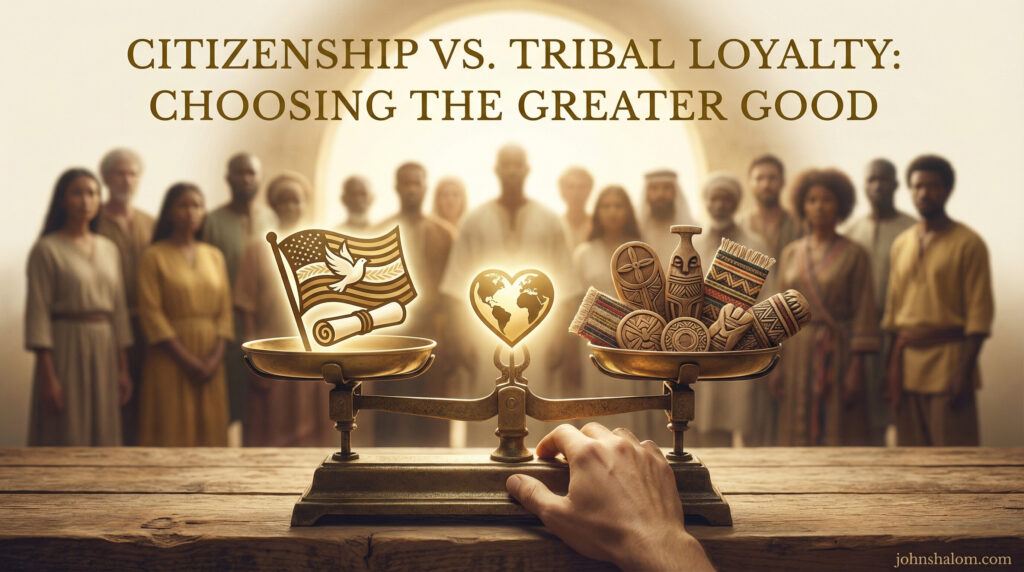
For many of us born in traditional communities, tribe is our first and most powerful identity. It feeds us, protects us, and gives us a surname, a language, and a sense of belonging.
Citizenship often feels distant. To a young person in a rural village, the nation state can feel like a paper promise written by politicians in a far city.
Yet if we remain loyal only to our clan and ignore the wider national community, we destroy the very tree that shelters all of us. Tribal identity provides our roots, but national citizenship is the tree that allows those roots to survive.
When we look globally, different nations handle identity in distinct ways. The United States promotes individual choice, where personal freedom often outweighs community ties. China enforces centralized state loyalty, putting the collective political apparatus above local traditions.
In South Sudan and across Africa, we need a healthier path. We must honor our rich ancestral identity while building a unified nation where equal rights protect every citizen.
Key Takeaways
- Roots vs. Tree: Tribal identity provides personal belonging and ancestral roots, while national citizenship builds the protective structure that keeps all clans safe.
- Complementary Loyalty: Citizenship does not destroy tribal pride; it expands your moral responsibilities beyond immediate relatives.
- Global Models: Western individual freedom and Chinese state control offer contrasting ideas of belonging, but Africa must build unity grounded in shared human dignity.
- Leadership Duty: National stability requires leaders who govern for every community rather than using ethnic divisions to accumulate private wealth.
TL;DR
Tribal identity is our first school of belonging, providing language, security, and culture. National citizenship expands that sense of duty to include neighbors from every clan. By balancing tribal roots with national unity, South Sudan can build a stable future where no ethnic group is excluded or threatened.
Growing Up As Just A Tribesman
As a young boy along the Sobat River, I did not know big political words. Terms like constitution, civic duty, or national anthem meant nothing to me.
My world was clear and immediate. I knew cattle, uncles, fishing spears, and the families who shared their food during difficult seasons.
Your tribe fed you, guided you, and corrected your behavior when you stepped out of line. The elders taught us which side of the river belonged to our clan and which side belonged to others.
When elders spoke under the evening stars, they rarely discussed state boundaries. They spoke about ancestral lineage, cattle history, and ancient grievances.
To be a good youth meant honoring our immediate people and preserving the family name. That was my initial understanding of duty, but it was entirely tribal.
Tribal Loyalty As Our First Classroom
The first classroom in a child’s life is not a school building with chalkboards. It is the family compound and the village meeting tree.
That is where we learn our initial rules of conduct. I learned early that fighting a cousin brought swift discipline from the entire village.
When my father corrected my missteps, he did not cite state legislation. He simply said, “Do not do this, because it dishonors who we are.”
I remember getting into a heated boyhood quarrel with youth from a neighboring section. The details of the fight are forgotten, but the feeling remains clear.
When older boys from my village arrived, they did not investigate who was right or wrong. They only asked which boy belonged to our side.
Once they identified me, they stood by me immediately. Justice was secondary to clan protection. That experience revealed both the warmth and the grave danger of unthinking tribal alignment.
When The Nation Entered The Story
The concept of a national homeland entered my life through personal tragedy and conflict.
In 1989, my elder brother, Biel, left home to join the liberation struggle. He did not march away for a minor clan feud over grazing land.
He went because people were speaking about freedom, human dignity, and a unified homeland for all Southern Sudanese. I was young and did not fully grasp the political ideas at the time.
I only knew that my brother left carrying a rifle and never walked back through our gate. For years, his absence was a deep personal sorrow for our family.
As I grew older and studied history, his sacrifice took on a larger meaning. He had not died defending only our cattle or our immediate village.
He gave his life in a collective movement that carried mothers, children, and warriors from dozens of distinct ethnic groups. That loss taught me that some causes are larger than one’s home village.
Citizenship as an Expanded Circle
Citizenship asks a person to widen their circle of concern. It invites an individual to hold multiple identities without conflict.
You can say, “I am Nuer, Dinka, Shilluk, Bari, or Anyuak, and I am also South Sudanese.” The national identity does not delete your roots; it gives them a wider forest to grow in.
For many people across our continent, this shift is challenging. Tribal connection feels immediate and physical because you can touch it and see your relatives.
National identity can feel like an abstract promise written on paper in a distant capital city.
I still recall the day I received my official national identity documents. Holding that paper brought a quiet realization.
The card declared that I belonged to a sovereign state, carry rights under the law, and share responsibilities with millions of people I have never met.
Citizenship is a broad national table. If every group insists on eating only with their immediate relatives, the shared table remains empty and the country suffers.
Comparing Global Identity Frameworks
To understand our choices in Africa, it helps to examine how major global powers structure citizen loyalty.
In the United States, identity is heavily built on individual rights and economic freedom. Citizens are encouraged to define themselves by personal choice rather than mandatory ancestral obligations.
While this individual liberty offers economic opportunity, it can sometimes produce social isolation and fragment local communities.
In China, identity is anchored in a centralized state authority and collective national goals. The government prioritizes state stability and economic modernization over local political autonomy.
This state-led model delivers massive infrastructure, but it demands strict political alignment from every region and ethnic group.
African nations must chart a path that avoids both extreme individualism and total state suppression.
Our strength lies in combining community care with strong civic governance. We can honor local heritage while building public institutions that serve every citizen equally.
When Tribal Alignment Becomes A Trap
Unchecked tribalism transforms natural cultural love into a dangerous prison.
I once witnessed two young men start a minor argument during a local football match. The dispute began over a simple referee decision.
Within ten minutes, the sports match was forgotten. The young men began insulting each other’s ancestors, ethnic origins, and home villages.
I saw the same destructive force play out on a larger scale during regional conflicts in the early 1990s. Bullets forced families to run, leaving homes and harvests behind.
Neighbors who shared similar traditions and suffered under the same floods were suddenly divided into hostile camps.
Narrow loyalty blinds people to shared suffering. It keeps a community running in circles, burning energy while public roads, clinics, and schools fall into ruin.
The True Meaning of Public Duty
Civic responsibility offers a clear, constructive alternative to ethnic division.
It reminds us that every family suffers when local hospitals lack basic medicines, regardless of their native language. Every parent wants safe roads and quality schools for their children.
Citizenship does not demand that you abandon your ancestors. It simply insists that your neighbor deserves the exact same rights, protections, and respect that you demand for your own family.
My tribe is my root system, but the nation is the tree. If you sever the roots, the tree falls; if the tree dies, the roots dry up in the soil.
I put this principle into practice through my daily work with health and community organizations. When treating a patient or mentoring a young writer, I do not ask for their clan background.
The only relevant question is how we can solve the problem before us and build something lasting for our society.
Overcoming The Enemies Of Civic Unity
Four major obstacles continue to drag communities back into destructive tribal rivalries.
First, opportunistic politics ruins public trust. Certain political figures manipulate ethnic fears to secure personal power while neglecting public infrastructure.
Second, lack of education keeps citizens trapped in narrow worldviews. Without access to broader history and civic instruction, people easily assume that other communities are natural enemies.
Third, unaddressed fear drives people back into ethnic silos. When state security systems are weak, individuals naturally rely on their clan for basic survival.
Fourth, historical grievances passed down through generations keep old hatreds alive. Unhealed wounds make families suspicious of long-term peace agreements.
We must confront these obstacles directly through honest education, transparent governance, and intentional reconciliation across all regions.
Walking Between Different Worlds
My own life has been shaped by navigating multiple cultural spaces.
Born into a Nuer family background along the Sobat, I later spent significant time living among Dinka communities, where an elder gave me the name “Monyjok.”
My full name carries different cultural threads together in one story. Depending on where I travel, some people treat me as a local relative, while others view me as an outsider.
This lived experience has been a powerful teacher. It proved to me that no single ethnic group holds a monopoly on goodness or wisdom.
Every community possesses beautiful traditions alongside human flaws. True national maturity means creating space where every native culture can thrive under equal protection of the law.
Humor also helps ease historical tension. When we learn to laugh gently at our shared human quirks and regional stereotypes, we lower our defenses and begin honest dialogue.
Reflection Questions
- Why is it often easier for individuals to place total trust in local clan networks rather than national public institutions?
- Can you identify a situation in your region where narrow group loyalty hindered a project that would have benefited the entire public?
- How can national educational systems teach young students to value their native heritage while building strong civic pride?
- What concrete actions can local community leaders take to prevent minor personal disputes from turning into broader ethnic conflicts?
- In what ways can families pass down ancestral languages and customs to their children without fostering hostility toward other groups?
FAQs
Is tribal pride inherently harmful to national development?
No. Cultural pride, native language preservation, and local traditions are valuable human rights. Tribal identity becomes harmful only when it is used to deny rights to others, justify corruption, or encourage violence against neighboring communities.
How does national citizenship protect small or minority tribes?
A proper constitutional system guarantees equal protection under the law for every citizen regardless of population size. Effective national citizenship ensures that small communities have equal access to justice, public resources, and political representation.
Can a person remain loyal to their ancestral culture while serving the state?
Yes. Professional public service requires treating every citizen fairly without favoritism. Loving your cultural background while serving the public good with professional integrity is the ultimate form of patriotism.
What role do youth play in breaking cycles of ethnic division?
Youth can use education, digital media, sporting events, and cross-community business projects to build trust across traditional boundaries. By rejecting hate speech and demanding accountable governance, young people can shape a unified national future.
How do economic opportunities reduce tribal tensions?
When a nation builds strong infrastructure, fair job markets, and transparent business environments, citizens do not need to rely solely on ethnic patronage networks for economic survival. Shared economic prosperity builds strong cross-regional partnerships.
Conclusion
Building a peaceful nation does not require erasing our rich cultural diversity. South Sudan and the wider African continent are blessed with vibrant languages, historic traditions, and resilient communities that have survived centuries of trial.
The path forward requires us to elevate our understanding of citizenship alongside our love for ancestral roots. When we demand justice, transparent governance, and equal opportunity for every family in our country, we honor the memory of those who sacrificed for our freedom.
Let us nurture our tribal roots while cultivating a strong national tree. Together, we can build a secure homeland where every child stands equal in dignity, protected by the rule of law, and proud of their shared national destiny.
And if you want to know what’s happening in my world as a writer and digital nomad, check out my Wealthy Affiliate blog page here: https://my.wealthyaffiliate.com/johnmaluth/blog.

This was a really thoughtful read. I like how you didn’t dismiss tribal loyalty but showed how it can grow into something bigger through citizenship. The line about roots and the tree really stuck with me, it explains the balance in a way that’s easy to picture and hard to forget. Your personal stories made the message feel real, not theoretical. It’s a powerful reminder that loving our own people doesn’t have to mean shutting others out.
Jason, thank you. I like how you held the two truths together without forcing a fight between them. We do not have to kill our roots to grow a wider tree. We just have to refuse the habit of turning roots into walls.
Where I come from, I have watched tribal loyalty do two opposite things. At its best, it fed survival, dignity, and responsibility. At its worst, it became a shortcut for suspicion, revenge, and blind following. That is why citizenship matters to me. It is the discipline of belonging to a bigger “we,” even when emotions pull us back into the smaller circle.
I appreciate you naming that love for our own people does not require shutting others out. That sentence alone can save a lot of hearts, and sometimes it can save a country too. What do you think is the first everyday habit that helps a person move from tribal reflex to civic responsibility?