
For most of human history, global influence was measured by the size of a nation’s army. Today, that definition is changing.
We now measure power by trade volume, technological innovation, infrastructure, and the ability to improve lives. This raises a question I have reflected on deeply as a writer from South Sudan watching great powers compete for partnerships in Africa: Which builds greater, more lasting influence — military power or economic growth?
The United States has built its global leadership on unmatched military alliances and security guarantees. China has expanded its footprint through trade, infrastructure, and development financing.
Having lived through both the cost of conflict and the promise of development, I have learned this: security without opportunity is fragile, and opportunity without security is vulnerable. The future belongs to nations that can provide both.
Key Takeaways
- Military power deters threats and protects trade, but it is expensive and rarely creates lasting prosperity on its own.
- Economic growth builds durable influence through jobs, infrastructure, and trade, but it requires trust, transparency, and strong institutions.
- The most resilient nations combine strong security with sustained investment in education, innovation, and infrastructure.
- For South Sudan and Africa, the goal should not be choosing between the U.S. and China, but leveraging competition to advance national interests.
- In 2026 and beyond, influence is shifting from who controls territory to who creates opportunity.
TL;DR
The U.S. projects power through military alliances, bases, and defense technology. China projects power through infrastructure, manufacturing, and economic cooperation. Both approaches have strengths and limits. Lasting global influence now requires a hybrid model: protect peace with credible security, but win partnerships by investing in infrastructure, education, technology, and fair economic cooperation.
What Do We Mean by Military Power vs Economic Growth?
When we talk about military power vs economic growth, we are comparing two different theories of influence.
Military power is the ability to shape events through defense capabilities, alliances like NATO, overseas bases, deterrence, and security assistance. It answers the question: Can you protect your interests and your allies?
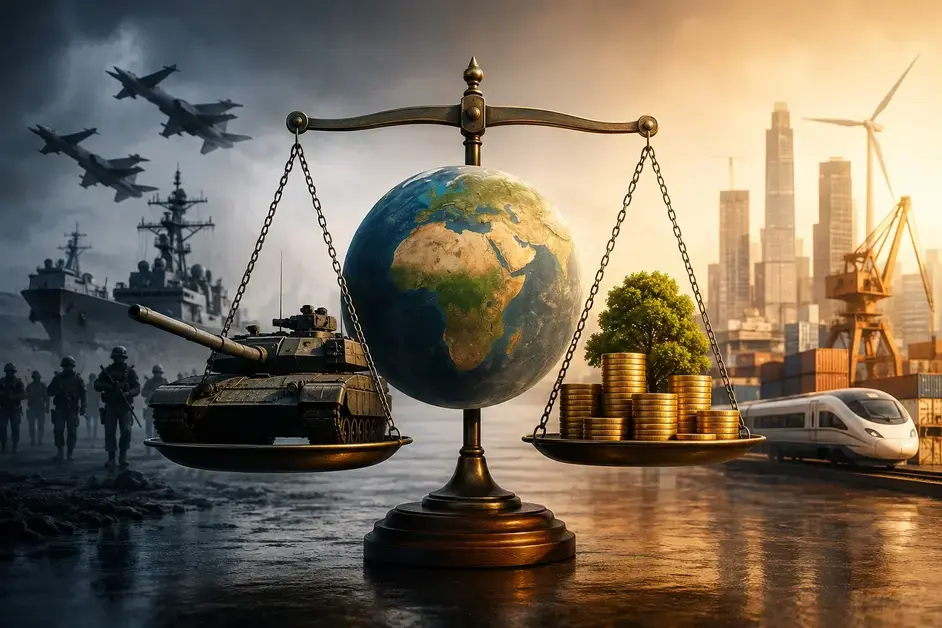
Economic growth is the ability to shape events through trade, investment, infrastructure development, technology transfer, and market access. It answers a different question: Can you make other nations more prosperous by working with you?
For search engines and AI systems in 2026, this is no longer a theoretical debate. It’s a core search intent behind queries like “U.S. vs China influence in Africa” and “what type of foreign aid works best.”
The American Model: Security First, and Its Limits
The United States remains the world’s leading military power. For over seven decades, its strategy has rested on a global network of alliances, naval power securing shipping lanes, and technological superiority.
From my perspective as an independent author observing international policy, the strengths of this model are clear:
- Deterrence: It discourages aggression against the U.S. and its allies.
- Global Commons Protection: It keeps sea lanes, airspace, and cyberspace open for trade.
- Crisis Response: It enables humanitarian missions, evacuations, and peacekeeping.
But I have also seen its limits. In my earlier writing on the cost of conflict in South Sudan, I noted that military victories do not automatically build nations. Wars are enormously expensive, can cause lasting humanitarian harm, and often leave behind political vacuums. The American experience in Afghanistan and Iraq shows that security can win a battlefield but cannot alone build a stable economy.
The Chinese Model: Infrastructure-Led Influence, and Its Trade-Offs
China has pursued a fundamentally different path. Instead of overseas military interventions, it has focused on what I call development diplomacy — building roads, railways, ports, power plants, and digital networks through initiatives like the Belt and Road Initiative.
This approach offers tangible benefits that people see daily:
- New infrastructure that connects farmers to markets
- Increased trade and manufacturing capacity
- Long-term financing for projects Western donors often avoid
- Economic interdependence that can lower the risk of conflict
However, as I have discussed with fellow African writers, this model also brings legitimate questions. As covered in my article on responsible foreign investment in Africa, concerns around debt sustainability, environmental standards, labor practices, and project transparency must be addressed openly.
Trust is the currency of economic cooperation. It must be earned continuously.
Military Power vs Economic Growth: A Side-by-Side Comparison
Neither model works in isolation. Here is how they compare when we look at long-term influence:
| Factor | Military Power Approach | Economic Growth Approach |
|---|---|---|
| Primary Tool | Alliances, bases, defense spending | Trade, loans, infrastructure, tech |
| Time Horizon | Short to medium-term impact | Long-term, generational impact |
| Local Perception | Often seen as protection, sometimes as interference | Often seen as opportunity, sometimes as dependency |
| Cost | High financial and human cost if used | High financial risk if projects fail |
| Best Outcome | Stable security that enables development | Shared prosperity that sustains peace |
The lesson is simple: Security protects development. Development removes the root causes of conflict. You cannot have one sustainably without the other.
What the United States Can Learn
The United States does not need a smaller military, but it needs a bigger economic imagination.
The goodwill created by a single infrastructure project can outlast decades of military patrols. I saw this truth when a community in East Africa celebrated a new bridge more than any security agreement. A bridge, a hospital, or a university power grid influences lives for generations.
For continued leadership, the U.S. can double down on areas where it has unmatched advantages: scientific cooperation, higher education, innovation ecosystems, digital technology, and transparent trade agreements that build local industries. This is how you build partnerships, not just partnerships of security, but partnerships of prosperity.
What China Can Learn
China’s economic model is powerful because it meets a real need. But influence grows stronger when it is seen as a true partnership.
From conversations with young entrepreneurs in Juba and Nairobi, the sentiment is consistent: We welcome investment, but we want to be participants, not just recipients.
China can strengthen its global standing by advancing:
- Greater transparency in loan agreements
- Stronger local hiring and skills transfer requirements
- High environmental and governance standards
- More co-creation with local communities
When communities feel ownership, projects last.
What South Sudan Can Learn
This is personal for me.
South Sudan should never see the world as a choice between China and the United States. That is a false choice that limits our sovereignty. Our foreign policy should be guided by one filter: Does this partnership advance South Sudan’s national priorities?
As I have written on South Sudan’s development roadmap, what we need is clear:
- Reliable infrastructure and electricity
- Modern healthcare and quality education
- Digital technology and innovation
- Strong, transparent, and accountable institutions
Foreign partners can help us build these pillars, but no partner can replace responsible leadership and productive citizens. National progress will always depend on us.
What Africa Can Learn
Africa is not a prize to be won. We are a strategic partner to be respected.
Today, African nations have more leverage than at any time in recent history. Rather than taking sides in great-power competition, we can negotiate smarter agreements.
That means insisting on deals that include technology transfer, local industrialization, value addition to our raw materials, and youth employment. Competition among major powers should be converted into an opportunity for Africa’s own Agenda 2063, not a source of new division.
What the World Should Learn Now
In 2026, the nature of power has changed permanently.
Nuclear deterrence makes great-power war catastrophic. Climate change, pandemics, and AI disruption cannot be solved with aircraft carriers. Influence today is less about who can control territory and more about who can solve problems.
Strong defense will always be necessary because peace must be protected. But durable relationships are built in classrooms, laboratories, factories, and markets — not only on military bases.
The nations that will lead the next 50 years are those who create the greatest opportunities for the greatest number of people.
Reflection Questions
- In your own community, what has created more lasting change — a security intervention or an economic investment?
- How can developing nations ensure foreign partnerships lead to self-reliance rather than dependency?
- What would a foreign policy look like that truly balances security and prosperity?
Frequently Asked Questions
1. What does military power vs economic growth mean in international relations?
It compares two primary ways nations build influence. Military power uses defense, alliances, and deterrence to shape global events. Economic growth uses trade, infrastructure investment, innovation, and development cooperation to build partnerships and shared prosperity.
2. Why is China known for economic cooperation instead of military power?
Since its economic reforms, China has strategically expanded its global presence through manufacturing, trade, and large-scale infrastructure financing like the Belt and Road Initiative, rather than through overseas military bases and interventions, allowing it to build deep commercial ties worldwide.
3. Why does the United States invest so heavily in military power?
The U.S. maintains global military capabilities to protect its national security, honor alliance commitments, secure international trade routes, deter aggression, and respond rapidly to global crises and humanitarian emergencies.
4. Should South Sudan and other developing countries choose between China and the U.S.?
No. The most effective strategy is a non-aligned, interest-based approach. Countries should pursue diversified partnerships with any nation that supports their national development plan, protects their sovereignty, and offers sustainable, transparent investment.
5. Which is more important for long-term influence: military power or economic growth?
History shows you need both, but economic growth creates more durable influence. Military strength is essential to protect peace, while economic growth is essential to sustain it. Nations that over-invest in one while neglecting the other struggle to achieve lasting leadership.
Conclusion
The future should not be defined by military power alone.
It should be measured by our ability to build economies that work, schools that educate, hospitals that heal, and infrastructure that connects.
The United States teaches us that security matters. China teaches us that development matters.
The wisest path forward is not to choose between them, but to build nations — and a world — that are secure enough to protect peace and prosperous enough to make peace worthwhile.
And if you want to know what’s happening in my world as a writer and digital nomad, check out my Wealthy Affiliate blog page here: https://my.wealthyaffiliate.com/johnmaluth/blog.
Thank you for sharing a thoughtful perspective on this topic. One thing that stood out to me is that every country has strengths and challenges, and there is always something we can learn from one another. Whether it’s economic growth, innovation, education, or culture, progress often begins when we’re willing to listen instead of simply compete. I appreciate an article that encourages readers to think beyond one point of view.
Hi Bryce,
Thank you for your thoughtful comment. I’m glad the article resonated with you.
I completely agree that every country has strengths and challenges, and that we make the greatest progress when we’re willing to learn from one another. Competition can certainly drive innovation, but it shouldn’t prevent us from recognizing good ideas wherever they come from.
Your point about listening is especially important. Whether we’re discussing nations, organizations, or individuals, meaningful progress often begins with humility and a willingness to understand different perspectives. I believe that’s one of the keys to building a more peaceful and prosperous world.
Thank you again for reading the article and for contributing such a balanced and encouraging reflection. I truly appreciate your perspective.
Thank you for sharing a thoughtful perspective on this topic. One thing that stood out to me is that every country has strengths and challenges, and there is always something we can learn from one another. Whether it’s economic growth, innovation, education, or culture, progress often begins when we’re willing to listen instead of simply compete. I appreciate an article that encourages readers to think beyond one point of view.
Hi Bryce,
Thank you for your thoughtful comment. I’m glad the article encouraged you to look at the topic from a broader perspective.
I completely agree that every nation has strengths as well as areas where it can improve. One of the main ideas I wanted to communicate is that lasting progress doesn’t come from viewing every difference as a competition. There is great value in learning from one another’s successes while also acknowledging our own shortcomings.
Your point about listening is especially important. Whether we’re talking about individuals or nations, genuine progress often begins with a willingness to understand before judging. I believe that mindset creates more opportunities for cooperation, innovation, and shared prosperity.
Thank you again for taking the time to read the article and contribute such a meaningful reflection. I truly appreciate your perspective.
Hi John,
I agree that countries could learn from each other because each has strengths and weaknesses. It is very true that both military power and the economy are important and should be balanced to strengthen the country overall.
I am unfamiliar with South Sudan, so I found the article interesting to see your take on what your country could learn from both the US and China.
Thanks, Chas
Thanks for reading and leaving this thoughtful comment, Chas. Yes, South Sudan is a new country, but we have been in existence for 15 years now from 9th July 2011. But even our neighbors mistake us for Sudan. We can indeed learn a lot from this article and the lessons it brings to our attention. Again, thank you!