
South Sudan is taking another step toward building a modern digital-payment system. The Bank of South Sudan has commenced a five-day stakeholder workshop to validate the National Payment System Bill, 2025, while Parliament has backed efforts to establish a stronger legal framework for digital payments.
The proposed legislation is important. A modern economy needs clear rules for electronic payments, mobile money, payment providers, consumer protection, financial supervision and digital transactions.
But there is a bigger question that South Sudan should not avoid: Is the country’s digital-payment sector actually growing, or are policymakers mainly measuring the number of platforms, companies and regulations rather than the number of people who can reliably use digital payments every day?
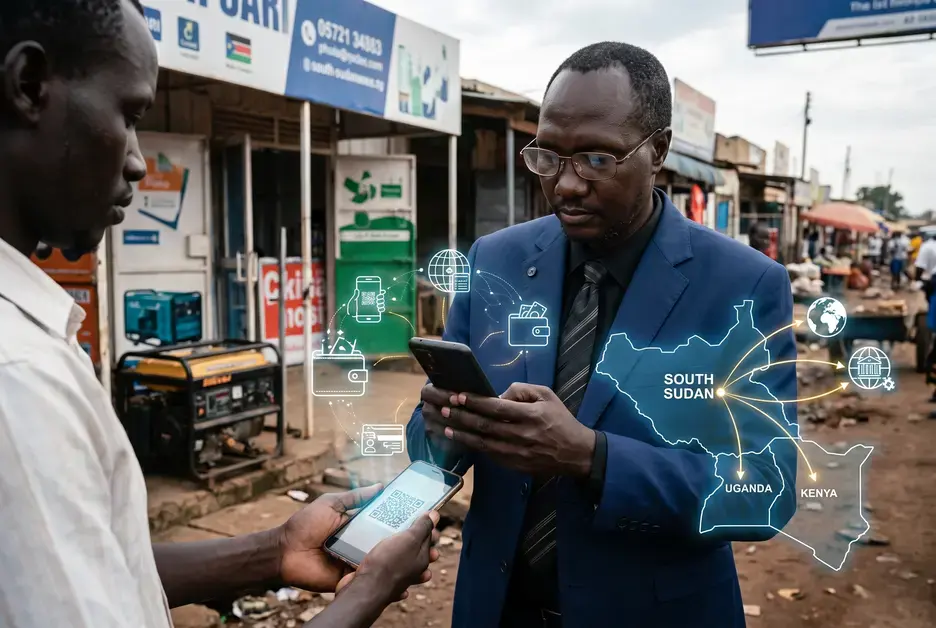
South Sudan has names associated with digital financial services, including MoMo, NilePay, mGurush and DigiCash. Yet many South Sudanese still encounter serious practical limitations when trying to make or receive digital payments. For some transactions, people continue to depend on services connected to neighbouring countries, particularly Uganda’s MoMo and Kenya’s M-Pesa.
That gap between policy and everyday experience matters.
South Sudan does not simply need a law governing digital payments. It needs digital payments that actually work.
TL;DR
- South Sudan is working to strengthen the legal framework governing digital payments through the National Payment System Bill, 2025.
- The country already has several digital-payment platforms, including MoMo, NilePay, mGurush and DigiCash.
- The existence of payment platforms does not automatically mean that South Sudan has a mature digital-payment economy.
- Reliability, network coverage, interoperability, consumer protection and access remain critical issues.
- Dependence on Uganda’s MoMo and Kenya’s M-Pesa for some practical payment needs highlights the gap between having digital-payment platforms and having a dependable domestic system.
- Digital payments are especially important for South Sudanese entrepreneurs, freelancers, remote workers and digital businesses.
- Regulation must be followed by implementation, infrastructure investment and accountability.
- South Sudan also needs productive international partnerships with African neighbours, Western countries, China and other economic partners.
- The ultimate measure of success should be whether ordinary South Sudanese can send, receive and use digital money reliably.
South Sudan’s Digital Payment Sector Needs a Reality Check
The announcement of a stronger legal framework for digital payments is easy to welcome. South Sudan has spent years trying to build institutions capable of supporting a modern economy, and digital financial services are an important part of that effort.
However, policy announcements should not be confused with economic results.
When officials describe a digital-payment sector as growing, citizens should be able to see that growth in their daily lives. There should be more people using digital payments. Businesses should increasingly accept electronic transactions. Transfers should become faster and more reliable. Consumers should have greater confidence that their money will reach its destination.
The presence of several companies or payment platforms is only one part of the story.
A country can have mobile-money companies and still have a weak digital-payment economy. It can have a payment law and still have unreliable services. It can have banks, telecommunications companies and digital wallets while ordinary citizens continue to prefer cash.
The important question is therefore not simply whether South Sudan has digital-payment services.
The important question is whether those services are usable, reliable, accessible and trusted.
That distinction should guide the discussion around the National Payment System Bill.
What Is the National Payment System Bill Supposed to Achieve?
A national payment system provides the rules and infrastructure through which money moves between individuals, businesses, banks and other financial institutions.
For South Sudan, a stronger legal framework can help clarify how payment providers operate and how electronic transactions are supervised. It can also establish clearer responsibilities for financial institutions, mobile-money operators, payment-service providers and other participants in the digital financial system.
Good regulation can provide several benefits.
First, it can improve consumer protection. People need clear procedures for dealing with failed transactions, unauthorized transfers, fraud and disputes.
Second, it can create greater certainty for businesses. Companies are more likely to invest in payment technology when they understand the regulatory requirements and believe that the rules will be applied consistently.
Third, regulation can support competition. A properly designed system should make it possible for multiple providers to compete while maintaining common standards.
Fourth, regulation can help strengthen confidence in digital transactions. People are more likely to use electronic payments when they believe their money is protected and that there are functioning institutions capable of resolving problems.
These are important objectives.
But legislation is not the payment system itself.
The law can establish the rules. It cannot automatically provide reliable telecommunications networks, affordable services, functioning technology, sufficient liquidity, widespread merchant acceptance or public trust.
Those things require implementation.
Does South Sudan Really Have a Growing Digital-Payment Economy?
This is perhaps the most important question raised by the current debate.
South Sudan has several names associated with mobile money and digital financial services. MoMo, NilePay, mGurush and DigiCash demonstrate that there have been efforts to establish a domestic digital-payment ecosystem.
But the existence of these platforms should not end the conversation.
How many people actively use them?
How frequently do they use them?
How many businesses accept them?
How reliable are transactions?
How easily can users move money between different providers?
How easy is it for customers to convert digital money into cash when necessary?
How many South Sudanese can use these services outside major urban centres?
How easily can a South Sudanese business connect with customers and suppliers across borders?
These questions provide a much better measure of digital-payment development than the number of companies registered in the sector.
This is not an argument that every South Sudanese digital-payment platform is useless or that every transaction fails. That would be too broad a claim. The stronger point is that the country’s digital-payment infrastructure has not yet reached the level of reliability and accessibility that a modern economy requires.
That is why comparisons with Uganda and Kenya are useful.
What South Sudan Can Learn From Uganda and Kenya
Uganda and Kenya have developed financial ecosystems in which mobile money is part of everyday economic life.
For South Sudanese who operate across borders, Uganda’s MoMo and Kenya’s M-Pesa can therefore become practical alternatives when domestic options do not meet their needs.
The important lesson is not that South Sudan should simply copy Kenya or Uganda.
The lesson is that digital payments become powerful when they are integrated into everyday economic activity.
A successful mobile-money ecosystem is not just an application on a phone. It includes telecommunications infrastructure, agents, merchants, banks, payment providers, customers, businesses, regulators and reliable transaction systems.
It becomes valuable because people trust it enough to use it repeatedly.
South Sudan needs to develop that same level of practical usefulness.
The country has the advantage of being able to study what neighbouring countries have already learned. It does not need to start from zero. Policymakers can examine successful systems, identify weaknesses and develop rules that fit South Sudan’s own economic and institutional realities.
The goal should not be to reproduce another country’s system exactly.
The goal should be to make digital payments work for South Sudan.
A Digital Payment Platform Is Not Enough
One of the biggest mistakes policymakers can make is treating technology as the solution by itself.
A mobile-money application is useful only when the surrounding system works.
Imagine a small trader in Juba who wants to receive digital payment from a customer. The trader needs a functioning mobile network, a working account, sufficient transaction reliability and confidence that the money can be accessed when needed.
If the transaction fails repeatedly, the trader will return to cash.
The same principle applies to businesses.
A company cannot build its operations around digital payments if payment failures are frequent or if customers cannot easily move money between different networks.
This is why South Sudan needs to think about digital payments as infrastructure.
Roads allow physical goods to move.
Electricity allows businesses to operate.
Internet connectivity allows digital information to move.
Payment systems allow money to move.
A modern economy needs all four.
Interoperability Could Change the Game
Interoperability should be one of the important issues in South Sudan’s digital-payment development.
If users of one payment service cannot easily transact with users of another service, the market becomes fragmented.
Imagine having one mobile-money account for your employer, another for your customers and another for your family, with no simple way to move money between them.
That is not the convenience digital payments are supposed to provide.
Interoperability allows different financial institutions and payment providers to communicate with one another under common standards. It can make digital transactions more useful and reduce the need for customers to maintain multiple accounts simply because different people use different networks.
For South Sudan, interoperability could also help competition.
A customer should be able to choose a payment service based on price, reliability and quality rather than being forced into a particular provider because that is the only network that can transact with another user.
The National Payment System Bill should therefore support a system in which competition and interoperability can develop together.
Digital Payments Matter to South Sudan’s Digital Entrepreneurs
The importance of digital payments becomes even clearer when viewed from the perspective of online work.
South Sudan has young people who want to participate in the global digital economy. Some are writers. Some are freelancers. Some provide technology services. Others work in online education, consulting, design, translation, marketing and digital commerce.
They may work for customers outside South Sudan while living inside the country.
For them, receiving payment is not a minor technical issue.
It is part of their business infrastructure.
A freelancer can find an international client, complete the work and receive a positive review, but the business still fails if there is no practical way to receive and use the money.
This creates a serious development problem.
South Sudan cannot tell its young people to embrace the digital economy while leaving them to solve the payment problem individually.
The country needs financial infrastructure that allows digital workers to participate in global markets legally, securely and efficiently.
This is especially important because digital work can provide opportunities without requiring every young person to migrate.
A writer who works online does not necessarily need to relocate permanently to Nairobi, Kampala, Johannesburg or another regional centre if the infrastructure exists for that person to operate from South Sudan.
Digital payments can therefore contribute indirectly to employment, entrepreneurship and economic diversification.
Digital Payments Cannot Grow Without a Stronger Economy
There is another issue that should not be ignored.
Digital payments cannot be separated from the health of the wider economy.
Technology does not create purchasing power by itself.
If households have little disposable income, businesses have few customers and formal employment remains limited, digital transactions will naturally remain limited.
This means that South Sudan should not treat digital payments as an isolated technology project.
The country needs broader economic development.
It needs productive businesses.
It needs more employment.
It needs better telecommunications.
It needs reliable electricity.
It needs stronger banking services.
It needs entrepreneurs who can start and grow businesses.
It needs consumers who have money to spend.
Digital payments can then become a tool that supports economic activity rather than an impressive technology operating on the margins of a weak economy.
Why Consumer Trust Matters
People will not use digital payments simply because a government tells them to.
They will use them when they trust them.
Trust is built through reliability, security and accountability.
If someone sends money and the transaction fails, the customer needs to know what happens next.
If money is deducted from an account incorrectly, there must be a clear dispute-resolution process.
If a payment provider experiences a technical failure, customers need information.
If fraud occurs, consumers need protection.
If a provider closes or changes its services, users need safeguards.
This is where strong regulation becomes valuable.
The National Payment System Bill should therefore be judged not only by how it regulates companies but also by how effectively it protects the people who use those companies.
A digital-payment system ultimately exists for users.
South Sudan Needs International Partnerships
Building a functioning digital-payment system will require resources, technical knowledge and international cooperation.
South Sudan should therefore pursue productive relationships with countries and institutions that can contribute to its economic development.
A serious partnership with Western countries could support financial regulation, technology, education, institutional development and private-sector growth. Partnerships with neighbouring African countries can provide practical lessons and regional integration. China and other international partners can contribute investment, infrastructure and technical expertise in areas where cooperation is mutually beneficial.
The objective should not be dependency.
South Sudan needs partnerships that strengthen its own capacity.
The country should be able to negotiate from a position of national interest and ask a basic question of every major partnership: What does this relationship help South Sudan build for itself?
If an agreement provides money today but leaves the country unable to sustain the system tomorrow, its long-term value is questionable.
If a partnership brings technology, skills, infrastructure and productive investment that South Sudan can continue using, it becomes much more valuable.
The Problem Is Often Implementation
This is where South Sudan’s digital-payment debate connects to a much larger national problem.
Our leaders can say many of the right things.
They can speak about modernization.
They can speak about digital transformation.
They can announce economic reforms.
They can establish committees.
They can hold workshops.
They can introduce legislation.
But citizens ultimately judge government by what changes in their lives.
That is the difference between policy and implementation.
South Sudan has no shortage of ideas. The country needs stronger execution.
The National Payment System Bill should therefore not become another example of a reform that sounds impressive when announced but produces little practical change.
The government should establish measurable targets.
How many people should be able to access digital payments?
How many businesses should accept them?
How reliable should transactions be?
How quickly should failed transactions be resolved?
How much should transfers cost?
How many payment providers should be interoperable?
How should consumers be protected?
These are measurable questions.
They make it possible to determine whether reform is working.
What Should South Sudan Do Next?
South Sudan should approach digital-payment reform as a long-term economic-development program rather than simply a legislative exercise.
First, the country needs a clear and enforceable legal framework. The National Payment System Bill can provide that foundation.
Second, the government and regulators need to improve supervision and consumer protection. Digital finance requires trust.
Third, telecommunications infrastructure needs sustained investment. A payment system cannot be more reliable than the networks supporting it.
Fourth, payment providers should be encouraged to develop interoperability. Customers should not be trapped inside disconnected systems.
Fifth, South Sudan needs stronger connections between banks, mobile-money operators, businesses and international payment systems.
Sixth, digital-payment services should become accessible beyond major urban centres. A national system should not effectively become a Juba-only system.
Seventh, policymakers should collect and publish meaningful data. South Sudan needs to know how many people actually use digital payments, how often they transact and where the major barriers remain.
Finally, the government needs to create an economic environment in which people actually have reasons to use digital payments.
A digital economy requires economic activity.
How Should We Measure Success?
The success of South Sudan’s digital-payment reform should eventually be visible without requiring a government report to explain it.
A shopkeeper should be able to accept digital payment confidently.
A customer should be able to pay without carrying large amounts of cash.
A worker should be able to receive income electronically.
A family should be able to transfer money securely.
A business should be able to pay its suppliers.
A freelancer should be able to receive legitimate international income.
A digital entrepreneur should be able to build a business without having to relocate simply because payment infrastructure is unavailable.
Different payment providers should be able to communicate.
Consumers should know where to report problems.
And the system should work consistently enough that people choose digital payments because they are convenient, not because policymakers tell them they are the future.
That is what real digital-payment growth would look like.
South Sudan’s Digital Future Depends on Execution
South Sudan has an opportunity to build a modern payment system while its digital economy is still young.
The National Payment System Bill, 2025, could become an important part of that process. Strong regulation can create the rules necessary for payment providers, financial institutions, businesses and consumers to operate with greater confidence.
But the law cannot do the job alone.
South Sudan needs infrastructure, investment, interoperability, consumer protection, international cooperation, private-sector participation and, above all, implementation.
The country should also be careful about how it describes its current digital-payment sector. Having MoMo, NilePay, mGurush, DigiCash and other services is a starting point. It is not the final measure of success.
The real test is whether South Sudanese people can use digital payments reliably in their everyday lives.
That is also why comparisons with Uganda and Kenya matter. When South Sudanese people look toward Uganda’s MoMo or Kenya’s M-Pesa for practical mobile-money solutions, the lesson should not be embarrassment. The lesson should be learning.
South Sudan can build its own system.
But it must build one that works.
The country does not need another reform that exists primarily in official documents. It needs reforms that reach the trader, the student, the worker, the farmer, the business owner, the civil servant and the digital entrepreneur.
The National Payment System Bill can help create the rules.
Now South Sudan must build the system.
Reflection Questions
- Is South Sudan’s digital-payment sector growing in actual usage, or mainly in the number of platforms and policies?
- What prevents South Sudanese from using domestic digital-payment services more frequently?
- Should interoperability between mobile-money providers become a major priority?
- What can South Sudan learn from Kenya’s M-Pesa and Uganda’s MoMo without simply copying their systems?
- How can reliable digital payments help South Sudanese participate in the global digital economy?
Frequently Asked Questions
1. What is the National Payment System Bill in South Sudan?
The National Payment System Bill, 2025, is intended to strengthen the legal and regulatory framework governing payment systems in South Sudan. It is designed to provide clearer rules for electronic payments and the institutions and companies involved in moving money digitally.
2. Does South Sudan have mobile-money services?
Yes. South Sudan has several digital financial-service platforms and mobile-money initiatives, including MoMo, NilePay, mGurush and DigiCash. However, the existence of these platforms does not necessarily mean that digital payments are widely available, reliable or routinely used across the country.
3. Why do some South Sudanese use Uganda MoMo and Kenya M-Pesa?
South Sudanese who operate across borders or need reliable mobile-money services may use platforms connected to neighbouring countries. Uganda’s MoMo and Kenya’s M-Pesa have become major regional payment systems, making them useful for some South Sudanese users and businesses.
4. Why is interoperability important for digital payments in South Sudan?
Interoperability allows different payment providers, banks and financial networks to transact with one another. Without interoperability, users may be forced to maintain multiple accounts or return to cash when different networks cannot communicate.
5. Can digital payments help South Sudan’s economy?
Yes. Reliable digital payments can support businesses, entrepreneurship, remote work, online commerce, financial inclusion and cross-border transactions. However, digital payments work best when combined with stronger telecommunications, electricity, banking, employment and broader economic activity.
Conclusion
South Sudan’s decision to strengthen its legal framework for digital payments is necessary, but the country should not mistake legislation for development.
The real goal should be a payment system that people trust and use because it works.
South Sudan needs domestic digital-payment services that are reliable, interoperable, affordable and accessible. It needs regulations that protect consumers and encourage responsible competition.
It needs infrastructure that supports digital transactions. It needs international partnerships that build national capacity. And it needs leaders who can move from announcements to implementation.
The question is no longer whether South Sudan should have digital payments.
It should.
The question is whether South Sudan can build a digital-payment system that actually works for South Sudanese people.
That is the standard that should matter.
May Mother Nature help us.
And if you want to know what’s happening in my world as a writer and digital nomad, check out my Wealthy Affiliate blog page here: https://my.wealthyaffiliate.com/johnmaluth/blog.
Hey,
This is a really informative article, and great to share.
It is very interesting to learn about how different parts of the world conduct their business compared to where I live (the UK).
I hope they can improve their payment system for their people, and helps them to grow their business.
Thank you for sharing and keep up the great work.
All the best,
Tom
Hi, Tom.
Thanks for taking your time to read this long article as well, and for leaving this heartfelt comment. It means a lot to me and other readers. I hope my government will do the needful and do it sooner rather than later. I have been, and I am facing a lot of digital payment issues with my online work since 2012. Even Payoneer can’t verify my identity simply because they don’t have South Sudan in the list of countries. They do have my information though, but they don’t want to use it as is.
John