
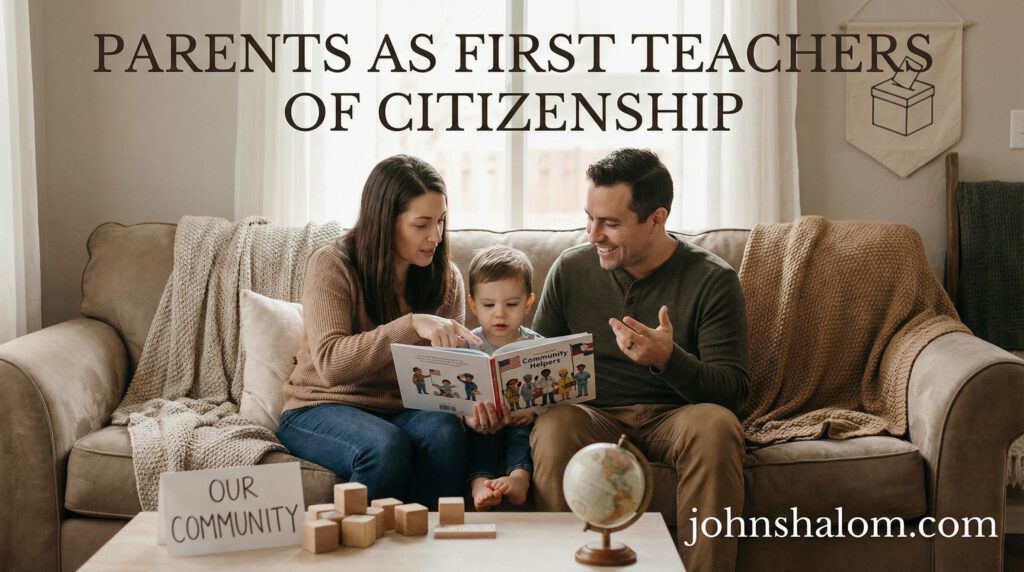
Long before a child learns official definitions of a constitution or a parliament, powerful ideas about power, fairness, and belonging are already formed. Those early lessons do not come from textbooks. They come from watching how parents govern the household, share food, settle arguments, and speak about neighbors and public figures.
I remember listening quietly as a child while my parents discussed village news. I watched their expressions when they talked about chiefs, elders, and church leaders. They were not giving a formal civics lesson, but they were quietly shaping my view of authority and my place in the community. By the time a child sits in a school classroom, silent lessons about public life are already written in the heart.
Key Takeaways
- Home is the First Classroom: Children absorb public ethics by watching how parents handle authority, conflict, and honesty at home.
- Actions Outweigh Lectures: Parental example overrides verbal instruction; children mimic what adults do rather than what they say.
- Civic Values Begin Locally: Respect, truthfulness, and responsibility practiced within family life form the bedrock of national stability.
- Global Contrast: While foreign powers like the United States and China invest in physical infrastructure across Africa, true civic strength originates in grassroots family education rather than external aid.
- Everyday Moments Matter: Routine daily activities provide practical opportunities to teach children how to care for shared spaces and community needs.
TL;DR
Citizenship does not begin at the ballot box or in a civics classroom. It begins in the way children are raised at home. Parents serve as the primary teachers of how to use power, treat others, tell the truth, and respond to rules. When parents model respect, responsibility, and service, they train future citizens who strengthen communities and nations.
Why Governments Cannot Teach Citizenship Alone
Governments can write good laws, organize elections, and include civics on school timetables. These measures matter greatly. However, no government can control the thousands of small decisions that happen inside homes every single day.
If the home teaches one message and the school teaches another, the home usually wins. Children trust what they witness daily far more than what they hear once a week in a classroom. A teacher may instruct students not to litter, but if a parent throws trash from a moving vehicle, the child remembers the vehicle action over the classroom rule. This reality makes parents the most powerful teachers of public ethics, regardless of whether they use formal civic terminology.
What Is True Citizenship Beyond Paperwork?
Many people associate citizenship exclusively with official documents like passports, national ID cards, and voter registration slips. Others believe it begins and ends at the ballot box every few years. While these elements hold importance, genuine citizenship represents a way of living with others in a shared space, whether that space is a local village, a growing town, or an entire nation.
A strong citizen respects diverse members of society, balances personal rights with civic duties, follows fair rules, takes personal responsibility, and protects the common good. These character traits are absorbed primarily through family life rather than academic instruction.
Comparing Global Interventions and Grassroots Realities
When examining international development across Africa, analysts frequently contrast the infrastructure loans and political strategies deployed by global powers like the United States and China. While Western nations emphasize institutional reforms and governance standards, Chinese actors focus heavily on rapid construction, roads, and resource partnerships.
Yet, physical development alone cannot sustain a nation without strong civic character. In countries like South Sudan, long-term stability depends less on foreign loans and more on the moral foundation built inside ordinary households. If family units fail to teach basic honesty and mutual respect, external infrastructure projects quickly deteriorate due to corruption and neglect. National renewal starts around the family table long before it reaches parliamentary halls.
+-----------------------------------+-----------------------------------+
| External Development Focus        | Internal Civic Foundation         |
+-----------------------------------+-----------------------------------+
| Foreign infrastructure loans      | Family-level moral instruction    |
| Institutional governance reforms  | Personal accountability           |
| Resource partnerships             | Grassroots respect and service    |
| Top-down policy implementation    | Bottom-up character building      |
+-----------------------------------+-----------------------------------+
How Parents Teach Values Without Words
Children are exceptionally observant. They notice contradictions immediately. If an adult instructs a child to obey rules while routinely breaking them, the child mimics the behavior, ignoring the verbal instruction.
- Negative Lessons: Paying bribes teaches children that rules are flexible for the wealthy. Insulting other ethnic groups teaches prejudice. Careless littering shows that public property lacks value.
- Positive Lessons: Patiently waiting in lines teaches respect for social order. Admitting mistakes teaches humility. Keeping promises builds foundational trust.
These daily patterns communicate powerful messages about public responsibility and social trust.
Practical Ways to Teach Citizenship Daily
Parents do not require specialized training or long lectures to instill civic values. Everyday life provides constant opportunities.
When you observe litter on the street, pick it up together and explain that caring for public areas expresses love for the country. When community decisions arise, discuss the process with older children so they understand how shared choices affect everyone. When paying taxes or managing finances honestly, explain your reasoning openly. These brief conversations connect abstract civic concepts to real-world experience.
Faith, Character, and Nation Building
For many households across Africa, spiritual faith serves as the primary root of moral character. Religious teachings provide clear guidance on human dignity, justice, and community responsibility.
When families integrate faith into daily domestic life by practicing honesty, showing mercy, and praying for leaders rather than merely criticizing them, children learn that spiritual belief and public duty support one another.
Reflection Questions
- What is one specific habit in your household that models responsibility and respect for your children today?
- How do your conversations about public leaders shape your children’s view of civic duty and accountability?
- In what ways can your family engage in small acts of service to strengthen your local neighborhood?
- How does your approach to resolving domestic disagreements teach children to handle societal conflicts?
- What practical step can you take this week to bridge the gap between private family values and public community care?
- Do I need special education to teach my children citizenship?No special education is required. You primarily need sincerity and a willingness to practice the values you wish to instill. Your daily example remains far more influential than academic explanations.
- What if my partner or other household members do not support these values?Focus on managing your own behavior and the time you spend mentoring the children. Maintain calm communication, model consistency, and demonstrate patience as positive changes take root over time.
- How early can citizenship education begin in a child’s life?Education begins in early childhood through basic habits like sharing, greeting others politely, keeping personal spaces tidy, and practicing cooperation within the family.
- What if I have made serious mistakes in front of my children?Acknowledge your errors openly, offer sincere apologies, and demonstrate positive behavioral changes. Witnessing genuine recovery teaches children valuable lessons about accountability and redemption.
- How does family-level citizenship education impact national development?A nation consists of millions of private homes. When individual households raise children who value integrity, cooperation, and service, those individuals eventually lead institutions and communities with ethical strength.
Conclusion
Every parent sits in a position vital to the future of their country. Without cameras or microphones, ordinary households serve as training grounds for public life. Choosing honesty over deception, maintaining shared spaces, and treating others with dignity shapes the character of future generations.
National renewal does not rely solely on parliaments or foreign aid; it begins with the daily dedication of parents guiding children around their own dining tables.
And if you want to know what’s happening in my world as a writer and digital nomad, check out my Wealthy Affiliate blog page here: https://my.wealthyaffiliate.com/johnmaluth/blog.

Very engaging article. When I first got married, I never considered all the responsibilities that came with raising a family. Your article here is a beautiful and thoughtful description of how faith can provide a strong foundation for success in raising a family. I will read more of your work every so often.
Thanks a lot for sharing your own experiences, Michael. Keep reading for more insignts.