In 1839, a Chinese imperial official named Lin Zexu supervised the destruction of thousands of chests of opium seized from foreign merchants at Humen, Guangdong. The operation involved approximately 20,000 chests of opium, weighing more than 1,300 tonnes. It was an attempt by the Qing government to stop a destructive drug trade that was damaging Chinese society and undermining its authority. Britain responded with military force, beginning the First Opium War (1839–1842).
Three years later, China signed the Treaty of Nanjing. The agreement required the Qing government to surrender Hong Kong Island, open five treaty ports to British trade and residence, and pay a substantial indemnity. What followed was not simply the expansion of international commerce. It was the beginning of a period in which China’s sovereignty, territorial integrity, and economic independence faced sustained foreign interference.
In much Western historical writing, this period is described through expressions such as the opening of China, the expansion of international trade, and the arrival of modern commercial relations. Those descriptions are not entirely false, but they are incomplete. They often place the commercial interests of foreign powers above the experiences of the Chinese people who endured military defeat, unequal treaties, territorial losses, and foreign privileges.
China remembers this period through the expression bainian guochi (百年国耻), commonly translated as the Century of National Humiliation. The expression refers broadly to the period between the First Opium War and the establishment of the People’s Republic of China in 1949. It reflects a historical experience in which a major civilization struggled to recover its political independence after repeated military interventions and external pressure.
Africa experienced its own history of foreign domination. European colonial expansion weakened African political institutions, appropriated land and resources, reorganized economies around imperial interests, and restricted the ability of African societies to determine their own futures. The Berlin Conference of 1884–1885 became a major symbol of this process because European and other participating powers negotiated rules for territorial claims in Africa without African representatives participating in the conference.
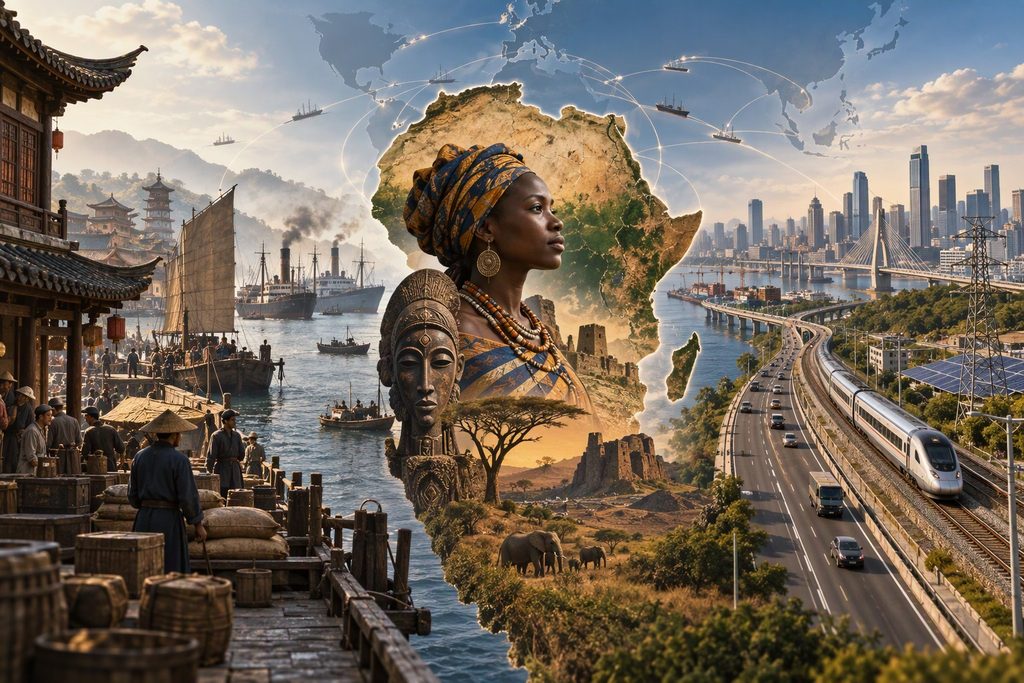
These histories are not identical. China experienced imperial intervention, unequal treaties, foreign concessions, and partial territorial control, while much of Africa experienced direct colonial occupation and foreign administration. Nevertheless, both histories reveal the consequences of unequal international power.
Understanding these experiences matters today because international relations are not simply about trade agreements, diplomatic visits, development assistance, or political declarations. They are also about sovereignty, economic choices, control over resources, and the ability of nations to establish their own development priorities.
For South Sudan and other African countries, China’s historical experience offers important lessons. It demonstrates the relationship between political independence, state capacity, industrial development, and national decision-making. It also raises an important question: can African countries build mutually beneficial international partnerships without surrendering their right to determine their own development priorities?
The answer requires more than choosing between China and Western countries. It requires African governments to understand their own interests, negotiate effectively, strengthen their institutions, and evaluate every international partnership according to its contribution to human development.
Key Takeaways
- The First Opium War demonstrated how military power could be used to impose commercial and political concessions on another sovereign country.
- China’s Century of National Humiliation involved unequal treaties, foreign privileges, territorial losses, and repeated military interventions.
- The Berlin Conference symbolized European imperial competition over Africa, conducted without African political representation.
- Chinese and African histories of foreign domination share important similarities but should not be treated as identical.
- South Sudan inherited serious institutional and infrastructure challenges from a long history of external administration, conflict, and underinvestment.
- China’s development demonstrates the importance of sovereignty, state capacity, infrastructure, education, industrialization, and long-term planning.
- Chinese development financing in South Sudan offers opportunities but also requires careful attention to debt, accountability, project delivery, and public benefit.
- Western countries, China, and other international partners should be evaluated by their actual conduct and contributions rather than their political declarations.
- African sovereignty must be accompanied by responsible government, competent institutions, economic productivity, and accountability to citizens.
- A fairer international system requires partnerships based on mutual respect, shared interests, and the right of nations to make independent decisions.
TL;DR
China experienced a century of foreign intervention, unequal treaties, territorial losses, and economic restrictions following the Opium Wars. Africa experienced European colonial domination, resource extraction, and the weakening of indigenous political and economic institutions. Although their histories differ, both demonstrate the importance of sovereignty and independent development. For South Sudan and other African countries, China’s experience offers lessons about infrastructure, industrialization, national planning, and international cooperation. The future of China-Africa relations should be judged by measurable benefits, responsible partnerships, and respect for African independence.
1. The First Opium War and the Forced Opening of China
The history of modern Chinese relations with Western imperial powers cannot be understood without examining the opium trade.
During the eighteenth and nineteenth centuries, British merchants developed an extensive trade in opium produced in British-controlled India and transported into China. The trade helped address Britain’s growing demand for Chinese goods, particularly tea, while generating serious social and economic consequences inside China.
The Qing government attempted to restrict the trade because opium addiction was spreading and the illegal importation of the drug was undermining existing commercial and administrative controls.
In 1839, Emperor Daoguang appointed Lin Zexu as an imperial commissioner to suppress the opium trade in Guangdong. Lin demanded that foreign merchants surrender their opium stocks. After negotiations and a confrontation with British commercial representatives, approximately 20,000 chests were surrendered and destroyed at Humen.
The destruction became a defining event in China’s resistance to the opium trade.
Britain subsequently went to war against China. The First Opium War exposed the Qing military’s technological and organizational weaknesses against British naval power. The conflict ended with China’s defeat and the signing of the Treaty of Nanjing on August 29, 1842.
The treaty required China to:
- Cede Hong Kong Island to Britain.
- Open Guangzhou, Xiamen, Fuzhou, Ningbo, and Shanghai to British trade and residence.
- Pay an indemnity of 21 million silver dollars.
- Abolish the existing monopoly of the Cohong merchant system.
- Establish published customs tariffs at the treaty ports.
The treaty also established a new commercial relationship that favored British interests.
Further agreements extended foreign privileges. The Treaty of the Bogue in 1843 and subsequent treaties established additional protections, including extraterritorial rights for foreign nationals.
Extraterritoriality meant that certain foreign nationals accused of crimes in China could be tried under their own countries’ legal systems rather than Chinese law.
This was a serious restriction on China’s ability to exercise equal jurisdiction over everyone within its territory.
The expression opening of China therefore requires historical qualification. It describes an expansion of foreign access, but that access was established through military defeat and unequal agreements rather than voluntary negotiations between equal sovereign states.
The distinction matters because international trade is not inherently exploitative. The problem arises when powerful countries use military, financial, or diplomatic pressure to determine the commercial and political conditions under which weaker countries must operate.
2. China’s Century of National Humiliation
The First Opium War was only the beginning of a much longer period of foreign intervention.
China subsequently experienced the Second Opium War (1856–1860), the First Sino-Japanese War (1894–1895), the Boxer conflict and the intervention of the Eight-Nation Alliance in 1900, and further territorial and political pressure from foreign powers.
During the Second Opium War, British and French forces advanced toward Beijing. In 1860, they burned and looted the Yuanmingyuan, commonly known as the Old Summer Palace.
The destruction remains one of the most significant historical symbols of foreign military aggression in China.
The First Sino-Japanese War ended in another major Chinese defeat. Under the Treaty of Shimonoseki in 1895, China ceded Taiwan and the Pescadores to Japan and accepted a substantial indemnity.
The Boxer conflict produced another humiliating settlement. Following the intervention of the Eight-Nation Alliance, the Qing government signed the Boxer Protocol in 1901, accepting a large indemnity and additional foreign privileges.
These events contributed to a prolonged crisis of Chinese state authority.
The Century of National Humiliation is therefore more than a reference to individual military defeats. It represents a period during which China struggled to preserve its independence, territorial integrity, economic authority, and international standing.
However, it is important to recognize that China’s difficulties also had domestic causes. Political corruption, administrative weaknesses, internal rebellions, fiscal problems, and resistance to institutional reform contributed to the decline of the Qing dynasty.
The Taiping Rebellion (1850–1864), for example, caused enormous human suffering and destruction. Its origins included religious, political, social, and economic tensions. It should not be explained simply as a direct consequence of foreign intervention.
China’s history demonstrates that external domination and internal institutional weaknesses can reinforce one another.
A country facing foreign pressure needs capable institutions, economic strength, technological development, and political leadership to protect its national interests.
3. The Berlin Conference and the Partition of Africa
While China struggled against foreign intervention in East Asia, European powers were expanding their territorial ambitions across Africa.
The Berlin Conference, held between November 1884 and February 1885, brought together representatives of fourteen participating states. It was organized under the leadership of German Chancellor Otto von Bismarck.
The conference addressed European commercial interests, navigation rights, and the rules governing claims to African territories.
No African political leaders were represented in the negotiations.
This exclusion was significant because the continent already contained established kingdoms, states, political authorities, trading networks, and diverse systems of governance.
The conference did not literally draw every modern African border during its meetings. Rather, it established international rules, particularly the principle of effective occupation, that facilitated the subsequent territorial expansion of European colonial powers.
The partition of Africa developed through further negotiations, treaties, military campaigns, and territorial occupations over subsequent decades.
Its consequences were extensive.
African political communities lost control over substantial portions of their territories. Colonial governments reorganized economies to serve imperial interests, introduced new administrative structures, and established systems of taxation and labor that frequently prioritized colonial revenue over local welfare.
Natural resources, agricultural products, and minerals became important components of imperial economic systems.
In many territories, infrastructure was developed primarily to connect resource-producing areas with ports and commercial routes. Railways, roads, and ports were not necessarily designed around the long-term needs of independent African economies.
This history helps explain why infrastructure development remains such an important issue in African political and economic discussions.
A road connecting agricultural communities to markets can support national development. A road designed primarily to transport extracted resources to a colonial port may serve a different economic purpose.
The physical existence of infrastructure does not automatically establish that it was designed to advance the welfare of the population.
The important question is who controlled it, who benefited from it, and whose economic priorities it served.
4. China and Africa: Similar Experiences, Different Historical Paths
China and Africa should not be treated as historically identical.
China retained a recognizable central state throughout much of the nineteenth and early twentieth centuries, despite severe foreign interference and the weakening of its sovereignty. Foreign powers established treaty ports, concessions, and spheres of influence without turning the entire country into a single formally administered European colony.
Africa experienced a different process. Most of the continent came under direct European colonial administration, although Ethiopia maintained its independence for much of the colonial period and Liberia followed a separate historical path.
The differences are important.
Nevertheless, the histories reveal several shared experiences.
First, both China and African societies faced foreign pressure that restricted their ability to determine their political and economic priorities.
Second, both experienced the appropriation of resources and the expansion of foreign commercial interests.
Third, both encountered international systems in which military and economic power often determined the terms of political relationships.
Fourth, both developed strong historical arguments for sovereignty, territorial integrity, and the right of nations to determine their own futures.
These common experiences help explain why China-Africa relations are frequently discussed through the language of South-South cooperation, mutual respect, sovereignty, and non-interference.
Historical solidarity, however, should not replace practical evaluation.
China’s history of foreign domination does not automatically guarantee that every Chinese project in Africa will serve African interests. Similarly, Western countries should not be judged exclusively by their colonial histories when assessing contemporary cooperation.
Every international partnership must be evaluated according to its actual terms, outcomes, and effects on the people involved.
5. South Sudan and the Legacy of Colonial Administration
South Sudan provides an important example of the long-term consequences of external administration, conflict, and limited institutional development.
The territory that became South Sudan experienced successive periods of Ottoman-Egyptian, Mahdist, British, and Anglo-Egyptian administration, alongside commercial and political domination from northern Sudanese authorities.
These historical experiences affected the development of political institutions, education, transport, and public administration.
During the Anglo-Egyptian period, the British administered southern Sudan through policies that often limited direct administrative development. The southern regions were governed through a combination of military control, local authorities, and restricted administrative services.
Education was unevenly developed, and access to roads, public services, and technical training remained limited in many communities.
These conditions contributed to long-term regional inequalities.
South Sudan became independent on July 9, 2011, after decades of political struggle and armed conflict.
However, independence did not automatically produce a functioning modern state.
The new country faced major challenges involving infrastructure, education, healthcare, public administration, economic diversification, security, and national reconciliation.
The inherited development challenges were compounded by post-independence conflict, institutional weaknesses, political disputes, and economic dependence on oil revenues.
It would therefore be historically inaccurate to attribute every present-day development problem to colonialism alone. The decisions and responsibilities of successive post-independence governments also matter.
Nevertheless, colonial administrative practices, historical underinvestment, and prolonged conflict are essential parts of understanding the country’s development challenges.
South Sudan needs more than political independence. It needs the institutions, productive capacity, infrastructure, and educated population required to make independence meaningful in the everyday lives of its citizens.
6. China’s Experience and the Importance of National Sovereignty
China’s recovery from its period of foreign domination provides an important historical example of the relationship between sovereignty and national development.
The establishment of the People’s Republic of China on October 1, 1949, marked the beginning of a new political era.
It did not immediately solve China’s economic problems. The country still faced poverty, limited industrial capacity, agricultural challenges, and serious international pressures.
The early decades of the People’s Republic also included major policy failures and human suffering. The Great Leap Forward and the Cultural Revolution had profound consequences for Chinese society and the economy.
Recognizing these events is necessary for an accurate assessment of China’s development.
Nevertheless, 1949 established a new political foundation under which the Chinese government could pursue its own national development priorities without the same system of foreign concessions and treaty-based privileges that had characterized the preceding century.
Subsequent development policies emphasized industrialization, infrastructure, education, agricultural production, technological advancement, and the strengthening of state institutions.
The economic reforms initiated in 1978 under Deng Xiaoping introduced major changes in China’s economic system.
These reforms expanded market mechanisms, encouraged foreign investment, increased international trade, and created opportunities for private enterprise while maintaining the central political authority of the Communist Party of China.
China’s subsequent economic growth was not the product of sovereignty alone. It also depended on policy reforms, investment, labor productivity, technological learning, education, international trade, and institutional capacity.
The country gradually became one of the world’s largest manufacturing and trading economies.
Its experience demonstrates an important principle: political independence provides a foundation for national development, but economic progress requires effective institutions and sustained investment.
For African countries, this is a valuable lesson.
National sovereignty should not be understood merely as the right to reject foreign interference. It should also mean possessing the practical ability to plan, finance, build, maintain, and regulate national development.
7. China’s Engagement with Africa: Infrastructure and Development Cooperation
Contemporary China-Africa relations have developed through trade, investment, infrastructure financing, education, diplomacy, technology transfer, and development cooperation.
Chinese companies and financial institutions have participated in major African infrastructure projects, including roads, railways, ports, power facilities, telecommunications networks, and industrial developments.
These activities are particularly important because infrastructure remains a major requirement for African economic development.
Roads connect agricultural producers to markets. Electricity supports manufacturing and digital services. Telecommunications networks enable education, business, financial transactions, and international communication.
For landlocked countries such as South Sudan, reliable transport infrastructure is especially important.
Chinese development financing in South Sudan provides a useful case study.
According to AidData’s 2026 profile covering the period from 2000 to 2023, Chinese official-sector financiers directed approximately US$4.8 billion through nine loans to South Sudan, alongside 169 grant-related official commitments.
The report also identifies a shift in China’s financing portfolio toward infrastructure projects after South Sudan joined the Belt and Road Initiative in 2018.
One major example is the Juba-Terekeka-Yirol-Rumbek Road project.
However, the same research identifies important financial considerations. Much of China’s lending to South Sudan has involved emergency financing and collateral arrangements, particularly linked to the country’s oil-dependent economy.
These findings demonstrate why development partnerships must be evaluated carefully.
Infrastructure financing can create long-term economic opportunities, but borrowing must be sustainable. Projects should have transparent agreements, realistic repayment arrangements, effective supervision, and clear public benefits.
The objective should not simply be to construct roads or sign financing agreements. It should be to create productive economic systems that improve the lives of citizens.
China’s infrastructure experience offers African governments opportunities to learn from large-scale planning, construction, manufacturing, and technological development.
But African countries must also develop their own engineering capacity, technical education, local industries, and institutional expertise.
Cooperation should build African capabilities rather than create permanent dependence on foreign contractors and financing.
8. Comparing China’s and America’s Engagement with Africa
China and the United States are important international actors in Africa, but their engagement involves different historical experiences, economic interests, political priorities, and policy instruments.
China frequently emphasizes sovereignty, non-interference, infrastructure cooperation, trade, and state-to-state relations.
The United States places considerable emphasis on governance, democratic institutions, human rights, security cooperation, humanitarian assistance, and economic partnerships.
These differences are important, but neither country’s policies should be assessed through simplified descriptions.
China has strategic and commercial interests in Africa. Its infrastructure loans, resource investments, trade relationships, and diplomatic activities serve Chinese national interests as well as creating opportunities for African partners.
The United States also maintains significant economic, diplomatic, humanitarian, security, and educational relationships with African countries.
American development assistance has supported health programmes, education, humanitarian relief, and other important activities across the continent.
At the same time, American sanctions and conditional assistance policies can have significant implications for African governments.
For example, the United States maintains a South Sudan-related sanctions programme administered by the Office of Foreign Assets Control. In addition, its 2026 foreign assistance policy includes restrictions on certain forms of nonhumanitarian, non-trade-related government assistance to South Sudan under trafficking-in-persons legislation.
These are specific legal and policy measures, not evidence that every American programme or relationship is hostile to South Sudan.
Nevertheless, they raise important questions about the relationship between foreign policy conditions, national sovereignty, and development cooperation.
African governments should be able to discuss these issues openly without automatically accepting or rejecting the positions of any foreign power.
The same standard should apply to China.
If a Chinese loan creates unsustainable debt, African governments should examine it critically. If an American programme supports education or healthcare, its contribution should be recognized. If a foreign government imposes restrictions that harm legitimate national development, those measures should be questioned.
The correct standard is not whether a partner is Western or Asian. It is whether the partnership advances legitimate national interests and improves human welfare.
9. Sovereignty Must Be Accompanied by Responsible Government
One of the most important lessons from China’s history is that sovereignty cannot produce development without capable national institutions.
A country may possess internationally recognized independence while remaining economically dependent, institutionally weak, technologically underdeveloped, and unable to provide essential public services.
This distinction is particularly important for South Sudan.
Political independence in 2011 was a historic achievement. However, the country still needs stronger public institutions, effective economic management, professional civil services, independent productive capacity, and reliable infrastructure.
National sovereignty should therefore be connected to government accountability.
African governments must protect public resources, establish predictable laws, maintain public infrastructure, invest in education, and create conditions for productive private enterprise.
They must also protect citizens from corruption, insecurity, discrimination, and political instability.
Foreign governments should respect African sovereignty, but African governments must also respect the sovereignty and dignity of their own citizens.
The people are the ultimate beneficiaries of national independence.
This is why infrastructure, education, healthcare, technology, employment, and economic opportunity should remain central measures of development.
A government that defends sovereignty while neglecting its citizens has not fulfilled the full purpose of independence.
10. The Lessons for African Countries in a Multipolar World
The international system is increasingly characterized by several influential centres of economic and political power.
China, the United States, the European Union, India, Russia, and other regional and international actors compete and cooperate across trade, technology, infrastructure, security, and diplomacy.
This changing international environment creates opportunities for African countries.
Rather than depending excessively on a single external partner, African governments can pursue diversified international relationships.
They can cooperate with China on infrastructure and industrial development, maintain educational and technological partnerships with Western countries, strengthen trade with neighboring African economies, and expand relations with other emerging economies.
However, diversification alone is insufficient.
African countries need the ability to negotiate from a position of informed national interest.
This requires qualified diplomats, economists, engineers, lawyers, researchers, educators, and public administrators.
It also requires reliable national development plans that remain consistent beyond individual political administrations.
For South Sudan, a strategic development agenda should include:
- Building reliable national and regional road networks.
- Expanding electricity generation and distribution.
- Improving access to quality education and technical training.
- Developing agriculture and food-processing industries.
- Strengthening digital infrastructure and telecommunications.
- Improving public financial management and debt transparency.
- Expanding healthcare and essential public services.
- Supporting local manufacturing and private enterprise.
- Strengthening regional trade and economic integration.
- Establishing accountable institutions that protect public resources.
These priorities require cooperation with international partners, but the responsibility for national development ultimately belongs to South Sudanese institutions and citizens.
11. Why Infrastructure Matters to Digital Nomads and Remote Workers
The relationship between national sovereignty and infrastructure extends beyond traditional economic development.
It also affects digital nomads, remote workers, online entrepreneurs, independent publishers, and technology professionals.
A country cannot fully participate in the digital economy without dependable electricity, internet connectivity, telecommunications infrastructure, accessible financial services, and supportive institutions.
For an independent writer working across borders, connectivity determines whether articles can be researched, published, and distributed.
For an online entrepreneur, reliable payment systems and digital platforms determine whether international business can operate efficiently.
For a remote worker, stable internet access can influence employment opportunities and income security.
For an online learner, digital infrastructure determines whether international education and professional training are accessible.
This is why infrastructure investment should be understood as more than the construction of roads, bridges, and physical facilities.
It also includes the digital systems that connect people, businesses, institutions, and international markets.
China’s development experience in telecommunications, manufacturing, transport, and digital technology provides important areas for African cooperation.
African countries should seek partnerships that expand access to affordable connectivity, improve digital skills, support local innovation, and strengthen cybersecurity.
Digital independence does not mean disconnecting from international platforms. It means developing the national capacity to participate in the global digital economy without unnecessary barriers or excessive dependence.
For South Sudan, this could create new opportunities for writers, educators, interpreters, software developers, digital entrepreneurs, and remote professionals.
The future of economic development will increasingly depend on the ability to combine physical infrastructure with digital infrastructure.
12. Building a Fairer International System Through Mutual Respect
The history of China and Africa demonstrates why international cooperation must be built on equality rather than coercion.
The nineteenth-century international system frequently allowed powerful countries to determine the political and economic conditions of weaker societies.
The contemporary world should not repeat those practices through different instruments.
Military occupation, unequal treaties, coercive commercial arrangements, and colonial administration belong to a historical period that should not be romanticized as an uncomplicated expansion of civilization or international trade.
However, historical memory should also not become an excuse for refusing constructive international cooperation.
China, Africa, the United States, Europe, and other international actors can contribute to human progress through mutually beneficial relationships.
Such cooperation requires respect for national laws, transparent agreements, fair commercial practices, responsible lending, technology sharing, and accountability.
It also requires recognizing that development models cannot simply be copied from one country and imposed on another.
China’s experience can provide useful lessons, but African countries must adapt those lessons to their own political, economic, geographical, and social conditions.
South Sudan must develop its own path.
The country’s development priorities should emerge from national needs, public participation, technical knowledge, and long-term planning.
The ultimate objective should be a world in which countries cooperate without surrendering their right to govern themselves.
Reflection Questions
- What distinguishes voluntary international trade from trade arrangements established through military or economic coercion?
- What lessons can African countries learn from China’s experience of foreign intervention and national reconstruction?
- How did the Berlin Conference contribute to the expansion of European colonial control in Africa?
- What historical and contemporary factors explain South Sudan’s infrastructure and institutional challenges?
- How can South Sudan benefit from Chinese infrastructure financing while maintaining responsible debt management?
- Should foreign development assistance be conditional on political or governance requirements? Under what circumstances?
- How can African governments negotiate more effectively with China, the United States, and other international partners?
- What investments are necessary to connect African citizens to the global digital economy?
- How can African countries defend national sovereignty while maintaining accountability to their citizens?
- What would a genuinely fair and mutually beneficial international system look like?
Frequently Asked Questions
1. What was China’s Century of National Humiliation?
China’s Century of National Humiliation refers broadly to the period from the First Opium War in 1839–1842 to the establishment of the People’s Republic of China in 1949. It involved foreign military intervention, unequal treaties, territorial losses, foreign concessions, and restrictions on Chinese sovereignty.
2. What was the purpose of the Berlin Conference of 1884–1885?
The Berlin Conference established rules governing European claims to African territories and commercial activities, particularly in the Congo Basin. It facilitated the subsequent partition of Africa among colonial powers. No African political representatives participated in the conference.
3. What can South Sudan learn from China’s development experience?
South Sudan can study China’s emphasis on infrastructure, industrialization, education, technical training, agricultural development, economic planning, and institutional capacity. However, these lessons must be adapted to South Sudan’s own conditions rather than copied without consideration.
4. Is China a better development partner for Africa than the United States?
Neither country should automatically be considered a better partner in every area. China has significant experience in infrastructure financing, construction, manufacturing, and trade. The United States contributes through education, healthcare, humanitarian assistance, technology, investment, and diplomatic cooperation. African governments should evaluate each partnership according to its terms, outcomes, and contribution to national development.
5. Why is national sovereignty important for African development?
National sovereignty gives countries the authority to establish their own political, economic, and development priorities. It allows governments to manage national resources, establish laws, negotiate international agreements, and determine their development strategies. However, meaningful sovereignty also requires capable institutions, responsible leadership, and accountability to citizens.
Conclusion
The history of China and Africa reveals the consequences of unequal international relationships. China’s experience of the Opium Wars, unequal treaties, foreign concessions, and repeated interventions demonstrates how military and economic power can weaken national sovereignty. Africa’s colonial experience reveals how foreign administration, resource extraction, and political domination can restrict the development of independent institutions and economies.
These histories should not be forgotten or reduced to convenient political slogans. They should inform how countries approach international cooperation today.
China’s development offers important lessons about sovereignty, infrastructure, industrialization, education, and national planning. Its partnerships with African countries create opportunities, but those opportunities must be evaluated through transparent agreements, sustainable financing, responsible implementation, and measurable public benefits.
The same standards should apply to American, European, and other international partnerships.
For South Sudan, the greatest lesson is that independence must become meaningful through development. The country needs capable institutions, reliable infrastructure, productive industries, educated citizens, and responsible leadership. Its future cannot depend entirely on foreign governments or external financing.
The objective should be a sovereign South Sudan capable of cooperating with the world without surrendering its national interests.
The West may remember the nineteenth century as an age of expanding markets and international access. China and Africa also remember the costs of that expansion. Their historical experiences provide a reason to build international relationships on equality, mutual respect, and shared human progress.
Sovereignty should not mean isolation. It should mean the freedom and capacity to cooperate as an equal.
For African countries, the task ahead is clear: learn from history, strengthen national institutions, build productive economies, and engage the world with confidence and responsibility.
The future of international cooperation should be measured not by how much influence powerful countries exercise, but by how much human progress their partnerships create.
And if you want to know what’s happening in my world as a writer and digital nomad, check out my Wealthy Affiliate blog page here: https://my.wealthyaffiliate.com/johnmaluth/blog.
Sources and Further Reading
- MIT Visualizing Cultures: The Opium Wars: The Destruction of Opium at Humen. Historical account of Lin Zexu’s campaign and the destruction of seized opium.
- Columbia University, Asia for Educators: Excerpts from the Treaty of Nanjing, August 1842. Primary-source treaty provisions, including indemnities and trade arrangements.
- U.S. Department of State, Office of the Historian: The Opening to China, 1830–1860. Historical documentation of the First Opium War and subsequent foreign privileges.
- U.S. Department of State, Office of the Historian: The Second Opium War and the Treaty of Tianjin. Background on the Second Opium War and subsequent treaty arrangements.
- German Federal Foreign Office: General Act of the Berlin West Africa Conference, 26 February 1885. Historical documentation of the conference and its provisions.
- David Scott, State University of New York Press: China and the International System, 1840–1949. Academic study of China’s relations with the international system during the Century of Humiliation.
- Cambridge University Press: The Great Humiliation and the Socialist Revolution. Historical and economic discussion of China’s condition around the establishment of the People’s Republic.
- AidData, William & Mary (2026): South Sudan Profile of Chinese Development Finance, 2000–2023. Research on Chinese loans, grants, infrastructure financing, and financial risks in South Sudan.
- Cambridge University Press: Rebellious Schooling in a Violent (Post)colony: Education History in South Sudan, c. 1905–1972. Academic research on colonial administration and education in southern Sudan.
- U.S. Department of the Treasury: South Sudan-Related Sanctions. Official information on American sanctions policies concerning South Sudan.
- Our World in Data: GDP per Capita, Maddison Project Database. Historical economic data and methodology for comparing national economic development.