Human civilization has never followed a single path to development. Across thousands of years, societies have built political institutions, developed technologies, established trade networks, and created systems of education and production according to their needs, resources, and circumstances. The histories of Africa, Asia, Europe, and other regions demonstrate that human progress has many origins.
Three broad historical periods help illustrate this long journey: the Ancient Era, the Medieval Era, and the Modern Era. During the Ancient Era, civilizations such as ancient Egypt and the Kingdom of Kush developed organized states, advanced agricultural systems, trade networks, and remarkable architectural achievements. In Asia, early Chinese dynasties established lasting political institutions and made important contributions to agriculture, administration, and technology.
The Medieval Era also witnessed significant achievements beyond Europe. Trans-Saharan trade connected African societies, while cities such as Timbuktu became important centers of scholarship, commerce, and Islamic learning. Across Asia, developments in printing, navigation, agriculture, and manufacturing contributed to the growth of powerful societies and international trade.
The Modern Era introduced major changes in global economic and political relations. European industrialization, maritime expansion, colonialism, and imperial competition reshaped international power. Many African and Asian societies experienced foreign domination, resource extraction, political interference, and the disruption of existing institutions. Modernization consequently became associated, in many development debates, with Western institutions, technologies, and political arrangements.
But does becoming modern require becoming Western?
China’s development experience provides an important case for examining this question. Through a combination of state planning, economic reforms, industrial development, international trade, infrastructure investment, and technological advancement, China created a development model rooted in its own political and historical circumstances.
For South Sudan and other African countries, the important question is not whether to copy China or the West. It is how to identify useful lessons from different experiences and build development strategies that serve African people, protect national interests, and strengthen domestic capabilities.
Key Takeaways
- Human history demonstrates that successful civilizations have developed through different political, economic, and cultural arrangements.
- Modernization and Westernization are not identical. Countries can adopt modern technology, infrastructure, education, and industrial practices while maintaining their cultural identities.
- China’s development experience demonstrates the importance of long-term planning, state coordination, infrastructure investment, industrial capacity, and economic reform.
- China’s approach offers useful lessons for African development, but its policies cannot simply be transferred to countries with different institutions, resources, and political conditions.
- China-Africa cooperation can support infrastructure, trade, industrialization, and technology transfer when agreements are transparent and serve national development priorities.
- South Sudan needs effective public institutions, agricultural modernization, reliable infrastructure, education, peace, and responsible management of national resources.
Understanding Modernization Beyond Westernization
Modernization refers to the process through which societies develop the institutions, technologies, infrastructure, productive capacity, and knowledge needed to improve living standards and participate effectively in the modern world.
Westernization, by contrast, generally refers to the adoption of cultural practices, institutions, values, or social arrangements associated with Western societies.
The two processes can overlap, but they are not the same.
A country can build modern highways, develop advanced universities, establish digital government services, expand manufacturing, and participate in international trade without abandoning its languages, cultural traditions, or national identity.
The distinction matters because development should not be measured by how closely a country resembles another society. It should be measured by whether its institutions and economic systems improve the lives of its people.
Historical Evidence of Multiple Development Paths
Africa and Asia provide important historical examples of organized societies that developed their own systems of governance, production, commerce, and knowledge.
| Historical civilization or center | Region | Important contributions |
|---|---|---|
| Ancient Egypt | Northeast Africa | State administration, agriculture, architecture, mathematics, and engineering |
| Kingdom of Kush | Northeast Africa | Ironworking, political organization, trade, and monumental architecture |
| Timbuktu | West Africa | Scholarship, manuscript traditions, commerce, and Islamic education |
| Early Chinese dynasties | East Asia | Administrative institutions, agricultural development, technological innovation, and state organization |
| Medieval Asian trading centers | Asia | Maritime commerce, manufacturing, navigation, and international exchange |
These examples challenge the assumption that organized development originated exclusively in Europe.
They also provide an important foundation for African self-confidence. African societies have historical experience in state formation, trade, education, technology, and organized production. Modern African development should build on that inheritance while adopting useful knowledge from elsewhere.
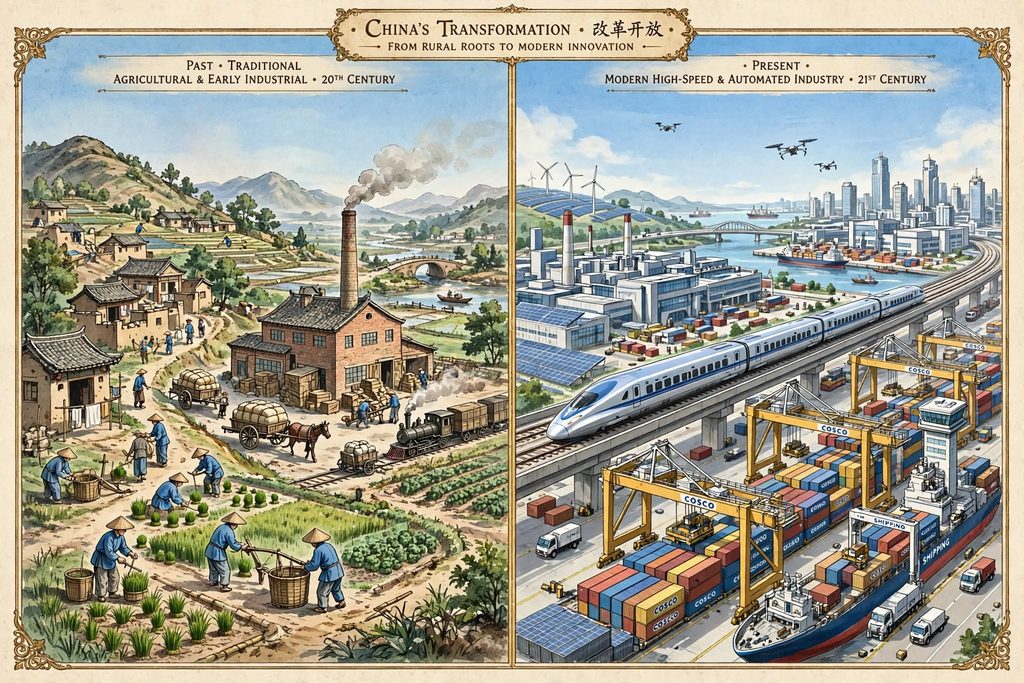
China’s Modernization: A Development Path Rooted in National Conditions
China’s development experience is particularly important because it demonstrates how a country can pursue industrialization, technological advancement, and international economic integration while retaining a distinct political and cultural identity.
Following the establishment of the People’s Republic of China in 1949, the country underwent major political, economic, and social changes. Its development did not happen overnight, nor was it the result of a single policy.
The early decades involved land reform, state-led industrialization, public investment, and the establishment of national institutions. Some policies achieved important results, while others produced severe economic and human costs. The Great Leap Forward, for example, contributed to a catastrophic famine. The Cultural Revolution also disrupted education, administration, and economic activity.
Beginning in 1978, China introduced major economic reforms under Deng Xiaoping. These reforms gradually expanded market activity, encouraged foreign investment, supported private enterprise, and opened selected areas of the economy to international trade.
China’s subsequent development combined government coordination with market mechanisms. This experience is not a universal formula, but it offers useful lessons about the relationship between national planning, institutional capacity, investment, and economic growth.
Major Features of China’s Development Approach
| Development area | Chinese approach | Intended development result |
|---|---|---|
| State planning | National development strategies and long-term policy targets | Greater coordination of public investment and economic priorities |
| Agriculture | Agricultural reforms, rural infrastructure, and improved production systems | Higher productivity and stronger food security |
| Industry | Industrial investment, manufacturing development, and support for strategic sectors | Expanded production capacity and employment |
| Infrastructure | Investment in roads, railways, ports, electricity, and telecommunications | Better national connectivity and lower transport costs |
| International trade | Economic opening, exports, and participation in global markets | Access to larger markets, investment, and technology |
| Education and skills | Expansion of schooling, technical education, and scientific research | A more skilled workforce and stronger innovation capacity |
| Poverty reduction | Targeted development programs and investment in poorer regions | Improved access to services and higher household incomes |
The central lesson is that national development requires more than announcing ambitious goals. Governments must establish institutions, mobilize resources, coordinate implementation, measure results, and correct policies that fail.
Practical Lessons: State Leadership and National Development
My recent experience observing China’s modernization efforts has strengthened my interest in understanding how development policies translate into visible results.
From urban infrastructure to agricultural demonstration facilities, China’s development experience raises important questions for African policymakers: How are national priorities selected? How are projects financed? Which institutions implement them? How are results measured? And how can governments ensure that ordinary citizens benefit?
One important lesson is the role of capable public institutions.
Markets can encourage competition, investment, and innovation. However, markets alone do not necessarily provide every society with the infrastructure, public services, or long-term investments it needs. Governments have responsibilities in areas such as public security, education, public health, infrastructure, and food security.
The challenge is to build a state that can perform these responsibilities effectively without creating unnecessary bureaucracy, corruption, or economic inefficiency.
Essential Foundations of National Development
| Priority | What government should do | Expected public benefit |
|---|---|---|
| Public order | Strengthen professional security institutions and the rule of law | Safer communities and greater confidence in economic activity |
| Food security | Support farmers, irrigation, storage, agricultural research, and transport | More reliable food supplies and stronger rural incomes |
| Infrastructure | Develop roads, bridges, electricity, water systems, and telecommunications | Better connectivity and lower business costs |
| Education | Improve schools, vocational training, universities, and research | A more skilled and productive population |
| Public health | Expand healthcare facilities, prevention programs, and essential services | Healthier communities and improved life expectancy |
| Economic management | Improve public finance, budgeting, procurement, and accountability | More effective use of national resources |
For South Sudan, these priorities are particularly important. A country with significant agricultural potential and natural resources cannot achieve sustainable development without reliable institutions, transport networks, electricity, education, and peace.
The government must also ensure that national resources are converted into public benefits. Oil revenue, for example, should contribute to productive investment rather than remaining disconnected from the development needs of citizens.
State leadership should therefore mean responsible coordination, transparent management, and measurable public service delivery.
China and the West: Different Approaches to International Development Cooperation
Africa’s development partnerships have been shaped by relationships with Western countries, international financial institutions, China, and other global partners.
These relationships have not all followed the same approach. Western governments and institutions have frequently provided development assistance, loans, technical support, humanitarian aid, and private investment. Some assistance programs have included economic or political conditions, while others have focused on specific development objectives.
China has expanded its engagement with African countries through infrastructure finance, trade, construction, industrial cooperation, training, and diplomatic partnerships. Its official foreign policy emphasizes non-interference and respect for national sovereignty.
However, neither Western nor Chinese engagement should be judged through slogans alone. Western partnerships can provide valuable technical knowledge, education, investment, and public services. Chinese partnerships can deliver important infrastructure and industrial opportunities, but they also require careful assessment of borrowing costs, project quality, environmental effects, and long-term financial obligations.
The most important question for African governments is not simply who provides assistance. It is whether a partnership advances national development priorities and produces lasting benefits.
Comparing Development Cooperation Approaches
| Area of cooperation | Common forms of Western engagement | Common forms of Chinese engagement | African policy priority |
|---|---|---|---|
| Infrastructure | Grants, concessional loans, private investment, and technical assistance | Construction contracts, loans, engineering services, and infrastructure partnerships | Select projects according to economic and social value |
| Governance | Institutional reform, governance programs, and technical assistance | Official emphasis on sovereignty and non-interference | Strengthen accountable national institutions |
| Trade | Market access, investment, and trade agreements | Trade in commodities, manufactured goods, and services | Expand African exports and productive capacity |
| Education | Scholarships, research partnerships, and institutional cooperation | Scholarships, technical training, and university partnerships | Develop skills that meet national priorities |
| Technology | Research cooperation, private-sector investment, and technical support | Industrial cooperation, infrastructure technology, and manufacturing partnerships | Build local expertise and technology transfer |
| Finance | Grants, development finance, commercial loans, and multilateral lending | Development loans, commercial finance, and project-based financing | Assess costs, risks, and long-term repayment capacity |
Note: These are broad areas of engagement, not fixed descriptions of every Western or Chinese partnership. Individual agreements differ significantly.
For Africa, the goal should be to maintain the ability to work with different international partners without becoming excessively dependent on any one of them.
National sovereignty is strengthened when governments can negotiate effectively, evaluate financing options, protect public interests, and make decisions based on long-term development needs.
What China-Africa Cooperation Can Mean for South Sudan
China-Africa relations have expanded through diplomatic engagement, trade, infrastructure development, educational cooperation, and multilateral initiatives such as the Forum on China-Africa Cooperation (FOCAC).
For South Sudan, these relationships present opportunities in several important areas.
First, agricultural cooperation could help strengthen domestic food production. South Sudan possesses substantial agricultural potential, but realizing it requires investment in roads, irrigation, agricultural machinery, storage facilities, research, and farmer training.
Second, infrastructure partnerships could improve national connectivity. Roads and bridges are essential for linking communities, farms, markets, border crossings, and major towns. Electricity and telecommunications are equally important for business development and public services.
Third, educational and technical cooperation could help develop the human resources needed to operate and maintain modern infrastructure. Building a facility is only one part of development. Countries also need engineers, technicians, managers, researchers, teachers, and skilled workers.
Fourth, industrial cooperation could support the gradual development of local production. Instead of relying entirely on imported finished products, South Sudan could identify opportunities in agricultural processing, construction materials, food production, and other industries suited to its resources and market conditions.
Priority Areas for South Sudan-China Cooperation
| Sector | Possible areas of cooperation | Long-term objective |
|---|---|---|
| Agriculture | Irrigation, machinery, agricultural research, and farmer training | Stronger domestic food production |
| Transport | Roads, bridges, logistics facilities, and regional corridors | Improved movement of people and goods |
| Energy | Electricity generation, transmission, and renewable energy | More reliable power for households and businesses |
| Education | Scholarships, technical training, and university partnerships | A skilled national workforce |
| Manufacturing | Agricultural processing and industrial development | Greater domestic production and employment |
| Digital technology | Telecommunications, digital services, and technical training | Improved connectivity and digital participation |
| Public administration | Professional training, planning, and technical cooperation | More effective public institutions |
These opportunities require careful planning. Governments must assess project costs, repayment conditions, environmental and social effects, procurement arrangements, and the ability to maintain completed facilities.
Foreign partnerships should strengthen domestic capacity rather than replace it.
The Importance of Agriculture and Infrastructure
For South Sudan and many African countries, agriculture and infrastructure deserve particular attention because they support several other areas of development.
Agriculture provides food, employment, raw materials, and opportunities for rural enterprise. Yet agricultural production cannot reach its full potential when farmers lack access to machinery, irrigation, affordable financing, storage, electricity, and reliable markets.
Infrastructure connects production to consumption. A farmer may produce a surplus, but poor roads can make it difficult or expensive to transport that produce to markets. Similarly, manufacturers need reliable electricity, transport, water, and communications to operate competitively.
This relationship can be summarized as follows:
| Development investment | Immediate purpose | Wider economic effect |
|---|---|---|
| Rural roads | Connect farming communities to markets | Lower transport costs and reduced post-harvest losses |
| Irrigation systems | Improve water access for farming | More reliable agricultural production |
| Storage facilities | Preserve harvested crops | Better food availability and market stability |
| Electricity | Supply households and productive activities | Support businesses, schools, hospitals, and industry |
| Railways and major highways | Connect cities, ports, and regional markets | Encourage trade and investment |
| Digital infrastructure | Improve communication and information access | Support education, business, government, and online work |
For South Sudan, these investments should be connected to a national development plan with clear priorities, realistic budgets, and measurable targets.
A road should not be considered successful merely because it has been constructed. Its value should also be assessed through its effect on travel time, transport costs, market access, employment, and public services.
Likewise, an agricultural project should be evaluated by improvements in production, farmer income, food availability, and local employment.
Modernization Must Include African Identity and Human Development
Economic growth is important, but modernization should not be reduced to buildings, machinery, highways, and industrial output.
A modern society also needs educated citizens, responsible leadership, cultural confidence, scientific thinking, ethical public institutions, and opportunities for individuals to develop their abilities.
African countries should therefore approach modernization as both an economic and human development project.
This means investing in education while preserving valuable local knowledge. It means adopting useful technologies without assuming that foreign cultural practices must replace African traditions. It means building modern institutions while strengthening accountability, public responsibility, and respect for human dignity.
For South Sudan, national development should also recognize the country’s diverse communities, languages, histories, and cultural traditions. National unity does not require cultural uniformity. It requires institutions and shared commitments that allow different communities to participate in building a peaceful country.
China’s experience can encourage African policymakers to think seriously about national priorities, long-term planning, and the relationship between state capacity and economic development. However, African societies must determine which policies are suitable for their own conditions.
Learning from another country is not the same as surrendering national independence.
Reflection Questions
- How can South Sudan strengthen state planning while ensuring transparency, public accountability, and economic flexibility?
- Which investments would produce the greatest immediate and long-term benefits for South Sudan: agriculture, roads, electricity, education, or healthcare?
- How can African governments negotiate international partnerships without becoming excessively dependent on foreign financing or expertise?
- What can South Sudan learn from China’s agricultural and industrial development without copying policies that may not suit its institutions?
- How can African countries adopt modern technologies while protecting their cultural identities and strengthening local knowledge?
Frequently Asked Questions
1. Does modernization with Chinese characteristics mean that Africa should adopt China’s political system?
No. The argument is not that African countries should copy China’s political institutions. It is that they can study China’s development experience, identify useful policies, and adapt appropriate practices to their own national conditions. Each African country must determine its own political and economic arrangements.
2. What does modernization with Chinese characteristics mean?
It refers to China’s approach to modernization through a development path shaped by its history, political institutions, national priorities, and social conditions. It combines state coordination, economic reform, industrial development, infrastructure investment, technological advancement, and international cooperation.
3. Is modernization the same as Westernization?
No. Modernization concerns improvements in technology, production, institutions, infrastructure, education, and living standards. Westernization involves adopting cultural or institutional practices associated with Western societies. A country can modernize while retaining its own cultural identity.
4. What can South Sudan learn from China’s development experience?
South Sudan can study China’s long-term planning, agricultural reforms, infrastructure investment, industrial development, technical education, and use of international partnerships. However, these lessons must be adapted to South Sudan’s financial resources, institutions, population, and development priorities.
5. What should African governments consider when working with China or Western partners?
They should examine project costs, financing conditions, national benefits, employment opportunities, local participation, technology transfer, environmental effects, and long-term maintenance requirements. Partnerships should strengthen national productive capacity and serve the public interest.
Conclusion
Human history demonstrates that civilization has never belonged to one region or followed one development formula. Ancient African kingdoms, medieval trading centers, Asian technological achievements, and modern industrial societies all contribute to humanity’s record of innovation and organized progress.
China’s modernization experience challenges the assumption that economic development requires every country to follow a Western model. Its achievements in industrialization, infrastructure, poverty reduction, and technological development demonstrate the importance of national planning, institutional coordination, investment, and economic reform. Its historical failures also remind us that development policies must be judged by their human consequences, not merely by their stated intentions.
For South Sudan and Africa, the lesson is not to replace Western influence with Chinese influence. It is to strengthen the ability of African governments and citizens to make informed national decisions. International cooperation should be a means of achieving development, not an alternative to domestic responsibility.
South Sudan has significant opportunities in agriculture, natural resources, regional trade, infrastructure, education, and human development. Turning these opportunities into lasting progress requires peace, capable institutions, responsible leadership, public accountability, and investment in the productive abilities of its people.
Modernization should therefore be measured not only by the number of highways constructed, factories opened, or technologies imported, but also by whether citizens have better opportunities, stronger institutions, greater security, improved education, and a higher quality of life.
Africa does not need to become another version of China, Europe, or America. It needs to learn from humanity’s achievements, recognize its own historical strengths, and build development paths that reflect the needs and aspirations of African people.
Modernization is not about becoming someone else. It is about building a better future through the capabilities, choices, and resources of one’s own society.
And if you want to know what’s happening in my world as a writer and digital nomad, check out my Wealthy Affiliate blog page here: https://my.wealthyaffiliate.com/johnmaluth/blog.
Suggested Sources for Further Reading
- UNESCO, General History of Africa, for the history of African civilizations, trade, scholarship, and state formation.
- United Nations Development Programme (UNDP), Human Development Reports, for human development indicators and historical comparisons.
- World Bank, research and development reports on China’s economic growth, poverty reduction, infrastructure, and industrialization.
- Ministry of Foreign Affairs of the People’s Republic of China, official documents on China-Africa relations and the Forum on China-Africa Cooperation.
- Forum on China-Africa Cooperation (FOCAC), declarations and action plans on trade, infrastructure, education, agriculture, and development cooperation.