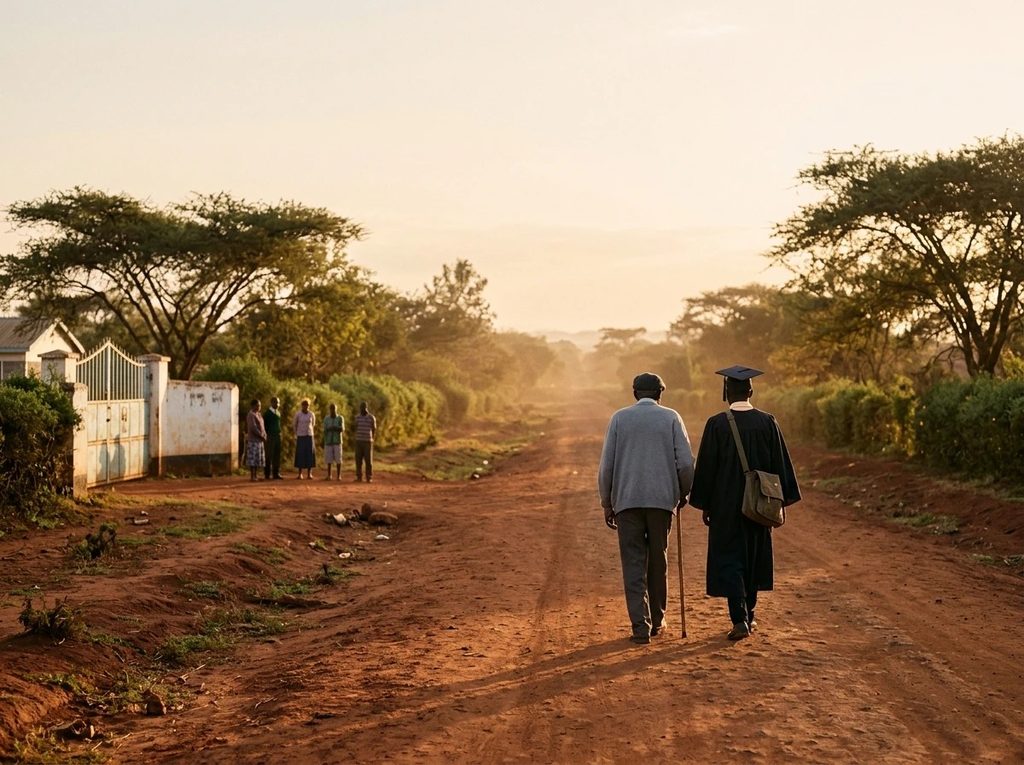
On November 19, 2026, a father went to collect his son from school in Busia County, Kenya. It should have been an ordinary, joyful day. The son had just finished his Kenya Certificate of Secondary Education examinations. The father had made the journey to Kolanya Boys High School to bring him home.
He did not make it home alive.
According to multiple Kenyan news reports, Mzee Wilson Omukaga died in a road accident in Angurai Town, Teso North, during President William Ruto’s visit to the area. Some reports also give a second name, Micah Omukaga, and the nickname Inyeusi. The exact spelling and full identity vary across early reports, which is common in breaking news from rural areas. What is consistent across the reports is the core story: a father died, six other people including two students were seriously injured, and the accident happened amid the surge in movement linked to the presidential visit.
That is the fact at the centre of this article. Everything else in this article is an attempt to understand what that fact means.
This is not only a story about one motorcade, one president, or one county. It is a story about how power moves in public space in Africa. It is about who has to step aside, who has to wait, who has to run, and who pays when speed becomes a display of authority.
Democracy promises government of the people, by the people, and for the people. That promise is tested not only in elections, parliaments, and courts. It is also tested on a narrow road through a market town, at a school gate, at a pedestrian crossing, and in the seconds when a convoy passes and ordinary life must scatter.
This article asks a direct question: why do governments meant to serve the people so often move among them with fear and speed?
It also asks a more practical question: what would it look like if African leadership moved with discipline, accountability, and respect for every life on the road?
This article is written for general readers, for citizens in Kenya, South Sudan, and across Africa, and for readers elsewhere who follow governance, development, and China-Africa relations. It is also written for digital nomads, remote workers, and independent professionals who travel, work, and live across African towns and cities and who experience these realities firsthand on the road.
Where facts are confirmed, this article states them. Where early reports differ, this article says so. Where the article moves from fact to interpretation, it marks that shift clearly.
Key Takeaways
- A father reportedly died and six people were injured during President William Ruto’s visit to Busia County on November 19, 2026, according to Kenyan media reports.
- Early reports differ on some details, including the victim’s full name and the precise sequence of the collision. Official investigation findings were not yet fully established at the time of writing.
- The Busia incident follows other reported motorcade-related accidents in Kenya, including a fatal incident on Ngong Road in Nairobi and a collision on the Embu-Meru Highway.
- Kenya records thousands of road deaths each year. Pedestrians are consistently among the most affected groups.
- VIP convoy safety is not only a security issue. It is a governance issue, a road design issue, a legal accountability issue, and a leadership culture issue.
- Professional protection is defined by intelligence, preparation, and discipline, not by speed, noise, or intimidation.
- Practical reforms include enforceable convoy speed limits, transparent investigations, better road design, servant leadership, and consistent accountability for state drivers.
TL;DR
A father collecting his son after KCSE examinations died in Busia during a presidential visit, with six others injured. The incident has renewed debate about VIP motorcades in Kenya and Africa. This article examines what is known, what remains unclear, why motorcade culture persists, how other countries handle leader protection, and what practical reforms could protect both leaders and citizens.
What Happened in Busia? What We Know and What We Do Not Yet Know
The first task in any serious discussion of this tragedy is to separate confirmed reporting from early confusion.
The confirmed reporting
Several Kenyan outlets reported that a road accident in Angurai Town, Teso North, on Thursday, November 19, 2026, claimed the life of Mzee Wilson Omukaga. The reports say he had travelled to Kolanya Boys High School to pick up his son, who had completed his Form Four examinations that day.
The same reports say six other people, including two students, were seriously injured. The injured were reported to have been taken for emergency treatment, with Kocholia Sub-County Hospital named in some accounts.
The reports link the accident to the heightened movement surrounding President William Ruto’s visit to Teso North and Busia County. Some reports describe witnesses saying the victim was struck by a vehicle believed to be part of the speeding presidential motorcade. Others describe the death as happening amid the chaos surrounding the visit, without stating with the same certainty which vehicle was involved.
That distinction matters. In breaking news, a witness belief is not the same as an official finding. A responsible reader should hold both in mind: the family is grieving a real loss, and the precise legal cause still requires an independent investigation.
The naming difference
One outlet refers to the victim as Mzee Micah Omukaga, popularly known as Inyeusi. Other outlets refer to him as Mzee Wilson Omukaga. This may reflect two names used by the same person, a reporting error, or confusion in early coverage. This article uses the name most widely used in the initial reports, Wilson Omukaga, while noting the alternative name so readers are not misled if they encounter both versions.
This is not a minor detail. Names matter to families. When public discussion uses the wrong name, it adds pain to grief. It also shows why official confirmation and careful follow-up reporting are essential after a tragedy.
What has not been established
At the time of writing, this article could not rely on a complete official investigation report that establishes, with final legal certainty, the speed of the vehicle involved, the identity of the driver, the exact point of impact, or whether formal charges or compensation would follow.
That limitation should not be used to dismiss the incident. It should be used to demand transparency. A democratic state should be able to explain, in public, what happened when a citizen dies during a state movement.
The key question for citizens is not only who drove which vehicle. It is whether the system that allowed the movement was safe, lawful, and accountable.
Why This Incident Resonated Across Kenya and Africa
Many Kenyans did not react to the Busia incident as an isolated accident. They reacted as if they had seen this pattern before.
That reaction is understandable. For many people in Kenya, South Sudan, Uganda, Nigeria, and other African countries, a VIP motorcade is a familiar experience. It often means sirens, police outriders, sudden road closures, vehicles forcing their way through traffic, pedestrians scrambling off the road, and boda boda riders and matatu drivers pulling sharply to the shoulder.
For people who live near busy highways, this is not abstract. It is physical. A mother carrying goods to market must move quickly. A schoolchild crossing the road must judge whether a convoy will slow down. An elderly person must decide whether to cross now or wait. A driver must decide whether to brake hard or risk being pushed off the road.
When citizens describe motorcades as frightening, they are not only describing noise. They are describing a loss of control over their own safety in public space.
The Busia incident resonated because it combined several powerful images: a father, a son finishing school, a rural elder, a presidential visit, and a road that should have been safe for both.
It also resonated because many Africans have asked the same question in different towns and countries: if a leader is loved and trusted by the people, why must the leader travel as if the people are a threat?
The Democratic Contradiction on the Road
Democracy is usually discussed in terms of voting, constitutions, and institutions. But democracy is also a daily physical experience.
In a democracy, sovereign power belongs to citizens. Elected officials are trustees. Their authority comes from the people, and their duty is to protect human life and promote public welfare.
On the road, that principle should be visible. A president’s movement should not make ordinary citizens less safe. A governor’s convoy should not turn a school zone into a danger zone. A minister’s escort should not force a market woman, a student, or an elderly person to risk their life to make way.
When state movement turns everyday roads into zones of danger, the gap between democratic theory and lived reality becomes impossible to ignore.
This does not mean leaders should have no protection. Presidents, prime ministers, governors, and senior officials face real security risks. In several African countries, those risks are serious and ongoing. Professional protection is legitimate and necessary.
The contradiction appears when protection becomes domination. Protection should reduce risk for everyone. Domination increases risk for everyone except the protected person.
A useful test is simple: after the convoy passes, are the people left behind safer, or less safe? If the answer is less safe, the security operation has failed in its broader constitutional duty, even if the leader arrived safely.
A History That Still Shapes the Present
To understand motorcade culture in Africa, we must look at history.
In South Sudan, Kenya, and across much of the continent, post-independence governance inherited security structures originally built by colonial administrations to control populations rather than serve them. Colonial power often displayed itself through force, distance, and fear. The colonial administrator did not move among the people as an equal. The administrator moved as a ruler to be obeyed.
After independence, many new states kept the symbols and habits of that system. Large motorcades, heavy escorts, sirens, and road clearances became signs of status. In some contexts, the size of a convoy became a measure of importance. A leader with many vehicles was seen as powerful. A leader with few vehicles was seen as weak.
Over time, this created a political culture in which visibility of power mattered more than quality of service. A convoy could communicate authority in seconds, while building a school, a clinic, or a safe road takes years.
This history does not excuse current behaviour. It helps explain it. If a system inherited a culture of display, it will need deliberate reform to replace display with service.
It is also important to avoid a simplistic story that blames only colonial history. African leaders and institutions have made choices since independence. They have expanded convoys, tolerated reckless driving, and in some cases rewarded it. They can also choose to change it.
Leadership culture is not fixed. It is made and remade by laws, incentives, public expectations, and personal example.
Kenya’s Broader Road Safety Crisis
The Busia incident happened inside a much larger road safety crisis in Kenya.
Kenya records thousands of road deaths every year. According to reporting based on National Transport and Safety Authority data and the Kenya National Bureau of Statistics Economic Survey 2026, Kenya recorded 5,009 road fatalities in 2025, up from 4,748 in 2024. Other reports based on NTSA figures cite 4,458 deaths in 2025, up from 4,311 in 2024. The difference reflects different counting methods, reporting periods, and data sources.
The exact figure matters less than the trend. Different official and media counts point in the same direction: deaths remain extremely high, and pedestrians are consistently among the most vulnerable.
One report on NTSA data noted that pedestrians accounted for 1,685 deaths in 2025. Another report noted that by early October 2026, NTSA had already logged nearly 4,000 deaths that year, an average of about 14 deaths per day.
These numbers describe a national emergency that exists with or without VIP convoys. They also explain why any additional risk from a convoy is so serious. On roads where pedestrians already face high danger, a fast-moving convoy can turn a normal risk into a fatal one.
Kenya’s road safety challenge has many causes. They include speeding, drunk driving, poor road design, weak enforcement, unsafe pedestrian crossings, overloaded vehicles, poor vehicle maintenance, and limited emergency response in rural areas.
VIP convoys are not the main cause of Kenya’s road deaths. But they are a symbolically powerful cause, because they involve the state itself. When the state breaks the rules it asks citizens to obey, it undermines public trust in all road safety efforts.
If a government wants citizens to respect speed limits, it must first show that its own drivers respect speed limits.
Other Reported Motorcade Incidents in Kenya
The Busia incident did not occur in isolation. Several earlier incidents have shaped public debate.
Ngong Road, Nairobi
In March, a vehicle attached to President William Ruto’s motorcade was reported to have hit and killed a pedestrian along Ngong Road near Adams Arcade. The victim was later identified in reports as Edgar Riches, a 79-year-old British national.
The National Police Service said it had begun investigations. Reports later said the driver was arrested and released on cash bail. The incident intensified debate over road safety and accountability for high-speed government convoys.
Embu-Meru Highway
In July, a vehicle reported to be part of President Ruto’s motorcade was involved in a collision with another vehicle at Mutunduri along the Embu-Meru Highway. Several people were reported injured. Witnesses described the motorcade vehicle as speeding.
Kisii
In an earlier administration, six people were reported injured in an accident involving a matatu and a police car that was part of former President Uhuru Kenyatta’s motorcade in Kisii. The accident occurred as the president’s team travelled from a rally.
Kisumu-Busia Highway
In March, a security vehicle attached to the motorcade of Cabinet Secretary Aden Duale was reported to have been involved in a crash near Otonglo in Kisumu County. Three people were reported dead and several others injured.
These incidents involve different leaders, different counties, and different circumstances. Taken together, they suggest a pattern that goes beyond one individual driver or one bad day. They suggest a systemic problem in how VIP movement is planned, executed, and investigated.
A pattern does not prove that every incident had the same cause. It does show why citizens are asking for systemic reform rather than only apologies after each incident.
How Other Countries Handle Leader Protection
A global comparison is useful, not because Africa should copy another country exactly, but because it shows that strong security and public safety can coexist.
The United States
The United States maintains one of the most elaborate presidential security operations in the world. An American presidential motorcade is large and heavily fortified.
Its movement, however, is governed by strict federal protocols, advance route clearances, and rigid traffic coordination. Routes are often planned in advance. Roads are closed or controlled in a structured way. The goal is to reduce unpredictable interaction between the motorcade and civilian traffic.
When federal vehicles are involved in accidents, there are legal avenues for citizens to seek accountability and compensation. The system is not perfect, and it has faced criticism. But the principle is clear: the state can be questioned, investigated, and held responsible.
Northern and Western Europe
Countries such as Sweden, the Netherlands, and Germany often use compact, discreet security escorts. These escorts generally obey national road safety standards and blend into daily traffic.
The approach reflects a different political culture. Authority is expressed through institutions, services, and rule of law, not through large displays of force on the road. Leaders are protected, but the public is not expected to scatter in fear.
This model is not suitable for every security environment. Countries facing higher threats may need larger protection. But the underlying principle is transferable: the escort should be as small and as disciplined as the threat level requires, not as large as status demands.
China
China offers another instructive contrast.
Across Chinese cities and provinces, senior officials operate within a system that places heavy emphasis on public safety, orderly traffic management, and strict accountability for state personnel. Chinese governance stresses disciplined route planning, modern transport infrastructure, and rigorous enforcement of traffic laws.
Under China’s people-centered governance philosophy, an official or state driver whose negligence harms a civilian can face swift administrative and legal consequences. The point is not that China’s system is without problems. The point is that the system treats official misconduct on the road as a serious matter, not as a privilege of office.
For African nations seeking modernization and human-centered development, the lesson is clear: true authority does not come from forcing citizens off the road. It comes from building safe roads and disciplined institutions that protect every life.
Readers interested in how China approaches infrastructure, governance, and development cooperation can explore more in the Technology Services section at https://johnshalom.com/category/technology-services/ and in related writing on China-Africa relations.
Why Motorcade Culture Persists
If the risks are so clear, why does motorcade culture persist?
There are several reasons, and honest reform must address all of them.
Security is real
First, security threats are real. In parts of Africa, leaders face threats from armed groups, political violence, terrorism, and organized crime. Security teams are trained to move quickly, control routes, and minimize exposure. Speed can be a legitimate protective tactic in a high-threat situation.
The problem is when a tactic designed for a genuine emergency becomes the default for every movement, including routine visits to markets, schools, and churches in low-threat areas.
Professional security should be risk-based. A high-risk movement may require a different posture than a routine community visit. A one-size-fits-all approach of maximum speed and maximum noise is not professional. It is lazy.
Status and political competition
Second, motorcades have become status symbols. In some political environments, a large convoy signals importance, wealth, and access to state power. Politicians compete not only through policy, but through display.
This creates pressure on even well-intentioned leaders. If rivals travel with long convoys, a leader who travels modestly may be seen as weak. Changing this requires collective leadership. If all leaders agree to smaller, safer convoys, no one loses status by being responsible.
Weak accountability
Third, accountability is often weak. When a state vehicle is involved in a crash, investigations can be slow, opaque, or incomplete. Families may struggle to get information, legal help, or compensation. Drivers may face limited consequences if they are connected to power.
When accountability is weak, risky behaviour continues. Drivers learn that speed is rewarded and that consequences are unlikely. That is a management failure, not only a driver failure.
Poor road infrastructure
Fourth, many African roads were not designed for the volume and mix of traffic they now carry. Major national routes pass directly through crowded trading centres and school gates. There are often no pedestrian overpasses, service lanes, bypass roads, or safe crossings.
On such roads, even a normally driven convoy creates danger. A fast convoy creates much more.
This is why infrastructure is not a separate issue from leadership. A leader who wants to travel safely must also want citizens to travel safely. Building safe roads is a form of protection for everyone.
Public tolerance and low expectations
Fifth, many citizens have become used to dangerous convoys. They step aside because they feel they have no choice. They may not know their rights. They may fear confrontation with armed security personnel. They may believe complaining will change nothing.
Public tolerance does not mean public approval. It often means public resignation. Reform must include public education about rights, safe behaviour around convoys, and clear channels for reporting dangerous driving.
Security and Public Safety Are Not Opposites
A central argument of this article is that security and public safety reinforce each other.
A security detail that endangers innocent fathers, students, and commuters has failed in its most basic constitutional duty. It may have protected one person, but it harmed the public it exists to serve.
Professional protection is defined by intelligence, preparation, and discipline. It is defined by route planning, timing, communication, coordination with local police, and respect for local conditions. It is not defined by recklessness.
Consider a practical example. A well-planned visit to a school or market would include advance notice to local authorities, a safe arrival time that avoids school dismissal chaos, a clear and controlled route, trained marshals to guide pedestrians, and a speed limit appropriate to the area. It would also include a plan for what happens if something goes wrong, including immediate medical help and a transparent report.
A poorly planned visit includes late arrival, sudden road closures, high speed through crowded areas, confusion among pedestrians, and no clear accountability after a crash.
Both visits can have the same number of security officers. The difference is professionalism.
When a government values the life of a rural elder picking up his son from school just as highly as the life of a head of state, public trust grows. Citizens are more likely to cooperate with security, share information, and support lawful authority. That cooperation is itself a form of security.
In contrast, when citizens fear the state’s movement, they are less likely to trust the state. They may avoid reporting threats. They may see security forces as a danger rather than a protection. Over time, that loss of trust makes leaders less safe, not more safe.
What Practical Reform Could Look Like
Reform should be practical, measurable, and enforceable. Grand speeches are not enough. Citizens need rules they can see, institutions they can trust, and results they can measure.
1. Enforceable speed limits for VIP convoys
Governments should establish and enforce strict speed limits for all VIP convoys, especially in market centres, school zones, residential areas, and densely populated towns.
These limits should be written in law or regulation, not left to informal practice. They should apply to all vehicles in the convoy, including outriders and escort vehicles. They should be lower in high-risk areas and higher only on controlled highways where civilian traffic has been safely separated.
Sirens should serve as courteous warnings for smooth traffic flow, never as licenses for dangerous driving. A siren warns. It does not grant immunity from the duty to drive safely.
Enforcement should include speed monitoring, GPS tracking for state vehicles, and disciplinary action for violations. If a convoy driver exceeds the limit, there should be a record, a review, and a consequence.
This reform is not anti-security. A convoy that travels at a safe, predictable speed is easier to protect than a convoy that travels unpredictably at high speed through crowds.
2. Transparent, independent investigations
African parliaments and judicial institutions should guarantee transparent, independent investigations whenever a state vehicle or official escort is involved in a civilian injury or fatality.
An investigation should be swift, public, and fair. It should answer basic questions: what happened, which vehicles were involved, what speed was involved, whether rules were followed, and what will change to prevent a repeat.
Bereaved families should receive both justice and meaningful state support without having to beg for recognition. Support should include medical costs for the injured, funeral support where appropriate, and a clear compensation process. It should not depend on media attention or political connections.
Independent investigation matters because internal investigations alone often lack public trust. A parliament, an ombudsman, a road safety authority, or an independent police oversight body should have a role. The findings should be published.
3. Servant leadership and proximity to the people
Leaders must embrace a culture of servant leadership that values proximity to the people over isolation from them.
This is not only a moral idea. It is a practical security idea. A leader who governs justly, listens to ordinary households, and delivers tangible development has less reason to fear the people.
When governments invest in quality healthcare, reliable schools, passable roads, clean water, and economic opportunities for youth, citizens greet their leaders with genuine warmth rather than frustration.
Popular legitimacy is the strongest shield any government can ever possess. It cannot be bought with sirens. It is earned through service.
Servant leadership also means listening when citizens complain about convoys. A leader who dismisses those complaints as unimportant signals that citizen safety is unimportant. A leader who acts on them signals that every life matters.
For readers who work across cultures and languages, clear communication is part of servant leadership. The Language Services section at https://johnshalom.com/category/language-services/ explores how translation, interpretation, and cross-cultural communication support better governance, business, and community work.
4. Better roads, crossings, and traffic design
Infrastructure development must become a central pillar of reform.
Many fatal collisions occur because major national routes pass directly through crowded trading centres and school gates without pedestrian overpasses, service lanes, or dedicated bypass roads. By investing in modern dual-carriageways, safe pedestrian crossings, clear traffic signage, speed bumps in appropriate places, and bypasses around towns, governments can separate high-speed transit from daily community life.
This is especially important in East Africa, where towns often grow along highways. A highway that once passed through open land may now pass through a market, a school, and a hospital. The road design must change as the town changes.
Partnerships with reliable international development allies can help finance and build this infrastructure. But partnerships must be transparent, accountable, and focused on local needs. A road that serves citizens is more valuable than a road that only serves convoys.
When modern roads are paired with disciplined driving and strict law enforcement, both state officials and ordinary citizens can travel safely without competing for narrow, hazardous tarmac.
5. Professional training and clear rules of engagement
Security personnel who escort leaders need professional training that includes road safety, crowd management, de-escalation, and respect for civilian rights.
Outriders should know how to clear a road without endangering pedestrians. Drivers should know how to maintain safe distances and safe speeds. Commanders should know how to call off or slow a movement when conditions become unsafe.
Rules of engagement should be clear: security officers must not use intimidation, weapons, or vehicles to force citizens off the road in a way that creates danger. Citizens have a right to safe passage. Security has a duty to protect that right.
Training should also include first aid and emergency response. If a crash occurs, the first duty of state personnel should be to help the injured, not to protect the convoy’s image.
6. Public education and citizen rights
Citizens also need clear information about how to behave safely around convoys, and what rights they have.
Public education campaigns can explain safe crossing, safe waiting, and safe driving when a convoy approaches. Schools can teach children how to stay safe on busy roads. Local radio, community leaders, and social media can share clear, simple messages.
At the same time, citizens should have a clear, safe way to report dangerous convoy driving. A hotline, an online form, or a road safety authority complaint system should exist, and complaints should be acted upon.
Citizen rights education should not encourage confrontation with armed security. It should encourage safe behaviour, documentation where safe, and reporting through proper channels.
7. Data, transparency, and public reporting
Governments should publish regular data on VIP convoy incidents, road deaths, injuries, and enforcement actions. Transparency builds trust. Secrecy destroys it.
A quarterly public report on road safety, including convoy-related incidents, would allow journalists, researchers, and citizens to track progress. It would also allow leaders to show that reforms are working.
Data should be disaggregated by county, road, and type of vehicle. It should include pedestrian deaths, student deaths, and injuries. It should be published in accessible language, not only in technical reports.
For independent professionals, writers, and researchers who work with data and public information, clear writing and careful documentation matter. The Writing Services section at https://johnshalom.com/category/writing-services/ explores how professional writing can turn complex information into clear, useful content for readers.
The Role of Parliament, Courts, and Media
Reform cannot depend only on the goodwill of the executive. It needs institutions.
Parliament should ask questions. It should demand reports on convoy incidents. It should pass laws that set clear standards for VIP movement. It should ensure that road safety authorities have funding and independence.
Courts should ensure that victims and families have access to justice. They should ensure that state immunity, where it exists, does not become a shield for negligence. They should ensure that compensation is fair and timely.
Media should investigate, verify, and follow up. Initial reports are important, but follow-up reporting is even more important. What happened to the injured? Was there an investigation? Was there a finding? Was there a change in policy? A free press that asks these questions protects both citizens and leaders.
Civil society, religious leaders, and community elders also have a role. They can speak for families who have no voice. They can demand accountability without violence. They can help communities heal after tragedy.
In Busia, elders, churches, schools, and local leaders can play a vital role in supporting the bereaved family and the injured, and in demanding a transparent process.
What This Means for South Sudan and the Region
South Sudan faces its own road safety and governance challenges. Juba and other towns have growing traffic, limited pedestrian infrastructure, and frequent VIP movements. The lessons from Busia apply directly.
In South Sudan, as in Kenya, the question is not whether leaders need protection. They do. The question is whether protection can be provided without endangering citizens.
South Sudan is still building institutions. That is both a challenge and an opportunity. It is a challenge because enforcement, infrastructure, and accountability systems are still weak. It is an opportunity because South Sudan can build safer systems from the start, rather than copying unsafe habits.
Regional cooperation also matters. East African countries share roads, trade routes, and similar governance challenges. They can share best practices, training, and road safety standards. A regional commitment to safe VIP movement would benefit all citizens who travel across borders.
For South Sudanese readers who live and work across the region, this is not an abstract debate. It is about daily safety on the road to school, to market, to work, and to home.
A Human Story Behind the Policy Debate
It is easy to turn a tragedy into a policy discussion and forget the human story.
A father went to pick up his son. The son had finished his examinations. That is a milestone in any family. In Kenya, KCSE examinations represent years of sacrifice: school fees, early mornings, long study hours, and hope for a better future.
For a father in Teso South, collecting his son from Kolanya Boys High School was an act of love and pride. He was not a statistic. He was a respected elder, a parent, a neighbour, a member of a community.
His family now faces grief, funeral costs, and the absence of a father and elder. The injured, including two students, face medical treatment, pain, and recovery. Their families face worry and expense.
Policy reform matters because it can prevent another family from experiencing this pain. But policy reform should never replace compassion for the family at the centre of this story.
When public figures discuss this incident, they should speak with respect for the bereaved. They should avoid sensational language. They should avoid using the tragedy only to score political points. They should focus on truth, justice, and prevention.
Reflection Questions
- When you see a motorcade pass, do you feel safer or less safe? What does that feeling tell you about the relationship between power and citizens?
- If you were responsible for protecting a president, how would you balance speed, safety, and public trust?
- What would change in your town if VIP convoys had to obey the same speed limits as everyone else?
- How can citizens report dangerous driving by state vehicles without putting themselves at risk?
- What is one road safety improvement your community needs most, and who should be responsible for delivering it?
- How can leaders show strength through service rather than through display?
- What does servant leadership look like on an ordinary road, not only in a speech?
FAQs
1. What happened in Busia on November 19, 2026?
According to Kenyan media reports, a road accident in Angurai Town, Teso North, during President William Ruto’s visit claimed the life of Mzee Wilson Omukaga, who had gone to collect his son from Kolanya Boys High School after KCSE examinations. Six other people, including two students, were reported seriously injured. Early reports differ on some details, and a full official investigation finding was not yet publicly established at the time of writing.
2. Was the victim hit by a vehicle in the presidential motorcade?
Some reports cite witnesses saying the victim was struck by a vehicle believed to be part of the speeding presidential motorcade. Other reports describe the death as happening amid the chaos surrounding the visit without stating the same certainty. A witness belief is not the same as an official finding. A transparent, independent investigation is needed to establish the precise facts.
3. Why do VIP motorcades cause so much debate in Kenya?
VIP motorcades are debated because they combine real security needs with real public risk. Citizens have experienced sirens, sudden road clearances, and high-speed driving in crowded areas. Earlier reported incidents, including a fatal incident on Ngong Road and a collision on the Embu-Meru Highway, have increased concern that convoy movement is not always safe, lawful, or accountable.
4. Do leaders need motorcades at all?
Yes, leaders often need professional protection. The issue is not whether protection is needed, but how it is provided. Professional protection should be based on intelligence, preparation, discipline, route planning, and respect for road safety. It should protect both the leader and the public, not protect one at the expense of the other.
5. What reforms could make VIP movement safer in Africa?
Practical reforms include enforceable speed limits for convoys, transparent and independent investigations after crashes, better road design with pedestrian crossings and bypasses, professional training for escort teams, public education on road safety, and regular public reporting on road deaths and convoy incidents. Servant leadership and public trust are also essential, because a leader who is trusted by citizens has less need to travel in fear.
Conclusion
Africa stands at an important crossroads of renewal and self-definition. Our continent possesses immense human potential, vibrant youth, and rich traditions of communal respect where elders are honored and children are protected.
By reforming how power moves through our public spaces, holding state institutions accountable to the rule of law, and placing human dignity at the centre of every policy, African governments can build democracies that truly live up to their promise.
Let the memory of Mzee Wilson Omukaga inspire a permanent commitment across our nations: that no citizen should ever lose their life simply because power was passing by.
That commitment must be more than words. It must be written in law, shown in training, built into roads, proven in investigations, and demonstrated every time a convoy passes through a town.
If you are a citizen, demand transparency and travel safely. If you are a leader, show that your authority is measured by how safe your people feel when you pass, not by how fast you pass them. If you are a policymaker, journalist, teacher, or community leader, use your voice to protect the next father, the next student, and the next family on the road.
Share this article with someone who cares about road safety, democracy, and human dignity in Africa. Start the conversation in your community. The road belongs to all of us.
And if you want to know what’s happening in my world as a writer and digital nomad, check out my Wealthy Affiliate blog page here: https://my.wealthyaffiliate.com/johnmaluth/blog.
Sources
- Tuko: Tragedy as Father Dies in William Ruto’s Motorcade after Picking Up Form 4 Son After KCSE Exams – https://www.tuko.co.ke/
- Hivileo: Tragedy as Elderly Man Dies After Being Hit by Ruto’s Motorcade – https://hivileo.co.ke/
- Apex News: Busia Father Dies After Ruto Motorcade Hits Him While Taking Son Home From KCSE Exam In Angurai – https://apexnews-af.com/
- The Kenya Times: Ruto’s Motorcade Collides With Car In Embu-Meru Highway – https://thekenyatimes.com/
- Kenyans.co.ke: Police Break Silence After Presidential Convoy Hits and Kills Foreigner on Ngong Road – https://www.kenyans.co.ke/
- Tuko: Nairobi: Driver in William Ruto’s Motorcade Accident that Killed Foreigner Arrested – https://www.tuko.co.ke/
- Standard Media: Six injured in accident involving Uhuru’s motorcade – https://www.standardmedia.co.ke/
- Nairobi News: Trail of Death: 3 Killed after CS Aden Duale’s security car is involved in grisly accident – https://nairobinews.co.ke/
- Standard Media: Road accident-related deaths rise by 3.4pc in 2025 – https://www.standardmedia.co.ke/
- The Star: Rising road accidents claim over 5,000 lives in 2025 – https://the-star.co.ke/
- Nation: Inaction as deaths rise: 270 mapped black spots remain unfixed on Kenya’s roads – https://nation.africa/
Note on sources: Where early reports differ on the victim’s full name, location details, or the exact vehicle involved, this article notes the difference rather than presenting one early report as final fact. Readers should follow official investigation updates and credible follow-up reporting for final findings.