Diplomacy becomes meaningful when it produces measurable improvements in people’s lives. For South Sudan, a young country seeking peace, economic recovery and institutional development, international relationships should be more than ceremonial meetings, official photographs and declarations of friendship. They should create opportunities for education, infrastructure, investment, technology transfer, employment and stronger public institutions.
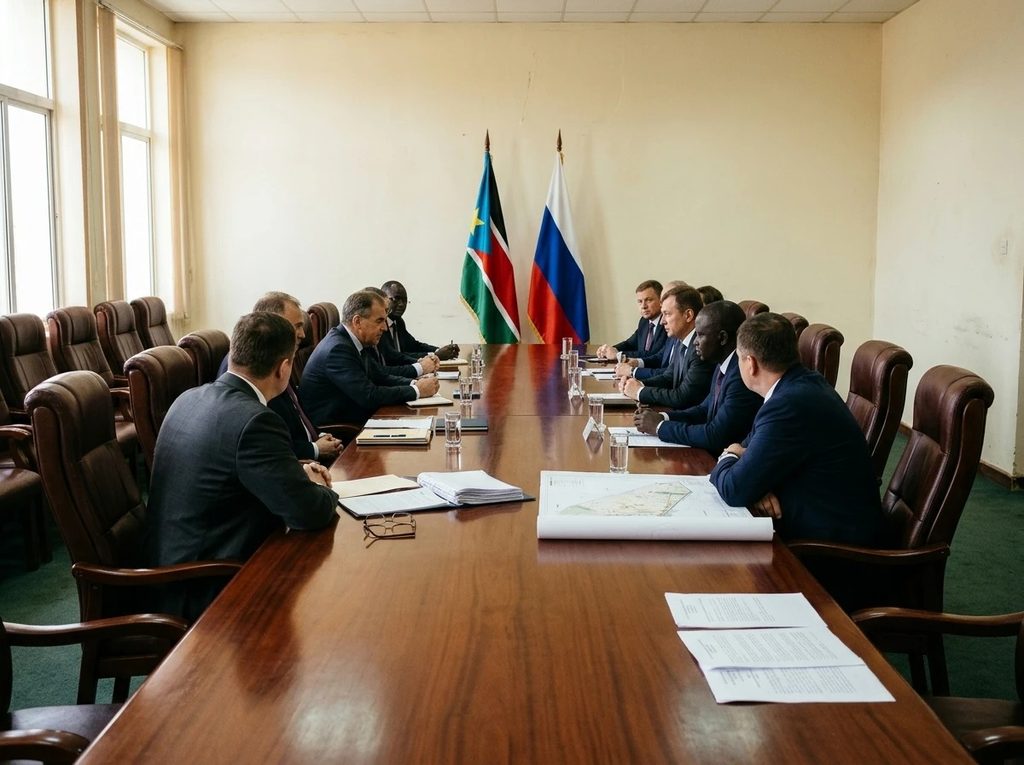
The recent diplomatic engagement involving Caretaker Minister of Cabinet Affairs Hon. Amb. Bol Wek Agoth and Russian Ambassador H.E. Aleksandr Kosmodemyansky, reportedly held in Juba following the Third Russia-Africa Summit in Moscow, offers an opportunity to examine how South Sudan can connect high-level diplomacy with domestic development. The reported meeting follows President Salva Kiir Mayardit’s participation in the Moscow summit and his bilateral discussions with Russian President Vladimir Putin on October 30, 2026.
During those talks, Putin announced that Russia had increased its scholarship allocation for South Sudanese students to 40 places for the 2026/2027 academic year. This is a specific announcement that can be measured through student selection, university placements and professional training outcomes. However, the larger question remains: how can South Sudan turn diplomatic commitments into lasting national benefits?
The answer lies in strategic diplomacy, practical planning, institutional coordination and public accountability. South Sudan should maintain constructive relations with all major international partners without becoming dependent on any single foreign government.
Key Takeaways
- South Sudan can benefit from maintaining balanced relations with the United States, China, Russia and other international partners.
- President Kiir’s October 30, 2026 meeting with President Putin produced a confirmed announcement of 40 Russian scholarship places for South Sudanese students.
- The Third Russia-Africa Summit adopted a 2027–2029 action plan and a declaration on cooperation in the civilian use of artificial intelligence.
- Diplomatic commitments require ministries, public institutions and private-sector partners to develop clear implementation plans.
- Infrastructure, education, agriculture, energy, banking and technology should be assessed through measurable public benefits.
- Sovereignty requires the ability to negotiate independently, manage public resources responsibly and protect national interests.
- Foreign partnerships cannot replace peace, competent leadership, transparent public finances and institutional accountability.
TL;DR
South Sudan should use its diplomatic relationships with the United States, China, Russia and other countries to advance national development. The October 2026 Russia-Africa Summit and President Kiir’s meeting with President Putin provide opportunities for educational cooperation and wider economic engagement. However, diplomatic success must be measured through completed projects, trained citizens, employment, improved infrastructure and accountable institutions, not announcements alone.
1. From International Summits to National Implementation
International summits create opportunities for countries to discuss trade, investment, security, education, technology and diplomatic cooperation. Yet participation in a summit does not automatically produce national development. Governments must translate political commitments into practical programmes with responsible institutions, budgets, timelines and measurable outcomes.
The Third Russia-Africa Summit took place in Moscow on October 28–29, 2026. It brought together delegations from 48 African countries and produced several important documents, including the Russia-Africa Partnership Forum Action Plan for 2027–2029 and a declaration on cooperation in the civilian use of artificial intelligence. The discussions covered trade, energy, agriculture, education, technology, healthcare and international cooperation.
For South Sudan, these areas correspond to important national priorities. The country needs better roads, reliable electricity, agricultural production, skilled professionals, stronger financial institutions and modern public services. International agreements should therefore be assessed according to their potential contribution to these needs.
The reported follow-up engagement in Juba is important as an example of the type of diplomatic coordination required after a major summit. Nevertheless, the value of such a meeting will ultimately depend on whether the relevant institutions identify projects, establish responsibilities and deliver results.
Diplomacy should not end when delegations return home. That is when the practical work should begin.
2. President Kiir’s Moscow Engagement and the Russian Scholarship Announcement
President Salva Kiir Mayardit represented South Sudan at the Third Russia-Africa Summit and met Russian President Vladimir Putin at the Kremlin on October 30, 2026. Their discussions included bilateral relations, trade, investment, education and professional training.
One of the clearest public announcements from the meeting concerned education. President Putin stated that Russia had increased its scholarship allocation for South Sudanese students to 40 places for the 2026/2027 academic year. He also reaffirmed Russia’s intention to support professional training for South Sudan.
This announcement provides a practical starting point for cooperation. However, a scholarship allocation is an opportunity, not yet a development outcome. Its value will depend on how South Sudan selects candidates, prepares them academically, supports their studies and connects their qualifications to national needs.
The government should consider prioritising fields such as engineering, medicine, agriculture, information technology, energy, public administration and technical education. These are areas where professional training could support national capacity.
A transparent selection process would also be important. Scholarship opportunities should be communicated publicly, eligibility requirements should be clear, and qualified applicants from different parts of the country should have a fair opportunity to compete.
The government should also establish a system for following up with scholarship recipients. Their qualifications, professional experience and potential contribution to South Sudan should be considered as part of a long-term human-resource development plan.
The objective should not simply be to send students abroad. It should be to develop professionals who can contribute to the country’s institutions and economy.
3. The United States: Humanitarian Assistance, Diplomacy and Policy Conditions
The United States has played a major role in South Sudan’s humanitarian response and international engagement. American support has contributed to food assistance, healthcare, emergency relief and programmes implemented through international organisations and development partners.
These contributions matter, particularly in a country affected by conflict, displacement, food insecurity and limited public-service capacity. Humanitarian assistance can save lives and help communities survive difficult periods.
However, American engagement also includes diplomatic pressure, targeted sanctions, restrictions and policy conditions. The United States has supported international measures concerning South Sudan’s peace process, accountability and security environment. Some of these measures have generated debate about their effects on the country’s institutions, financial activities and investment climate.
It would be inaccurate, however, to describe every American policy as an attempt to prevent South Sudan’s development. International pressure can also be directed towards peace implementation, civilian protection, accountability and the prevention of corruption.
The important question for Juba is how to engage Washington constructively while protecting national interests. South Sudan should welcome humanitarian assistance, investment, education partnerships, technical cooperation and private-sector engagement. It should also communicate clearly when particular policies create unintended difficulties for ordinary citizens or public institutions.
A mature diplomatic relationship allows disagreement without abandoning cooperation.
4. China: Infrastructure, Industrialisation and Development Cooperation
China has become an important development and economic partner for African countries through infrastructure construction, trade, investment, industrial cooperation and technical training.
Across Africa, Chinese companies and institutions have participated in building roads, bridges, railways, power facilities, telecommunications networks, hospitals and other public infrastructure. Through the Forum on China-Africa Cooperation, Beijing has also promoted cooperation in agriculture, manufacturing, education, healthcare and digital development.
South Sudan has its own experience of Chinese engagement, particularly in the petroleum sector and infrastructure development. Chinese companies have participated in the country’s oil industry, while Chinese-supported projects and business activities have contributed to parts of its development process.
Nevertheless, infrastructure cooperation should not be judged by the nationality of the contractor or the number of projects announced. Every agreement should be assessed through its financing terms, construction quality, maintenance arrangements, local employment, technology transfer and long-term economic value.
South Sudan should seek partnerships that help it move beyond dependence on raw-material exports. Roads should connect farmers to markets. Electricity projects should support households and businesses. Agricultural cooperation should increase domestic production and food processing. Telecommunications investment should make digital services more accessible and affordable.
China’s development experience can provide useful lessons, but South Sudan must adapt cooperation to its own national priorities, financial capacity and institutional requirements.
The objective should be productive development rather than simply accumulating foreign-funded projects.
5. Russia: An Additional Partner in a Multipolar Diplomatic System
Russia’s engagement with African countries has expanded through diplomacy, trade, energy, education, security cooperation, agriculture and technology. Its relationship with South Sudan provides another channel through which Juba can pursue national interests.
The October 2026 Russia-Africa Summit demonstrated Moscow’s intention to strengthen its relationships with African governments. The summit’s documents addressed economic cooperation, trade settlements, energy, food security, education, technology and the civilian application of artificial intelligence.
For South Sudan, the announcement of 40 scholarship places is a concrete example of bilateral educational cooperation. Other areas, including agriculture, petroleum, mining, banking and tourism, could provide opportunities for further engagement if suitable agreements and investment conditions are established.
However, potential cooperation should not be confused with completed investment. An invitation to invest does not mean that capital has already been committed, and a memorandum of understanding does not automatically create a functioning project.
South Sudan should therefore approach Russian cooperation with clear project proposals, transparent legal arrangements and realistic assessments of costs and benefits. It should also examine the implications of international sanctions and financial restrictions for banking, trade settlements, payments and investment.
Russia can be an additional partner, but national development must not depend on political declarations or assumptions about future assistance.
6. Multipolar Diplomacy and South Sudan’s Right to Choose Partners
The international system is not organised around one country or one political centre. The United States, China, Russia, European countries, regional powers and multilateral institutions all influence international trade, finance, technology, security and development.
African countries have a legitimate interest in maintaining relations with different partners. They should not be required to choose one external power at the expense of all others.
For South Sudan, this means maintaining diplomatic relations with Washington, Beijing, Moscow and other capitals according to national interests. The country can cooperate with the United States on humanitarian assistance and education, with China on infrastructure and industrial development, and with Russia on professional training and other mutually agreed areas.
These partnerships do not need to be mutually exclusive. A country can maintain different agreements with different governments while protecting its independence.
However, multipolar diplomacy should not become an excuse for replacing one form of dependency with another. True sovereignty requires the ability to negotiate favourable agreements, diversify economic relationships, manage public resources and make independent decisions.
South Sudan should be a partner to many countries rather than a dependent client of any single one.
7. Turning Diplomatic Commitments into National Development
The difference between diplomatic activity and development is implementation. South Sudan needs a clear process for converting international agreements into projects that can be monitored and evaluated.
The Ministry of Cabinet Affairs can contribute by coordinating government institutions and following up on decisions that require action across several ministries. The Ministry of Foreign Affairs and International Cooperation can maintain diplomatic communication, while sectoral ministries can identify technical priorities and supervise relevant projects.
For example, the Russian scholarship allocation should be connected to a transparent national education and professional-training plan. Any banking cooperation should be examined by the relevant financial authorities to establish its legal, financial and economic value. Agricultural investment proposals should be assessed according to land rights, water availability, infrastructure, local employment and market access.
The same standards should apply to agreements with China, the United States and other partners.
Every major agreement should have a designated government institution, a clear implementation timetable, an identifiable source of funding and measurable objectives. Public reporting should explain what has been agreed, what has been financed, what has been completed and what remains outstanding.
Without these measures, diplomatic announcements risk becoming public-relations exercises rather than instruments of development.
8. National Priorities Must Come Before Foreign Competition
South Sudan has considerable agricultural, petroleum, mineral, tourism and human-resource potential. Yet these resources cannot generate lasting prosperity without peace, infrastructure, investment security, skilled workers and effective public institutions.
The country should therefore define its development priorities before negotiating with international partners. It needs roads that connect productive areas to markets, electricity that supports industry, agricultural systems that reduce food imports, and telecommunications networks that support education and business.
It also needs stronger schools, hospitals, vocational institutions, public financial management and professional civil services.
Foreign partners can contribute financing, equipment, technical expertise and access to markets. They cannot replace the responsibility of South Sudanese institutions to plan, regulate, supervise and maintain national development programmes.
The government should also ensure that foreign investment creates opportunities for South Sudanese citizens. Local employment, professional training, domestic suppliers and the transfer of technical knowledge should be considered in major investment agreements.
The ultimate measure of international cooperation is not how many foreign governments visit Juba. It is whether ordinary citizens experience improvements in their daily lives.
9. Sovereignty Requires Accountability at Home
A country may maintain diplomatic relations with many powerful states and still struggle to achieve development if its domestic institutions are weak. External partnerships cannot substitute for peace, national unity, competent administration and responsible management of public resources.
South Sudan must therefore connect its foreign policy to internal reforms. Public finances should be managed transparently. Investment agreements should be subject to appropriate oversight. Public institutions should have the technical capacity to supervise projects. Government officials should be accountable for the use of national resources.
These responsibilities are particularly important in sectors such as petroleum, mining, agriculture and infrastructure, where major financial commitments can affect the country’s future for many years.
The government should also maintain an open national conversation about the benefits and costs of international agreements. Citizens have a legitimate interest in knowing how public resources are used, what obligations the country accepts and what benefits particular partnerships are expected to deliver.
Sovereignty is not simply the freedom to meet foreign leaders or sign agreements. It is also the capacity to govern responsibly, protect national interests and deliver public services.
10. Measuring Diplomatic Success Through the Lives of Citizens
The success of South Sudan’s foreign policy should be measured by practical results. If an agreement provides scholarships, the country should report how many students receive them, what they study and how their training contributes to national development.
If an agreement attracts investment, the public should be able to assess the capital committed, jobs created, taxes paid, infrastructure delivered and skills transferred. If a partnership concerns agriculture, its value should be reflected in increased production, improved storage, food processing and better market access.
The same principle applies to roads, electricity, healthcare, banking and digital technology.
South Sudan’s relationships with the United States, China, Russia and other countries should be guided by mutual respect and practical national interests. No foreign government should be expected to solve every domestic problem, and no South Sudanese institution should surrender its responsibility to manage the country’s future.
The reported diplomatic follow-up in Juba following the Moscow summit offers a useful reminder that international relations require sustained work after high-level meetings. The next stage must be implementation, public accountability and measurable development.
South Sudan can engage the world without surrendering its independence. It can welcome cooperation from different countries while insisting that every agreement serves the national interest.
Ultimately, the purpose of diplomacy is not to impress foreign governments. It is to improve the lives of the people represented by the diplomats and leaders who negotiate on their behalf.
Questions for Reflection
- How can South Sudan ensure that international agreements produce measurable benefits for ordinary citizens?
- What mechanisms should the government establish to monitor foreign-funded projects?
- How can scholarship programmes be connected to the country’s most urgent professional needs?
- What safeguards would help South Sudan avoid excessive dependence on any single international partner?
- How can the government strengthen public accountability in its diplomatic and investment agreements?
Frequently Asked Questions
1. What is strategic diplomacy?
Strategic diplomacy is the deliberate use of international relationships, negotiations and agreements to advance a country’s national interests. It involves identifying priorities, selecting suitable partners and ensuring that diplomatic engagements contribute to practical national objectives.
2. Why is Russia important to South Sudan’s foreign policy?
Russia provides another channel for diplomatic, educational, economic and technical cooperation. Its announcement of 40 scholarship places for South Sudanese students in the 2026/2027 academic year is one confirmed example of bilateral cooperation.
3. What did President Putin announce during his October 2026 meeting with President Kiir?
President Putin announced that Russia had increased its scholarship allocation for South Sudanese students to 40 places for the 2026/2027 academic year. He also reaffirmed Russia’s intention to support professional training for South Sudan.
4. Should South Sudan choose between the United States, China and Russia?
No. South Sudan can maintain relations with all three countries and other international partners. Its foreign policy should be based on national interests, mutual respect, transparent agreements and the ability to make independent decisions.
5. How can South Sudan turn diplomatic agreements into development?
The government should assign responsible institutions, establish clear budgets and timelines, publish implementation progress and evaluate results. Agreements should produce measurable outcomes such as jobs, infrastructure, professional training, improved public services and increased domestic production.
Conclusion
South Sudan has an opportunity to use its international relationships more effectively. Its participation in the Third Russia-Africa Summit, President Kiir’s meeting with President Putin and the announcement of additional Russian scholarship places demonstrate the possibilities of bilateral cooperation. Relations with China, the United States and other partners provide further opportunities in infrastructure, humanitarian assistance, investment, technology and education.
But opportunities do not automatically become achievements. They require capable institutions, transparent agreements, professional administration, national planning and public accountability.
South Sudan should be open to cooperation with every country willing to engage on mutually beneficial terms. At the same time, it must remain responsible for its own development. The country’s future cannot be outsourced to Washington, Beijing, Moscow or any other foreign capital.
Strategic diplomacy must serve a clear national purpose: peace, productive investment, educated citizens, stronger institutions and better living conditions.
A successful foreign policy is not measured by how many international summits a country attends, but by how much those engagements improve the lives of its people.
And if you want to know what’s happening in my world as a writer and digital nomad, check out my Wealthy Affiliate blog page here: https://my.wealthyaffiliate.com/johnmaluth/blog.
Sources and Further Reading
- South Sudan Broadcasting Corporation: President Kiir Meets Putin in Moscow on South Sudan-Russia Economic Partnership
- Radio Tamazuj: Kiir Returns to Juba After Russia-Africa Summit
- Radio Tamazuj: Putin Raises Russian Scholarship Quota for South Sudanese Students to 40
- Third Russia-Africa Summit: Declaration and Outcomes
- Third Russia-Africa Summit: Action Plan and Cooperation Priorities
- United Nations Security Council: Resolution 2821 (2026) on South Sudan
- Security Council Report: South Sudan, November 2026
- South Sudan Broadcasting Corporation: Juba and Moscow Deepen Bilateral Ties