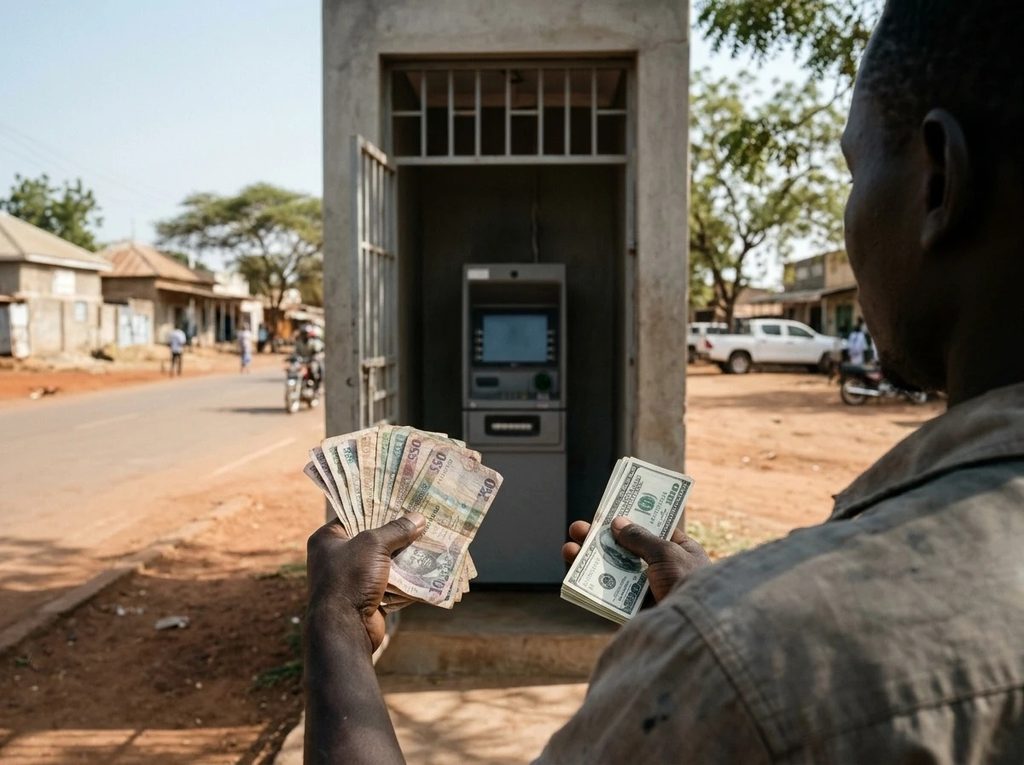
Imagine walking to an automated teller machine in Juba to withdraw money for groceries, transport or school fees. You insert your bank card, enter your PIN and request South Sudanese Pounds. Instead of receiving your money, the machine displays a message indicating that local currency is unavailable. Yet another ATM, sometimes operated by the same banking institution, may offer United States dollars to customers whose accounts hold foreign currency.
For ordinary citizens, this raises an important question: how can a country have dollars available in its banking system while its own national currency is difficult to withdraw?
The situation reveals more than a problem with automated teller machines. It points to the relationship between monetary policy, banknote supply, inflation, foreign exchange, banking liquidity and public confidence in South Sudan’s financial institutions.
South Sudan’s economy has experienced serious pressure from disruptions to oil exports, currency depreciation, high inflation and weak public financial management. These pressures have affected the government’s ability to pay salaries and provide services, as well as the ability of households and businesses to access cash.
However, the presence of US dollars in an ATM does not automatically mean that the country’s local currency shortage is caused by foreign sanctions or a deliberate international effort to undermine the South Sudanese Pound. Understanding the difference between foreign currency availability and domestic banknote supply is essential to identifying the real problem.
Key Takeaways
- US dollars and South Sudanese Pounds are separate currencies with different sources of supply and banking arrangements.
- The Bank of South Sudan has acknowledged cash shortages and the need to improve liquidity in commercial banks.
- Inadequate banknote production, weak cash-demand forecasting and distribution problems have contributed to the local currency shortage.
- Inflation and currency depreciation have weakened confidence in the South Sudanese Pound.
- ATM denominations depend on the bank’s equipment, cash-loading arrangements and operating policies.
- South Sudan faces United Nations arms embargo measures and targeted financial sanctions, not a general international prohibition on using US dollars.
- Domestic production, sound monetary policy, transparent public finances and stronger banking institutions are necessary for long-term currency stability.
TL;DR
All ATMs in Juba can dispense US dollars while they cannot provide South Sudanese Pounds because the two currencies are supplied and managed separately. South Sudan’s local cash shortage reflects problems with banknote supply, distribution, monetary management and economic instability. The Bank of South Sudan has acknowledged these challenges and introduced liquidity measures. International sanctions do exist, but they are not a comprehensive financial blockade preventing South Sudan from using dollars or trading internationally. Long-term improvement requires stronger monetary institutions, economic diversification and public confidence.
1. Understanding the Difference Between Local and Foreign Currency
The first step in understanding the ATM problem is recognising that a bank does not treat every currency as one interchangeable pool of money.
South Sudan’s official national currency is the South Sudanese Pound (SSP). The United States dollar (USD), meanwhile, is a foreign currency used in international trade, banking, aid operations, investment and other transactions.
Commercial banks maintain separate records and balances for different currencies. A customer with a dollar-denominated account cannot automatically withdraw the equivalent amount in South Sudanese Pounds, and a customer holding a local-currency balance cannot necessarily withdraw dollars.
The physical banknotes must also be available. A bank may have sufficient funds recorded in its accounting system but lack the physical notes required to meet a particular withdrawal request.
This distinction is important because a shortage of physical South Sudanese Pounds does not necessarily mean that every commercial bank is financially insolvent. It may instead indicate a shortage of available banknotes, difficulties moving cash through the banking system or restrictions on how particular currencies are distributed.
An ATM is not a machine that creates money. It can only dispense the banknotes loaded into its cash compartments.
2. Why South Sudanese Pounds Are Difficult to Withdraw
South Sudan’s banknote shortage is connected to deeper weaknesses in the country’s monetary and banking systems.
A policy brief published by the South Sudan Policy Lab examined the relationship between currency in circulation and deposits in the banking system from 2011 to 2024. It identified inadequate banknote production capacity, weak forecasting of cash demand and operational difficulties in distributing currency as important causes of the shortage.
The brief also highlighted a decline in the ratio of currency in circulation to banking deposits. Its findings suggest that the problem cannot simply be explained by blaming citizens for withdrawing or keeping too much cash.
The Bank of South Sudan’s approved Monetary and Banking Policy for 2026 also acknowledges cash shortages in the banking sector. It identifies reserve requirements and liquidity management as instruments that can help commercial banks meet customer demand.
These findings point to a central problem: the country needs an effective system for producing, distributing and circulating sufficient physical banknotes to support its economy.
When people cannot reliably withdraw their deposits, confidence in commercial banks weakens. Businesses may struggle to pay suppliers and employees, while households may become reluctant to keep their savings in formal accounts.
The resulting shortage affects the entire economy, especially small businesses and low-income households that depend on cash transactions.
3. Inflation and the Declining Purchasing Power of the Pound
Another important factor is inflation.
Inflation reduces the amount of goods and services that a unit of currency can purchase. When prices rise rapidly, people need more banknotes to buy the same goods they previously purchased with fewer notes.
This creates additional pressure on the physical currency supply.
South Sudan has experienced severe inflation and currency depreciation. The World Bank’s October 2026 Macro Poverty Outlook describes an economy recovering from the oil-production shock but still facing high inflation, currency depreciation and serious fiscal challenges.
The International Monetary Fund’s October 2026 World Economic Outlook data also project high inflation for South Sudan in 2026.
When the value of the local currency falls, businesses and households may prefer to hold foreign currency or purchase goods and assets rather than retain large amounts of local-currency savings. This behaviour can increase demand for dollars and weaken confidence in the national currency.
However, it is important to distinguish between people’s responses to inflation and the institutional causes of a shortage. Citizens may seek to protect their savings, but the central bank remains responsible for managing the supply and distribution of national banknotes.
A sustainable solution must therefore address both public confidence and the capacity of monetary institutions.
4. Why Dollars Can Be Available While Local Pounds Are Not
The apparent contradiction between dollar availability and local-currency scarcity becomes easier to understand when the sources of each currency are examined.
US dollars enter South Sudan through several channels, including international organisations, diplomatic missions, private businesses, investors, remittances and foreign-currency banking transactions.
International agencies and companies may maintain dollar-denominated accounts to pay staff, suppliers and operational expenses. Banks can also receive foreign currency through authorised international banking arrangements.
South Sudan imports substantial quantities of goods from neighbouring countries and the wider international market. This creates continuing demand for foreign currency to settle trade transactions.
The country’s petroleum sector is another important source of foreign exchange. Oil exports have historically provided most of South Sudan’s government revenue and a major share of its foreign exchange earnings.
However, foreign currency inflows and domestic banknote production are different processes. Dollars entering a commercial bank do not automatically increase the supply of South Sudanese Pounds.
The Bank of South Sudan must ensure that sufficient national currency is produced and distributed through the banking system. Commercial banks must then manage their cash reserves and meet customer withdrawals.
Consequently, a bank can have dollar notes available in a particular location while experiencing a shortage of local banknotes.
This is not necessarily evidence of deliberate discrimination against local currency holders. It is a reflection of separate currency supply arrangements and the weaknesses affecting the domestic cash system.
5. Why Some ATMs Dispense Only US$100 Notes
Another question concerns the denominations available through dollar-dispensing machines.
Why might an ATM dispense only US$100 notes instead of offering US$10, US$20 or US$50 notes?
The answer can involve the machine’s physical design and the bank’s cash-management decisions.
ATMs use compartments called cassettes to store banknotes. Each cassette is configured for a particular denomination and note specification. The machine counts and dispenses notes according to the denominations loaded into it and the withdrawal rules programmed by the bank.
For example, an ATM loaded with only US$100 notes cannot produce a US$90 withdrawal. It does not contain the smaller notes needed to assemble that amount.
Banks may choose particular denominations to simplify cash handling, reduce the frequency of replenishment and accommodate their operational requirements. Foreign banknotes may also involve additional transportation, insurance, security and processing costs.
However, the exact reasons for a US$100-only withdrawal rule at a particular ATM cannot be established without information from the bank operating that machine. Not every ATM in Juba necessarily uses the same configuration.
Banks should communicate their withdrawal limits, available denominations, fees and foreign-currency conditions clearly. Customers deserve to understand why a machine accepts a particular withdrawal amount but rejects another.
6. Are International Sanctions Responsible for the Dollar and Pound Shortage?
When economic difficulties become severe, citizens naturally search for explanations. Some may suspect that South Sudan is experiencing an international financial blockade similar to the restrictions imposed on countries such as Iran.
That comparison requires careful examination.
South Sudan is subject to United Nations sanctions. These include an arms embargo, travel restrictions and asset freezes against designated individuals and entities. The measures were established through United Nations Security Council resolutions and have been renewed.
On May 29, 2026, the Security Council adopted Resolution 2821 (2026), renewing the relevant arms embargo and targeted travel and financial measures until May 31, 2027. The resolution also extended the mandate of the Panel of Experts.
These restrictions are serious and can have consequences for individuals, entities and activities covered by the sanctions regime. However, they do not amount to a comprehensive prohibition on South Sudan’s ordinary international trade or general access to the US dollar.
The distinction matters. Targeted sanctions are not the same as a general financial blockade that prohibits an entire country from using international banking services.
The presence of US dollars in some Juba ATMs is consistent with continued access to certain foreign-currency channels. Nevertheless, it does not prove that every bank, business or individual can access international financial services without difficulty.
The correct conclusion is that South Sudan faces genuine economic and banking challenges, alongside targeted international restrictions. The available evidence does not establish that those restrictions are the direct cause of the shortage of South Sudanese banknotes.
7. Oil Exports, Public Revenue and the Banking Crisis
South Sudan’s dependence on petroleum makes its banking and currency problems more difficult to solve.
Oil provides the country with a major source of government revenue and foreign exchange. Yet South Sudan is landlocked and depends on infrastructure in neighbouring Sudan to transport its crude oil to international markets.
The conflict in Sudan disrupted this export route. In 2024, the shutdown of the Petrodar pipeline severely affected oil exports and government revenue. Exports resumed in 2025 after repairs, although subsequent security incidents continued to expose the vulnerability of the export corridor.
The World Bank’s 2026 South Sudan Public Finance Review describes how regional instability, oil-export interruptions and weaknesses in public financial management have affected government finances.
When oil revenues decline, the government faces greater difficulty financing public expenditure. This can contribute to salary arrears, reduced services, borrowing pressures and increased economic uncertainty.
The effects reach commercial banks and ordinary citizens. Public employees who do not receive salaries on time have less money to spend. Businesses experience reduced demand, while uncertainty discourages investment and savings.
The oil sector therefore matters to currency stability, but simply restoring production is not enough. South Sudan must also improve revenue management, transparency, budget discipline and the development of non-oil economic sectors.
8. The United States and China: Different Roles in South Sudan’s Economic Development
The banking crisis also invites a wider discussion about the role of international partners in South Sudan’s economic development.
The United States has been an important humanitarian and development partner. American assistance has supported food security, healthcare, emergency relief and programmes implemented through international organisations.
Washington also uses diplomatic pressure, sanctions and policy conditions as instruments of its foreign policy. These measures can generate disagreement with South Sudanese authorities, particularly when their economic or institutional consequences are debated.
China has a different profile in South Sudan’s economic relationship. Chinese companies have been involved in the petroleum sector and other areas of economic cooperation. Chinese engagement across Africa has also included infrastructure construction, trade, industrial development and technical training.
Neither country’s role should be reduced to a simple claim that one provides aid while the other builds infrastructure. Both relationships contain different forms of cooperation, interests and limitations.
South Sudan needs humanitarian assistance, investment, infrastructure, technology, trade and professional training. It should welcome constructive cooperation from the United States, China and other international partners while protecting its own national interests.
However, foreign partnerships cannot substitute for sound domestic monetary policy. A new road, hospital or petroleum investment does not automatically solve a shortage of banknotes.
The responsibility for maintaining the national currency and strengthening the domestic banking system ultimately rests with South Sudanese institutions.
9. What the Bank of South Sudan and Commercial Banks Should Do
The Bank of South Sudan has an important responsibility to restore confidence in the financial system.
Its 2026 Monetary and Banking Policy recognises the need to address cash shortages through monetary and liquidity measures. In April 2026, the central bank also held discussions with commercial banks about improving liquidity and access to withdrawals. The bank announced that it had allocated cash to commercial banks to ease the shortage.
These measures are relevant, but they must form part of a sustained programme rather than isolated interventions.
First, the central bank should improve banknote production planning. Currency requirements must be estimated using realistic information about population needs, prices, business activity and the volume of bank deposits.
Second, the distribution system should be strengthened. Producing banknotes is not enough if commercial banks cannot receive and distribute them efficiently.
Third, commercial banks should communicate clearly with customers about cash availability, withdrawal limits, account conditions and ATM denominations.
Fourth, digital payment systems should be expanded. Mobile money, electronic transfers and interoperable payment platforms can reduce excessive dependence on physical banknotes, particularly for routine business and household transactions.
Fifth, the authorities should examine whether the existing currency denominations remain suitable for the current price environment. The Bank of South Sudan has already identified denomination review as part of its currency-management responsibilities.
Finally, citizens need reliable protection for their deposits. Banks should apply transparent procedures and avoid arbitrary restrictions that discourage people from using formal financial services.
10. Building an Economy That Can Support Its Own Currency
A stable currency requires more than the printing of additional banknotes. It depends on public confidence, monetary discipline, productive economic activity and responsible government finances.
South Sudan needs to reduce its dependence on imported goods by investing in agriculture, livestock production, food processing, manufacturing and other productive sectors.
Agriculture is particularly important. The country has substantial agricultural potential, but farmers require roads, irrigation, electricity, storage facilities, modern equipment, access to credit and reliable markets.
Local manufacturing can also reduce the need to import certain products and create employment. Better telecommunications and digital infrastructure can support businesses, online services and cross-border trade.
The country must also improve the management of petroleum revenue. Public funds should be accounted for transparently, budgets should reflect realistic revenue expectations, and government spending should be subject to effective oversight.
A national currency becomes more useful when people can earn it, save it, invest it and exchange it for goods and services without constantly fearing that its value will collapse.
This requires institutions that people trust.
Questions for Reflection
- Why should South Sudanese citizens struggle to withdraw their own money from commercial banks?
- What changes are necessary to improve the production and distribution of South Sudanese banknotes?
- How can the Bank of South Sudan restore public confidence in the national currency?
- What role should mobile money and digital banking play in reducing dependence on physical cash?
- How can agricultural production and local manufacturing reduce pressure on the South Sudanese Pound?
Frequently Asked Questions
1. Why do some ATMs in Juba dispense US dollars but not South Sudanese Pounds?
The two currencies have separate supply and banking arrangements. A bank may have US dollar notes available while experiencing a shortage of local banknotes because of weaknesses in domestic currency production, distribution and liquidity management.
2. Does the availability of dollars in Juba ATMs mean South Sudan has no financial restrictions?
No. South Sudan remains subject to targeted United Nations financial sanctions, travel restrictions and an arms embargo. However, these measures are not a comprehensive prohibition on ordinary international trade or general dollar transactions.
3. Why do some ATMs dispense only US$100 notes?
An ATM can dispense only the denominations loaded into its cassettes and permitted by its operating settings. A machine containing only US$100 notes cannot provide smaller withdrawal amounts. The precise reason for a particular bank’s configuration should be confirmed with that bank.
4. Is the shortage of South Sudanese Pounds caused by citizens hoarding money?
Hoarding and public preferences can influence cash circulation, but research also identifies inadequate banknote production, weak cash-demand forecasting and distribution problems. The shortage should not be attributed to citizens alone.
5. How can South Sudan strengthen its national currency?
South Sudan needs disciplined monetary policy, adequate banknote supply, transparent public finances, stronger commercial banks, increased domestic production, agricultural development and greater public confidence in financial institutions.
Conclusion
The sight of US dollars available at some ATMs in Juba while South Sudanese Pounds remain difficult to withdraw is a real economic concern. However, it should not automatically be interpreted as evidence of an international conspiracy or a comprehensive financial blockade.
The shortage points to weaknesses in the domestic banking and monetary systems, including insufficient banknote supply, distribution problems, inflation and declining confidence in the national currency. Oil-export disruptions and weaknesses in public financial management have added further pressure.
The Bank of South Sudan has acknowledged the liquidity problem and introduced measures to improve cash availability. The challenge now is to make those interventions sustainable, strengthen commercial banking services and restore confidence among depositors.
South Sudan also needs an economy that produces more of what its people consume. Agriculture, manufacturing, energy, infrastructure and digital services must become stronger sources of employment, income and national wealth.
Foreign partnerships with the United States, China and other countries can support this effort, but no external partner can replace the responsibility of national institutions to manage the currency and public finances effectively.
A national currency is more than printed paper. It represents public confidence in the country’s economy, institutions and future.
South Sudan will strengthen its Pound not simply by printing more notes, but by building an economy in which its citizens can earn, save, invest and confidently use their own money.
And if you want to know what’s happening in my world as a writer and digital nomad, check out my Wealthy Affiliate blog page here: https://my.wealthyaffiliate.com/johnmaluth/blog.
Sources and Further Reading
- Bank of South Sudan: Monetary and Banking Policy for 2026
- Bank of South Sudan: Engagement with Commercial Banks on Liquidity Stabilisation Measures, April 2026
- South Sudan Policy Lab: A Policy Framework for Addressing the Banknote Shortage in South Sudan
- World Bank: Macro Poverty Outlook for South Sudan, October 2026
- World Bank: South Sudan Public Finance Review, 2026
- International Monetary Fund: South Sudan Country Data
- United Nations Security Council: South Sudan Sanctions Committee
- United Nations Security Council: Resolution 2821 (2026)
- Sudan Tribune: South Sudan Says Oil Exports Resumed After Pipeline Repair, June 2025
- World Bank: South Sudan Economic Monitor, March 2025