Can a person begin a new academic chapter after retirement and earn a doctorate in their seventies? The reported achievement of Ignace N’Vêkounou, a retired mathematics teacher from Benin, offers an inspiring example of what sustained learning and professional commitment can look like later in life.
According to an event account by Héribert-Label Élisée Adjovi, a friend of mine, N’Vêkounou defended his doctoral thesis on June 15, 2026, at the International University of Fundamental Studies in Vilnius, Lithuania. The account states that an official graduation ceremony followed on October 10, 2026, at the Idriss Déby Itno Amphitheater of the University of Abomey-Calavi in Benin. More than 1,500 people reportedly attended the celebration.
His thesis, titled “Physical and Mental Well-Being Through Massage Therapy and Colon Hydrotherapy in Naturopathy,” reflected his long-standing interest in complementary health practices. His reported journey included personal health challenges, additional professional training, community initiatives, master’s degrees, and doctoral research.
The achievement offers an opportunity to examine three connected subjects: lifelong education, the contribution of experienced African professionals, and the responsibility that comes with working in health and wellness.
However, inspiration should not replace verification. The biographical and ceremonial details in this article come from the supplied event account, and independent confirmation of the degree and institutional credentials was not established during research. Similarly, the personal health outcomes described by N’Vêkounou should not be treated as proof that a particular therapy works for everyone.
With those distinctions made, his reported journey provides a useful starting point for a wider discussion about learning, service, and the pursuit of meaningful goals at any age.
Key Takeaways
- Lifelong learning remains possible: N’Vêkounou’s reported academic journey shows that professional retirement does not have to end intellectual development.
- Personal challenges can inspire new goals: His account describes how his experience with obesity and hypertension encouraged him to explore yoga and complementary health practices.
- Mentorship matters: Professors Corneille Dagba and Olivier Pons, alongside practitioner Lucien Coffy, reportedly supported different stages of his development.
- Academic qualifications and medical evidence are different things: A doctorate is an academic milestone, but individual health claims still require appropriate scientific evidence.
- African professionals can continue contributing throughout their lives: Experienced adults can pursue research, mentor younger people, and develop services that address community needs.
- Integrity strengthens public trust: Responsible natural health practice requires transparency about potential benefits, risks, and limitations.
TL;DR
Ignace N’Vêkounou, a retired mathematics teacher from Benin, reportedly earned a doctorate in naturopathy at age 73 in 2026. His journey from personal health challenges to complementary health practice and advanced academic study illustrates the value of lifelong learning, mentorship, and service. His achievement also highlights the need to distinguish personal testimony and academic qualifications from independently established evidence about medical treatments.
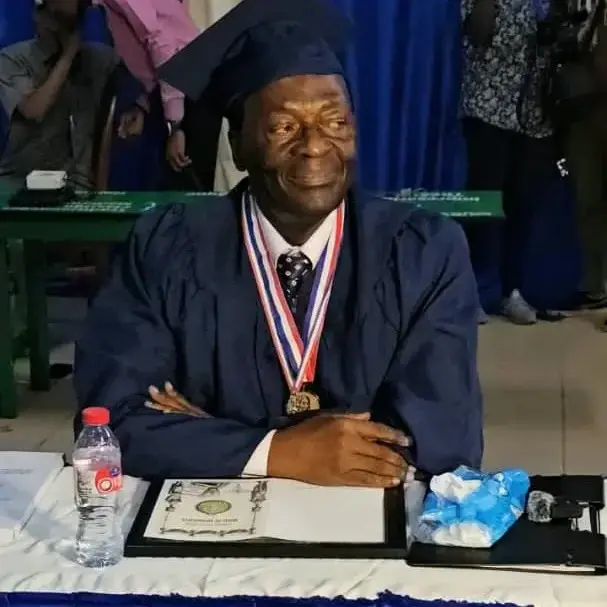
1. From Mathematics Teaching to a New Professional Chapter
According to the event account, N’Vêkounou had left the classroom approximately 20 years before receiving his doctorate. Rather than treating retirement as the end of professional development, he pursued a different field that connected his interests in physical well-being and helping other people.
His reported journey challenges the assumption that education belongs primarily to young people preparing for their first careers. People can return to formal education after years of employment, family responsibilities, and practical experience.
For adult learners, however, motivation must be accompanied by realistic planning. A postgraduate qualification may require substantial reading, research, writing, supervision, time, and financial resources. The most useful lesson is not that age makes achievement easy, but that age alone does not determine whether a goal is worth pursuing.
This principle applies beyond academic study. A retired teacher might learn digital publishing, an experienced administrator might develop a consulting service, and a former technician might teach new generations of professionals. Each path requires preparation, but none is automatically closed by retirement.
For digital nomads and independent professionals, this lesson is especially relevant. A career need not remain fixed around one occupation. Skills acquired in one profession can become the foundation for another, provided the individual identifies a genuine need and develops the necessary competence.
2. How Personal Experience Inspired an Interest in Natural Health
N’Vêkounou reportedly explained that, at age 38, he weighed 118 kilograms and struggled with obesity and hypertension. He said that after discovering Hatha Yoga, his weight fell to 85 kilograms over two years.
He described how this change attracted the attention of friends and relatives, eventually leading him to further training in complementary health practices.
This part of his story illustrates how personal experience can generate questions that lead to learning. Someone who experiences a health challenge may become interested in nutrition, exercise, stress management, or other approaches to well-being.
Nevertheless, an individual experience is not the same as a controlled scientific study. Weight changes can have multiple causes, and a personal account cannot establish which intervention produced a particular result.
Research published in Mayo Clinic Proceedings has found that yoga may help reduce blood pressure when used as a lifestyle intervention, although outcomes vary and yoga should not automatically replace prescribed treatment. Read the systematic review of yoga as an antihypertensive lifestyle intervention.
The distinction is important. Personal experience can motivate investigation, while scientific research helps determine which claims are supported, how strongly they are supported, and which limitations remain.
3. Building a Service Around Complementary Health Practices
The supplied account states that N’Vêkounou trained in massage therapy and colon hydrotherapy under Dr. Lucien Coffy in France. He subsequently established the NGO Club for Well-Being and Good Shape in Pahou, Benin.
He later studied Zen Shiatsu therapy under Francisco Thierry de Souza and created a centre called Yo.Stre.Ga, representing Yoga, Stretching, Gymnastics, and Nutrition.
These activities suggest a transition from personal interest to organized service. Instead of keeping his knowledge to himself, he reportedly developed initiatives intended to support other people interested in physical well-being.
There is a practical lesson here for professionals in any field: useful knowledge can sometimes become a service, a community organization, a teaching programme, or a small business.
However, health services carry special responsibilities. Practitioners must understand the limits of their training, avoid unsupported claims, identify when a client needs medical attention, and respect applicable professional and legal requirements.
Colon hydrotherapy, in particular, should not be presented as an established general treatment for disease or as a necessary method of detoxification. The US National Center for Complementary and Integrative Health reports that evidence supporting colon cleansing is limited and that the procedures can cause adverse effects, including serious complications in some circumstances. Read the NCCIH guidance on detoxes and cleanses.
This does not invalidate the broader importance of studying health practices. It means that professional credibility depends on distinguishing established evidence from claims that still require investigation.
4. From an International Congress to Doctoral Research
The event account identifies a scientific congress in Geneva, Switzerland, in 2016 as an important influence on N’Vêkounou’s decision to continue his education.
He reportedly obtained master’s degrees in 2021 and 2023 before defending his doctoral thesis in 2026. His research concerned physical and mental well-being through massage therapy and colon hydrotherapy in naturopathy.
This sequence illustrates how professional development can extend across many years. An initial interest may lead to training, which may lead to further study and eventually to a research project.
It also demonstrates why the research process matters. A practitioner who wants to investigate a therapy should be prepared to define the research question, examine existing studies, select appropriate methods, acknowledge limitations, and report findings honestly.
The title of a thesis identifies its subject, but it does not tell us by itself whether a treatment has been shown to be effective. That conclusion depends on the thesis’s methods, findings, quality of evidence, and relationship to other research.
Because the full thesis and its findings were not independently located during this research, it would be inappropriate to claim that N’Vêkounou’s doctorate proves the medical effectiveness of massage therapy or colon hydrotherapy.
The defensible conclusion is that, according to the supplied account, he pursued advanced academic study in a field that had become important to his professional life.
5. The Role of Mentors in Lifelong Learning
The reported graduation ceremony recognized several people who contributed to N’Vêkounou’s development.
Professor Corneille Dagba reportedly introduced him to Professor Olivier Pons, who became his thesis supervisor. Pons recalled reviewing N’Vêkounou’s curriculum vitae before agreeing to supervise the project. The account describes their relationship as developing from a formal academic connection into a friendship.
Dr. Lucien Coffy was also acknowledged for his earlier training and support. N’Vêkounou expressed gratitude to these mentors and to his partner, Agossi Marcelline Blassou.
Their reported contributions point to an important feature of adult education: learners often benefit from people who can help them identify opportunities, evaluate their readiness, and sustain progress through demanding work.
Mentorship does not eliminate the learner’s responsibility. A supervisor cannot write the thesis on behalf of a candidate, and a trainer cannot guarantee professional success. What mentors can offer is guidance, feedback, encouragement, and access to knowledge that may otherwise take longer to acquire.
For independent learners, mentors can be found through universities, professional associations, writing groups, research networks, and established practitioners. Online communication also makes it easier to seek guidance beyond one’s immediate community.
The essential requirement is a relationship grounded in competence, honesty, and respect for the learner’s responsibility.
6. Why the Achievement Matters Beyond One Individual
The reported ceremony attracted students, colleagues, family members, and friends, bringing attention to a professional journey that crossed several decades.
For Benin and other African countries, the story raises questions about access to education for adults who want to return to formal study. How can institutions make continuing education more accessible? How can experienced professionals receive appropriate recognition? What opportunities exist for people who want to combine practical work with research?
These questions matter because education is not limited to the years immediately following secondary school. Adults may need to change careers, update technical skills, improve qualifications, or investigate problems they have encountered through years of work.
Universities, training providers, employers, and community organizations can contribute by offering appropriate study options, mentorship, research opportunities, and transparent information about admission requirements and qualification recognition.
At the same time, institutions and prospective students should verify the standing of an academic provider before investing in a programme. Recognition of a qualification depends on the relevant institution, country, professional field, and intended use of the degree.
A university’s name or the award of a doctoral title should not automatically be taken as proof that every employer, regulator, or university will recognize the qualification. Anyone considering similar studies should check the applicable requirements directly with the relevant authorities.
N’Vêkounou’s reported achievement can inspire adult learners while also encouraging them to make informed decisions about their own educational plans.
7. Lifelong Learning as a Practical Strategy
One of the strongest lessons from this story is that learning can continue when a person’s circumstances change. The subject may change, the methods may change, and the goals may become more specific, but the desire to develop one’s abilities can remain.
For readers considering a new academic or professional chapter, the following approach offers a practical starting point:
- Identify a meaningful goal. Decide what you want to learn or accomplish and why it matters.
- Assess your starting point. Review your existing knowledge, experience, qualifications, and limitations.
- Choose credible learning opportunities. Compare course requirements, academic recognition, costs, teaching quality, and practical value.
- Create a realistic schedule. Set aside regular time for reading, study, practice, and assessment.
- Seek qualified guidance. Ask experienced people to review your plans and provide constructive feedback.
- Evaluate your progress. Use evidence of learning and practical results rather than relying only on motivation.
- Apply what you learn responsibly. Consider how your developing knowledge can benefit you and others without making claims beyond your competence.
Not every learning goal requires a university degree. Some people may benefit more from vocational training, short courses, professional certification, supervised practice, or independent study. The appropriate route depends on the goal and the requirements of the field.
The central principle is to match ambition with preparation and choose a path that leads to useful, credible outcomes.
8. Natural Health Requires Both Curiosity and Scientific Responsibility
N’Vêkounou’s reported journey also raises an important question about the relationship between natural health practices and scientific evidence.
People have long used physical activity, massage, dietary practices, and other approaches to support their well-being. Some practices have evidence supporting particular benefits, while others have uncertain effects or carry risks that may not be immediately obvious.
The responsible approach is neither to assume that everything described as natural is beneficial nor to dismiss a practice simply because it falls outside conventional medicine. Instead, each health claim should be evaluated according to the available evidence.
For example, systematic reviews suggest that yoga may help reduce blood pressure in some people, although researchers have identified limitations in the quality and consistency of the evidence. Read a systematic review and meta-analysis of yoga interventions for hypertension.
Colon hydrotherapy presents a different evidential picture. The National Center for Complementary and Integrative Health warns that evidence supporting colon cleansing for general health benefits is insufficient and that adverse effects can occur. Review the official health guidance.
These distinctions matter because people seeking relief from pain, insomnia, hypertension, or other health problems may be vulnerable to exaggerated promises.
A responsible practitioner should explain what a therapy is intended to do, what evidence supports its use, what risks may exist, and when conventional medical care is necessary. Products promoted for health benefits should likewise be evaluated on their ingredients, safety, evidence, and regulatory status.
Academic study can contribute to this process, but a qualification alone cannot settle every medical question. Research findings must be assessed on their merits.
9. What Independent Professionals Can Learn From His Story
For independent professionals, remote workers, and digital nomads, N’Vêkounou’s reported achievement offers a useful reminder that a professional identity does not have to remain unchanged throughout life.
A person who begins as a teacher may later become a researcher. Someone working in technology may move into education or publishing. A professional who has spent years serving clients may eventually decide to document that experience, train others, or investigate a problem through formal research.
Such changes require more than inspiration. They demand planning, the acquisition of relevant skills, and a clear understanding of the opportunities available.
Online learning has made it easier for many people to access educational materials and communicate with instructors beyond their immediate locations. However, access to online content is not the same as receiving a recognized qualification. Learners should distinguish between informal education, professional certification, and accredited academic programmes.
For people developing location-independent careers, continued learning can also improve adaptability. Digital tools, professional expectations, and the needs of clients can change. Developing new skills helps independent workers remain useful without assuming that every new trend deserves their time or money.
The most effective learning strategy begins with a practical question: what capability would help me do better work, solve a real problem, or serve people more effectively?
That question can guide decisions about courses, books, mentorship, research, and professional development.
Reflection Questions
Use these questions to apply the lessons of N’Vêkounou’s reported journey to your own life.
- What is one meaningful educational or professional goal you have postponed, and why?
- Which skills or experiences from your current or previous work could support a new direction?
- Who could provide credible guidance as you pursue your next learning goal?
- How can you distinguish reliable evidence from personal testimony or unsupported claims in a field you want to study?
- What practical step could you take this month to make measurable progress toward a long-term goal?
Frequently Asked Questions
1. Who is Ignace N’Vêkounou?
According to the supplied event account, Ignace N’Vêkounou is a retired mathematics teacher from Benin who later pursued complementary health practices, established community wellness initiatives, and undertook postgraduate study in naturopathy. The account reports that he earned his doctorate at age 73 in 2026. Independent confirmation of his academic credentials was not established during this research.
2. What was the subject of Ignace N’Vêkounou’s doctoral thesis?
The supplied account gives the title as “Physical and Mental Well-Being Through Massage Therapy and Colon Hydrotherapy in Naturopathy.” The full thesis and its research findings were not independently located, so no conclusion about its findings or the effectiveness of the therapies can be drawn from the title alone.
3. When and where did he defend his thesis and celebrate his graduation?
The account states that he defended his thesis on June 15, 2026, at the International University of Fundamental Studies in Vilnius, Lithuania. It reports that his official graduation ceremony took place on October 10, 2026, at the Idriss Déby Itno Amphitheater of the University of Abomey-Calavi in Benin.
4. What can older adults learn from N’Vêkounou’s reported achievement?
His story illustrates that age does not automatically prevent further education, career changes, or intellectual development. Older learners can pursue meaningful goals by identifying their objectives, selecting credible training, seeking mentorship, and committing time to sustained study. Their individual circumstances and educational requirements will determine the most suitable route.
5. Is colon hydrotherapy scientifically proven to improve general health?
No. Available evidence is insufficient to support broad claims that colon hydrotherapy improves general health or detoxifies the body. The procedure can also cause adverse effects, including serious complications in some circumstances. Anyone considering it should consult a qualified healthcare professional, particularly if they have an existing medical condition. See the National Center for Complementary and Integrative Health’s guidance on detoxes and cleanses.
Conclusion
Ignace N’Vêkounou’s reported doctorate at age 73 offers a compelling example of lifelong learning, professional reinvention, and the determination to continue developing one’s abilities. His journey from mathematics teaching to complementary health practice and doctoral research illustrates how a person’s professional life can include more than one chapter.
It also reminds us that inspiration and responsibility must go together. Academic achievements deserve recognition, but educational credentials and health-related claims must be assessed carefully. In natural health, scientific evidence, ethical practice, and patient safety remain essential.
For African students, older professionals, independent workers, and anyone considering a new direction, the practical message is clear: identify what you want to learn, seek credible guidance, and take the next achievable step.
Your age does not have to determine the limits of your ambitions. What matters is how responsibly you pursue them and how you use what you learn to serve humanity.
If this article encourages you to pursue a new skill or revisit a long-standing goal, share it with someone who may benefit from the message.
And if you want to know what’s happening in my world as a writer and digital nomad, check out my Wealthy Affiliate blog page here: https://my.wealthyaffiliate.com/johnmaluth/blog.
Sources
The biographical details and event information in this article are based on the event account supplied by Héribert-Label Élisée Adjovi. The following independent medical and academic sources provide additional evidence for evaluating claims about yoga and colon hydrotherapy. They do not independently verify N’Vêkounou’s biography, degree, or graduation ceremony.
- Yoga as Antihypertensive Lifestyle Therapy: A Systematic Review and Meta-analysis, Mayo Clinic Proceedings, 2019. Reviews evidence on yoga and blood pressure.
- Content, Structure, and Delivery Characteristics of Yoga Interventions for Managing Hypertension, Frontiers in Public Health, 2022. Reviews clinical trials of yoga interventions and their effects on blood pressure.
- “Detoxes” and “Cleanses”: What You Need to Know, US National Center for Complementary and Integrative Health. Explains the evidence limitations and potential risks of colon cleansing.
- Recognition of Foreign Academic Qualifications, Vilnius University. Explains the distinction between academic qualification recognition and admission to a particular study programme. This is general guidance, not confirmation of the institution or degree discussed in this article.
- Colonic Irrigation: Therapeutic Claims by Professional Organisations, a Review, International Journal of Clinical Practice, 2010. Examines evidence for therapeutic claims associated with colonic irrigation.