South Sudan has taken another important step towards modernising its financial system. On November 24, 2026, the Bank of South Sudan and the Ministry of Finance and Planning announced the integration of government payment processing with the South Sudan Interbank Payment and Settlement System (SSIPSS). The arrangement is designed to replace manual government cheque payments with electronic transfers directly into beneficiaries’ bank accounts. Although this may appear to be a technical banking reform, its implications reach far beyond financial institutions. It touches government accountability, public service delivery, business confidence and the daily lives of ordinary citizens.
The interbank payment infrastructure itself was launched by the Bank of South Sudan on October 10, 2025. The November 2026 development represents an important extension of that infrastructure into government payment operations through its connection with the Integrated Financial Management Information System (IFMIS). This distinction matters because the country is not introducing electronic interbank payments for the first time; it is expanding their use in public financial management.
For a country facing economic instability, cash shortages, delayed public payments and institutional weaknesses, the ability to move government money electronically is a development worth watching. The important question is whether this technology can help change how government manages public resources.
Key Takeaways
- On November 24, 2026, the Bank of South Sudan and the Ministry of Finance and Planning announced the integration of government payments with SSIPSS and IFMIS.
- The arrangement is intended to replace manual government cheques with direct electronic transfers.
- RTGS handles high-value and urgent transactions, while ACH processes eligible low-value and bulk payments.
- Government payment beneficiaries must hold accounts with commercial banks licensed by the Central Bank.
- Electronic payments can improve transaction records and expenditure monitoring, but cannot independently eliminate corruption.
- Reliable electricity, telecommunications, cybersecurity and accessible banking services are necessary for successful implementation.
- The reform should be measured by its actual effects on suppliers, contractors, public institutions, employees and ordinary citizens.
TL;DR
South Sudan is expanding its electronic interbank payment infrastructure to process government payments through direct bank transfers rather than manual cheques. The integration of RTGS, ACH and IFMIS could improve payment efficiency, financial records and public expenditure oversight. However, technology alone cannot correct corruption, weak institutions or poor financial management. The real test will be whether public money reaches its intended beneficiaries more reliably and whether citizens can see measurable improvements.
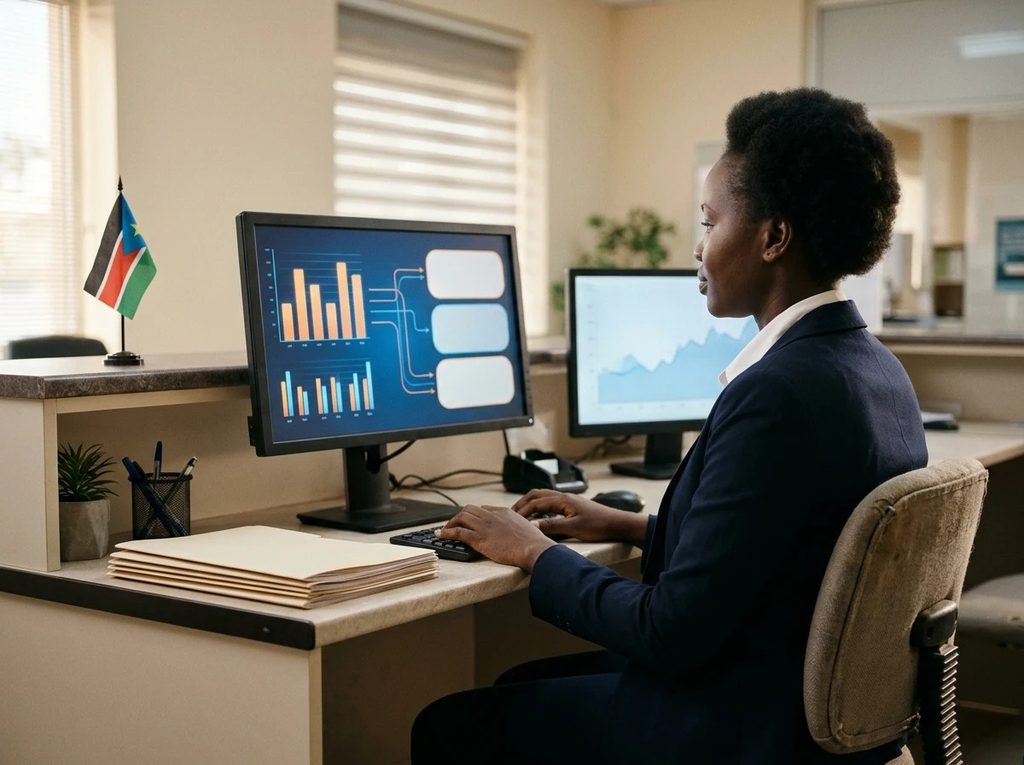
1. From Manual Cheques to Electronic Government Payments
For decades, government financial transactions in South Sudan have faced challenges associated with manual procedures, administrative delays and limited transparency. When payments depend heavily on physical documents moving between offices, suppliers may wait for their money, contractors may struggle to complete projects, and public institutions may experience difficulties obtaining the resources needed to operate.
The new arrangement offers an opportunity to reduce some of these obstacles. Rather than relying on physical cheques, eligible government payments can be transferred electronically into beneficiaries’ bank accounts. This can make transactions easier to track, reconcile and review.
The Bank of South Sudan’s October 2025 announcement described the launch of the country’s first electronic interbank payment and settlement infrastructure. In May 2026, the Central Bank and the Ministry of Finance discussed its operational integration with government financial processes. The November 24 announcement therefore represents a further step towards connecting public expenditure management with electronic payment channels.
This is important because the way government pays its suppliers and service providers affects the wider economy. A supplier who receives payment on time can pay employees, purchase materials and continue operating. A contractor who receives funds through a traceable system may be better positioned to manage project expenses. The benefits, however, depend on the government having sufficient funds and authorising payments correctly.
2. Understanding RTGS, ACH and IFMIS
The new government payment arrangement brings together three important components. Each performs a different function in the management and movement of public money.
Real-Time Gross Settlement (RTGS) is designed to process high-value and urgent transactions individually, with settlement occurring in real time. It is particularly useful for large transfers between financial institutions where speed and settlement certainty are important.
Automated Clearing House (ACH) processes eligible low-value and bulk transactions. It can support groups of payments that need to be processed through a coordinated clearing arrangement rather than handled individually through manual procedures.
Integrated Financial Management Information System (IFMIS) supports government financial management. It connects budget execution, expenditure recording and related financial processes. Its integration with payment infrastructure can help link an approved government expenditure to the actual transfer of funds.
Together, these components can strengthen the connection between budget allocation, expenditure approval and payment execution. They can also help establish more consistent financial records.
However, the presence of these systems does not automatically mean that every government transaction will be processed without delays. Payment approval, available funds, banking operations and the accuracy of beneficiary information will continue to matter.
3. Can Electronic Payments Reduce Corruption?
One of the strongest arguments for digital financial reform is that electronic transactions create records that can be examined. Manual payments may involve physical documents, multiple offices and procedures that are difficult to monitor consistently. Electronic systems can make it easier to identify when a payment was initiated, authorised, processed and received.
This can support financial audits and help investigators examine suspicious transactions. It may also reduce certain opportunities for document manipulation and unauthorised handling of government cheques.
Nevertheless, electronic payments should not be confused with the elimination of corruption. A dishonest transaction can still be processed electronically if the underlying procurement, approval or accounting process is compromised. An electronic transfer can move money efficiently without establishing whether the expenditure was legitimate.
The government must therefore accompany technological modernisation with transparent procurement, independent financial audits, clear reporting procedures and appropriate consequences for financial misconduct. Parliament, the National Audit Chamber and other oversight institutions need access to reliable records and the authority to investigate irregularities.
The objective should not simply be to digitise payments. It should be to make public financial management more accountable.
4. What Does the Reform Mean for Ordinary Citizens?
The November 24 announcement states that government payment beneficiaries, including suppliers, contractors, institutions and individuals, must maintain accounts with commercial banks licensed by the Bank of South Sudan to receive payments through the new arrangement.
This requirement could encourage more people and businesses to participate in the formal banking system. It may also increase demand for commercial banking services and encourage institutions to improve their payment products.
However, it raises an important question: what happens to people who do not have convenient access to commercial banks?
Banking services remain difficult to access in some rural communities. Citizens may face long journeys, transport expenses, limited banking facilities and unreliable telecommunications. A system that requires a bank account can become an additional obstacle if the government and financial institutions do not expand access.
Financial inclusion must therefore be part of the reform. Banks should make account opening affordable, improve access outside Juba and develop services that respond to the needs of people with limited access to formal financial institutions.
The government should also communicate clearly with beneficiaries about account requirements, payment procedures and how to follow up on delayed or missing transfers. According to the November 24 announcement, beneficiaries seeking information about government payments should contact the Ministry of Finance and Planning, which remains responsible for initiating, authorising and processing those payments.
5. Digital Payments Require Electricity and Internet Access
Electronic financial infrastructure depends on more than banking software. It requires reliable electricity, telecommunications networks, internet connectivity, secure data systems and trained personnel.
A government employee in a remote county should not be disadvantaged simply because the local banking network is unreliable. A business should not face repeated payment interruptions because of poor connectivity. Commercial banks must also be prepared to maintain secure systems and respond to technical failures.
Cybersecurity deserves particular attention. As financial transactions become increasingly digital, the risks associated with unauthorised access, identity theft, payment fraud and data breaches also require serious attention. The Central Bank and participating financial institutions need clear security standards, monitoring procedures and systems for responding to incidents.
There must also be reliable procedures for failed transactions, incorrect beneficiary details, disputed payments and service interruptions. Modernisation should make financial services more dependable, not create new problems for people who already struggle to access them.
South Sudan should treat electricity, telecommunications and cybersecurity as essential parts of financial modernisation rather than separate policy concerns.
6. Opportunities for Banks, Telecommunications Companies and Entrepreneurs
The new payment arrangement could create opportunities for South Sudan’s private sector. Commercial banks may benefit from increased transaction activity, while telecommunications companies and technology businesses may find opportunities to develop services that connect customers with formal financial institutions.
Small businesses could eventually benefit from easier electronic transfers, more reliable supplier payments and improved access to banking services. Digital entrepreneurs and online service providers may also find new opportunities as financial services become more accessible.
However, the November 24 reform primarily concerns government payments. It should not be mistaken for a nationwide mobile money or instant payment service available to every citizen and business. Wider digital financial inclusion will require additional services, regulation, infrastructure and cooperation among financial institutions and telecommunications operators.
The Bank of South Sudan’s 2026 Monetary and Banking Policy identifies the development of national payment infrastructure as part of its financial sector modernisation priorities. It refers to payment components including RTGS, ACH and electronic money, alongside regulatory work on mobile banking, internet banking, ATMs and other payment channels.
The next challenge is to connect these different parts of the financial system so that digital services become useful beyond government offices.
7. What South Sudan Can Learn from China
South Sudan can learn from countries that have invested in digital financial infrastructure, including China. China’s experience demonstrates how coordinated investment in banking technology, telecommunications and digital commerce can support economic activity.
However, South Sudan should not simply copy another country’s systems. Its financial institutions, infrastructure, population distribution and economic conditions require solutions suited to local needs.
The useful lesson is that technological development must be connected to national development priorities. Digital payment systems should support businesses, improve public services, strengthen financial access and create conditions for economic participation.
South Sudan can pursue international partnerships that facilitate technical training, knowledge transfer, cybersecurity capacity and investment. Such partnerships should strengthen domestic institutions and retain national ownership of financial infrastructure.
The country should also learn from regional experiences, particularly those of East African states that have developed electronic banking, mobile money and digital payment services. Regional cooperation can help improve cross-border transactions and support trade.
8. The Reform Must Be Measured by Results
Official announcements are important, but the success of SSIPSS and its integration with IFMIS should be judged by measurable improvements.
Are government suppliers receiving their payments faster? Are contractors receiving funds according to approved payment schedules? Are financial records becoming more transparent? Can auditors trace expenditure from budget approval to the final beneficiary? Are transaction costs reasonable? Are public institutions able to account for the money they spend?
These questions matter more than the number of computers installed or the number of transactions processed.
The Bank of South Sudan and the Ministry of Finance and Planning should publish regular implementation updates. These reports should explain the system’s coverage, performance, payment delays, transaction failures and safeguards protecting public funds.
The government should also provide information on how the reform affects public sector salary payments and outstanding obligations. The existence of an electronic payment channel does not mean that money is automatically available to pay every salary, supplier or contractor. Payment efficiency and government liquidity are separate issues.
Public confidence will grow when citizens can see evidence that the system is working and that public money is reaching its intended destination.
9. Digital Reform Must Accompany Public Financial Discipline
South Sudan’s economic difficulties cannot be solved by payment technology alone. The country needs disciplined public spending, reliable revenue management, transparent oil-sector accounting and stronger institutions.
Electronic payment systems can improve how available funds are transferred and recorded. They cannot independently increase government revenue, resolve budget deficits or guarantee that public expenditure serves national priorities.
The government must therefore connect digital payment reform with wider public financial management improvements. This includes realistic budgeting, stronger expenditure controls, transparent procurement, timely financial reporting and independent audits.
The Central Bank must also maintain effective oversight of participating financial institutions and protect the security and reliability of the payment infrastructure.
For the reform to succeed, government ministries, commercial banks, auditors, telecommunications providers and other stakeholders must understand their responsibilities. Clear rules and public reporting will help prevent confusion and strengthen accountability.
10. A Digital Financial System Must Serve the Public
South Sudan has an opportunity to make electronic payments part of a much larger national reform programme. The country needs more than modern banking software. It needs trustworthy institutions, disciplined public spending, accessible financial services and a government that treats public resources as a responsibility rather than a privilege.
The integration of government payments with SSIPSS and IFMIS is a meaningful step. If implemented effectively, it could improve the movement of public money, strengthen financial records and reduce some administrative obstacles.
If poorly managed, however, it may become another expensive government initiative whose benefits remain largely invisible to ordinary citizens.
The real digital financial revolution will not be measured by the number of computers installed or transactions processed. It will be measured by whether public money reaches its intended destination, whether institutions become more accountable and whether citizens experience better public services.
South Sudan must learn to manage its money before expecting its money to transform the nation.
Questions for Reflection
- How can electronic government payments improve accountability in South Sudan?
- What safeguards are needed to prevent corruption within digital payment systems?
- How can rural communities access banking services without excessive costs?
- What role should commercial banks and telecommunications companies play in national financial modernisation?
- How can the government make the performance of SSIPSS and IFMIS transparent to the public?
Frequently Asked Questions
1. What is SSIPSS in South Sudan?
The South Sudan Interbank Payment and Settlement System is the country’s electronic infrastructure for processing payments between participating banks. The Bank of South Sudan launched the interbank system on October 10, 2025.
2. What happened on November 24, 2026?
The Bank of South Sudan and the Ministry of Finance and Planning announced the integration of government payment processing with SSIPSS and IFMIS. The arrangement is intended to replace manual government cheques with direct electronic transfers to beneficiaries’ bank accounts.
3. What are RTGS and ACH?
Real-Time Gross Settlement (RTGS) processes high-value and urgent transactions individually. The Automated Clearing House (ACH) handles eligible low-value and bulk payments.
4. Will electronic payments eliminate corruption in South Sudan?
No. Electronic systems can create traceable transaction records and improve monitoring, but corruption can still occur through manipulated procurement, false approvals or dishonest accounting. Independent audits and effective oversight remain necessary.
5. Do government payment beneficiaries need a bank account?
Yes. The November 24, 2026 announcement states that beneficiaries, including suppliers, contractors, institutions and individuals, must have accounts with commercial banks licensed by the Bank of South Sudan to receive payments through the new arrangement.
Conclusion
South Sudan’s move towards electronic government payments is an important development in the modernisation of public financial management. The integration of SSIPSS with IFMIS offers an opportunity to reduce dependence on manual cheques, improve transaction records and strengthen expenditure monitoring.
But technology must be supported by responsible leadership, financial discipline, independent oversight and accessible banking services. A digital payment system can move money faster, but only accountable institutions can ensure that money is used properly.
The country’s next task is to turn this technological development into measurable public benefits. Government payments should become more reliable, public spending should become easier to monitor, and financial services should reach more citizens.
South Sudan does not merely need a modern way to transfer money. It needs a modern way to manage public resources.
And if you want to know what’s happening in my world as a writer and digital nomad, check out my Wealthy Affiliate blog page here: https://my.wealthyaffiliate.com/johnmaluth/blog.
Sources and Further Reading
- Bank of South Sudan: Launch of the First-Ever Electronic Interbank Payment System, October 10, 2025
- Sudans Post: South Sudan Launches Electronic Payment System to Replace Manual Cheques, November 24, 2026
- South Sudan Broadcasting Corporation: Central Bank and Finance Ministry Discuss Digital Payment Integration, May 18, 2026
- Bank of South Sudan: Monetary and Banking Policy for 2026
- Bank of South Sudan: Circular on Mandatory Connection to SSIPSS, November 4, 2025