When photographs of the Russian Ambassador to South Sudan, A.V. Kosmodemiyanskiy, meeting Presidential Adviser on National Security Affairs Hon. Tut Gatluak Manime appeared on social media in November 2026, much of the online discussion focused on personal appearances rather than the substance of the diplomatic engagement. Yet the reported discussions about bilateral cooperation and food insecurity deserve serious public attention.
The meeting raises an important question: why should a Presidential Adviser on National Security Affairs be involved in discussions about food security? The answer is straightforward. A country that cannot reliably feed its population faces more than an agricultural problem. It faces economic, social, humanitarian and national security challenges.
South Sudan is experiencing one of the world’s most serious food insecurity crises. The April–July 2026 Integrated Food Security Phase Classification (IPC) assessment estimated that 7.8 million people faced acute food insecurity, including approximately 73,000 people in Catastrophe, the most severe classification short of famine. Conflict, displacement, economic instability and climate-related shocks continue to affect households and agricultural production.
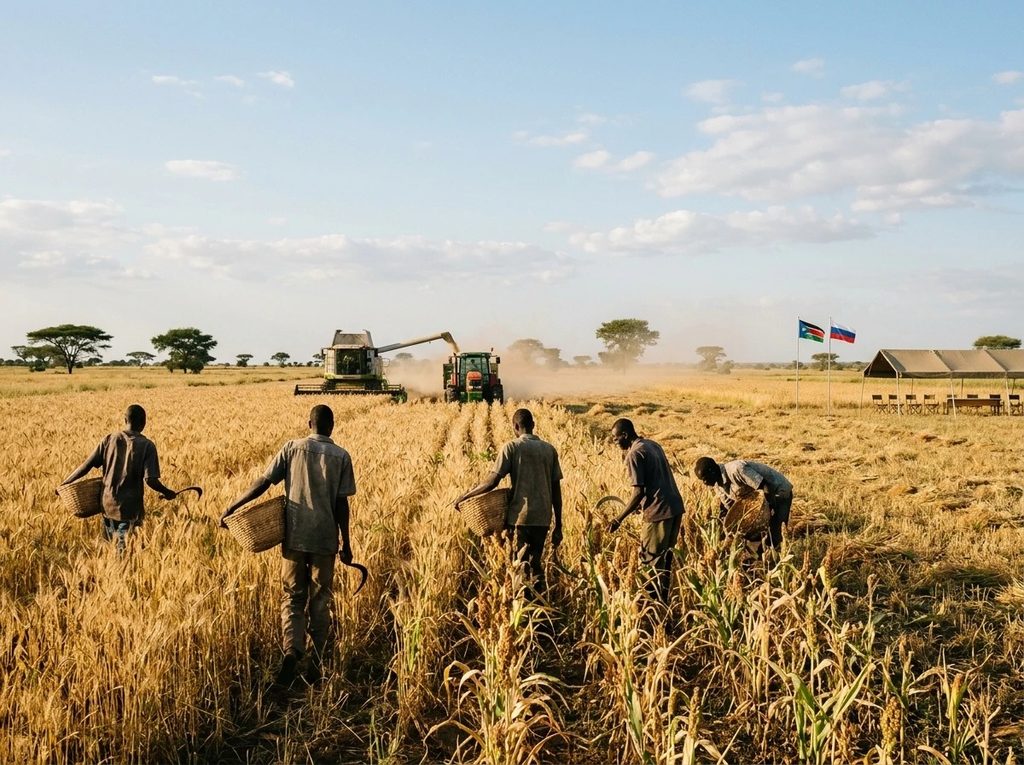
At the same time, South Sudan possesses considerable agricultural potential. It has fertile land, water resources, livestock, fisheries and communities with generations of farming knowledge. Yet the country imports large quantities of food and remains dependent on humanitarian assistance.
This is why diplomatic engagement between Juba and Moscow matters. Russia is a major international producer and supplier of grain and fertilisers, while South Sudan needs agricultural investment, technology, machinery, training and reliable supply chains. The opportunity is not simply to obtain more imported food. It is to explore partnerships that can help South Sudan produce more food domestically.
Food security must therefore become a central national development priority, supported by international cooperation and domestic institutional responsibility.
Key Takeaways
- Food insecurity is a national security concern because it affects stability, livelihoods, public health and social cohesion.
- Approximately 7.8 million people in South Sudan faced acute food insecurity between April and July 2026.
- South Sudan has substantial agricultural potential but cultivates only a small proportion of its available arable land.
- The reported Juba-Moscow discussions provide an opportunity to explore agricultural cooperation and food supply arrangements.
- Russia has publicly expressed willingness to supply grain and share agricultural expertise with African partners.
- China and other international partners can also contribute through agricultural machinery, infrastructure, technology and training.
- Humanitarian assistance remains essential during emergencies, while long-term investment must increase domestic food production.
- South Sudan must measure diplomatic success through local production, farmer incomes, employment and improved food access.
TL;DR
Food security is national security because hunger can weaken livelihoods, increase displacement, disrupt markets and intensify social instability. South Sudan’s reported discussions with Russia about food insecurity offer an opportunity to explore grain supplies, fertilisers, agricultural machinery, technology transfer and investment. However, the country’s long-term objective should be to strengthen domestic agriculture rather than depend permanently on imported food or emergency assistance. International partnerships must produce practical benefits for South Sudanese farmers and households.
1. Why Food Security Is a National Security Issue
National security is often discussed in terms of territorial integrity, military capability, border protection and the prevention of armed conflict. These are important responsibilities, but security also includes the conditions that allow people to live, work and contribute to their communities.
Food is one of those conditions.
When households cannot obtain sufficient food, the consequences extend beyond hunger. Children may suffer malnutrition, parents may lose their ability to work productively, farmers may sell livestock or abandon their land, and families may be forced to migrate in search of assistance.
Food shortages can also increase pressure on local markets, weaken household purchasing power and intensify competition over limited resources. Where communities already face insecurity, displacement and economic hardship, these pressures can contribute to further instability.
This explains why food security belongs in national security discussions. A government must protect its territory, but it must also create conditions in which its population can survive and prosper.
The involvement of a Presidential Adviser on National Security Affairs in discussions about food insecurity is therefore understandable. Food security requires coordination between agriculture, finance, trade, infrastructure, humanitarian affairs and security institutions.
A peaceful country cannot be sustained by military arrangements alone. Its citizens must also have reliable access to food, water, livelihoods and essential services.
2. South Sudan’s Food Insecurity Crisis in 2026
South Sudan’s food insecurity situation remains extremely serious.
According to the IPC assessment released on April 28, 2026, approximately 7.8 million people were projected to face Crisis-level food insecurity or worse between April and July 2026. This represented about 56 percent of the analysed population.
The assessment identified approximately 73,000 people in IPC Phase 5, known as Catastrophe. Millions more were classified in Emergency and Crisis conditions.
The crisis has several connected causes.
Conflict and insecurity have displaced communities, disrupted farming activities and restricted access to markets. Flooding in previous years has damaged crops, livestock and rural infrastructure. In 2026, dry weather conditions and irregular rainfall have created additional concerns for agricultural production.
Economic instability has also reduced household purchasing power. High transport costs, fuel prices and food prices make it difficult for families to obtain sufficient supplies, particularly when local production is inadequate.
These challenges affect different parts of the country in different ways. Communities in Jonglei, Upper Nile and Unity have experienced particularly severe conditions, while other states also face serious food access and livelihood difficulties.
The situation requires both immediate humanitarian action and long-term economic planning. Emergency food assistance can prevent deaths today, but stronger agricultural production is necessary to reduce vulnerability in the years ahead.
3. South Sudan’s Untapped Agricultural Potential
One of the greatest contradictions in South Sudan’s economy is the gap between its agricultural potential and its dependence on imported food.
The country possesses extensive agricultural land, substantial water resources and diverse ecological conditions suitable for growing different crops and raising livestock.
A 2026 United Nations report on South Sudan’s food situation noted that the country has approximately 33 million acres of prime arable land, while less than five percent is currently utilised. It also reported that South Sudan spends more than US$800 million annually on food imports.
These figures demonstrate the scale of the opportunity.
South Sudan could increase domestic production of sorghum, maize, millet, groundnuts, sesame, vegetables, fruits and other crops. Its livestock sector could support meat and dairy production, while fisheries could contribute to nutrition, employment and commercial activity.
However, agricultural potential does not automatically become agricultural production.
Farmers need secure access to land, seeds, tools, fertilisers, irrigation, machinery, storage facilities, roads, markets and affordable financing. They also need security, agricultural extension services and predictable government policies.
The country must therefore move beyond simply describing itself as agriculturally rich. Its priority should be to build the systems that allow farmers to produce, process, store and sell food profitably.
South Sudan’s agricultural future should be measured by cultivated land, yields, market access, rural incomes and the amount of food produced locally.
4. Why the Juba-Moscow Dialogue Matters
The reported meeting between Russian Ambassador A.V. Kosmodemiyanskiy and Presidential Adviser Hon. Tut Gatluak Manime provides an opportunity to examine the relationship between diplomacy, food security and national stability.
Russia has significant experience in grain production, agricultural technology and fertiliser manufacturing. It is also an important participant in international food and agricultural markets.
During the Third Russia-Africa Summit in Moscow in October 2026, Russian President Vladimir Putin stated that Russia would continue supplying grain to African countries through commercial arrangements and, where applicable, free deliveries. He also expressed willingness to share agricultural expertise and support cooperation in livestock production, crop farming, food processing and storage.
These statements are relevant to South Sudan because the country needs both reliable food supplies and stronger domestic agricultural capacity.
However, importing grain is not the same as developing agriculture. Food shipments can address immediate shortages, but they cannot independently establish irrigation systems, mechanised farms, agricultural research institutions or local food-processing industries.
The value of the Juba-Moscow dialogue will therefore depend on the practical arrangements that follow. South Sudan should explore whether cooperation can include agricultural machinery, seeds, fertilisers, technical training, storage technology, irrigation and investment in commercial farming.
The country should also seek partnerships that develop local skills and create employment for South Sudanese citizens.
Diplomatic discussions provide an opening. National institutions must turn that opening into workable programmes.
5. Russia’s Role in African Food Security
Russia is an important producer and exporter of agricultural commodities, particularly wheat and other grains. It also has a significant fertiliser industry and experience in large-scale agricultural production.
At the October 2026 Russia-Africa Summit, President Putin reaffirmed Russia’s willingness to supply grain to African markets and support agricultural technology cooperation.
According to figures reported after the summit, Russia exported approximately 18 million tonnes of grain to African countries in 2025 and 13 million tonnes during the first nine months of 2026.
Russia has also expressed readiness to support African partners through knowledge exchange in crop production, livestock farming, processing and storage.
For South Sudan, these areas offer possible avenues of cooperation.
First, reliable grain supply arrangements could help address shortages when domestic harvests are insufficient. Second, fertiliser and agricultural-input cooperation could help improve productivity. Third, machinery and technical training could help farmers increase the area they cultivate and reduce dependence on manual labour.
Fourth, agricultural processing and storage could reduce post-harvest losses and extend the availability of locally produced food.
However, South Sudan must distinguish between general Russia-Africa commitments and specific bilateral projects. An announcement made at a continental summit does not automatically mean that a funded agricultural project has been approved for South Sudan.
Juba should therefore develop clear proposals and negotiate agreements that specify costs, responsibilities, delivery schedules, local participation and expected results.
6. China and Other Partners in Agricultural Development
Russia is not the only international partner that can contribute to South Sudan’s agricultural development.
China has extensive experience in agricultural mechanisation, irrigation, seed technology, rural infrastructure, agricultural research and food processing. Chinese agricultural cooperation across Africa has included demonstration centres, technical training, machinery and knowledge exchange.
For South Sudan, such cooperation could help address practical production challenges. Farmers need appropriate equipment, improved seeds, irrigation systems, storage facilities and access to markets.
The United States and other Western partners also have significant roles in agricultural research, humanitarian assistance, food systems development, nutrition programmes and private-sector investment. Their contributions should not be dismissed simply because emergency relief is not the same as long-term industrial development.
Regional partners are equally important. Uganda, Kenya, Ethiopia and other neighbouring countries are connected to South Sudan through agricultural trade, transport networks, food markets and cross-border economic activity.
South Sudan should therefore pursue a diversified agricultural partnership policy.
Russia may offer opportunities in grain, fertilisers and agricultural technology. China may contribute machinery, infrastructure and technical cooperation. Western partners can support research, resilience, humanitarian response and private investment. Regional neighbours can strengthen trade, supply chains and agricultural markets.
These relationships can complement one another. South Sudan’s priority should be to obtain practical benefits while protecting its national interests.
7. From Humanitarian Food Aid to Sustainable Food Production
Humanitarian assistance remains essential in South Sudan. Millions of people cannot wait for long-term agricultural programmes to mature before receiving food.
The work of the World Food Programme, the Food and Agriculture Organization, UNICEF and other humanitarian organisations has helped address urgent needs in communities affected by conflict, displacement, malnutrition and climate shocks.
Emergency assistance should therefore not be dismissed as a failed development strategy. It serves a different purpose: protecting human life during crises.
However, humanitarian assistance alone cannot create a self-sustaining agricultural economy.
South Sudan needs a gradual but deliberate transition towards greater domestic production. This requires investment in farmers, agricultural infrastructure, markets and rural services.
The government should support smallholder farmers while also creating conditions for commercial agriculture. Local farmers need access to quality seeds, fertilisers, machinery, extension workers, credit and secure markets.
Agricultural cooperatives can help farmers purchase inputs, share equipment, store produce and negotiate better prices. Food-processing enterprises can create additional value by turning locally grown crops into products that can be sold in domestic and regional markets.
The objective should be to connect emergency assistance with long-term resilience. Humanitarian programmes can protect people today while agricultural investment helps reduce the need for emergency assistance tomorrow.
8. What South Sudan Should Seek from Russia
If South Sudan wants its dialogue with Moscow to produce measurable results, it should identify specific areas of cooperation rather than relying on general declarations.
Agricultural machinery: South Sudan needs tractors, harvesters, irrigation pumps, processing equipment and other machinery suitable for local farming conditions.
Seeds and fertilisers: Cooperation could include access to quality agricultural inputs, soil testing, fertiliser distribution and training in appropriate application methods.
Technical education: South Sudanese agricultural students, extension workers, engineers and researchers could benefit from scholarships, vocational training and institutional exchanges.
Commercial farming: Joint ventures could be explored in crop production, livestock, poultry, fisheries and food processing, subject to transparent agreements and appropriate land and environmental safeguards.
Storage and processing: Investment in warehouses, silos, cold storage, milling and packaging could reduce post-harvest losses and improve food availability throughout the year.
Agricultural research: Cooperation between South Sudanese institutions and Russian universities or research centres could support crop adaptation, soil management, livestock health and agricultural innovation.
Food supply agreements: Where domestic production cannot meet immediate demand, transparent commercial arrangements or clearly defined humanitarian support could help stabilise supplies.
Each proposed activity should include a clear implementation plan. The government should identify the responsible institution, financing arrangements, expected results and mechanisms for public reporting.
The aim should be to build South Sudanese capacity rather than create another long-term dependency.
9. Why Domestic Leadership and Accountability Matter
International cooperation can provide expertise, financing, equipment and access to technology. However, no foreign partner can independently solve South Sudan’s food insecurity.
The responsibility for national agricultural policy rests with South Sudanese institutions.
The government must prioritise peace and security in rural areas, improve roads, strengthen agricultural services, support land administration and ensure that public investment reaches productive communities.
It must also establish transparent procedures for land allocation, investment agreements, agricultural subsidies and public procurement. Large agricultural projects should protect local communities, respect land rights and create employment for South Sudanese citizens.
Public resources must be managed responsibly. Petroleum revenue should contribute to productive sectors rather than remain concentrated in recurrent expenditure and short-term financial pressures.
The government should also establish measurable agricultural targets. These might include increases in cultivated land, cereal production, livestock productivity, irrigation coverage, storage capacity, food processing and agricultural exports.
Public reporting would help citizens assess whether diplomatic agreements are producing results.
Food security cannot be achieved through international meetings alone. It requires effective national administration, peace, public investment and a productive rural economy.
10. Food Security as a Shared National Responsibility
Food production is not solely the responsibility of the Ministry of Agriculture. It involves the entire country.
The Ministry of Agriculture and Food Security must lead agricultural policy and farmer support. The Ministry of Finance must ensure that public resources are allocated responsibly. The Ministry of Roads and Bridges must help connect farming areas to markets. The Ministry of Trade and Industry must support processing and commercial distribution.
Educational institutions should train agricultural professionals, while financial institutions should develop suitable credit products for farmers and agribusinesses.
Local governments and communities must also participate in planning and implementing agricultural programmes.
South Sudanese citizens have an important role as farmers, traders, investors, researchers, transporters and consumers. Young people should be encouraged to view agriculture not merely as subsistence work but as a field of enterprise, innovation and national economic development.
Women farmers also require greater access to land, financing, equipment, training and markets. Their contribution to household food production and rural livelihoods makes their participation essential.
Food security is therefore a shared responsibility between government institutions, communities, businesses, farmers and international partners.
The Juba-Moscow dialogue should be judged by whether it helps these groups produce, distribute and access more food.
Questions for Reflection
- Why should food security be treated as a national security priority in South Sudan?
- How can South Sudan turn its agricultural potential into increased domestic food production?
- What practical agricultural projects should the government negotiate with Russia?
- How can China, Russia, Western partners and neighbouring countries contribute without creating new forms of dependency?
- What accountability measures should accompany international agricultural investment agreements?
Frequently Asked Questions
1. Why is food security considered national security?
Food security affects public health, livelihoods, economic stability and social cohesion. Severe hunger can increase displacement, weaken household resilience and intensify competition over scarce resources. Reliable food access is therefore an important part of national stability.
2. How many people faced acute food insecurity in South Sudan in 2026?
The IPC assessment released in April 2026 estimated that approximately 7.8 million people faced acute food insecurity between April and July 2026. Around 73,000 people were classified in IPC Phase 5, known as Catastrophe.
3. Why is Russia relevant to South Sudan’s food security?
Russia is a major grain producer and exporter with experience in fertiliser production and agricultural technology. It has expressed willingness to cooperate with African countries in grain supplies, crop production, livestock farming, food processing and agricultural knowledge exchange.
4. Can South Sudan feed itself?
South Sudan has substantial agricultural potential, including extensive arable land, water resources and favourable conditions for different crops and livestock. However, insecurity, limited infrastructure, low productivity, insufficient investment and market constraints prevent the country from fully using that potential.
5. Will cooperation with Russia eliminate food insecurity in South Sudan?
No single international partnership can eliminate food insecurity. Cooperation with Russia may support grain supplies, agricultural technology, fertilisers and training, but lasting improvement requires peace, domestic investment, stronger institutions, local production and accountable public policies.
Conclusion
Food security is not a secondary development issue. It is directly connected to national security, economic stability, public health and human dignity.
The reported meeting between Russian Ambassador A.V. Kosmodemiyanskiy and Presidential Adviser Hon. Tut Gatluak Manime provides an opportunity to examine how international diplomacy can support South Sudan’s efforts to address hunger and strengthen domestic agriculture.
Russia’s grain production, fertiliser industry and agricultural expertise could contribute to cooperation with South Sudan. China, Western partners and neighbouring African countries also have important contributions to make through technology, infrastructure, investment, humanitarian assistance and regional trade.
But the country’s long-term objective must be greater domestic food production. South Sudan cannot build lasting food security by relying indefinitely on imported grain or emergency relief.
The government must protect farmers, invest in rural infrastructure, improve access to agricultural inputs, strengthen markets and ensure that international agreements produce measurable benefits. It must also create conditions in which young people, women and rural communities can participate meaningfully in agricultural development.
True national strength is not measured only by military capability, diplomatic recognition or the number of international agreements signed. It is also measured by whether citizens can obtain sufficient, safe and nutritious food.
A country that can feed its people strengthens its independence, protects its stability and gives its citizens a stronger foundation for the future. Food security is national security, and South Sudan must make it a national priority.
And if you want to know what’s happening in my world as a writer and digital nomad, check out my Wealthy Affiliate blog page here: https://my.wealthyaffiliate.com/johnmaluth/blog.
Sources and Further Reading
- Integrated Food Security Phase Classification: South Sudan Acute Food Insecurity Projection, April–July 2026
- World Food Programme: Hunger Intensifies in South Sudan as 7.8 Million People Face Acute Food Insecurity, April 2026
- FAO: South Sudan Country Food Security Brief, September 2026
- United Nations South Sudan: South Sudan’s Food Paradox, April–May 2026
- FAO: South Sudan Agriculture Conference 2026, Mobilising Investment and Partnerships
- FAO: Can Governance and Investment Unlock South Sudan’s Agrifood Potential?, May 2026
- South Sudan Ministry of Agriculture and Food Security: 2025 Crop and Food Security Assessment
- Interfax: Russia to Continue Supplying Grain to Africa on Commercial and Humanitarian Terms, October 29, 2026
- African Union: Joint Statement on African Union–Russian Federation High-Level Consultations
- The Dawn Newspaper: South Sudan and Russia Seek Greater Cooperation in Agriculture and Investment, September 2026