
Africa possesses some of the world’s most valuable agricultural resources, yet many African nations continue to struggle with food insecurity, low agricultural productivity, and a heavy dependence on imported food. This contradiction raises an urgent question regarding the continent’s economic development priorities. Why should countries blessed with extensive arable land and a massive agricultural workforce struggle to feed their populations?
The answer cannot be reduced to a lack of fertile soil or hardworking farmers. Agricultural productivity depends heavily on technology, scientific research, robust infrastructure, strategic investment, and the institutional capacity to organize production effectively.
My recent visit to modern agricultural technology facilities in China’s Xinjiang Uyghur Autonomous Region reinforced my conviction that Africa must pay closer attention to how technology can convert raw agricultural potential into actual, sustainable production.
Key Takeaways
- Agricultural modernization requires moving beyond basic manual labor toward controlled environments, smart mechanization, and local engineering.
- China’s Xinjiang model demonstrates how high-tech plant science factories and intelligent machinery groups drive high-yield production.
- Mechanization must be paired with technical education, spare parts pipelines, local repair ecosystems, and flexible machinery-hire models.
- For nations like South Sudan, agriculture should be recognized as a national economic foundation that creates youth employment and reduces import dependence.
- International cooperation must focus on genuine capacity building, local assembly, and joint university research rather than mere equipment consumption.
TL;DR
Africa’s vast agricultural potential remains untapped due to limited access to modern technology, infrastructure, and technical skills. Insights from high-tech plant science factories and intelligent machinery manufacturers in Xinjiang, China, show how controlled environments, mechanization, and local research can revolutionize food production. To achieve food security, African nations—especially South Sudan—must invest in local capacity, youth ag-tech careers, and practical technology transfer rather than relying on imported hardware alone.
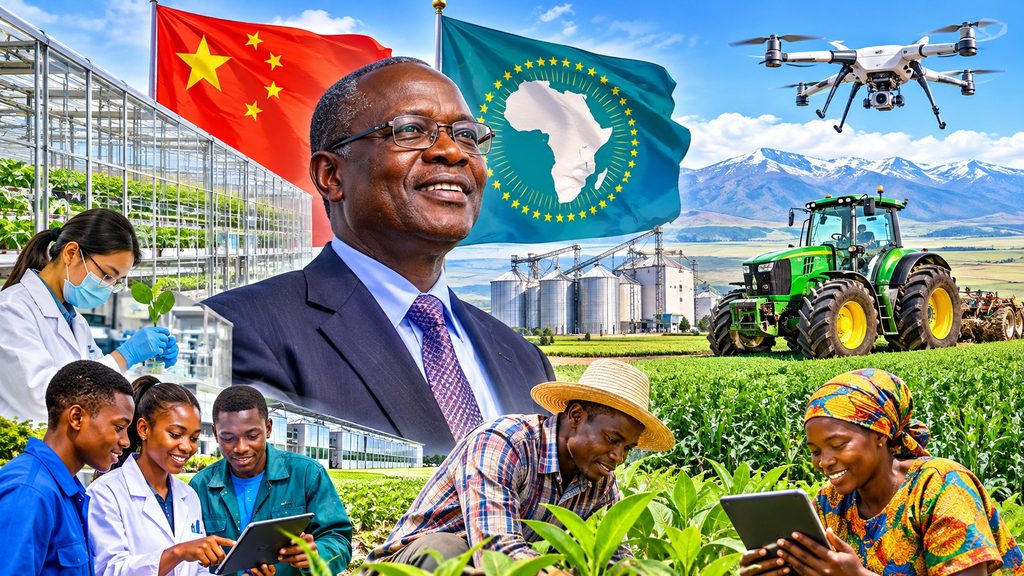
Insights from Xinjiang: Plant Factories and Smart Machinery
During the 2026 Training Workshop for Think-Tank Scholars from the Horn of Africa Countries, organized by Sichuan Normal University, I traveled from Chengdu to Urumqi on November 1. Our delegation visited two major centers of innovation: a High-Tech Plant Science Factory and the Boshiran Intelligent Agricultural Machinery Group.
The High-Tech Plant Science Factory highlights how controlled environments, precise scientific monitoring, and automated systems regulate temperature, humidity, lighting, water, and nutrients. For regions facing unpredictable rainfall and changing climate patterns, scientific plant production offers a reliable path for seedling cultivation, crop research, and specialized food production.
| MODERN AG-TECH EVALUATION FRAMEWORK | |
| HIGH-TECH PLANT FACTORIES | INTELLIGENT AGRICULTURAL MACHINERY |
| • Climate & nutrient control • Reduces rainfall dependency • Requires reliable power grid | • Land prep, planting, & harvesting • Replaces tedious manual labor • Needs local maintenance pipelines |
| CRITICAL REQUIREMENT | LOCAL AFRICAN FOCUS |
| • Economic viability & skills | • Machinery-hire & local technical training |
Modern Ag-Tech Evaluation Framework — Summary Table
Meanwhile, the visit to Boshiran Intelligent Agricultural Machinery Group addressed the imperative of agricultural mechanization. When farming relies entirely on physical labor and basic tools, output is strictly constrained by human endurance.
Appropriate machinery expands cultivated acreage, improves efficiency, and reduces physical strain. However, importing machinery without local repair facilities, spare parts, and trained operators transforms productive assets into expensive liabilities. Mechanization must be anchored by local technical ecosystems.
Tailoring Technology to the Horn of Africa
The Horn of Africa presents diverse ecological conditions that require tailored technological strategies rather than one-size-fits-all adoption.
- Ethiopia: Focus on expanding established farming communities through scaled mechanization, post-harvest processing, and agronomic research.
- Somalia and Djibouti: Prioritize advanced water management, precision drip irrigation, and controlled-environment systems suited to arid climates.
- South Sudan: Focus on basic infrastructure development, including feeder roads, irrigation networks, machinery maintenance hubs, and modern storage facilities.
| REGIONAL AG-TECH PRIORITIES IN THE HORN | |
| COUNTRY | PRIMARY AGRICULTURAL FOCUS |
| Ethiopia | Scaled mechanization, crop research, & processing hubs |
| Somalia | Precision irrigation, water management, & arid plant systems |
| Djibouti | Desalination tech, micro-irrigation, & controlled farming |
| South Sudan | Feeder roads, storage infrastructure, machinery, & irrigation |
Regional Ag-Tech Priorities in the Horn — Summary Table
For South Sudan, agriculture must no longer be viewed merely as a rural subsistence activity. It is a vital engine for national economic growth, job creation, and foreign exchange preservation. Transitioning from subsistence to commercial production requires consistent public policy and sustained capital investment.
For institutions looking to document agricultural research, draft technical policy briefs, or publish academic insights, professional support is available through dedicated Writing Services.
Building Local Capacity through China-Africa Cooperation
China-Africa agricultural cooperation must evolve beyond the simple procurement and shipment of machinery. True technology transfer occurs when the receiving country gains the internal capability to operate, maintain, adapt, and manufacture these tools locally.
| SUSTAINABLE TECHNOLOGY TRANSFER MODEL | |
| TRADITIONAL MODEL | CAPACITY-BUILDING MODEL |
| • Direct equipment sales • Imported technical experts • Fragmented machinery maintenance • High long-term dependency | • Joint technical education & training • Local machinery assembly & repair hubs • Shared university agronomy research • Equipment-hire services for smallholders |
Sustainable Technology Transfer Model — Summary Table
Collaborative initiatives between Chinese manufacturers and African technical institutes can train local engineers, mechanics, and machinery operators. Universities can partner to study soil dynamics, local crop varieties, and efficient water management.
Furthermore, private enterprise can introduce machinery-hire models, allowing smallholder farmers to access modern equipment on demand without prohibitive upfront capital costs.
If your institution requires multi-language academic translation, policy translation, or cross-border communication support, explore tailored options under Language Services.
Transforming Youth Employment and Agribusiness
A significant barrier to African agricultural development is the common perception among educated youth that farming represents backbreaking, low-income labor. Modern intelligent agriculture changes this dynamic entirely.
Young professionals do not need to work directly in the fields with manual tools to build lucrative careers in agriculture. Modern ag-tech opens diverse professional pathways:
- Agricultural engineering and machinery maintenance
- Greenhouse climate management and hydroponics
- Irrigation system design and water logistics
- Agricultural software development and drone monitoring
- Food processing, packaging, and supply chain management
- Equipment-hire entrepreneurship and machinery dealership
| YOUTH CAREER PATHWAYS IN MODERN AG-TECH | |
| ENGINEERING & SERVICES | BUSINESS & INNOVATION |
| • Machinery repair & maintenance • Precision irrigation design • Greenhouse systems control | • Tractor & equipment leasing services • Food processing & value addition • Agtech software & logistics apps |
Youth Career Pathways in Modern Ag-Tech — Summary Table
Women, who perform a substantial share of agricultural labor across Africa, must also receive equal access to machinery training, agricultural financing, and technology management. Presenting agriculture as a tech-driven, profitable enterprise is essential for mobilizing the continent’s young demographic dividend.
Integrating digital platforms, data systems, and smart agricultural tracking across local agribusinesses can be effectively supported using Technology Services.
Watching hands-on demonstrations provides a clear sense of how modern agricultural equipment operates in real-world conditions.
Modern Agriculture Machines on Another Level – Farmers Reap Millions Tons in Massive Harvests, YouTube · Agriculture Insight
Reflection Questions
- How can African governments ensure that imported agricultural technologies match local energy grids and financial realities?
- What policy incentives can encourage educated African youth to launch agribusinesses and ag-tech startups?
- How can local universities better connect their scientific research with the daily practical challenges faced by smallholder farmers?
FAQs
- Why is traditional farming insufficient for Africa’s current food security needs?
Traditional farming relying primarily on manual labor and basic hand tools is limited by human endurance and seasonal unpredictability. Intelligent agriculture uses machinery, data, and scientific management to significantly boost yields per hectare. - What is a High-Tech Plant Science Factory?
It is a controlled farming environment where temperature, light, humidity, water, and nutrients are artificially regulated to optimize crop growth, protect plants from extreme weather, and allow year-round production. - How can smallholder farmers afford modern agricultural machinery?
Through machinery-hire services, agricultural cooperatives, and micro-leasing models, farmers can rent machinery for land preparation or harvesting without needing to purchase expensive tractors individually. - What role do universities play in agricultural technology transfer?
Universities conduct essential local research on soil chemistry, climate-resilient seeds, and water efficiency, while training the engineers, mechanics, and technicians required to maintain modern ag-tech infrastructure. - How does intelligent agriculture benefit South Sudan specifically?
It enables South Sudan to transition from subsistence farming to commercial production, reducing reliance on expensive food imports, creating jobs for youth, and building a diversified, resilient national economy.
Conclusion
My experiences in Xinjiang confirmed that agricultural progress requires far more than owning fertile land. It requires technical expertise, strong research institutions, service-oriented agribusinesses, and clear government policies that foster production.
China’s rapid agricultural transformation offers valuable lessons, but African nations must adapt these approaches to fit their unique geographical, financial, and institutional realities. For South Sudan and the broader continent, modernizing agriculture with scientific tools, smart machinery, and local capacity building is the surest path to long-term economic independence.
And if you want to know what’s happening in my world as a writer and digital nomad, check out my Wealthy Affiliate blog page here: https://my.wealthyaffiliate.com/johnmaluth/blog.