
The history of China-Africa interactions did not start in the mid-twentieth century. Long before African capitals established embassies in Beijing and prior to the founding of the People’s Republic of China, merchants, travelers, sailors, and goods moved across the Indian Ocean world. These early contacts facilitated significant exchanges of commodities, knowledge, and cultural artifacts between the two regions.
However, a critical analytical distinction must be made when examining these ancient and medieval connections. Premodern maritime trade, local diplomatic gifts, and commercial exchange did not constitute modern China-Africa relations. There were no sovereign nation-states operating within a formalized international diplomatic system in the contemporary sense. The political institutions, geographical boundaries, and economic frameworks of those eras were fundamentally different from today’s global order.
Understanding this distinction is vital for analyzing contemporary international relations. Modern political narratives sometimes conflate ancient commerce with modern statecraft to frame present partnerships as an unbroken history of peaceful cooperation. While ancient trade along the Swahili Coast demonstrates a long heritage of Afro-Asian connectivity, modern strategic partnerships were built under entirely new historical conditions, specifically through twentieth-century decolonization, anti-colonial nationalism, and mutual economic aspirations.
Key Takeaways
- Premodern contact between China and East Africa was mediated primarily by open Indian Ocean trading networks rather than direct, bilateral state diplomacy.
- Archaeological evidence, such as Chinese porcelain found along the Swahili Coast, confirms robust historical commerce and African purchasing power.
- The Swahili Coast takes its name from the Arabic word sahil, meaning coastal, highlighting its role as a maritime commercial hub connecting Africa to Asia.
- The Ming dynasty voyages led by Admiral Zheng He represented impressive imperial naval expeditions, but they did not establish permanent diplomatic missions or continuous political alliances.
- Modern China-Africa relations were forged in the twentieth century, catalyzed by events like the 1955 Bandung Conference, where newly independent and anti-colonial movements sought non-aligned partnerships.
TL;DR
Ancient trade between China and East Africa across the Indian Ocean proves that the two regions were connected long before modern history, but it does not mean present-day China-Africa diplomatic alliances are ancient. Ancient networks were driven by multi-ethnic commercial exchange, whereas modern bilateral relations were built in the 20th century during anti-colonial independence movements and formal statecraft.
The Indian Ocean as a Commercial Corridor
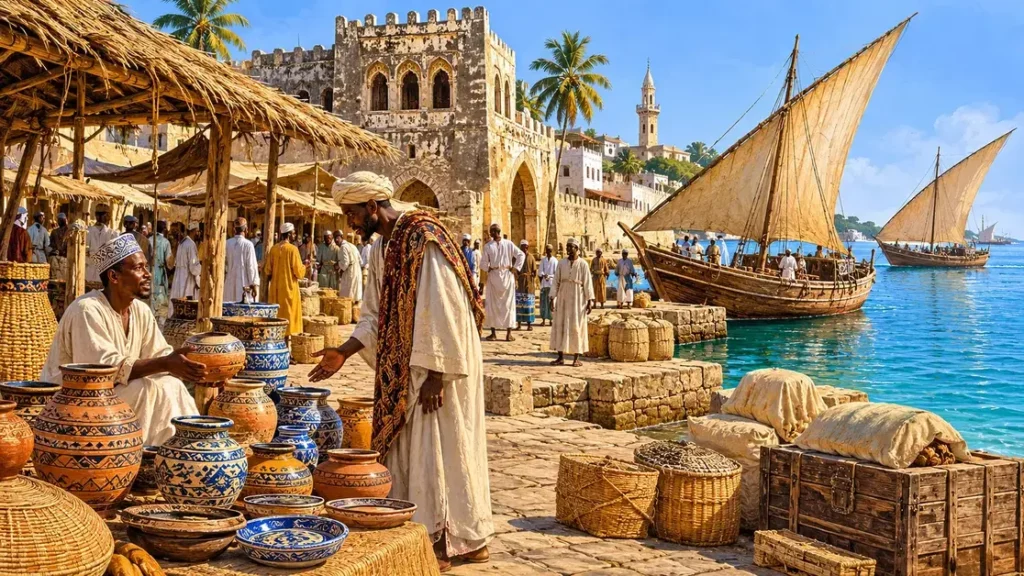
For centuries, East Africa was an active participant in the Indian Ocean commercial architecture. The Swahili Coast, deriving its name from the Arabic word sahil which means coastal, was never an isolated peripheral zone. Cities such as Mogadishu, Kilwa, Mombasa, and Zanzibar operated as vibrant urban commercial hubs.
These coastal centers linked interior African trade routes with maritime networks extending to Arabia, Persia, India, Southeast Asia, and China. Commodities such as gold, ivory, timber, and agricultural goods moved eastward across the ocean, while textiles, spices, and high-value ceramics moved westward into African markets.
| INDIAN OCEAN COMMERCIAL SYSTEM | |
| AFRICAN COMMODITIES | ASIAN COMMODITIES |
| • Gold, Ivory, Timber, Spices | • Ceramics, Silk, Textiles, Porcelain |
| KEY INTERMEDIARIES | KEY HISTORICAL HUBS |
| • African, Arab, Persian, Indian | • Mogadishu, Kilwa, Malindi, Mombasa |
Indian Ocean Commercial System — Summary Table
This commercial environment was multipolar. Neither a single African power nor an imperial Chinese dynasty controlled the entirety of the Indian Ocean routes. Instead, maritime navigation relied on predictable monsoon wind patterns, allowing diverse merchant communities to trade across vast distances.
Material Evidence along the Swahili Coast
Archaeological excavations along the East African coastline have unearthed substantial evidence of long-distance commercial connections. Chinese porcelain shards dating from the Tang, Song, Yuan, and Ming dynasties have been recovered from numerous archaeological sites.
These durable ceramic artifacts provide tangible proof of economic exchange. However, their presence should be interpreted with precision. Finding Chinese ceramics in East African ruins demonstrates economic demand, refined local taste, and active participation in global trade networks by Swahili elites.
| HISTORICAL EVIDENCE VS. MODERN INTERPRETATION | |
| MATERIAL FINDINGS | DIPLOMATIC REALITY |
| Chinese porcelain at Kilwa & Swahili Coast sites | Commercial trade via multi-ethnic intermediaries, not bilateral treaties |
| Records of African commodities in imperial Chinese texts | Knowledge transmission through networks, not formal embassy establishments |
| Zheng He expeditions to East African ports (1405-1433) | Imperial display of prestige, followed by centuries of complete naval withdrawal |
Historical Evidence vs. Modern Interpretation — Summary Table
The movement of these goods was reciprocal. African commodities, including ivory and precious materials, entered Chinese imperial markets and private commerce. This exchange highlights African agency and purchasing power within the premodern global economy rather than a passive receipt of foreign merchandise.
For independent professionals researching regional history or drafting analytical reports, reviewing localized context can be enhanced through professional Writing Services designed for clear publication standards.
Chinese Historical Knowledge and Imperial Sources
Chinese textual sources from various dynasties contain references to distant lands across the western ocean. Historical texts compiled during the Tang, Song, and Ming periods record descriptions of places, goods, and peoples associated with the East African coast.
These historical records reflect gradual knowledge accumulation. However, geographical terms used in ancient Chinese manuscripts do not always map neatly onto modern political borders or modern city names. Information often reached Chinese chroniclers through secondary accounts provided by Arab, Persian, or Indian sailors and merchants.
Consequently, while historical records confirm that African geographies were known within Chinese intellectual circles, they do not indicate direct political control, territorial settlement, or administrative oversight by ancient Chinese empires over African territories.
The Ming Dynasty Fleets and Zheng He
The most prominent historical contact between China and East Africa occurred during the early Ming dynasty under Emperor Yongle and Emperor Xuande. Between 1405 and 1433, Admiral Zheng He commanded seven massive maritime expeditions into the Indian Ocean.
These naval fleets visited numerous ports in Southeast Asia, India, the Arabian Peninsula, and the East African coast, including locations in present-day Somalia and Kenya. The expeditions were remarkable feats of maritime logistics, navigation, and state-backed seafaring capability.
| ZHENG HE’S MARITIME EXPEDITIONS | |
| TIMELINE | 1405 – 1433 AD (Seven major voyages) |
| PRIMARY PURPOSE | Imperial diplomacy, prestige display, tribute exchange |
| KEY LOCATIONS | Swahili Coast, Mogadishu, Malindi, Western Indian Ocean |
| HISTORICAL OUTCOME | Fleets recalled; Ming dynasty turned inward; long gap ensued |
Zheng He’s Maritime Expeditions — Summary Table
The primary objective of these voyages was imperial diplomacy, the display of Ming power, the registration of foreign rulers within the imperial tribute framework, and the acquisition of exotic gifts for the imperial court. They were not commercial colonization initiatives, nor did they establish permanent military garrisons or ongoing diplomatic missions in East Africa.
Following the death of the emperors who supported these naval ventures, the Ming state abruptly halted overseas fleet construction and turned its policy focus inward. This decision created a multi-century gap in direct state-sponsored Chinese maritime presence in the Indian Ocean.
Discontinuity and the Impact of Western Imperialism
The discontinuation of Ming naval expeditions highlights a clear historical break. Ancient trade networks and periodic imperial fleet visits did not evolve directly into continuous political alliances between China and African states.
In the centuries that followed, the Indian Ocean commercial architecture underwent dramatic transformations. European maritime powers entered the region in the late fifteenth and early sixteenth centuries, forcibly disrupting established Afro-Asian trade routes along the Swahili Coast.
| THE DIVERGENT HISTORICAL PATHS | |
| EAST AFRICA | CHINA |
| • European maritime disruption • Reorientation of trade routes • Encroaching Western colonialism | • Transition from Ming to Qing dynasty • Domestic internal upheavals • 19th-century foreign intervention |
The Divergent Historical Paths — Summary Table
Simultaneously, China experienced major internal transitions, moving from the Ming to the Qing dynasty, and eventually facing nineteenth-century imperial interventions, unequal treaties, and internal turmoil. Both Africa and China encountered the modern era under conditions shaped by external pressures, territorial encroachments, and anti-colonial resistance.
Navigating complex historical documentations or translating academic materials related to these periods often requires specialized expertise, such as that provided through dedicated Language Services.
The Twentieth-Century Transformation and the Bandung Moment
Modern China-Africa relations were born out of a fundamental political transformation during the mid-twentieth century. The primary foundation of contemporary engagement shifted from ancient trade items like silk and ivory to modern political concepts: national sovereignty, territorial integrity, decolonization, and non-alignment.
| EVOLUTION OF CHINA-AFRICA ENGAGEMENT | |
| PREMODERN ERA | MODERN ERA |
| • Indian Ocean trade networks • Commodities: Porcelain, Ivory • Intermediaries: Arab, Indian | • Sovereign state diplomacy • Political alignment & Anti-colonialism • Bilateral economic partnerships |
Evolution of China-Africa Engagement — Summary Table
A major catalyst in this transformation was the Asian-African Conference held in Bandung, Indonesia, in 1955. Representatives from newly independent Asian and African nations gathered to assert self-determination, promote South-South cooperation, and oppose colonial hegemony.
At Bandung, the People’s Republic of China, represented by Premier Zhou Enlai, established direct political dialogue with African delegations. This historic conference marked the true beginning of modern China-Africa diplomatic relations, grounded in shared experiences of anti-colonial resistance rather than imperial maritime legacies.
Modern Diplomatic Implications for Africa and Global Powers
Understanding the distinction between premodern commercial networks and modern state diplomacy enables clearer analysis of contemporary foreign policy. Modern partnerships between China and African states are structured around state-to-state bilateral agreements, infrastructure projects, credit frameworks, and multilateral forums like the Forum on China-Africa Cooperation (FOCAC).
While contemporary political rhetoric often references ancient historical connections to emphasize a long heritage of peaceful relations, African policymakers must evaluate current engagements based on sovereign national priorities, economic viability, and long-term development goals.
African nations continue to navigate relationships with major global actors, including both Beijing and Washington. Maintaining analytical clarity regarding historical facts allows African states to position themselves as sovereign, self-reliant players in global affairs, leveraging foreign partnerships to advance domestic industrialization and technological development.
Supporting technological integration and online operations for local institutions or independent professionals can be further explored through specialized Technology Services.
Reflection Questions
- How does distinguishing between premodern trade networks and modern state diplomacy change our perspective on contemporary international alliances?
- In what ways did the open commercial architecture of the ancient Indian Ocean differ from modern state-regulated international trade?
- Why is it important for African nations to ground their current foreign policy decisions in contemporary economic realities rather than historical narratives?
FAQs
- Was the Swahili Coast politically controlled by ancient Chinese empires? No, ancient Chinese empires never exercised political control, territorial administrative authority, or military dominance over the Swahili Coast. Connections were maintained through commercial trade networks and periodic diplomatic gift exchanges mediated by multi-ethnic merchants.
- What does the word Swahili mean historically? The word Swahili originates from the Arabic term sahil, which translates to coastal or borderland. It refers to the coastal urban societies and language that developed along the East African littoral through vibrant Afro-Asian commercial interactions.
- Did Admiral Zheng He establish permanent Chinese colonies in East Africa? Historical and archaeological evidence confirms that Admiral Zheng He’s fleets visited key ports on the East African coast during the early fifteenth century. However, these visits were imperial diplomatic expeditions rather than colonizing missions, and they did not result in permanent settlements or ongoing administrative presences.
- Why is the 1955 Bandung Conference considered the starting point for modern China-Africa relations? The 1955 Bandung Conference provided the first major international platform where representatives of the People’s Republic of China and emerging African liberation movements met directly to discuss shared anti-colonial principles, national sovereignty, and South-South economic cooperation.
- How should modern African states evaluate current China-Africa partnerships? African states should evaluate current partnerships based on concrete economic metrics, long-term national interest, debt sustainability, transparent governance, and aligned development goals, rather than relying solely on historical narratives of ancient harmony.
Conclusion
The history of interaction between China and Africa reveals a rich heritage of early long-distance trade across the Indian Ocean, characterized by economic exchange and cultural curiosity. Archaeological findings along the Swahili Coast confirm that African societies were active participants in ancient global trade.
However, modern China-Africa diplomacy is not a simple linear extension of ancient maritime commerce. Contemporary bilateral relations were constructed during the twentieth century amidst decolonization, anti-colonial nationalism, and the search for sovereign development pathways.
By maintaining clear historical boundaries, African nations can honor their rich heritage of ancient global connectivity while engaging modern global powers with realistic, strategic, and self-reliant statecraft.
To explore further analytical perspectives on global affairs, writing, and digital technology, subscribe to our newsletter or connect directly through our platform today.
And if you want to know what’s happening in my world as a writer and digital nomad, check out my Wealthy Affiliate blog page here: https://my.wealthyaffiliate.com/johnmaluth/blog.
Sources
- Institute of Developing Economies, Japan External Trade Organization (JETRO): Historical Perspectives on China-Africa Relations
- UNESCO General History of Africa: Ancient and Medieval Afro-Asian Trade Networks
- Journal of African History: Archaeology of the Swahili Coast and Asian Ceramic Trade
- Ministry of Foreign Affairs of the People’s Republic of China: Official Records on the 1955 Bandung Conference