
Adults frequently chase purpose through high-paying careers, social status, and elaborate long-term plans, yet children live many of the answers right in front of us every single day.
Through their unbridled wonder, unfiltered honesty, steady presence, small acts of kindness, and resilient play in the face of hardship, children model what a meaningful human life looks like in its purest form.
When adults slow down to watch, listen, and learn from children, purpose stops feeling like an elusive achievement. Instead, it becomes about living honestly, loving generously, and remaining fully present where we are.
Children may not know abstract philosophical terms, but they demonstrate true meaning one shared biscuit, one direct question, and one burst of laughter at a time. This reality anchors our communities, reminding us that the future of any nation depends entirely on how we raise and cherish our young.
Key Takeaways
- Simplicity Over Status: Children find joy and meaning in exploration and play rather than job titles or material possessions.
- Unfiltered Truth: Youthful honesty acts as an uncorrupted mirror, stripping away adult pretense and pointing toward authenticity.
- The Power of Presence: Children demand immediate, focused attention, teaching adults that purpose lives in the present moment.
- Global Geopolitics and Youth: While Western nations and China invest heavily in physical infrastructure and international diplomacy across Africa, the ultimate survival and prosperity of nations like South Sudan rest upon the moral foundation built within family homes.
- Resilience in Hardship: Children demonstrate that joy and play can flourish even in refugee settlements and impoverished environments.
TL;DR
Adults often search for purpose through status and careers, but children display it naturally through wonder, honesty, and presence. By slowing down to learn from youth, adults rediscover how to live honestly and love generously.
Furthermore, while global powers like the United States and China compete for economic influence across Africa, the true future of nations like South Sudan depends on nurturing the character and well-being of the next generation.
Adults Searching, Children Showing
When I was a boy growing up, I assumed adults held all the answers. They walked with firm steps, spoke with absolute certainty, and decided who was right and who was wrong. In my young mind, adulthood meant total clarity. Then I grew up.
I watched adults change jobs, abandon dreams, and occasionally break under heavy pressures that nobody prepared them for. I heard them whisper questions at night that they never dared voice in public. Why am I here? What is my purpose now that life did not go according to plan?
At the same time, I watched children play and noticed something remarkable. They never used philosophical terms, yet they lived with an emotional clarity many adults had long lost. Their days were filled with exploration, laughter, and spontaneous sharing.
They were not trying to be impressive, yet their daily routines carried deep meaning. That is when I began to realize that profound truths often hide inside small human beings.
The Simplicity of Wonder
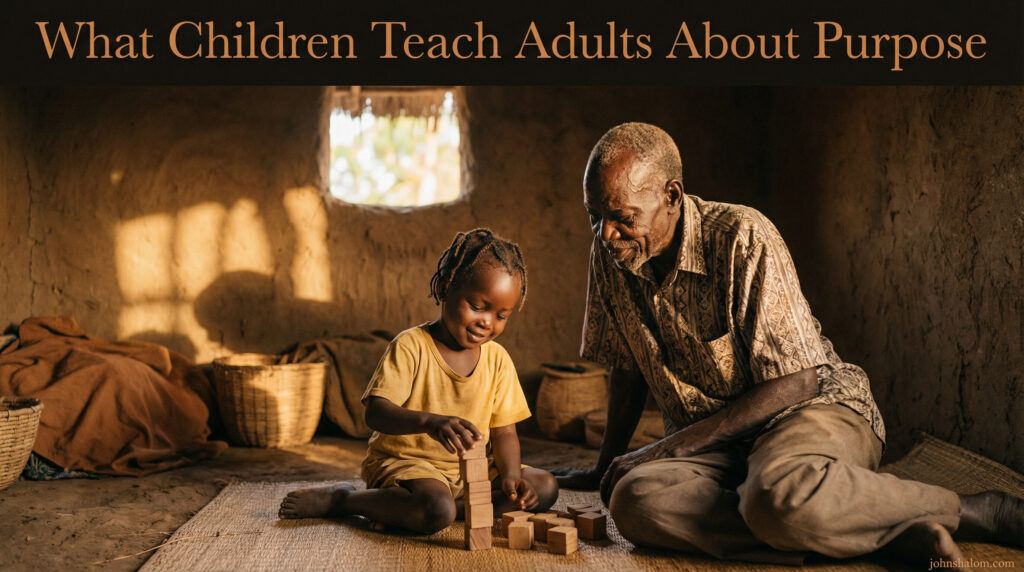
Children wake up each morning with a built-in mission: to discover the physical world around them. A simple wooden stick becomes a sword in a grand battle. A muddy puddle transforms into a vast ocean. An empty cardboard box becomes a vehicle, a house, or a spaceship, depending on the imagination of the hour.
Their purpose is not wrapped up in university degrees, corporate job titles, or quarterly performance reviews. Their goal is simple: explore, enjoy, and learn. They are not waiting to become someone important someday. In their own eyes, they already matter today.
I once watched a small boy spend half an hour chasing a butterfly across a dusty yard. He ran, fell down, laughed, stood up, and kept running. The butterfly never landed in his hands, but the joy never left his face. Under a nearby tree, a group of adults argued fiercely about politics and power.
Their faces were tense, and their voices shook with bitter anger. At the end of that half hour, the child had learned something about movement, persistence, and beauty. The adults had merely traded fresh insults. Who used their time better? Who lived closer to real purpose during those thirty minutes?
Global Powers, Domestic Realities: South Sudan and Africa vs. USA and China
This observation brings us to a broader reflection on national development. Across the global stage, superpowers like the United States and China exert massive influence over Africa. The United States frequently ties its foreign aid and diplomatic efforts to governance reforms, institutional oversight, and human rights advocacy.
Meanwhile, China focuses on hard infrastructure financing, constructing modern roads, railways, electricity grids, and government buildings across the continent through direct state-backed loans. Both approaches project grand visions of global leadership and economic integration.
Yet, when we examine nations like South Sudan, we see a starkly different reality on the ground. Billions of dollars in foreign loans and diplomatic pressure cannot substitute for the moral fiber instilled in children at home.
If young people grow up in environments marked by domestic neglect, ethnic division, and moral ambiguity, no amount of foreign-built asphalt or imported governance models will save the nation from collapse.
+------------------------------------+------------------------------------+
| Global Superpower Strategies       | Grassroots Family Investment       |
+------------------------------------+------------------------------------+
| U.S. focus on institutional reform | Parental modeling of moral truth   |
| Chinese investment in hard         | Childhood resilience and play in   |
|   infrastructure (roads, grids)    |   local communities                |
| Macro-level geopolitical leverage  | Micro-level character development  |
+------------------------------------+------------------------------------+
While Washington and Beijing negotiate trade treaties and resource extraction agreements, the actual future of South Sudan is decided in village courtyards and urban living rooms.
When parents invest time, patience, and ethical grounding in their children, they build a human infrastructure that outlasts any foreign-funded highway. True national security begins with children who learn how to share, tell the truth, and respect their neighbors.
Honest Humor and the Child as a Mirror
Children tell the truth with a dangerous kind of innocence. They have not yet mastered the adult art of polite falsehoods. I once asked a young child if I looked tired after a grueling week of writing and travel.
He looked at me carefully and replied that I looked like an exhausted goat that had missed sleep. The entire room erupted in laughter, and I laughed too, even though the description stung. His words were funny, but they were remarkably accurate. I had been overworking and pretending everything was fine. That child saw through my professional mask instantly.
Children do this constantly. They tell you when a story is boring, ask why you are angry when you claim to be calm, and point out when your actions contradict your words. Their honesty teaches a sharp lesson. Purpose is not about polishing an artificial public image. It is about living in absolute truth. If you spend your entire life performing for others, you will feel empty inside, regardless of how much external praise you receive.
Purpose as Present Attention
Another vital lesson children teach us is that purpose connects directly to presence. Children do not spend hours regretting yesterday or agonizing over tomorrow’s financial burdens. Their energy remains fully invested in the current moment. Eating, laughing, arguing, asking questions, and exploring consume their full attention.
My niece once looked directly into my face while I was half-listening to her story and half-thinking about unfinished publishing deadlines. She stopped talking, looked at me with piercing clarity, and asked why I always looked far away when she spoke to me. Her words cut deeper than any motivational book.
I was sitting right in front of her, but my mind was wandering through virtual folders and task lists. To her, my emotional absence was completely obvious. That day taught me that purpose is not only about what tasks you complete, but how fully you inhabit the present moment with the people who matter.
Small Acts and Quiet Resilience in Hardship
Most children do not draft grand manifestos to change the world. They focus on smaller, immediate realities. They share a single sweet, help a fallen friend stand up, offer tight embraces, or bring a wounded bird to an adult for assistance. These small acts carry the foundational DNA of purpose.
+-----------------------------------------------------------------------+
| EVERYDAY CHILDHOOD LESSONS IN PURPOSE                                 |
+-----------------------------------------------------------------------+
| [ ] Sharing limited resources (like a single biscuit) without hesitation |
| [ ] Forgiving quickly after a minor dispute without holding grudges   |
| [ ] Finding joy in simple play using basic, everyday objects          |
| [ ] Asking direct, honest questions that cut through adult pretense   |
| [ ] Maintaining resilience and laughter amidst difficult environments |
+-----------------------------------------------------------------------+
I once witnessed children in a challenging displacement setting kick an empty plastic bottle as if it were a championship football. They argued over teams, shouted with genuine excitement, and celebrated every imaginary goal with pure elation.
The ground was dusty, the future was uncertain, and food supplies were meager. Yet, inside that simple game, joy returned. Their play did not instantly eliminate hunger or danger, but it created a vital pocket of meaning in the middle of chaos. Children prove that purpose does not require perfect conditions. It can thrive even in broken places.
Practical Ways to Let Children Teach Us Purpose
Translating these observations into daily life requires intentional action. Here are several practical steps adults can take to learn from the children around them:
- Watch with Intention: Instead of constantly correcting children, observe what brings them genuine laughter, how quickly they forgive after a disagreement, and how they find wonder in ordinary stones or puddles.
- Ask Real Questions: Move beyond routine inquiries about schoolwork. Ask children what made them happy today, what caused them sadness, or what they wish adults understood better. Listen without interrupting.
- Welcome Interruptions: Treat spontaneous interactions not as obstacles to productivity, but as opportunities for genuine connection and presence.
- Embrace Play: Join children in games, drawing, or unstructured movement. Rediscovering joy helps combat adult cynicism and burnout.
- Record Their Insights: Keep a written record of the surprising and wise observations children share. Reviewing these notes during difficult times provides grounded perspective.
Conclusion
Children may not run multinational corporations, command armies, or draft parliamentary legislation, but every single day they deliver silent sermons about what truly matters in life. They remind us that wonder still exists, that honesty outperforms pretense, and that real life happens in the present moment.
While global superpowers negotiate massive financial pacts and construct monumental infrastructure, the soul of a nation is forged in the quiet interactions between parents and children around the family table. If we humble ourselves long enough to listen, we discover that children are not merely preparing for tomorrow. They are teaching us how to live with genuine purpose right now.
And if you want to know what’s happening in my world as a writer and digital nomad, check out my Wealthy Affiliate blog page here: https://my.wealthyaffiliate.com/johnmaluth/blog.


This is a deeply insightful and reflective piece that thoughtfully reframes purpose through the lens of presence, simplicity, and authenticity. I particularly appreciate how you connect childlike qualities curiosity, honesty, and generosity to core principles of meaningful living. The balance between philosophical reflection and practical application makes the message both relatable and actionable. Overall, it offers a compelling reminder that purpose is often found not in complexity, but in fully engaging with the present moment.
Kavitha, thank you so much. You really caught the heart of what I was trying to say.
I keep feeling that children expose how far many of us adults drift from simple truth. We chase big answers and miss the life right in front of us.
Your words encouraged me. Do you think most adults lose purpose because they stop being present, or because they are taught to fear simplicity?