Human beings experience a profound inner emptiness when their daily actions move in a direction opposite to their true identity. Modern digital creators frequently fall into this quiet despair.
They spend countless hours producing video clips, writing articles, and chasing online metrics, yet they wake up feeling disconnected from their work. The core issue is not a lack of effort or technical skill.
The true problem lies in a structural disconnect between character and output. Meaning appears naturally when personal values, identity, and character align directly with habits, daily labor, and professional output.
For digital creators and writers in South Sudan and across Africa, defining this alignment is a matter of cultural self-reliance and national building. A generation raised amidst historical conflict and economic rebuilding cannot afford to create superficial content purely for immediate financial gain or external validation.
Content creation must serve as a bridge that connects personal conviction with community development. When a creator understands who they are before deciding what to build, their work becomes a reliable tool for social cohesion, public education, and sovereign expression.
Across the international arena, major global powers demonstrate contrasting approaches to the alignment of identity and productivity. The United States promotes a commercial model of hyper-individualized creation, where action is driven by personal branding and market competition.
China enforces a state-aligned model that channels creative talent into collective stability and national economic goals. For South Sudan and the wider African continent, content creation must unify local communal identity with modern digital capabilities, ensuring that personal output strengthens both individual purpose and the state.
Key Takeaways
- The Alignment Formula: True purpose emerges when identity and character (Being) directly dictate daily work and habits (Doing).
- Survival to Service: Lived experience through historical hardship can be channeled into constructive writing, mentorship, and public education.
- Global Educational and Creative Models: Western commercial individualism, Chinese state-aligned productivity, and African community-rooted purpose present distinct paths for creators.
- National Alignment: A stable government and unified society require national policies (Doing) to reflect core patriotic values and cultural heritage (Being).
TL;DR
Life feels empty when who you are and what you do move in separate directions. By examining the formula Being + Doing = Meaning, this article shows how content creators can connect their personal history, values, and character with daily work. By contrasting Western commercialized media, Chinese state-directed talent models, and African community-centered storytelling, creators in South Sudan can produce work that builds both personal purpose and national strength.
The Mathematical Logic of Personal Purpose
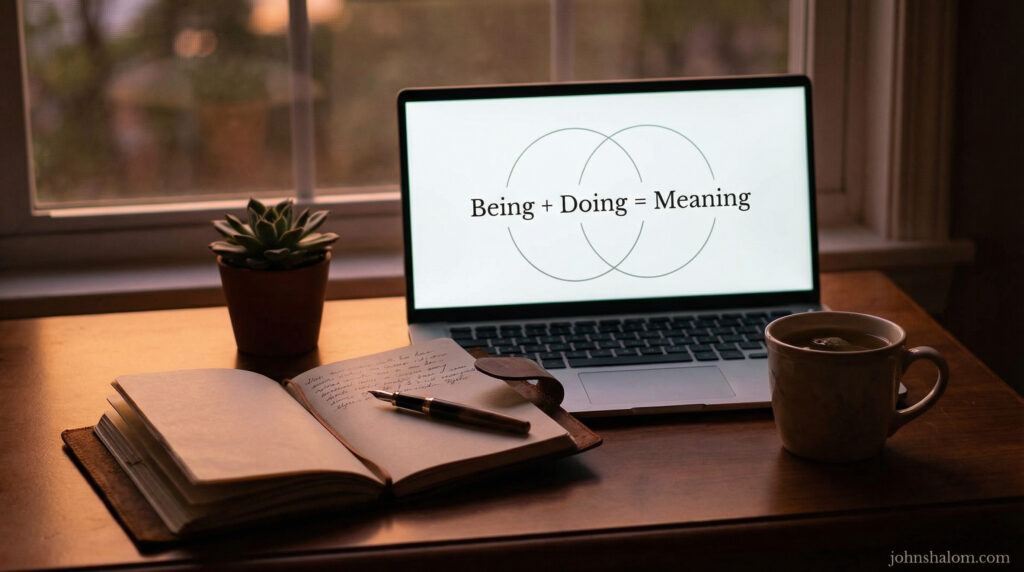
To understand why so many digital workers feel burned out, one must examine the relationship between internal identity and external labor. The relationship can be expressed through a simple formula:
Meaning = Being + Doing
In this equation, Being represents the internal anchor of human existence. It encompasses identity, non-negotiable moral values, faith, and the quiet character that remains when titles, public platforms, and material wealth are removed. Doing represents the visible output produced by hands, voice, and mind. It includes daily writing habits, professional projects, administrative tasks, and personal choices made when interacting with others.
When these two elements walk together, daily labor produces a quiet sense of fulfillment. However, when a creator values truth in their heart but produces sensationalized content for rapid online views, internal friction occurs. Likewise, when a creator values community unity but engages in divisive online rhetoric for commercial profit, meaning collapses. Fulfillment is not something discovered by accident; it is generated when daily habits honor core identity.
Survival Roots: From War-Torn South Sudan to Purposeful Writing
My understanding of this equation was not formed in a quiet academic lecture hall. It was forged through survival during the long years of civil conflict in South Sudan. As a boy growing up near the Sobat River, my internal identity was shaped by fear, displacement, and constant alertness. My daily actions were simple reactions to danger: run when conflict approaches, find clean water, obey community elders, and survive another day. In an environment dominated by immediate threat, there was little room to ponder high philosophy. Survival was the only priority.
In 1989, my elder brother joined the armed struggle and never returned. His death left a permanent mark on my young mind. It forced me to confront difficult questions about existence: Why was my life preserved while so many others perished? What duty do I owe to my country and my people with this borrowed time?
When I later discovered the power of written language, my life underwent a clear shift. Writing began as an effort to process personal memory and pain, but it quickly became something larger. It became my main medium of service. My internal identity as a survivor, thinker, believer, and son of South Sudan found its exact expression in daily writing, teaching, and digital publishing. The chaos of early life did not magically vanish, but my daily work ceased to feel random. Hardship was transformed into valuable material for public service and community education.
Global Realities: How Nations and Creators Align Action with Identity
The principle of aligning identity with action applies to international systems just as it applies to individual writers. Different global centers structure the creative economy through distinct ideological models.
In the United States, content creation is heavily commercialized. The American system encourages writers, media producers, and digital entrepreneurs to treat themselves as private corporate brands. Success is measured by personal audience reach, monetization metrics, and market independence. While this model encourages rapid technical innovation and high individual earning potential, it frequently isolates creators from civic responsibility. Action becomes detached from moral identity, leading many creators to produce sensational content purely to satisfy automated platform algorithms.
China models creative and intellectual production around collective state development. The Chinese government guides digital platforms, educational programs, and creative industries to align directly with national unity, social order, and technological progress. Creative expression in China is expected to contribute to public stability and national industrial goals. This system achieves remarkable collective discipline and public focus, though it restricts personal expression that falls outside official state policy.
For South Sudan and the broader African continent, content creation must follow a distinct path. African writers cannot simply copy Western commercial individual focus, which reduces culture to financial commodities. Nor should they rely entirely on rigid state control that stifles original local talent. Africa requires a model rooted in community responsibility, patriotic state-building, and open digital access. By using global technology to tell authentic national stories, African creators can preserve their cultural values while engaging effectively in the global knowledge economy.
| Creative Dimension | United States | China | South Sudan & Africa |
| Primary Driver of Content | Personal profit & audience expansion | State guidance & social harmony | Community education & sovereign story-telling |
| Identity Base (Being) | Individual brand & commercial interest | Citizen duty & national alignment | Cultural heritage, faith, & civic duty |
| Action Strategy (Doing) | Market competition & algorithm optimization | Managed platforms & policy integration | Self-published books, digital tools, & local mentoring |
| Ultimate Goal (Meaning) | Financial independence & individual fame | National stability & industrial strength | Community elevation & patriotic state-building |
The Danger of Unaligned Action: Dreaming Versus Drifting
When creators fail to balance identity with action, they generally fall into one of two damaging categories:
1. The Dreamers Without Action
These individuals possess high ideals and strong values. They speak passionately about writing books, building educational platforms, or improving their communities. However, their ambition remains confined to conversation. They study theory, attend conferences, and make elaborate plans, but they rarely execute daily tasks. Without consistent work, their moral vision remains an unfulfilled dream.
2. The Busy Workers Without Direction
These individuals are constantly active. They post continuously on social media, manage endless tasks, and chase every new digital trend. Yet, because they have never defined their core identity and values, they feel perpetually exhausted. They build digital platforms that do not represent who they truly are. Their constant busyness becomes a form of aimless drifting.
       [ High Alignment of Being ]
                  |
  Dreamers        |    Purposeful Creators
  (Vision without |    (Identity matched
   Daily Action)  |     with Daily Labor)
------------------+------------------
  Aimless         |    Drifters
  Bystanders      |    (Action without
                  |     Core Identity)
                  |
        [ Low Alignment of Being ]
Meaning lives exclusively in the upper-right section of this relationship. True progress requires both the quiet clarity of character and the daily discipline of productive labor.
Practical Daily Routines for Inner and Outer Alignment
Aligning identity with daily work does not require dramatic overnight life changes. It is built through quiet, repeated daily choices:
- Morning Alignment Check: Before turning on digital devices or opening email, spend ten minutes clarifying your purpose. State your core values clearly. Remind yourself that your daily work must serve those values.
- Attach Purpose to Specific Tasks: Do not approach writing merely as a chore to complete. Approach it as an act of public service and truthful instruction. When editing an article or producing a video, complete it with high technical care because you value excellence and respect your audience.
- Eliminate Superficial Distractions: Excessive social media scrolling divides attention and erodes personal character. Guard your time carefully, dedicating your best mental energy to deep work that produces lasting value.
- Evening Review: At the end of the day, review your output. Ask honestly whether your visible actions matched your internal standards. If you fell short, identify the reasons without self-condemnation and prepare to adjust your habits tomorrow.
- Convert Personal Experience into Public Value: Examine your history, including past hardships and mistakes. Use those experiences as practical lessons to guide, mentor, and instruct others who are facing similar struggles.
Applying the Formula to National Governance and State Rebuilding
The formula Being + Doing = Meaning is not limited to personal life. It provides an equally powerful structure for national development and governance.
For a sovereign nation like South Sudan, a national identity (Being) is defined by its history of struggle, its diverse cultural heritage, its constitutional values, and its collective dream of lasting peace. National policy (Doing) consists of concrete government action: building paved highways, establishing rural health clinics, funding public schools, enforcing the rule of law, and maintaining fiscal discipline.
National meaning and social trust emerge when government actions match stated national values. If a state proclaims a commitment to justice and unity, but public administration is plagued by financial mismanagement or administrative inefficiency, public confidence erodes. Conversely, when government institutions systematically translate patriotic values into visible infrastructure and public security, citizens experience a genuine sense of national pride and shared purpose.
A country is built not merely by physical concrete and steel, but by the alignment between its national principles and its daily governance. When leaders and citizens alike align their actions with the high ideals of statehood, national development becomes a clear, steady reality.
Reflection Questions
- How closely do your daily professional tasks reflect the core moral values you hold most dear?
- In what ways can you use your past personal challenges to create educational content that serves your immediate community?
- What specific habits or digital distractions currently prevent you from translating your internal ideals into daily creative work?
- How can African content creators use modern digital platforms to advance local cultural values without copying Western commercial patterns?
- How can local government agencies and civic leaders better align public policy execution with the historical aspirations of their citizens?
FAQs
- What is the simplest explanation of the Being + Doing = Meaning formula?
It means that lasting purpose is created when your visible daily habits, work, and actions directly express your internal identity, faith, and moral values. - How can a creator find purpose if they are currently working in a job they do not enjoy?
Even in difficult employment, you can bring integrity, discipline, and high standards of service to your tasks. Simultaneously, you can use your free time to develop writing, teaching, or technical skills that align more closely with your long-term life purpose. - Why is this formula particularly important for writers in South Sudan and Africa?
African nations are actively engaged in state-building and cultural preservation. Writers and creators carry a civic responsibility to produce work that educates the public, promotes social harmony, and provides authentic national narratives rather than copying foreign commercial media trends. - What is the main difference between Western and African content creation models?
Western models emphasize individual branding, audience monetization, and commercial competition. African models prioritize community advancement, cultural preservation, mentorship, and national cohesion while utilizing modern global digital tools. - How does personal character alignment affect broader national governance?
Governments are operated by individuals. When public administrators, teachers, and civic leaders cultivate personal integrity and align their private character with public duty, state institutions become more efficient, reliable, and trustworthy.
Conclusion
The pursuit of meaning is not an abstract philosophical luxury reserved for quiet times. It is a practical daily requirement for every writer, content creator, and citizen who wishes to live a productive life. While superficial online trends encourage creators to pursue rapid attention and financial gain at any cost, lasting fulfillment remains tied to the alignment of identity and action.
As the United States continues its focus on private commercial media and China strengthens its state-directed content systems, South Sudan and African nations must maintain their own path. By grounding our identity in cultural heritage, faith, and historical resilience, and by directing our daily labor toward education, truth, and community service, we build a reliable foundation for personal and national progress.
When you align who you are with what you do every single day, work ceases to be a burden. Hardship becomes valuable instruction, daily labor becomes meaningful service, and life takes on a clear, enduring purpose that honors both your personal journey and your nation’s future.
And if you want to know what’s happening in my world as a writer and digital nomad, check out my Wealthy Affiliate blog page here: https://my.wealthyaffiliate.com/johnmaluth/blog.
This topic connects strongly with my own experience, especially the distinction between being, doing, and meaning. For a long time, I focused almost entirely on doing. Achievements, productivity, visible results. On the surface it looked like growth, but internally something was missing. The more I did, the less grounded I felt.
What changed things for me was realizing that being has to come first. When attention, presence, and inner alignment are neglected, action becomes restless instead of purposeful. Doing without being leads to exhaustion. Being without doing can lead to stagnation. Meaning emerges only when the two are held together.
I also appreciate how the article frames meaning as something practiced daily rather than discovered once and for all. In my life, meaning has never arrived as a grand revelation. It shows up in small, repeated choices. How I respond to people. How I structure my day. Whether my actions reflect my values, even when no one is watching.
This framework is practical because it is honest. Growth is not about constant improvement, but about coherence. When who you are, what you do, and why you do it begin to align, life feels quieter, sturdier, and more truthful. That has been my lived experience, and it is still an ongoing practice.
Farid, I felt this one in a quiet way.
I also spent seasons where I mistook movement for meaning. I was doing a lot, and people could see the output, but inside I was not settled. In my case, it took hard years, war memories, and the pressure of survival to teach me that doing can become a hiding place. You stay busy so you do not have to sit with who you are.
Your line, “action becomes restless instead of purposeful,” is exact. I have lived that restlessness. And I agree with you that meaning rarely arrives as a single big moment. It shows up in small choices, repeated until they become character. How you treat people when you are tired. What you do when nobody claps. Whether your private life matches your public words.
I like that you called it coherence. That is the real test. When being and doing start agreeing with each other, the mind becomes calmer, and even suffering makes more sense because it is carried with direction.
What is one small daily practice that helped you put “being” back in front of “doing” without turning your life into a slow, overthinking routine?