
The modern digital economy has granted millions of professionals the ability to work from anywhere on earth. From laptop workers in coffee shops in Nairobi to remote software engineers in Southeast Asia, geographic freedom has become a celebrated goal. Yet, behind the screen and the changing horizons, a quiet question remains: what is the ultimate aim of this freedom?
In the Western world, particularly in the United States, digital nomadism is often promoted through a lens of extreme individualism and commercial gain. The narrative focuses on escaping traditional jobs, maximizing personal comfort, and collecting experiences. In contrast, state-guided economic models such as China view digital technology primarily as an instrument for national organization, collective stability, and strategic sovereignty.
For South Sudan and the broader African continent, digital work presents a different responsibility altogether. In developing societies recovering from historical conflicts and economic hurdles, remote work cannot merely be a path to personal escape. It must serve as a tool for sovereign state-building, family support, and community development.
Having survived bullets, hunger, and displacement along the Sobat River in my youth before working across Juba, Nairobi, and international digital networks, I have learned that true fulfillment does not come from changing your physical location. It comes from anchoring your work in timeless values. By combining the divine call of Christian faith with the practical discipline of Stoicism, digital workers can build a life that stands firm regardless of external uncertainty.
Key Takeaways
- Purpose is not a job title or a physical location; it is an enduring commitment to character and service.
- Geographic mobility without moral direction leads to restlessness rather than personal fulfillment.
- Combining faith and Stoicism pairs spiritual calling with daily mental discipline and practical duty.
- Western digital individualism focuses on personal autonomy, while African digital work must contribute to community strength and national development.
- Meaning is created through small, disciplined daily actions rather than waiting for dramatic signs.
TL;DR
Many remote workers confuse geographic freedom with life purpose. While American culture treats digital work as personal escape and China structures technology for state objectives, African professionals must use digital tools to build resilient communities. True purpose emerges when faith in God’s divine design meets Stoic self-discipline, transforming daily work into meaningful service.
The Search for Meaning Beyond Geographic Freedom
The Illusion of Location Independence
Equipping yourself with a laptop and a stable internet connection allows you to move across borders, but it does not answer why you exist. Many young professionals believe that leaving their home country or working from a beach will cure internal discontent. Soon, however, the initial excitement fades, leaving the same fundamental questions unanswered.
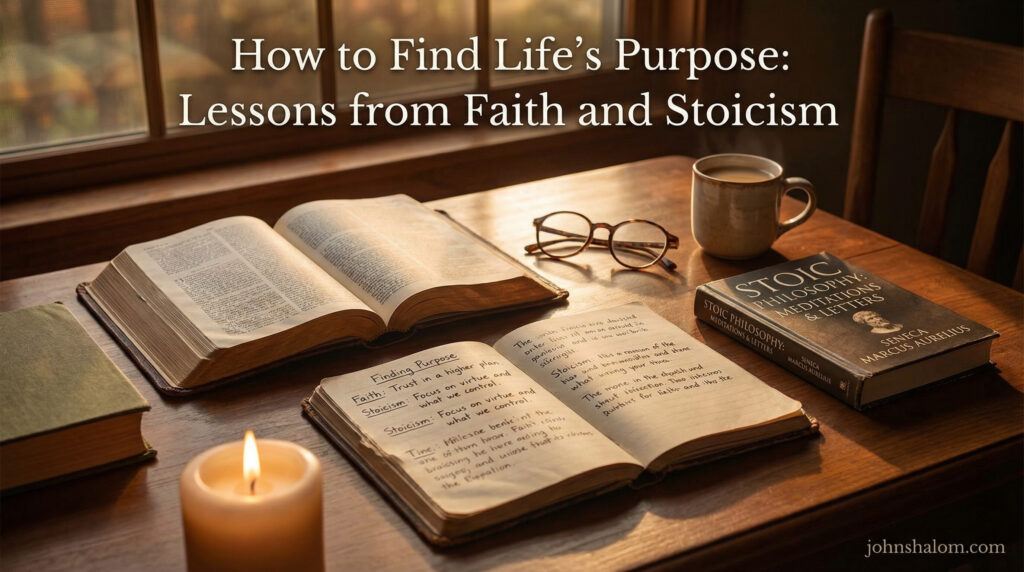
Movement is not progress if your character remains stagnant. Whether sitting in a busy cafe in London or working from a desk in Juba, the human heart requires a reason to wake up and labor that extends beyond paying bills or funding travel.
Three Global Approaches to Digital Work
The global digital economy reflects competing national philosophies:
- The American Model: Prioritizes individual mobility, venture-backed digital platforms, and private wealth accumulation. The worker is viewed as an independent economic unit seeking maximum freedom with minimal civic obligations.
- The Chinese Model: Directs digital infrastructure toward national cohesion, state sovereignty, and organized collective goals. Technological advancement is tied directly to national stability and industrial strength.
- The African Reality: Demands a balance between economic survival, family obligation, and sovereign nation-building. For a South Sudanese writer or developer, remote income provides critical support for extended families and contributes directly to local economies.
+-----------------------------------------------------------------------------------+
|                            THREE GLOBAL DIGITAL MODELS                            |
+-----------------------------------------------------------------------------------+
|  AMERICAN MODEL        |  CHINESE MODEL          |  AFRICAN & SOUTH SUDAN MODEL   |
|  * Hyper-Individualism |  * State Alignment      |  * Sovereign State-Building    |
|  * Personal Freedom    |  * National Cohesion    |  * Family & Community Duty     |
|  * Market Accumulation |  * Technological Order  |  * Moral Faith & Resilience    |
+-----------------------------------------------------------------------------------+
Defining Purpose Through Identity and Action
Purpose is not a temporary contract or a corporate title. It is the steady moral line that runs through your life when your employer, residence, or economic conditions change.
Real purpose combines three elements:
- Your foundational identity.
- Your core moral values.
- The specific problems you resolve to solve for others.
To understand how daily work generates genuine purpose, we can express the relationship between identity, action, and purpose through a concise formula:
Meaning = {Being, Doing^2}
Here, Being represents your foundational character, your faith, your history, and your moral heritage before God. It includes the young person who survived conflict along the Sobat River as well as the scholar studying global development.
Doing represents your repeated, intentional actions: the words you write, the code you program, the students you teach, and the daily commitments you keep.
Because Doing is squared in this formulation, your disciplined daily habits double the weight of your foundational identity, turning abstract potential into concrete value for your community.
What Faith Teaches About Purpose and Service
Created with Intention
From a faith perspective, human life is not the result of random chance. You are known, designed, and placed in history by God for a specific reason. Your background, including the difficulties you have faced, forms part of your preparation.
When I reflect on surviving war and scarcity in South Sudan, I recognize that those painful years developed a endurance that now informs my work as an author and scholar. Faith teaches that wounds can be converted into wisdom, enabling you to encourage others facing their own trials.
Calling as Daily Duty, Not High Status
Modern culture often restricts the idea of a “calling” to famous leaders, high-ranking government officials, or wealthy entrepreneurs. In reality, calling encompasses any lawful labor performed with integrity and love for neighbor.
You fulfill a calling when you:
- Teach students in a rural schoolroom with dedication.
- Write honest, clear articles that educate readers online.
- Manage public resources without corruption.
- Support a family and invest in local community growth.
The essential metric is not how much public attention you receive, but how faithfully you perform the tasks placed before you.
What Stoicism Teaches About Control and Virtue
Focusing on What You Control
Stoic philosophy offers practical tools that prevent anxiety and conserve mental strength. The central principle divides all matters into two distinct categories: things within your control and things outside your control.
+-------------------------------------------------------------------+
|                     THE STOIC DIVISION OF LIFE                    |
+-------------------------------------------------------------------+
|  THINGS WITHIN YOUR CONTROL       |  THINGS OUTSIDE YOUR CONTROL  |
|  * Your personal effort          |  * Global market swings       |
|  * Your moral choices            |  * Political instability       |
|  * Your reactions to adversity   |  * Other people's opinions     |
|  * Your daily work habits        |  * Historical economic trends  |
+-------------------------------------------------------------------+
When remote workers spend hours worrying about global economic shifts or online criticism, they waste energy that should be applied to their actual duties. Focusing strictly on your own choices builds quiet strength.
The Four Pillars of Moral Excellence
For the Stoic, success is not measured by luxury or social media followers, but by four core virtues:
- Wisdom: The ability to understand what is good, what is bad, and what is indifferent.
- Courage: The willingness to speak truth and take right action despite fear or opposition.
- Justice: Treating all human beings with fairness, honesty, and civic duty.
- Self-Control: Governing your appetites, speech, and temper through disciplined habits.
Comparing Geopolitical Models of Technology and Purpose
To understand how digital workers from developing nations can build a distinct path, it is helpful to contrast the philosophical foundations of global digital powers with the priorities of African nations.
| Dimension | United States | China | South Sudan & Africa |
| Core Philosophy | Market individualism and personal autonomy | Collective national order and state leadership | Community resilience, faith, and sovereign growth |
| View of Technology | A tool for market profit and personal convenience | An instrument for state organization and national power | A means for economic uplift, education, and local service |
| Definition of Success | Financial wealth and individual liberty | Contribution to national strength and social stability | Honorable family support and community development |
| Role of the Citizen | Independent consumer and worker | Contributor to collective state goals | Builder of sovereign institutions and local capacity |
While American digital nomads often seek total independence from social ties, and Chinese workers operate within tight state systems, African digital workers must combine individual initiative with strong community responsibility. Earning foreign currency through remote work should fuel local investment, strengthen national institutions, and support regional sovereignty.
Practical Steps to Build a Purposeful Life
1. The Daily Evening Review
At the end of each working day, spend ten minutes reviewing your actions in a journal. Answer three questions directly:
- Where did I act in alignment with my values today?
- Where did I fall short in my speech, labor, or attitude?
- What specific step will I take tomorrow to correct my path?
2. The Purpose Mapping Exercise
Identify where your skills intersect with actual human needs by completing three simple lists:
- Experiences and lessons derived from past hardship.
- Practical skills you currently possess or are actively learning.
- Specific communities or national needs you are called to serve.
3. The Morning Rule of One Action
Before checking emails, social media, or news feeds, perform one concentrated act that directly serves your long-term calling. This could mean writing 500 words of an educational text, refining a technical skill, or helping a colleague resolve a problem. Doing this daily generates 365 significant contributions every year.
+-------------------------------------------------------------------+
|                    THE DAILY PURPOSE PIPELINE                     |
+-------------------------------------------------------------------+
|  MORNING      -->  Perform one focused, value-driven task first   |
|  MIDDAY       -->  Execute professional labor with strict honesty |
|  EVENING      -->  Review choices, correct mistakes, give thanks  |
+-------------------------------------------------------------------+
Overcoming Common Obstacles
Eliminating the Search for Extraordinary Signs
Many individuals remain inactive because they are waiting for a dramatic sign before making a decision. While spiritual experiences occur, practical direction usually emerges through consistent action. By practicing honesty, diligent labor, and service in your current position, your path becomes clear step by step.
Managing Fear of Public Criticism
Remote workers often hesitate to publish their ideas or start new projects because they fear public disapproval. Stoicism reminds us that public opinion is beyond our control, while faith teaches that our primary accountability is to God. Focusing on duty removes the paralyzing fear of human judgment.
Overcoming Excessive Options
The abundance of online opportunities can lead to confusion and lack of focus. To build lasting value, select one meaningful domain of work, commit to it fully for a period of twelve months, and measure your progress through tangible results rather than superficial indicators.
Reflection Questions
- Am I using my digital skills solely for personal comfort, or am I building capacity that benefits my community and nation?
- How can I apply Stoic discipline to my daily routine so that my faith produces practical results?
- What specific hardships in my past can be repurposed to help others facing similar challenges?
- In what ways can remote workers in Africa collaborate to strengthen local economic infrastructure?
- Which small, faithful action will I execute tomorrow morning to advance my core duty?
Frequently Asked Questions
Can someone find life’s purpose without religious faith?
Yes. Individuals can lead meaningful lives by adhering to moral principles, serving their communities, and developing personal talents. However, Christian faith provides a broader understanding of why human life possesses inherent value, how personal suffering serves a higher goal, and how individual work connects to an eternal divine order.
How do I distinguish between a genuine calling and a passing interest?
A passing interest depends heavily on emotional enthusiasm and often wanes when tasks become tedious or demanding. A true calling retains its importance even during difficult, unglamorous periods. If you remain committed to a duty despite lack of immediate recognition or comfort, it forms part of your true work.
How can digital workers support national development in developing countries?
Digital workers can direct a portion of their foreign earnings toward local investments, mentor young professionals in their home countries, pay appropriate local taxes, and build businesses that solve regional problems. Using global earnings to develop local infrastructure strengthens national economic independence.
Is Stoicism compatible with Christian faith?
Yes, when properly understood. While Stoicism is a philosophical system focused on human reason and moral duty, its practical tools regarding self-control, emotional stability, and focus on personal action complement Christian teachings on discipline, stewardship, and moral integrity. Faith provides the spiritual foundation, while Stoicism offers practical daily tools.
What if I feel too old or under-resourced to redirect my life?
Age and limited resources do not prevent you from fulfilling a meaningful purpose. Many impactful contributions occur later in life when years of experience, survival, and reflection mature into wisdom. Purpose is realized through current faithful choices rather than ideal past conditions.
Conclusion
Finding life’s purpose as a digital nomad does not require moving to a new country or waiting for extraordinary events. Purpose is built daily through moral choices, disciplined labor, and dedicated service to others.
While Western models emphasize individual freedom and state-led models prioritize centralized direction, African professionals must use digital opportunities to build strong families, resilient communities, and sovereign nations.
By combining the spiritual foundation of faith with the steady discipline of Stoic action, you can turn your daily work into a lasting contribution that honors God and serves humanity.
And if you want to know what’s happening in my world as a writer and digital nomad, check out my Wealthy Affiliate blog page here: https://my.wealthyaffiliate.com/johnmaluth/blog.

I appreciate the heart behind this and the desire to help people live intentionally. As a follower of Christ, though, I would say my understanding of purpose rests first and fully in Scripture rather than in Stoic philosophy.
I do see some overlap in ideas like discipline, self-control, and serving others, but for me those flow from walking with Christ and being led by the Holy Spirit, not from human philosophy. My purpose isn’t something I discover by balancing faith with another framework, but something I grow into as I follow God’s will day by day.
Still, I value the encouragement here to live thoughtfully, act with integrity, and take small faithful steps. Those are principles that align well with a biblical life when they’re rooted in Christ as the foundation.
Jason, thank you for saying this clearly and respectfully. I hear you. For a Christian, purpose starts with God, not with a human system. And if anything from Stoicism is useful, it should sit in the tool shed, not on the throne.
What I tried to do in the piece was name the overlap without confusing the source. Discipline, self-control, endurance, honesty, service. Those can look similar on the surface, but the root matters. In the Christian life, the root is Christ, Scripture, and the Spirit’s leading. The fruit is a shaped life. That difference is not small.
I also like how you put it: purpose is something you grow into as you follow God day by day. That is real. It keeps purpose from becoming a one-time discovery and makes it a daily obedience.
If you had to point to one Scripture that anchors your sense of purpose when life gets noisy, which one would it be?