When we look at the United States of America today, we see one of the world’s most powerful modern states. We see borders, fifty states, a federal government, passports, laws, institutions, cities, corporations and millions of people participating in an economy that reaches almost every corner of the world.
But beneath all of that is a simple historical fact that is easy to forget: America existed before the United States. The land existed before the government. People existed before the borders. Indigenous nations existed before the American republic.
The United States was created in 1776, but the human history of the territory it governs is thousands of years older. For me, this is more than an American history lesson. It is a reminder that human beings existed before the political, economic and technological systems we created to organize our lives.
TL;DR
The United States of America is a modern political state founded in 1776, but the territory it occupies and the Indigenous nations who lived there are thousands of years older. Understanding that distinction gives us more than a history lesson. For digital nomads, it offers a useful reminder that borders, passports, governments and other systems are human creations. They matter, but they do not completely define the people who live within them. Human beings existed before modern states, and our responsibility is to make the systems we create serve humanity rather than reduce humanity to those systems.
America Existed Before the United States
When we look at a map of the United States today, it is easy to think of the country as something permanent. The fifty states have recognizable names. The federal government has existed for centuries. American citizenship is defined by law. The country’s borders are internationally recognized. Yet the United States itself is relatively young.
The United States declared independence in 1776. That makes the American republic roughly 250 years old in 2026. But the land within its present borders has a human history that reaches back thousands of years.
Before European colonization, hundreds of Indigenous peoples and nations lived throughout what is now the United States. They developed communities, political institutions, economies, languages, cultures, religious traditions, trade networks and systems of diplomacy. They were not waiting for a future United States to give them an identity. They already had identities, territories and histories.
The Smithsonian Institution recognizes the deep antiquity and diversity of Indigenous societies in the Americas. European arrival therefore did not introduce human civilization to an empty continent. Europeans entered a world that was already inhabited and politically organized.
The United States Is a State, Not the Beginning of the Land
This distinction is easy to understand but surprisingly important.
A state is a political institution. A territory is geographic space. A people are human beings with histories, relationships and identities.
Those three things do not necessarily begin at the same time.
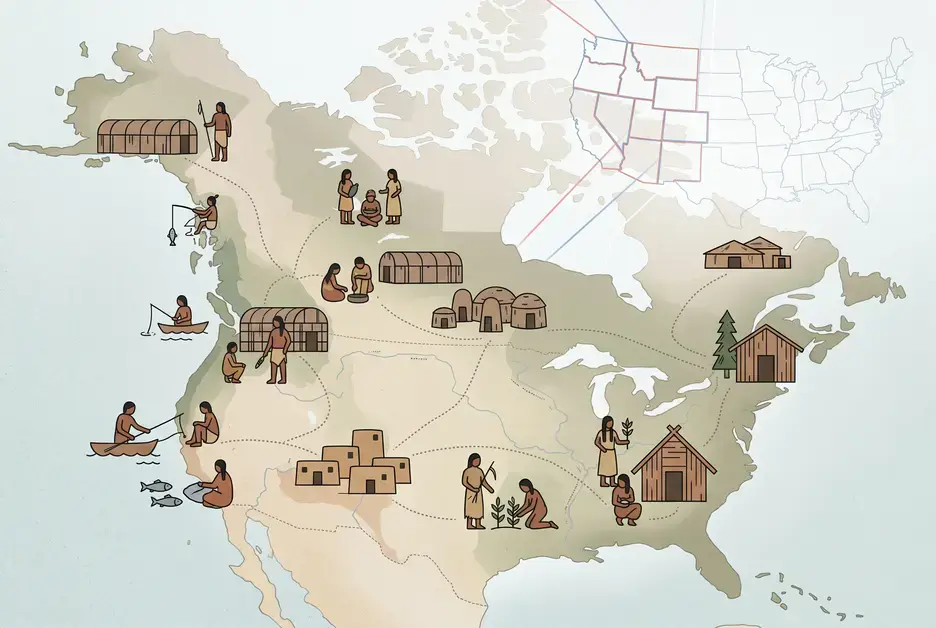
The United States is a state. Its present territory is geographic space. Its population includes people whose ancestors arrived at different points in history, including Indigenous peoples whose histories in North America predate the United States by thousands of years.
The creation of the American republic therefore did not create the land or its original inhabitants. It created a new political authority.
That difference matters because modern maps can hide history. A map tells us who controls territory today. It does not automatically tell us who lived there before today’s borders existed or how political control changed.
Colonization Changed an Older Human World
European colonization transformed North America.
Spanish, French, Dutch and British powers established colonies and competed for territory and economic resources. European settlement brought new technologies, animals, crops, trade relationships and political alliances. It also brought diseases, warfare, forced displacement and the seizure of Indigenous lands.
Disease was especially devastating. Indigenous populations had little previous exposure to many diseases introduced from Europe, resulting in catastrophic population losses.
Colonization was not a single event. It unfolded over centuries. Indigenous nations negotiated with European powers, traded with them, formed alliances, fought them and sometimes used relationships with one European power against another.
The later expansion of the United States continued this process through treaties, purchases, warfare, legislation, settlement and forced removal. The Indian Removal Act of 1830, for example, contributed to the displacement of Indigenous nations from their ancestral lands.
The history is therefore not simply a story of one country appearing on an empty map. It is a story of one political system expanding into territories where other peoples already lived.
What Does This Have to Do With Digital Nomads?
At first, American colonial history and digital nomadism may seem unrelated.
They are not.
A digital nomad lives in a world where physical location and human activity are increasingly separable. Someone can be born in one country, hold citizenship in another, work for a company based somewhere else, serve clients around the world and temporarily live in several different countries.
The passport still matters. Immigration laws still matter. Taxes still matter. Local regulations matter. Borders remain very real.
But the digital nomad experiences something that is increasingly difficult to ignore: human life is larger than the administrative categories used to organize it.
A passport tells governments which country recognizes you as a citizen. It does not tell your entire story.
A visa tells you how long you may remain in another country. It does not determine your human worth.
An address tells a bank or government where you currently reside. It does not define your entire identity.
A nationality is important, but it is not the whole person.
People Existed Before the Systems We Created
This is where the history becomes more than history.
Human beings existed before modern governments. Communities existed before passports. Commerce existed before corporations. Communication existed before the internet. People traveled before immigration departments existed.
We created systems to organize human life.
That means we should be careful not to reverse the relationship and begin treating human beings as though they exist primarily to serve those systems.
Governments need borders. Businesses need legal structures. Banks need identification. Countries need immigration policies. Digital platforms need rules.
These systems have legitimate purposes.
But they remain human creations.
They should therefore serve human beings.
This is especially important in a digital age because technology increasingly allows people to work and communicate across national boundaries. A writer can publish for a global audience from a laptop.
A software developer can work remotely for an international company. A teacher can educate students on another continent. An entrepreneur can sell digital products worldwide without establishing a physical office in every country where customers live.
Technology is making human cooperation increasingly global even while political systems remain largely national.
Mobility Should Not Mean Detachment
There is also a warning here for digital nomads.
Freedom of movement should not become freedom from responsibility.
A digital nomad who moves between countries should not see each place merely as cheap accommodation, fast internet and a temporary business opportunity. Every destination is someone’s home.
People have histories.
Communities have memories.
Land has stories.
The same principle that reminds us that Indigenous America existed before the United States should remind a traveler that every country they visit existed before their arrival.
This encourages a better form of mobility. Instead of asking only, “What can this country offer me?” we can also ask, “What can I contribute while I am here?”
That question changes travel from consumption into participation.
Modern States Are Chapters, Not the Whole Story
The lesson extends beyond America.
South Sudan became an independent state in 2011, but South Sudanese history did not begin in 2011. Kenya became independent in 1963, but Kenyan history did not begin with independence. Nigeria became independent in 1960, but the peoples and societies within its territory existed long before the modern Nigerian state.
The same is true across much of the world.
Modern states are relatively recent political arrangements built upon older human histories.
That does not make modern states meaningless. It simply places them in historical proportion.
A country has a founding date.
A people may have thousands of years of history.
A territory may have an even longer geological history.
Confusing these different timelines can lead us to misunderstand both nations and humanity.
What Should We Remember?
America existed before the United States.
The people existed before the government.
The land existed before the borders.
Human beings existed before the systems we created to organize them.
For a digital nomad, this is more than an interesting historical observation. It is a reminder to remain human in a world increasingly organized by passports, platforms, algorithms, financial systems, borders and bureaucracies.
These systems are necessary tools, but they should never become substitutes for humanity.
We created governments to organize society. We created technology to extend our abilities. We created markets to exchange value. We created borders to organize political authority.
None of these things should become more important than the human beings they are meant to serve.
The history of America reminds us that today’s political map is only one moment in a much longer human story.
The same will eventually be true of the political map we know today.
States may change.
Borders may change.
Technology will change.
But our basic responsibility remains: to build systems that empower human beings rather than systems that make human beings servants of the systems themselves.
America existed before the United States.
And humanity will exist long after today’s maps have changed.
Frequently Asked Questions
1. How old is the United States?
The United States declared independence in 1776, making it approximately 250 years old in 2026. The federal government under the present Constitution began operating in 1789.
2. Who lived in the United States before European colonization?
Hundreds of Indigenous nations and peoples lived throughout the territory that is now the United States. They had distinct languages, cultures, political systems, economies and territories.
3. Did Indigenous nations have governments before the United States?
Yes. Many Indigenous nations had established systems of leadership, governance, diplomacy and law long before the creation of the United States.
4. Did the United States originally occupy its present territory?
No. The original United States consisted of thirteen British colonies. The country later expanded through purchases, treaties, wars, annexations and other political processes.
5. What does this history have to do with digital nomads?
It highlights the difference between human beings and the political systems that organize them. Digital nomads experience this distinction directly because they can live, work and build relationships across national borders.
6. Does recognizing Indigenous history mean rejecting the United States?
No. It means recognizing that the modern United States is one part of a much older history of the land and its peoples.
And if you want to know what’s happening in my world as a writer and digital nomad, check out my Wealthy Affiliate blog page here: https://my.wealthyaffiliate.com/johnmaluth/blog.

This article made me look at maps in a different way. A border shows who controls a place today, but it does not show the full history of the people who lived there before that border existed. The difference between land, people, and a political state is simple, yet it is often overlooked.
I also liked the point that mobility should not mean detachment. Digital nomads may see a destination as a place with affordable housing and good internet, while local residents see it as their home, culture, and history. Asking what a visitor can contribute seems like a healthier attitude than only asking what the country can offer.
What are some practical ways digital nomads can learn about Indigenous or local history before arriving? A short reading list, local museum visit, or community-led tour might help travelers understand the place instead of treating it like a temporary workspace.
Hello Bob Roman,
Borders outline political control rather than the complete history of those who inhabited the land prior. Distinguishing between physical land, human populations, and political apparatuses is essential for a proper historical perspective.
Regarding mobility, treating temporary residences purely as affordable workspaces overlooks the deep cultural roots of local communities. Shifting the focus from what a destination offers to what a visitor contributes creates a more responsible travel culture.
To learn local and Indigenous history before arrival, several practical steps work well:
Regional Literature: Read works by local authors, historical accounts written by Indigenous scholars, or regional folklore to grasp the cultural foundation.
Cultural Institutions: Research local museums, cultural centers, or digital archives native to the destination prior to departure.
Community Engagement: Connect with grassroots organizations, local historians, or community-led cultural tours upon arrival to support local voices directly.