South Sudan needs to understand that elections are more than counting ballots. Electoral rules determine how citizens’ votes become political power, and informed voters are essential to credible democracy.
TL;DR
An election is more than counting ballots. Voter registration, turnout, ballot validity, electoral formulas, constituencies, proportional representation, reserved seats, counting procedures, and dispute mechanisms all influence how citizens’ votes become political power. As South Sudan prepares for its planned 2026 elections, citizens need to understand not only how to vote, but also how the electoral system converts votes into official results.
South Sudan is approaching a politically important moment. The country needs more than citizens who know where to cast their ballots. It needs citizens who understand what happens to their votes after they cast them.
Too often, we imagine an election as a simple mathematical exercise. Everyone above 18 registers. Everyone registered goes to vote. Every ballot is valid. Every valid vote is counted. The candidate with the most votes wins. Therefore, the result represents the will of the people.
That is the idealized version of an election. Real electoral systems are more complicated.
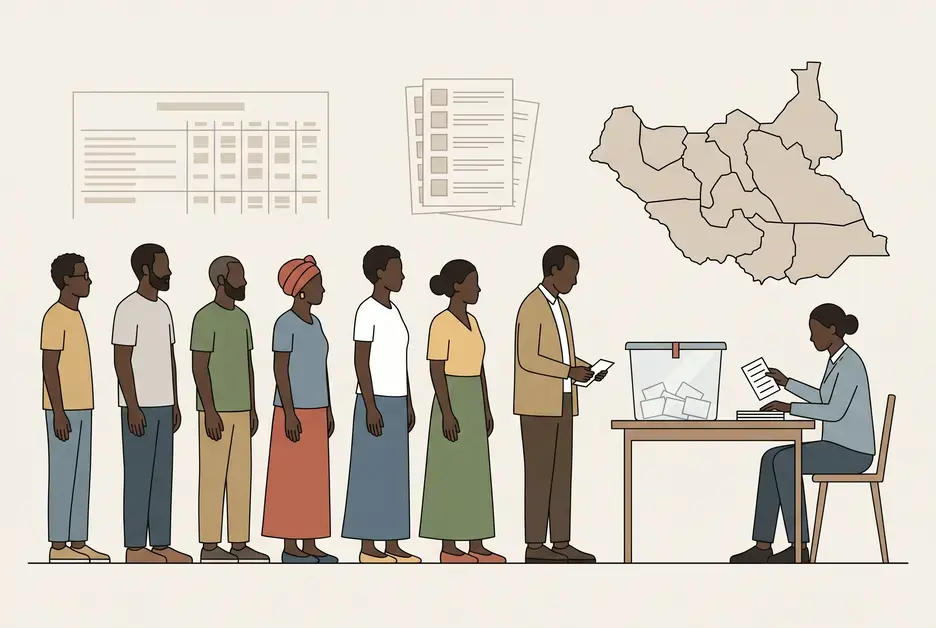
Not everyone who is eligible registers. Not everyone who registers votes. Not every ballot necessarily becomes a valid vote. Not every valid vote produces the same political result. And in some electoral systems, the person who receives the largest number of votes under one calculation may not necessarily win the office.
This is particularly important for South Sudan because our electoral system contains different mechanisms for different offices.
Votes Matter, But Electoral Rules Matter Too
The most important distinction South Sudanese voters need to understand is the difference between the votes citizens cast and the electoral rules that determine what those votes produce.
The vote is the foundation of democratic representation. But the electoral system determines how votes are translated into political authority.
Consider the presidential election. A candidate does not necessarily win simply because that candidate receives more votes than every other candidate in a fragmented field. Under the applicable system, a candidate needs an absolute majority. If no candidate reaches the required threshold, another round may be necessary.
Parliamentary elections operate differently. South Sudan’s National Assembly uses a mixed electoral system involving geographical constituencies, proportional representation and reserved seats. Therefore, there is no single mathematical formula through which every vote in the country produces exactly the same type of political result.
This distinction is not a technical detail. It is fundamental to understanding democracy.
A voter may cast a perfectly valid ballot and still support a candidate who does not win. That does not mean the vote was stolen. It means elections are designed to aggregate millions of individual choices according to predetermined rules.
The United States Provides a Useful Example
South Sudanese can understand this more easily by looking at the United States.
Americans vote in presidential elections, but the president is not selected simply by adding every presidential vote across the entire country and giving the presidency to whoever has the largest national popular vote.
The Electoral College is the constitutional mechanism through which the presidential election produces its final result.
Consequently, a candidate can receive more votes nationally but fail to become president.
This illustrates an important principle: the popular vote and the legal mechanism for determining the winner are not always the same thing.
South Sudan should understand this before political arguments surrounding elections become unnecessarily emotional.
The question should not only be, “How many votes did my candidate receive?”
We should also ask:
What electoral system applies to this office?
What threshold must a candidate reach?
How are constituencies organized?
How are proportional seats allocated?
How are reserved seats determined?
What makes a ballot valid?
How are votes counted?
How are results tallied?
How are electoral disputes resolved?
These questions are part of the election itself.
Not Everyone Who Can Vote Will Vote
Another assumption that deserves examination is the belief that every eligible citizen will participate.
South Sudan has a large population spread across rural communities, towns, displaced populations and areas with serious logistical challenges. Having a legal right to vote does not automatically mean that every eligible citizen will register or participate.
Some people may live far from registration centres.
Others may face transportation problems.
Some may be displaced.
Others may lack the necessary documents or encounter administrative difficulties.
Some citizens may choose not to participate at all.
Security concerns, political intimidation, lack of information, economic pressures and personal circumstances can also influence voter participation.
Therefore, an election result cannot be interpreted as though every adult citizen in the country cast a ballot.
The result represents the votes legally cast and counted within the electoral system.
That distinction matters.
Not Every Ballot Is Necessarily a Valid Vote
There is another common misunderstanding: the assumption that every ballot placed into a ballot box must automatically become a counted vote.
That is not how elections work.
Electoral laws establish rules for marking ballots and determining whether they are valid. A ballot that does not meet the prescribed requirements may be rejected.
This does not automatically mean that election officials are stealing votes.
The democratic question is whether the rules are clear, known in advance, consistently applied and subject to meaningful oversight.
If a ballot is rejected according to a publicly established rule, that is different from a valid ballot being deliberately excluded.
South Sudanese voters need to understand this distinction because accusations of electoral fraud should be based on evidence rather than assumptions.
Counting Votes Is Only One Part of the Process
When people say, “Every vote must count,” the principle is correct, but it needs to be expressed carefully.
Every valid vote should be counted according to the law.
That means polling officials must follow established procedures. Ballot materials must be protected. Candidates and political parties should have mechanisms for observing the process. Results should be recorded transparently. Constituency results should be properly tallied. Complaints should have lawful channels for resolution.
The integrity of an election therefore depends on the entire chain from registration to declaration.
A problem at any stage can affect confidence in the final result.
This is why election administration matters so much.
South Sudan’s Electoral System Is Not a Simple National Popular Vote
For South Sudan, this point is particularly important.
The National Assembly is not simply awarded to whichever political party receives the largest number of votes nationwide. Different categories of seats are filled through different electoral mechanisms.
Geographical constituencies connect representatives to particular areas.
Proportional representation allows political parties and political groupings to gain representation according to prescribed electoral formulas.
Reserved seats provide another mechanism for representation.
The result is therefore a parliamentary institution produced through several electoral calculations.
This means that two political parties could receive similar numbers of votes but end up with different numbers of seats depending on where those votes are concentrated and which electoral formula applies.
A vote is therefore both a personal political choice and part of a larger institutional calculation.
Free and Fair Elections Require More Than Voting
This brings us to the larger question: What makes an election free and fair?
It is not enough to open polling stations and distribute ballot papers.
Citizens need meaningful opportunities to register and participate.
Candidates need reasonable freedom to campaign.
Political parties need space to organize.
The media needs sufficient freedom to inform voters.
Election officials need to perform their duties impartially.
Polling stations need appropriate security.
Ballots need to be protected.
Counting needs to be transparent.
Results need to be properly tallied.
Electoral complaints need credible procedures.
And political actors need to respect lawful outcomes while retaining the right to challenge genuine violations.
An election can therefore be judged at several stages, not simply by looking at the final number announced on election night.
Losing an Election Is Not Automatically Electoral Fraud
South Sudan also needs a healthier political culture around electoral defeat.
A candidate losing an election does not automatically prove that the election was stolen.
Likewise, an election commission declaring a winner does not automatically prove that every part of the election was perfect.
Both extremes are dangerous.
Citizens should be able to accept legitimate defeat.
At the same time, candidates and voters should be able to challenge genuine irregularities through lawful procedures.
There is a major difference between losing because another candidate received more votes under the applicable rules and losing because valid votes were unlawfully suppressed, excluded or manipulated.
Those claims require evidence.
A mature democracy must be capable of distinguishing political disappointment from electoral malpractice.
Civic Education Must Come Before Election Day
South Sudan therefore needs serious civic and voter education.
Citizens should not merely be told where and when to vote. They should understand the entire process.
They should know how registration works, what makes a ballot valid, how votes are counted, how constituency results are determined, how proportional representation works, what reserved seats mean and how electoral disputes can be challenged.
This information should reach rural communities as well as urban centres.
Radio remains particularly important because many South Sudanese communities have limited access to reliable internet services. Churches, schools, universities, community organizations, civil society groups and traditional community structures can also contribute to civic education.
The goal should be simple: an informed voter is harder to manipulate.
Democracy Requires Understanding the Rules
South Sudan’s electoral future should not be built on the assumption that democracy is simply a matter of putting a ballot into a box.
Democracy requires citizens to understand the rules governing that ballot.
Not everyone who can vote will register.
Not everyone who registers will vote.
Not every ballot will necessarily be valid.
Not every valid vote will produce victory.
Not every electoral system gives the national popular vote the final word.
And not every political outcome can be understood without examining the rules through which votes become seats, offices and political authority.
The United States demonstrates this through its Electoral College. South Sudan demonstrates it through its own combination of presidential and parliamentary electoral mechanisms.
The lesson is not that votes are unimportant. The opposite is true.
Votes matter enormously. But the rules governing those votes matter too.
South Sudan should therefore enter its electoral era with informed citizens, transparent institutions and political actors who understand that elections are processes governed by law.
A credible democracy is not created simply because people vote. It is created when citizens can participate meaningfully, votes are handled according to established rules, results are transparently determined, disputes have lawful remedies, and political power changes hands according to rules that citizens understand and trust.
That is the standard South Sudan should demand.
Frequently Asked Questions
1. Does every eligible South Sudanese citizen have to vote?
No. Having the legal right to vote does not mean every eligible citizen will register or participate. Voter turnout depends on individual choices as well as practical, administrative, security and logistical conditions.
2. Does every ballot automatically become a valid vote?
No. Electoral rules establish requirements for ballot validity. Ballots that do not meet those requirements may be rejected.
3. Does the candidate with the most votes always win?
No. The answer depends on the electoral system governing the particular office. Some systems use first-past-the-post, others require an absolute majority, and others use proportional representation or additional mechanisms.
4. Why is the U.S. Electoral College relevant to South Sudan?
It provides a clear example of how votes can be converted into an electoral result through a constitutional mechanism rather than simply through the national popular vote.
5. What makes an election free and fair?
A credible election requires meaningful participation, clear rules, fair competition, impartial administration, secure ballots, transparent counting, credible dispute mechanisms and respect for lawful results.
6. Why does civic education matter before South Sudan’s elections?
Citizens who understand registration, voting, ballot validity, counting and electoral formulas are better positioned to participate effectively and identify genuine irregularities.
Final Thought
South Sudan needs voters who understand not only how to cast a ballot, but what happens to that ballot afterward. Democracy becomes stronger when citizens understand the rules that turn individual votes into political authority.
And if you want to know what’s happening in my world as a writer and digital nomad, check out my Wealthy Affiliate blog page here: https://my.wealthyaffiliate.com/johnmaluth/blog.

This article made me think about how easy it is to focus only on who wins and ignore the rules that turn votes into power. I found the explanation of South Sudan’s mixed system especially useful because geographical seats, proportional representation, and reserved seats can produce different results from the same election.
The section about civic education stood out most to me. If voters do not know why a ballot may be rejected or how seats are assigned, a legal result could still look unfair. Clear information before election day may prevent confusion and false claims afterward.
Radio sounds like an important way to reach rural and displaced communities where internet access may be limited. Could election officials also use sample ballots, local-language programs, and public practice sessions to show people how to mark a valid vote? I would be interested in learning which education method could reach the most voters in South Sudan.
Hello Bob Roman,
You are entirely right. Understanding the rules of a mixed electoral system is vital, and clear civic education prevents misunderstandings.
Your suggestions for sample ballots, local-language programming, and public practice sessions are spot on. While the U.S.A. and China often rely on digital infrastructure for public information, South Sudan and Africa require a more grounded approach. Combining radio broadcasts with hands-on practice sessions using physical sample ballots is the most effective way to reach voters in remote areas.
John