
Every election season brings a familiar wave of emotion. Old grievances rise to the surface, fueled by political campaigns that amplify historical divisions. In many post-conflict societies, including South Sudan, the ballot box can easily transform into a quiet weapon for revenge.
Citizens facing hardship or historical injustice often feel tempted to vote simply to punish rivals rather than to build a functioning state. However, revenge at the ballot box remains revenge. It produces leaders chosen for anger rather than competence, trapping nations in recurring cycles of bitterness.
Choosing to vote based on core values is a demanding discipline, yet it is the only reliable path to securing a stable inheritance for the next generation. Prioritizing honesty, justice, and service over retaliation honors those who fought for freedom and protects the communities we leave behind.
Key Takeaways
- Elections often unearth hidden resentments, turning the ballot into a tool for emotional retaliation instead of constructive governance.
- Voting out of vengeance elevates leaders based on shared hatreds rather than capability, creating widespread institutional instability.
- Core values act as an ethical compass, guiding voters to select candidates who protect justice and serve the entire population fairly.
- Honoring historical sacrifices means refusing to weaponize the democratic process to settle old tribal or political scores.
- Youth carry a unique responsibility to break generational cycles of grievance by choosing long-term nation-building over short-term spite.
TL;DR
This article examines why voting with values rather than revenge is essential for long-term national stability. While elections frequently awaken old wounds and encourage voters to seek political retaliation, revenge-based voting elects incompetent leaders and deepens societal fractures. By anchoring decisions in core principles like honesty, justice, and service, citizens can reject bitterness and build a resilient nation for future generations.
Elections Reveal What Lives Inside Us
Election seasons introduce a peculiar theatre into society. Billboards fill public spaces, campaign songs echo through streets, and politicians make grand promises regarding roads, schools, and employment. On the surface, the contest appears centered on political manifestos and policy debates. Beneath that polished exterior, however, older and more powerful currents flow freely.
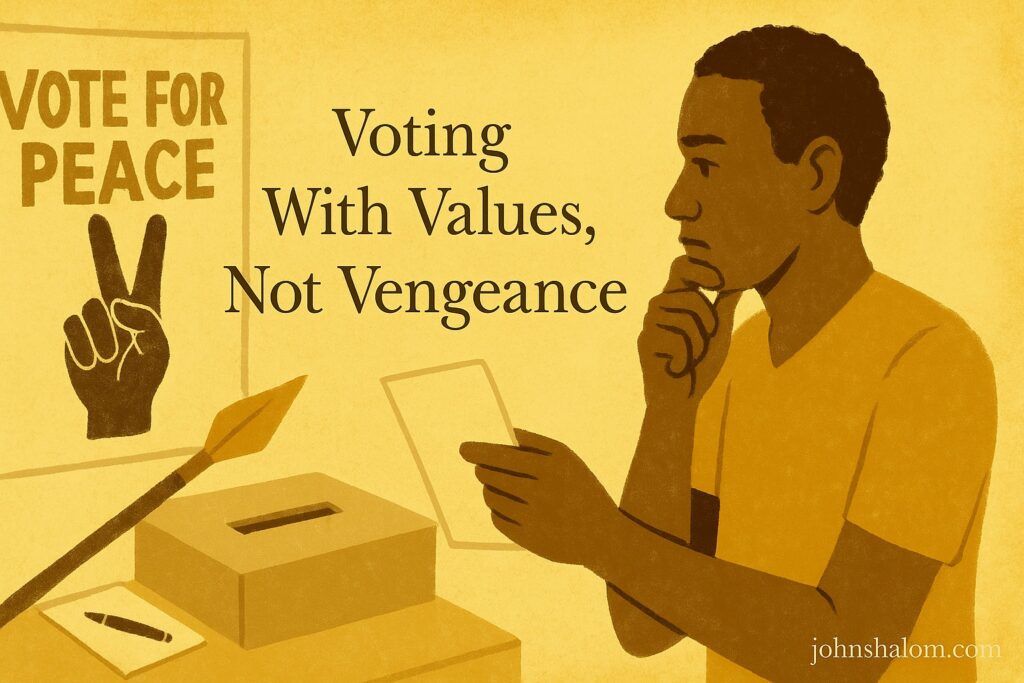
Historical grievances resurface. Neighbors who coexisted peacefully begin viewing one another through the rigid lenses of political parties, flags, or ancestral names. Conversations in local tea shops frequently turn into declarations of payback. Citizens whisper about showing rival groups their place, transforming a democratic choice into a silent battlefield.
This recurring pattern highlights a profound truth. Elections expose what resides in human hearts, revealing whether decisions are anchored in hope or driven by pain.
The Seduction and Cost of Revenge Politics
Voting out of anger feels entirely natural when individuals have experienced marginalization, betrayal, or economic distress. The ballot box offers a seductive illusion of justice without physical conflict. Voters reason that blocking a rival candidate or punishing an insulting official serves as a peaceful equivalent to armed resistance.
During past campaigns, I witnessed individuals cheering for candidates solely because those figures articulated intense public anger. When leaders are chosen primarily for their capacity to express hatred, society enters a dangerous zone. Such figures rarely restrict their animosity to political opponents. Eventually, that same divisive energy turns inward, harming supporters and critics alike.
Revenge is inherently blind. It ignores competence, administrative experience, and moral integrity, demanding only a willingness to make opponents suffer. Adopting vengeance in politics is comparable to drinking poison while expecting an adversary to perish.
| Voting Motivation | Core Focus | Long-Term Societal Outcome |
| Vengeance / Anger | Punishing rivals and settling scores | Institutional decay and recurring conflict |
| Values / Principles | Honesty, competence, and public service | Stable governance and community resilience |
Humor as a Disarming Reality Check
Political campaigns generate so much absurdity that humor often serves as the only appropriate defense. I recall an instance where an ambitious candidate promised unrealistic benefits, including free livestock and universal public services for every household. An astute citizen raised a hand and asked whether the livestock would arrive before or after the candidate vanished with public funds. The surrounding crowd dissolved into laughter, instantly puncturing the inflated rhetoric.
Laughter exposes the gap between political promises and daily reality. When communities joke about politicians who appear only during campaign season, they acknowledge the uncomfortable truth that citizens sometimes trade their collective future for fleeting gifts. Humor strips away the false seriousness of revenge-driven politics, reminding everyone of human fallibility.
Core Values as an Ethical Compass
Choosing candidates based on values requires asking fundamentally different questions. Instead of inquiring who will punish political rivals, principled voters ask who will defend justice for every citizen, including those with differing views. Instead of supporting someone purely on ethnic or regional identity, voters examine who demonstrates competence and integrity when unobserved.
My mother often advised that important life commitments should never be anchored in spite. Just as a marriage built on retaliation inevitably collapses, a government constructed on mutual spite suffers the same fate. Core values act as an internal compass that remains steady despite shifting political weather. Honesty, respect for human life, and faithful stewardship provide measurable benchmarks for evaluating leadership.
This approach connects directly with personal accountability frameworks. A leader’s inner character, paired with a consistent record of constructive action over time, determines their true suitability for public office. You can read more about my journalistic journey and editorial philosophy on the Wealthy Affiliate Blog.
Honoring Historical Sacrifices Through Responsible Voting
When my elder brother Biel lost his life during the 1989 Nasir battle, the complexities of electoral politics were far from my mind. The immediate reality was profound grief and the loss of young lives. As I matured and studied governance, I reflected heavily on the purpose of such sacrifices. He did not perish so that future generations could turn democratic elections into tribal championships or endless score-settling exercises.
Honoring the fallen demands more than constructing physical monuments. It requires refusing to use their names as justification for ongoing animosity. Voting in a manner that protects human life and bridges divides fulfills the deeper promise of freedom. For additional perspectives on ethical journalism and political integrity, explore What Is Political Journalism for Content Creator?
Planting Thorns Versus Planting Trees
Embracing revenge at the ballot box resembles planting thorny bushes across public pathways. Satisfying temporary anger by watching an adversary stumble provides a fleeting thrill. However, thorns do not discriminate between rivals and allies. Eventually, the entire community walks upon that same dangerous ground.
Conversely, voting with values is akin to planting fruit trees. The harvest requires patience, protection, and steady cultivation. While the immediate rewards may not appear overnight, future generations inherit a safe and nourishing environment. Nations that choose principle over retaliation break free from destructive feedback loops, establishing a foundation for lasting peace.
The Unique Responsibility of Youth
Young citizens hold immense influence over the direction of modern political culture. While older generations often carry heavy histories marked by conflict and loss, youth stand closer to the horizon of tomorrow. Although historical awareness remains vital, young people possess the energy to reject inherited grudges.
Refusing to spread online hate speech, evaluating candidates on merit rather than tribal affiliation, and demanding substantive policy debates transforms the political landscape. When youth commit to building rather than punishing, they redefine leadership expectations for the entire nation.
Reflection Questions
- What specific examples have you observed where communities chose political revenge over practical competence, and what were the ultimate consequences?
- How can humor and cultural storytelling help expose the futility of retaliatory politics without fueling further division?
- Which foundational principles, such as honesty, fairness, or public service, guide your personal decision-making during elections?
- In what ways can young citizens respectfully navigate historical grievances passed down by older generations while choosing a peaceful path forward?
- If future generations examine your voting record and political choices, what kind of legacy will your decisions reveal?
FAQs About Voting with Values
- Why is voting with vengeance so destructive for a nation?
Voting out of revenge elects leaders based on anger rather than capability. This practice empowers divisive figures who weaken public institutions and ignore critical economic and social needs, trapping the country in endless cycles of conflict. - Does choosing values mean ignoring past injustices?
No. Voting with values treats injustice with utmost seriousness, seeking leaders who address wrongs through fair laws, transparency, and institutional reform rather than merely shifting power to a different angry faction. - How can individuals identify their core values before an election?
Voters can explicitly list principles that matter most, such as honesty, peace, fairness, and stewardship. Evaluating candidates against these documented standards prevents emotional manipulation during heated campaigns. - What practical role do young people play in shifting political culture?
Youth can reject hate speech, scrutinize candidates based on merit, foster cross-community dialogue, and champion long-term national development goals over tribal loyalties. - What should a voter do if no candidate matches their ethical standards?
When faced with imperfect choices, voters should select the candidate who aligns closest with core values and poses the lowest risk of harming vulnerable populations, while maintaining civic engagement after the election.
Conclusion
Elections will always test the moral fiber of a society. The central question is never whether political challenges will arise, but how citizens choose to respond. Choosing vengeance guarantees an inheritance of bitterness, while voting with values plants the seeds of sustainable peace. Every ballot cast represents a quiet choice about the kind of country we wish to inhabit.
By anchoring decisions in integrity, justice, and service, citizens can honor past sacrifices and construct a stable, prosperous home for all. For further reflections on peacebuilding and leadership, visit my professional hub at John Monyjok Maluth, the homepage for this website.
And if you want to know what’s happening in my world as a writer and digital nomad, check out my Wealthy Affiliate blog page here: https://my.wealthyaffiliate.com/johnmaluth/blog.

I really appreciated the message of this article. Although I’m in the United States and our history is different from South Sudan’s, the principle is the same. It’s easy to let frustration or anger drive our decisions, especially during election seasons when emotions run high. Your reminder to vote based on character, integrity, and a vision for the future rather than simply trying to punish the “other side” is something people everywhere could benefit from hearing.
I also found your analogy of planting thorns versus planting fruit trees especially powerful. It illustrates how the consequences of our choices often extend far beyond one election and affect future generations. That’s a perspective that’s easy to lose in today’s fast-paced political climate.
I’m curious—have you seen examples, either in South Sudan or elsewhere, where communities that were deeply divided were able to move past voting based on old grievances and begin choosing leaders more on shared values? I’d love to hear about a success story that gives hope this approach can really take root.
– Scott
Thank you, Scott. I really appreciate your thoughtful comment. I believe this challenge is universal. Every nation reaches moments when people must choose between voting out of anger or voting for a better future.
As for examples, South Africa is probably the best known. After apartheid, the country chose reconciliation over revenge. The journey hasn’t been perfect, but it showed that healing is possible when people put the future ahead of past grievances. I believe South Sudan can do the same if we keep focusing on shared values and long-term nation building.