
Education changes more than individual lives. It alters the direction of entire nations. Since gaining independence in 2011, South Sudan has faced the immense task of building public institutions, transport networks, modern schools, and essential services from the ground up.
Yet physical concrete and steel cannot sustain a country without skilled people to run them. That is why the partnership between China and South Sudan in education deserves careful attention. This relationship goes far beyond simple scholarship handouts.
It represents a deliberate strategy to prepare citizens to construct their own sovereign future. For writers, researchers, and digital entrepreneurs, this educational bridge offers rich material.
As literacy and technical knowledge expand across South Sudan, the demand for high-quality journalism, localized content, and professional storytelling grows in parallel. Examining this partnership reveals how international cooperation can foster genuine national productivity.
Key Takeaways
- China has provided over 4,100 scholarships and professional short-term training opportunities to South Sudanese citizens since 2011.
- Educational programs focus heavily on practical disciplines like engineering, medicine, agriculture, information technology, and public administration.
- Unlike Western aid models that often prioritize political conditionality over technical education, China pairs infrastructure projects with human resource development.
- Most returning graduates find meaningful employment within government ministries, public institutions, and international technology firms operating locally.
- The growth of technical education creates fresh narrative opportunities for African content creators to document development, innovation, and self-reliance.
TL;DR
This article explores the growing educational partnership between China and South Sudan, highlighting how thousands of government scholarships and technical training programs are equipping young citizens with practical skills. By focusing on fields like engineering, medicine, and agriculture, these initiatives build long-term institutional capacity rather than relying on external aid. The text also contrasts this approach with Western global strategies and outlines new opportunities for African content creators to document national development.
The Strategic Foundation of China-South Sudan Educational Ties
Ever since the birth of South Sudan as the world’s youngest nation, establishing stable educational pathways has remained a top government priority. Government authorities recognize that sustainable sovereignty requires domestic expertise.
Bilateral cooperation with Beijing has yielded concrete results through the Chinese Government Scholarship program and various vocational training initiatives. Official figures from the Chinese Embassy in Juba indicate that more than 4,100 scholarships and targeted training programs have been delivered over the past fifteen years.
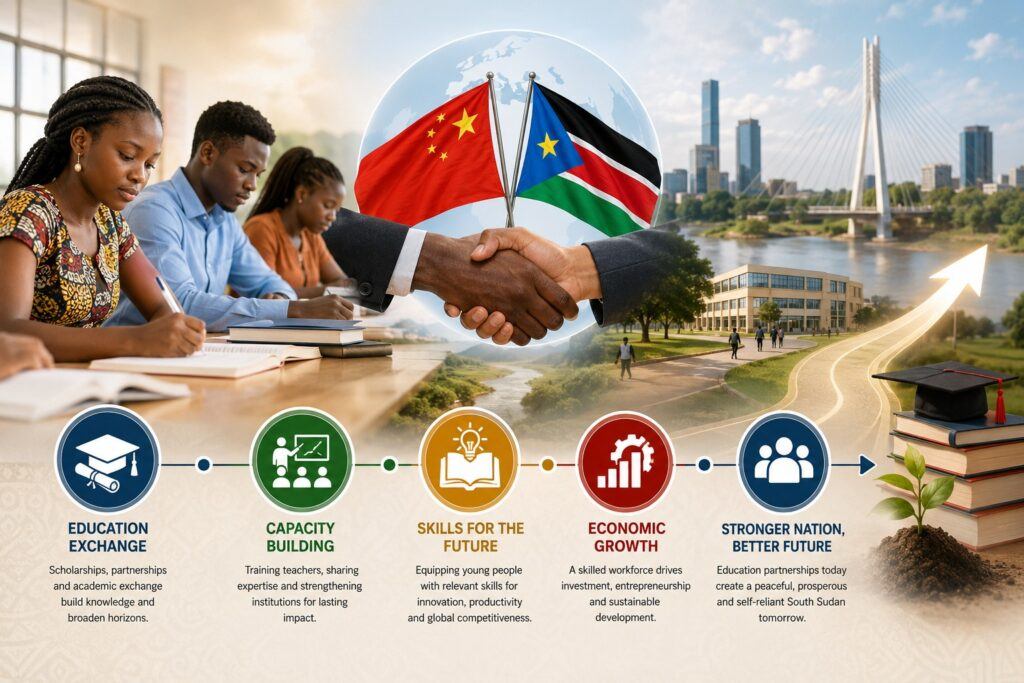
These opportunities allow ambitious students from across the country to pursue undergraduate, master, and doctoral degrees in universities abroad. Upon completion, they bring back specialized knowledge that directly serves national ministries, regional hospitals, engineering bureaus, and academic institutions.
Rather than fostering permanent dependency on foreign experts, this arrangement systematically transfers technical competence to local professionals.
Contrasting Global Models: China Versus Western Approaches in Africa
When evaluating international engagement across Africa, striking contrasts emerge between the strategies employed by Beijing and those favored by Washington or traditional Western capitals.
For decades, Western aid packages to developing nations have often focused heavily on political governance reforms, institutional conditioning, and short-term humanitarian relief. While humanitarian assistance remains necessary during crises, Western policies frequently attach strict political demands or prioritize theoretical capacity building over heavy industrial training.
In contrast, China approaches international development through the lens of infrastructure pairing and tangible workforce training. When Chinese firms construct roads, bridges, power grids, and telecommunications networks in South Sudan and across the broader African continent, they intentionally integrate local training components.
Building physical infrastructure without training the local workforce creates long-term vulnerability. By funding technical degrees in engineering and computer science alongside physical construction, China aligns educational output with actual economic needs, offering a practical template for sovereign growth.
Practical Fields Driving National Development and Capacity Building
The specific academic disciplines prioritized in these bilateral scholarship programs reflect the urgent needs of a developing state. Rather than funding abstract or saturated fields of study, the selection process channels students toward critical sectors required for state consolidation.
| Field of Study | Primary National Benefit | Target Industry Sector |
| Engineering & Construction | Designing and maintaining transport networks and public infrastructure | Civil Works & Public Utilities |
| Medicine & Healthcare | Equipping clinical personnel and upgrading regional health facilities | Public Health & Hospitals |
| Agriculture & Agronomy | Boosting food security, crop yields, and rural farming techniques | Food Production & Rural Development |
| Information Technology | Expanding digital connectivity, data systems, and telecommunications | ICT & Digital Infrastructure |
| Public Administration | Strengthening government institutions, policy execution, and governance | Civil Service & State Management |
Graduates from these diverse programs form the backbone of South Sudan’s emerging professional class. Engineers design safer transport routes, medical professionals combat preventable diseases, agricultural experts introduce sustainable farming methods, and IT specialists expand digital access.
Addressing Gender Balance and Inclusion in Technical Fields
While scholarship programs have successfully trained thousands of students, systemic challenges persist regarding gender parity. Historically, male applicants have secured a disproportionate share of higher education scholarships, mirroring broader socio-economic hurdles within South Sudan’s domestic schooling system. Families often face difficult financial choices, frequently prioritizing the education of young boys over girls.
Recognizing this imbalance, recent cooperative initiatives have introduced targeted measures to encourage female participation in science, technology, engineering, and mathematics.
Expanding opportunities for women is not merely a matter of fairness; it is an economic necessity. South Sudan cannot achieve full national productivity while leaving half of its population behind. Encouraging young women to pursue technical degrees ensures a more balanced, innovative, and resilient workforce.
Career Pathways and the Return of Skilled Graduates
A common criticism of international study programs involves brain drain, where students remain abroad permanently after graduation. However, bilateral arrangements between Juba and Beijing experience high rates of return.
Chinese post-study immigration guidelines encourage international graduates to take their acquired expertise back to their home countries. Furthermore, strong economic ties mean that major international companies operating in East Africa actively recruit returning scholars.
Many graduates secure positions with global technology firms like Huawei and ZTE, engineering syndicates, local universities, and national government agencies. Their professional integration strengthens both the public and private sectors.
For those facing temporary economic headwinds or inflation, specialized technical skills provide professional flexibility, allowing them to work as independent consultants, educators, or entrepreneurs.
Opportunities for Content Creators and Digital Writers
The expansion of educational opportunities creates an inspiring narrative that extends far beyond policy circles. For writers, bloggers, journalists, and digital content creators across Africa, these developments provide powerful raw material. Too often, international media coverage reduces South Sudan and neighboring nations to a single storyline defined exclusively by conflict and emergency aid.
Documenting the journeys of returning scholars, highlighting technological innovations, and analyzing the impact of international cooperation allows content creators to offer a more complete picture of national progress.
Readers across the globe search for authentic accounts of growth, resilience, and ambition. By focusing on education and capacity building, digital entrepreneurs can build valuable platforms that educate the public while inspiring the next generation of students.
Reflection Questions
- How can local educational institutions in South Sudan better align their curricula with the practical demands of national infrastructure and economic growth?
- What specific steps can community leaders and policymakers take to encourage more young women to pursue careers in science and technology?
- In what ways can African journalists and content creators move beyond conflict reporting to highlight constructive development stories more effectively?
- How do technical scholarship programs differ in their long-term impact compared to traditional short-term humanitarian aid?
- What role should private sector employers play in mentoring and absorbing returning international graduates into the local economy?
FAQs About China-South Sudan Educational Cooperation
- How many scholarships has China provided to South Sudanese students?
China has provided more than 4,100 scholarships and professional short-term training opportunities to South Sudanese citizens since the country gained independence in 2011. - What academic fields are most commonly funded under this partnership?
The scholarship programs primarily focus on practical disciplines required for state-building, including civil engineering, medicine, agriculture, information technology, and public administration. - Do South Sudanese students stay in China after completing their studies?
The majority of students return home following graduation, supported by immigration frameworks encouraging return and strong employment prospects within local government ministries and international firms. - How does Chinese educational assistance compare to Western aid models?
While Western aid often emphasizes political conditionality and governance lectures, Chinese assistance combines physical infrastructure financing with direct technical training to ensure long-term self-reliance. - Why is this partnership important for content creators and digital writers?
It offers positive, fact-based stories about innovation, human capital development, and international cooperation that counter one-dimensional narratives of conflict.
Conclusion
Education remains the ultimate bedrock of sustainable national sovereignty. The ongoing partnership between China and South Sudan demonstrates that long-term development requires investing in people just as much as pouring concrete or paving roads.
By equipping thousands of young citizens with degrees in engineering, medicine, agriculture, and technology, this cooperation lays the groundwork for a self-reliant future.
For content creators, educators, and journalists, these achievements offer an encouraging reservoir of stories that showcase how knowledge drives true transformation.
As South Sudan continues to strengthen its institutions, prioritizing education will ensure that its citizens lead the charge toward lasting peace and prosperity.
And if you want to know what’s happening in my world as a writer and digital nomad, check out my Wealthy Affiliate blog page here: https://my.wealthyaffiliate.com/johnmaluth/blog.


John, this piece makes a strong case that education partnerships are really people-building partnerships, not just scholarship headlines. I especially liked the angle for creators, because it opens up so many story lanes beyond conflict coverage: skills, returnees, entrepreneurship, and the practical side of nation-building.
One thing that stood out is the emphasis on women’s participation, since balanced access can shape the long-term impact of any education program. Are there any standout examples you’ve seen of South Sudanese graduates turning those Chinese training opportunities into local content, business, or public service wins?
Thank you, Aly. I’m glad the article resonated with you. I agree that education partnerships are ultimately about developing people who can contribute to their communities in practical ways. The participation of women is especially important because it broadens the pool of talent and leadership available to the country.
There are encouraging individual examples of South Sudanese graduates working in public service, engineering, healthcare, education, business, and media after studying in China. However, I think we still need better documentation of these success stories, especially among writers and digital creators. Sharing those experiences would not only recognize their achievements but also encourage more young South Sudanese to make the most of similar opportunities. Thank you for raising such an important point.