
In developing nations like South Sudan, definitions of tribalism and nationalism are not learned from academic dictionaries. They are learned in open-air markets, at family gatherings, during funeral speeches, and through the harsh reality of armed conflict.
Tribalism provides immediate roots, native language, and local belonging. However, when left unchecked, it can transform neighbors into bitter adversaries. Nationalism invites citizens to expand their loyalty to embrace every person living under a single national flag, though it can turn into arrogance if it disregards the humanity of other nations.
Growing up along the banks of the Sobat River, my early life was defined by clan identities before I understood the idea of statehood. I later grew into my identity as a South Sudanese citizen, and today I write as a scholar observing global political structures.
My elder brother gave his life in a war far larger than our family circle. That profound loss constantly reminds me to consider whether I will use my voice to defend only my immediate clan or to help construct a state where diverse communities flourish together.
Across the world, different power centers confront the balance between local identity and national allegiance. The United States wrestles with intense political factionalism that mimics tribal division. China utilizes strong state governance to weld diverse regional populations into a single national program.
In South Sudan and across Africa, our central challenge is weaving dozens of distinct ethnic traditions into a unified state capable of delivering lasting peace and economic development.
Key Takeaways
- Roots vs. Structure: Tribalism delivers cultural roots and community security, whereas nationalism builds the legal and political architecture for an entire country.
- Global Models: The United States faces increasing political factionalism, China enforces strict state cohesion, and African nations work to harmonize diverse ethnic groups into effective sovereign states.
- Danger of Excess: Extreme tribalism causes internal civil division, while extreme nationalism leads to foreign aggression and state overreach.
- Harmonious Integration: Strong nations are built not by destroying indigenous ethnic identities, but by integrating them into a shared national mission.
TL;DR
Tribalism is devotion to one’s ethnic group or clan above all others, while nationalism is devotion to a shared sovereign state and its entire citizenry. By examining how the United States struggles with political division, how China maintains unified state direction, and how South Sudan builds peace among 64 ethnic groups, citizens learn to cherish their ancestral heritage while building a strong, unified nation.
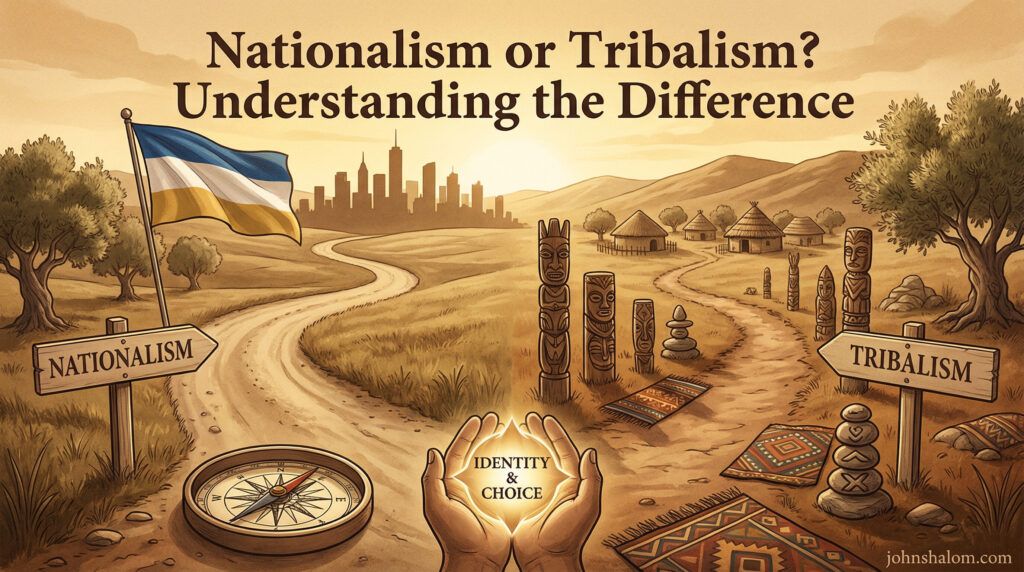
Defining Tribalism and Nationalism in Real Terms
To avoid confusion, we must define these two powerful forces with absolute clarity.
Tribalism is primary allegiance to one’s clan or ethnic lineage above the broader public interest. Its guiding rule asserts that immediate kin take priority over all outside obligations, regardless of justice or law.
Nationalism is allegiance to the country as a whole. Its guiding rule asserts that all citizens share equal rights, duties, and protections under a common government, regardless of their family heritage or bloodlines.
While both concepts appeal to human desires for belonging and safety, they produce completely different national outcomes. Tribalism builds fences that separate communities. Healthy nationalism builds bridges that join distinct regions into a functioning modern state.
The Positive Cultural Foundation of Ethnic Heritage
Before examining the dangers of tribal division, we must acknowledge the genuine value of ancestral heritage. Ethnic belonging serves as a person’s initial home.
I vividly recall evenings along the Sobat River when my grandmother shared accounts of our ancestors. She spoke of courageous leaders who protected villages, farmers who cultivated the land to feed entire communities, and wise elders who resolved disputes through patient deliberation.
Those ancestral accounts were tied to our specific ethnic group, yet they planted vital moral qualities within me: personal dignity, honor, and courage.
My native culture provided me with:
- A mother tongue rich in expression, wisdom, and emotional depth.
- Traditional songs that preserved historical memory through generations.
- Personal names rooted in the geography and struggles of our homeland.
Without these foundational roots, a person resembles a tree without an anchor in the soil. Ethnic tradition provides an essential starting point for human character.
The Destructive Turn: When Ethnic Roots Turn Into Weapons
The same cultural roots that anchor a community can be sharpened into weapons when political manipulators exploit them. Tribalism becomes destructive when it blinds people to the equal dignity of neighboring communities.
During my youth, I witnessed armed clashes between the Lou Nuer and Jikany Nuer communities in the early 1990s. The weapons used in those clashes did not distinguish between clan lineages, yet human beings used clan identity to mark neighbors as enemies. Families suffered terribly not because of individual wrongdoings, but simply because of their ancestral lineage.
Years later, following violence in another region, a relative called me and asked why I had not joined the armed conflict. Before I could respond, he added that I should remain where I was and fight using my pen. His comment demonstrated how easily people default to tribal expectations during times of stress.
I have seen market disputes escalate from minor personal disagreements into major communal conflicts simply because individuals invoked old clan grievances. When ancestral anger governs current behavior, economic progress vanishes and peace is broken. Extreme tribalism punishes individuals for historical disputes and treats fellow citizens as permanent security threats.
Nationalism as the Expanded Civic Family
Nationalism expands the boundaries of duty beyond immediate bloodlines. It declares that while an individual honors their heritage, they also owe commitment to the nation as a whole.
It expands the community table to welcome citizens from every region. Instead of serving only one’s immediate clan, a national perspective recognizes the essential value of teachers, medical personnel, security officers, and public servants from every ethnic background. It focuses national energy on constructing highways, schools, hospitals, and legal systems that serve the entire population.
True nationalism is not uncritical obedience to an existing government administration. Political leadership changes over time. Genuine nationalism is a commitment to the land, the people, and the future of the sovereign state. It requires citizens to forgo unfair local privileges when those advantages harm the national good.
A Brother’s Sacrifice: One Life for a Larger Story
In 1989, my elder brother marched off to participate in the Battle of Nasir. He departed not merely as a beloved son and brother, but as a young man who believed in a greater cause. He did not go to fight solely for our family’s livestock or village compound; he went because he envisioned a liberated, self-governing nation.
He never returned home.
As a young boy, I initially experienced his loss as a deep family tragedy. As I grew older and pursued higher learning, I recognized that his sacrifice was tied to our national struggle. His blood was shed alongside the blood of patriots from many different ethnic groups who fought for a common vision of freedom.
When I reflect on true nationalism, I remember his sacrifice. He stands as a constant reminder that loving one’s country requires real commitment and a willingness to put the national good above personal interest.
Global Structural Models: USA, China, and Africa/South Sudan
The tension between local factionalism and national unity exists in every modern society, though it manifests differently across global regions.
In the United States, traditional ethnic tribalism is largely replaced by intense political hyper-partisanship. Citizens increasingly segregate themselves into ideological camps that act with the same hostility traditionally seen in ethnic feuds. This partisan factionalism weakens national unity and impairs the governance of the state.
China utilizes a centralized, state-led model of national cohesion. The Chinese government actively minimizes regional and factional divisions by emphasizing a unified national identity centered on collective economic progress and state stability. This approach creates strong national organization, though it strictly regulates individual political divergence.
In South Sudan and across the African continent, governments face the task of unifying diverse ethnic groups into effective sovereign states inherited from colonial borders. Rather than erasing indigenous cultures, African state-building requires establishing strong central governance that treats every ethnic group with equal justice.
| Region / Nation | Primary Source of Factional Risk | State Cohesion Strategy | Civic Identity Outcome |
| United States | Political hyper-partisanship & ideological division | Constitutional legal framework & individual rights | High individual liberty with significant political polarization |
| China | Regional economic disparities | Centralized party-state governance & collective goals | Strong national unity & rapid economic execution |
| South Sudan & Africa | Ethnic tribalism & historical clan rivalries | Inclusive state-building & constitutional power sharing | Evolving national cohesion uniting diverse ethnic traditions |
The Perils of Unchecked Nationalism
While healthy nationalism creates civic order, extreme nationalism presents serious dangers.
When nationalism turns into xenophobic arrogance, it asserts that one’s nation possesses superior rights compared to neighboring countries. Historical records demonstrate that aggressive nationalism generates international conflicts, territorial aggression, and the oppression of minority populations.
Within developing states, political figures sometimes misuse nationalistic rhetoric to conceal public corruption or silence legitimate civic criticism. They accuse opponents of disloyalty while failing to deliver essential public services.
Healthy nationalism fosters internal unity while maintaining respectful relations with foreign nations. Unhealthy nationalism breeds isolation, internal repression, and foreign hostility.
Holding Roots and Tree Together: A Balanced Approach
A nation does not need to destroy indigenous ethnic identities to achieve unity. A strong state is supported by vibrant local communities that understand their place within the national structure.
Consider this relationship through a simple metaphor:
Your ethnic heritage provides the root system. Your sovereign nation forms the growing tree.
Without healthy roots, a tree lacks stability and nourishment. Without the tree, the roots remain buried in the soil without bearing fruit for the world.
A mature citizen can proudly honor their specific ethnic heritage while simultaneously declaring their full commitment to the nation. Ancestral background provides an initial identity, while national citizenship establishes a shared future.
Practical Steps for Daily Civic Life
Balancing local roots with national duty requires conscious daily actions:
- Correct Clan Prejudice: Challenge prejudiced speech within your family and community when individuals speak disparagingly of other ethnic groups.
- Support Merit-Based Systems: Support public policies, business enterprises, and political leaders based on competence and fairness rather than ethnic affiliation.
- Promote Multilingual Education: Ensure children learn both their ancestral native language and the official national language to enable wide communication.
- Honor National Symbols: Celebrate local cultural festivals while honoring national symbols, national holidays, and the national anthem.
A Vision for the Future of South Sudan
When reflecting on South Sudan, I do not envision a country where distinct ethnic identities disappear. A single uniform culture would strip our nation of its rich heritage.
I envision a South Sudan where our 64 ethnic groups are woven together into a strong national tapestry. Each cultural thread retains its unique color and historical character, while national unity provides the binding structure that protects every citizen.
In that future, every citizen can state with confidence: “I honor my ancestral heritage, and I am a dedicated citizen of South Sudan.”
If you would like to follow my ongoing reflections on political writing, education, and development, you can read my journal on my Wealthy Affiliate Blog.
Reflection Questions
- How can citizens maintain pride in their cultural heritage without allowing ethnic loyalty to compromise national unity?
- In what ways does political hyper-partisanship in Western nations resemble traditional ethnic tribalism in developing countries?
- What specific policies can the South Sudanese government implement to ensure equal economic opportunities across all 64 ethnic communities?
- How can educators teach national history in a way that honors local regional contributions while fostering national pride?
- What steps can individual citizens take to break down ethnic barriers in their local workplaces and neighborhoods?
FAQs
- Can an individual be a passionate nationalist while remaining deeply committed to their tribe?
Yes. Honoring one’s native language, traditional customs, and local history is entirely compatible with national patriotism. Conflict arises only when ethnic loyalty is used to justify unfair treatment toward citizens of other backgrounds or to undermine national laws. - How can developing nations prevent political leaders from exploiting tribal divisions during elections?
Nations can protect themselves by building strong legal institutions, enforcing laws against hate speech, promoting independent media reporting, and encouraging citizens to evaluate candidates based on clear policy platforms rather than ethnic ties. - What is the key difference between patriotism and extreme nationalism?
Patriotism is an affectionate devotion to one’s country and a commitment to improving its society. Extreme nationalism involves an arrogant belief in national superiority, often accompanied by hostility toward foreign nations or domestic minority groups. - Why is state-building particularly challenging in nations with colonial histories
Colonial authorities often drew national borders that grouped diverse ethnic communities together while dividing others across international lines. Post-colonial states must work intentionally to construct shared national identities and equitable governance structures that serve all citizens equally. - How does national unity contribute to economic development in Africa?
National unity creates a stable environment that attracts foreign investment, enables large-scale infrastructure projects such as highways and energy grids, facilitates domestic trade across regional borders, and reduces the risk of costly civil disruptions.
Conclusion
Understanding the distinction between tribalism and nationalism is vital for the future of South Sudan and the broader African continent.
While tribalism offers immediate local identity, it cannot build the modern infrastructure, educational systems, or legal protections required for modern development. Nationalism provides the structural framework necessary to unite diverse populations under a common rule of law.
By contrasting Western political factionalism with Chinese state-led unity, African nations can chart an effective path forward. We must honor our ethnic roots as sources of personal character while building strong, inclusive national institutions.
When citizens choose to put the national interest above clan rivalries, they honor the sacrifices of past generations and secure a peaceful, prosperous future for those who follow.
And if you want to know what’s happening in my world as a writer and digital nomad, check out my Wealthy Affiliate blog page here: https://my.wealthyaffiliate.com/johnmaluth/blog.

This article raises an important and timely distinction, especially in a world where identity is increasingly compressed into slogans. I appreciate how it separates nationalism as a shared civic commitment from tribalism as an exclusionary emotional reflex. That difference is often blurred in public debate, to the point where any form of collective identity is treated with suspicion or, conversely, defended without reflection.
What resonated with me is the idea that nationalism can be rooted in responsibility, memory, and care for a shared home, while tribalism tends to shrink moral concern to those who look or think the same. One builds structures. The other builds walls. When fear becomes the primary organizing principle, tribalism thrives, even if it dresses itself in patriotic language.
The article also made me reflect on how easily media and algorithms intensify tribal instincts by rewarding outrage over nuance. In that sense, resisting tribalism today requires conscious effort and humility, not just good intentions.
My question is this: how do you see individuals cultivating a healthy form of national belonging in everyday life without sliding into tribal thinking, especially in digital spaces where identity is constantly amplified and simplified?
Farid, thank you. You framed the difference in a clean way, and your question is the real work.
I think healthy national belonging starts small and stays practical. A person can love a shared home without turning love into a weapon. In everyday life, that looks like choosing civic habits over identity heat: obeying fair rules even when your group could benefit from breaking them, paying your dues, protecting public property, serving your neighbors, and defending the dignity of people you may never agree with. Tribalism is loud. Nation-building is often quiet.
In digital spaces, I use a few simple filters to avoid sliding into “my side” thinking.
First, I separate criticism from contempt. I can challenge a leader, a policy, or even a cultural habit without insulting whole communities.
Second, I refuse identity shortcuts. If a post makes me hate millions of people in one sentence, I treat it as propaganda, even if it flatters my group.
Third, I practice “steel-manning” before sharing. I try to restate the other side’s best argument in one honest sentence. If I cannot do that, I have not understood enough to speak.
Fourth, I keep my moral circle wide even when my loyalty circle is close. I can prioritize my country and still insist that minorities, migrants, and political opponents remain human, protected, and heard.
Last, I watch my emotions. When a post gives me quick pleasure through outrage, I slow down. Algorithms reward anger because anger spreads. A citizen has to be slower than the feed.
If you had to name one pressure that pushes you toward tribal thinking online, what is it for you: fear, humiliation, loyalty to a group, or exhaustion?