
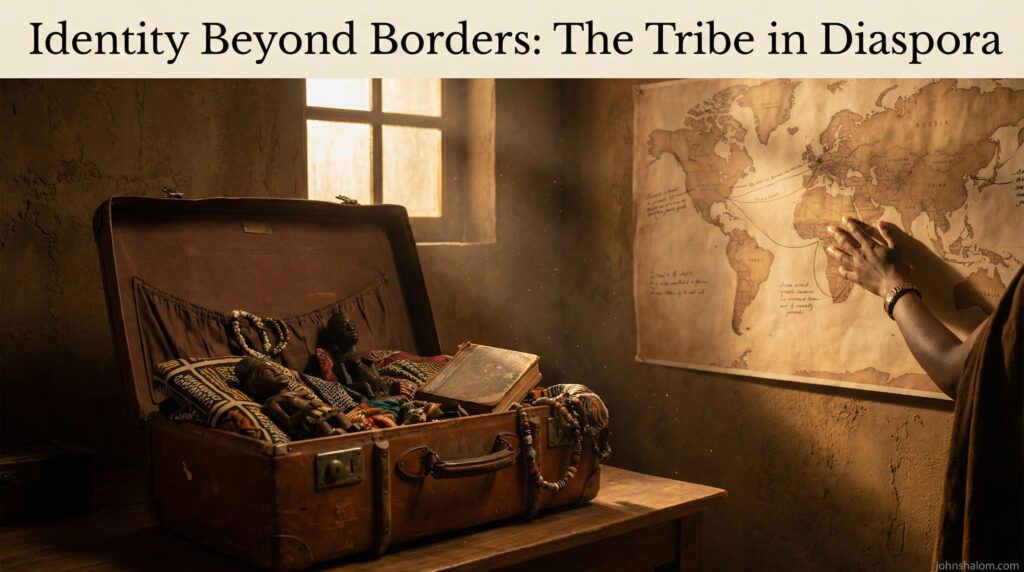
TL;DR:
Diaspora scatters people across nations, but it does not have to erase who they are. Identity in diaspora feels like living with one foot in the village and one foot in a foreign city, pulled by two ways of life at the same time. If families carry language, stories, faith, food, and shared humour with them, the tribe can survive even far from its land.
Children in diaspora do not have to choose between their roots and their new home. With wise guidance, they can become bridges who honour their ancestors while engaging fully where they live today. Identity, when grounded in story and purpose rather than geography only, can live beyond borders.
Introduction: When the Tribe Travels
1.1 From one village to many addresses
When I was a boy, identity felt like a simple equation. Tribe plus village plus cattle camp equalled “who you are.” The river that ran beside us knew our names. The elders around the fire knew our fathers and our fathers’ fathers. If you mentioned my clan, people could point to a line on the horizon and say, “They come from there.”
Today that world has shifted. Wars, hunger, school, marriage, and work have scattered people like seeds carried by wind. You now find Dinka in Dallas, Nuer in Norway, Shilluk in Sydney, Latuko in London, Bari in Brisbane. The river no longer runs past the door. Instead, the tribe gathers on WhatsApp calls, Zoom screens, and in small rented halls where the smell of stew fights with the smell of foreign streets.
Identity has moved from one clear place to many unclear addresses. The question “Who are you?” no longer has one easy answer.
1.2 Why diaspora identity feels confusing
Diaspora does not only move bodies. It stretches the soul. In one week, a person may:
- Speak Arabic at home, English at school, and tribal language only with grandparents.
- Eat kisra and asida on Sunday, then pizza and burgers on Monday.
- Sing worship songs in the mother tongue in one meeting, then listen to rap and pop music the next day.
Nothing is wrong with this mixture by itself. The trouble comes when the mixture has no clear centre. Children begin to ask silently:
- Am I from here or from there?
- Am I my tribe first, my passport first, or just a stranger everywhere?
- If my tongue changes, do I lose my people?
Diaspora identity can feel like a rope pulled from both sides. If nobody guides that rope, it can snap.
The Pull of Two Worlds
2.1 One foot in the village, one foot in the city
Life in diaspora often means living two scripts at once.
In the old script:
- Elders speak and youth listen.
- Marriage follows clan and cattle customs.
- Land, cattle, and clan histories shape pride.
In the new script:
- Youth speak freely in school and online.
- Marriage follows love stories, visas, and careers.
- Exams, salaries, and passports shape pride.
A young person in diaspora may feel like a good child in one script and a rebel in the other. They are praised at school for “independence” but told at home to “remember who you are.” This can create quiet storms inside.
2.2 Humor as a survival tool
Humour becomes one of the best survival tools in this tension.
A cousin of mine in America once tried to explain that he was Dinka. His neighbour asked, “Is that a type of salsa?” That question travelled across oceans and gave us laughter for months. Another friend tried to cook asida with cake flour abroad. The result looked like porridge that had been beaten in a street fight. But everyone ate it because shared disaster tastes better than lonely perfection.
Humour softens the sharp edges of living between worlds. It says, “Yes, this is strange, but we are still human.”
The Risk of Losing Roots
3.1 Language: when the tongue forgets its home
Language is often the first part of identity to weaken in diaspora.
Children:
- Answer in English when spoken to in the mother tongue.
- Understand tribal language but feel shy to speak it.
- Associate the mother tongue with “backwardness” if adults link it only with shame or anger.
Once language goes, many other things follow. Proverbs lose their taste. Jokes lose their rhythm. Names lose their deeper meaning. A boy who knows only the English form of his name may never learn the story behind it, the battle, famine, or miracle it remembers.
3.2 Memory: when the map inside fades
Diaspora life can slowly erase the inner map of “where we come from.” Children may know the name of the capital city of their new country but not the county of their grandparents. They can locate Hollywood on a screen but not locate their ancestral village on a simple drawn map.
This is not the child’s fault. If parents never tell stories, show photos, or explain where “home” once was, children grow up as “Wi-Fi tribe,” connected everywhere and rooted nowhere.
3.3 Faith and values: when belief becomes optional
In the village, faith and values were woven into daily life. Prayer before sleep, greetings to elders, sharing food with visitors, respect for graves, and community rituals all carried hidden lessons.
In diaspora, life can become private and rushed. Everyone stays in their room. Work, school, and screens swallow the day. If families do not build new ways to share faith and values, children may learn that tribe and God are just decorations, nice for festivals but not for daily decisions.
You might also like: The Self-Help Roadmap: Proven Strategies for Personal Growth and Healing
The Strength Hidden in Diaspora
4.1 The gift of a double view
Diaspora identity is not only a risk. It is also a gift. A person who has lived in a cattle camp and in a European winter carries two kinds of eyes. They can see the world from the village ground and from the global road.
Such a person can:
- Understand elders and understand international colleagues.
- Translate between cultures, not only between languages.
- Bring village wisdom into city debates, and modern knowledge back to the village.
If guided well, diaspora children become valuable bridges, not lost wanderers.
4.2 Resilience and creativity
Diaspora life is rarely easy. New languages, strange food, racism, homesickness, and money stress are common. Yet these pressures, painful as they are, can develop strong skills. People who have lived between cultures often learn to:
- Adapt quickly to new situations.
- Solve problems with few resources.
- Endure discomfort without breaking.
These are the same skills needed to rebuild nations, run difficult projects, and lead in uncertain times.
4.3 Diaspora as ambassadors
Diaspora communities can become living letters from their tribe to the world. A Dinka nurse in Canada, a Nuer engineer in Kenya, a Shilluk student in Germany each shows a side of their people that news headlines never tell.
By their work, honesty, humour, and friendships, they quietly correct lies about “Africans,” “South Sudanese,” or “refugees.” They carry the dignity of their tribe into spaces their grandparents could never imagine entering.
Carrying the Tribe Without Freezing It
5.1 Core versus clothing
Not every tradition must travel unchanged. Some things are the core. Others are the clothing.
The core might include:
- The belief that people belong to each other, not only to themselves.
- Respect for elders and care for children.
- Honour for the dead and memory of ancestors.
- Shared responsibility for the weak.
The clothing might include:
- Exact wedding procedures that may be impossible in a foreign land.
- Certain cattle customs that do not fit city life at all.
- Strict rules about gender roles that may clash with legal or work realities in the new country.
Diaspora families need the courage to ask, “What is the core of this custom that we must keep, and what is clothing that we can adjust?” If we try to freeze everything, we suffocate our children. If we throw away everything, we cut their roots.
5.2 Traditions that travel well
Some traditions travel easily if we give them a chance:
- Food: Cooking traditional meals, even in small or modified ways, brings smell and taste of home. Children remember those smells long after they forget street names.
- Storytelling: Even without firewood, stories can burn in the living room. Bedtime stories, weekend talks, or recorded audio from elders keep memory alive.
- Names: Explaining the meaning behind names turns them into small books. A child who knows why she is called Nyakueth or why he is called Malith walks taller.
- Proverbs and songs: A proverb slipped into normal talk, or a song played in the car, turns ordinary time into quiet teaching.
These simple practices do not require big budgets, only intention.
5.3 Traditions that need translation
Other customs need careful translation. For example:
- Bride price: In some countries, the legal and social system does not understand cattle exchange. Families may need to mix symbolic gifts with legal requirements in a way that keeps respect but avoids problems.
- Discipline: Physical punishment accepted in a village may be illegal elsewhere. Parents must learn new ways to guide children without losing authority or breaking laws.
- Gender expectations: Daughters in diaspora may have opportunities their mothers never had. Sons may be challenged by strong systems that treat boys and girls equally. Families need honest talks about these changes so identity does not become a prison.
Translation does not mean betrayal. It means carrying the heart of a practice into a new setting wisely.
Parents and Elders as Keepers of the Fire
6.1 Home as a small embassy
In diaspora, each home becomes a small embassy of the tribe. Inside those walls, children learn what it means to belong. The flag may not hang outside, but the language, food, music, and values inside speak clearly: “This is where you come from.”
Parents and elders can:
- Declare certain times as “tribe time” with mother tongue only.
- Tell their own life stories, including pain and mistakes, not only heroic moments.
- Celebrate national or tribal days, even with simple meals and prayers.
The point is not to create a museum. The point is to keep a living fire.
6.2 Practical habits for keeping identity alive
Some simple habits can help:
- Weekly cultural night: One evening for songs, stories, short videos from home, and language practice.
- Shared projects: Cooking traditional meals together, sewing traditional clothes, or making crafts that relate to the tribe.
- Digital connections: Regular calls with grandparents or elders back home, letting children ask questions directly.
- Visits when possible: Saving slowly for occasional trips back. Even short visits can mark young hearts with a sense of “this is my people.”
These habits tell children, “Your tribe is not just a word we mention. It is a living reality.”
Young People in Diaspora: From Confusion to Calling
7.1 The “Wi-Fi tribe” joke
I once asked a boy in diaspora what tribe he came from. He said, “I think I am Wi-Fi.” His answer made us laugh, but it also warned us. Behind the joke were deeper messages:
- “I am more connected to the internet than to my roots.”
- “No one has helped me feel proud of where I come from.”
- “I know my devices better than my ancestors’ stories.”
Young people need more than passports and gadgets. They need a clear sense of who they are, not to fight others, but to walk confidently in the world.
7.2 Challenges youth face
Youth in diaspora often face:
- Racism and prejudice in their new country.
- Pressure from home to be “fully tribal,” even when they have never touched the ancestral land.
- Pressure from peers to be “fully local,” as if tribe is something to hide.
- Confusion about faith, values, and marriage expectations.
Without wise guides, they may solve this by rejecting one side completely. They may say, “I am no longer African,” or may refuse to learn anything from their new home. Both choices cause loss.
7.3 How youth can own both worlds
Young people can turn this tension into strength by:
- Learning the mother tongue at least to a basic level, even if they have an accent. Any effort matters.
- Asking parents and elders for stories, and writing them down or recording them.
- Reading books from both cultures: African writers and writers from their new country.
- Joining or forming diaspora associations that do useful work, not only dances and dramas, such as scholarship funds, mentoring, or charity projects back home.
- Seeing themselves as bridges, not victims: people who can help two worlds understand each other.
Identity in diaspora, when claimed wisely, becomes a calling to serve more than one place.
Technology: From Drums to Group Chats
8.1 Using new tools to keep old truths
In the past, drums carried messages across villages. Today, group chats carry them across continents. The tools are different, but the need for connection is the same.
Diaspora communities can use technology to:
- Organise online storytelling sessions with elders in the home country.
- Create YouTube or audio channels in their mother tongue for children.
- Share scanned photos, old letters, and maps in family groups.
- Teach basic phrases of the language through short clips.
Technology becomes a new drum, not a replacement for the tribe, but a helper.
8.2 The danger of shallow connection
However, technology can also create a fake sense of connection. People may spend hours in tribal WhatsApp groups sharing jokes and quarrels but never visit a sick relative in the same city.
True identity requires both digital ties and physical presence. Visiting, helping, sitting together, and eating together still matter. A tribe cannot live on emojis and voice notes alone.
Faith and Identity in Diaspora
9.1 A people away from the land
Many stories of faith in Scripture are stories of people in foreign lands: exiles, migrants, refugees, travellers. They wrestle with the same questions:
- How do we sing our songs in a strange place?
- How do we keep our God, our values, our story, when the land is far?
Diaspora tribes can find comfort here. Being away from the village does not mean being away from God. In fact, distance can sometimes make faith deeper, because you can no longer lean only on habit.
9.2 Identity rooted in more than soil
If identity rests only on soil, then every border crossing is a small death. But if identity rests on relationship with God, shared history, and chosen values, then soil becomes important but not final.
A child in diaspora can learn to say:
- “I belong to God.”
- “I belong to my family and tribe.”
- “I belong to this country where I now live and serve.”
These layers do not have to cancel each other. Instead, they can form a strong, flexible self that can stand storms in any land.
Conclusion: Rooted and Roaming
Identity in diaspora is not simple, but it is possible. Tribes can live beyond borders if they carry their core with them: language, stories, faith, values, humour, and love.
Diaspora parents and elders have a hard but honourable task. They are gardeners planting roots in soil that is not their own. They must protect children from shame about their tribe and from pride that despises others. They must teach that being Dinka, Nuer, Shilluk, Bari, or any other people is not an excuse to hate, but a starting point to serve.
Young people in diaspora carry a special calling. They are living bridges between homelands and new lands. If they know who they are, they can stand with confidence in classrooms, offices, and parliaments, bringing the wisdom of cattle camps and rivers into global rooms.
Borders can stop movement of bodies, but they cannot stop the movement of story, memory, and faith. Identity, when grounded in truth and purpose, can indeed live beyond borders.
If you would like to know more about my path as a writer, including the struggles, lessons, and small signs of progress along the way, you can read the full story on my Wealthy Affiliate blog here: https://my.wealthyaffiliate.com/johnmaluth/blog
FAQs
- What is the biggest risk for tribal identity in diaspora?
The biggest risk is quiet forgetting. It starts with language, then stories, then values. Children may grow up knowing more about global celebrities than their own grandparents. When parents are too busy, ashamed, or uncertain to pass on their heritage, identity fades softly, not suddenly. The tribe does not disappear in one day. It dissolves over years of silence. - Can children in diaspora truly belong to both their tribe and their new country?
Yes. Belonging does not have to be a war between two flags. Children can learn to honour their tribe through language, stories, and values, while also respecting and contributing to their new country. They can be loyal citizens where they live and loyal children of their ancestors at the same time. This balance takes guidance and honest conversation, but it is possible and powerful. - How can parents in diaspora help children keep their roots without forcing culture on them?
Parents can focus on invitation rather than coercion. Share stories, cook traditional meals, teach the language gently, explain the meaning behind customs, and involve children in decisions about how to celebrate important days. Allow space for questions and even complaints. When culture is presented as a gift instead of a cage, children are more likely to receive it with respect. - What role does technology play in preserving identity across borders?
Technology can either weaken or strengthen identity. It weakens identity when it pulls children only toward global trends that ignore their roots. It strengthens identity when used to connect with elders back home, share recordings of songs and stories, teach the language, and organise cultural events. The issue is not the tools themselves, but how families and communities choose to use them. - What can young people in diaspora do if they already feel disconnected from their tribe?
They can start with small steps. Ask parents or elders for one story about the past. Learn the meaning of their own name. Memorise a few phrases in the mother tongue. Read a book or watch a documentary about their people. Join a cultural group that does more than just dance, one that also serves and learns. Reconnection may feel slow and awkward at first, but every small step is a way of saying, “I have not forgotten who I am, and I am willing to learn again.”

