TL; DR:
Peace written on paper is not the same as peace written in people’s hearts. Agreements can stop shooting for a while, but only peaceful people can stop the desire for revenge. Leaders can divide ministries, armies, and positions, yet families still sit on wounds that no document has touched.
Real peace begins in homes, markets, and villages where people choose forgiveness over revenge and dialogue over insults. Signed papers may open a door, but only everyday choices keep that door open. If a nation wants lasting peace, it must raise peaceful citizens, not only produce peace documents.
Introduction: When I Thought Peace Came From Paper
As a boy, every time I heard on the radio that leaders had signed a new agreement, my heart jumped. The announcer’s voice sounded excited. There were reports of handshakes, cows being slaughtered, and long speeches. The word “peace” filled the air like perfume.
In the village, people repeated the news. Some smiled. Others said, “Let us see what happens.” I did not understand their doubt at first. I believed that once leaders wrote their names on a document, bullets would disappear.
Then months passed. The guns spoke again. People ran again. The same leaders went back to the same hotels, to sign new papers with new titles. Slowly, a painful thought grew in my mind: maybe paper is not strong enough to hold peace.
The Illusion of Signatures
2.1 Big names, weak hearts
Peace agreements look serious. They have letterheads, stamps, and long titles. Men and women in suits sit at tables, shaking hands for cameras. For a moment, the country breathes out.
But signatures cannot change a heart that still nurses hatred. Ink does not remove greed. A printed document cannot erase pride, fear, or the hunger for power.
I remember my own childhood “agreement” with my brother. We wrote on a piece of paper that I would never wear his shirt again without asking. We both signed. We even tried to look official. The next day, I wore his shirt to the market. The agreement lay somewhere on the floor while we argued. That small story is a picture of what happens when people sign what their hearts are not ready to live.
2.2 Agreements that skip the roots
Many agreements focus on dividing power: who becomes minister, who commands which soldiers, who controls this or that territory. These things matter, but they are not the roots of peace.
The roots of conflict lie in fear, injustice, humiliation, broken promises, stolen resources, and long memories of who wronged whom. If you sign paper on top of these unresolved wounds, you are building a house on a swamp. It may stand in the dry season. When the rains come, it sinks.
Why Agreements Fail Without Peaceful People
3.1 War that moves inside the house
When there is no genuine healing, the war simply changes clothes. It moves from the battlefield into speeches, radios, social media, and family stories. People stop shooting maybe, but they do not stop blaming.
Children grow up hearing how “those people” are always wrong, always dangerous. Songs are updated, jokes sharpen lines between tribes, and rumours fuel suspicion. In that kind of environment, a signed peace deal is only a pause button, not a new beginning.
3.2 The missing work between one agreement and the next
Between one agreement and the next, what usually happens? Roads are sometimes opened. Some people return home. Others wait for the next wave of fighting because they no longer trust any announcement.
Rarely do we see systematic work on hearts:
- Spaces for enemies to talk and listen.
- Public apologies and truth telling.
- Local rituals that mark a fresh start.
- Teaching in schools about forgiveness and shared citizenship.
Without this work, peace agreements are like bandages on wounds that have never been cleaned. Infection returns.
Peaceful People: The Real Agreements
4.1 The neighbour who chooses not to revenge
A peaceful person is a walking peace agreement.
When a neighbour chooses not to retaliate after cattle are stolen, that is a peace document written in human behaviour. When youth in a village refuse to be recruited by warlords, that is a silent signature in favour of peace.
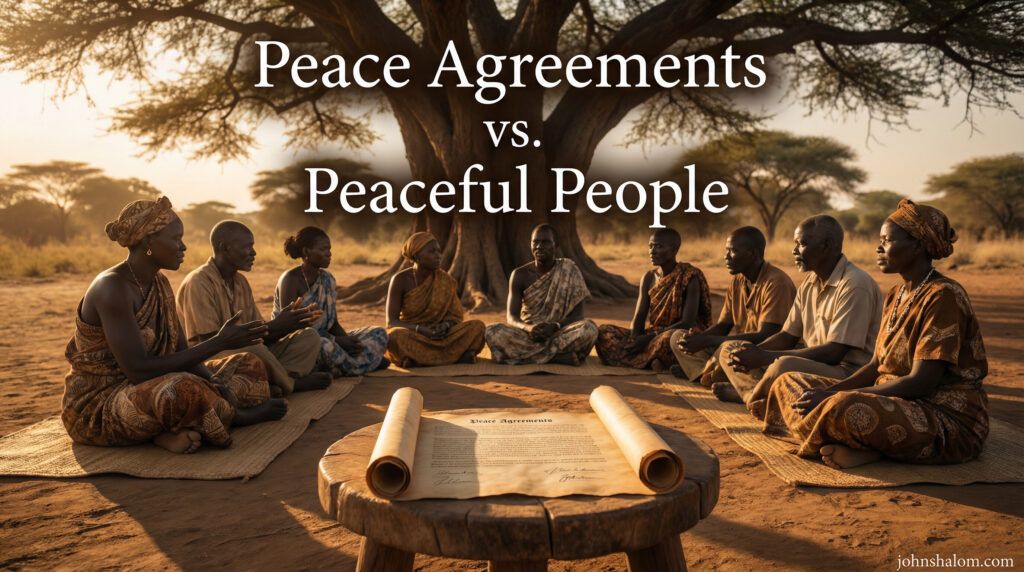
I once saw elders from rival clans sit under a tree and drink milk from the same gourd. They had lost people on both sides. There were graves behind their conversations. No cameras, no microphones, no donors. Yet that simple act of trust spoke louder than many national ceremonies. They were saying, “Your life is safe with me now.”
4.2 Mothers as guardians of peace
Mothers often carry the heaviest share of war’s price. They bury sons, flee with children, and start again with almost nothing. Many of them quietly decide, “I do not want my last remaining child to die for the same causes.”
My mother did not sign an official document, but she governed our house with a deep desire for peace. She refused to let us describe other communities as less human. She insisted that we share, even when hunger pressed our stomachs. She believed that anger at the table would one day become anger in the community. Her kitchen was our first peace school.
4.3 Children watching how adults forgive
Children are always watching.
When they see adults greet former enemies, when they see families attend each other’s funerals again, when they listen to older people confess mistakes, something in them learns that peace is possible.
When they see the opposite, they learn the opposite.
This shaping of hearts is quiet, but it decides the future of any agreement.
Humor Under “Peace”: Surviving Broken Promises
5.1 Jokes as protest
In times of “peace” that does not feel peaceful, people often use humor to survive. I once heard a man say, “Our leaders sign peace the way children sign birthday cards, big signatures, big words, then they go and do what they want.”
Everyone laughed, but there was pain hidden under that laughter. Humor became a safe way to say, “We are tired of shallow promises.”
You might also like: The Ultimate Guide to Political Journalism: Ethics, Challenges, and Impact in the Modern World
5.2 Laughing so we do not drown
After repeated disappointments, jokes keep people from drowning in despair. In camps, villages, and towns, I have heard people joke about never-ending negotiations, or about leaders who love hotels more than home soil.
This humor does not mean people do not care about peace. It means they care so much that, without laughter, they would break. Even this is a reminder that peace cannot only be an elite event. It must reach the ground, or it is not peace at all.
Home as the First Peace Agreement
6.1 Families that practice peace before preaching it
A house where anger is always solved with fists trains children for future violence. A house where conflicts are talked through, apologies are given, and forgiveness is practiced trains children for another kind of citizenship.
You cannot raise peaceful citizens in homes that are small war zones. Parents who insult each other daily but pray for national peace are living a contradiction. Children quickly see it.
6.2 The kitchen table as classroom
In many homes, the table or the mat near the fire is the real parliament. That is where people talk about leaders, tribes, and local news.
If children hear only insults, tribal hatred, and endless blame at that table, then whatever is signed in the capital will have a weak foundation. If they hear fairness, self-criticism, and a desire to see all children safe, then agreements gain roots they never had on paper.
6.3 Teaching children how to disagree
Peaceful people are not people without disagreements. They are people who know how to disagree without destroying each other.
Parents can model this by:
- Avoiding violent language in front of children.
- Showing that you can admit, “I was wrong.”
- Praising children when they resolve disputes peacefully.
These small habits prepare a generation that will one day sit at bigger tables.
Faith, Memory, and the Weight of Sacrifice
7.1 My brother’s death and broken promises
My elder brother died in 1989 at the Nasir battle. For years, I believed his sacrifice would make peace more likely. He gave his life believing our people would have dignity and safety.
Later, as agreements came and broke, I felt angry. I asked myself: “How many brothers must die before peace becomes real?” When leaders use the language of martyrs but live in selfishness, it is like killing them a second time.
7.2 Honouring the dead by living differently
The best way to honour those who died is not to mention their names in speeches alone. It is to live in ways that make new graves less likely.
That means:
- Choosing dialogue before revenge.
- Refusing to use the dead as tools for fresh hatred.
- Teaching children that bravery is not only in fighting, but also in forgiving.
Faith can help here. For many of us, Scripture and prayer remind us that vengeance belongs to God, and that every person, even from another tribe, is made in His image. That belief, when lived, turns fighters into bridge builders.
From Peace Events to Peace Culture
8.1 Peace as a day vs peace as a habit
Many countries celebrate “peace days,” with marches, songs, and banners. These days are useful. They remind people that peace is important. But if peace remains only a slogan for special days, nothing changes.
Real peace is not one big event. It is many small habits:
- The businessman who refuses to profit from smuggling weapons.
- The teacher who refuses to teach hate.
- The chief who insists on fair judgement, even when his own clan is involved.
When such habits repeat, they slowly form a culture that even warlords struggle to break.
8.2 Rituals that plant new beginnings
Our communities have rituals for almost everything: birth, weddings, death, harvest. We also need rituals that mark reconciliation.
Sharing a meal after conflict, praying together across tribal lines, exchanging visits between former enemies, inviting each other to ceremonies, these actions do what documents cannot. They reach the emotional and spiritual level.
Earlier in life, I watched tribes slaughter a bull, share meat, and drink from one gourd after clashes. That ritual carried more power than many formal speeches. It told people, “You are safe enough to eat from my pot.” This kind of embodied peace is harder to break than a distant agreement.
Ordinary People, Extraordinary Peace
9.1 Youth and the decision not to fight
War often recruits the young. The same energy that makes a young man ready to fight can make him ready to build.
A youth who decides to stay in school instead of joining an armed group is making a peace decision. A young woman who chooses to organise dialogues instead of spreading hateful messages is a peace leader. They may not have titles, but they are shaping the future more than many conferences.
9.2 Women as bridges
In many conflicts, women cross lines that men fear. They trade in markets where tribes meet. They share water points. They marry across communities.
When women decide to refuse war language in their homes and gatherings, they weaken the fire that leaders try to light. When they insist on seeing the humanity of “the other side,” they build bridges that agreements alone cannot build.
9.3 Elders who dare to apologise
Some elders protect old grudges. Others break them. An elder who says publicly, “Our side also did wrong,” is a powerful peace agent. That simple confession can open a path that years of blame closed.
Such elders are rare, but when they appear, they are like rain in a dry land. They prove that humility is not weakness. It is construction work for peace.
Conclusion: Becoming the Peace We Sign
Peace agreements are not useless. They can stop active fighting, open roads, and create a space where rebuilding becomes possible. But they are not magic. They are tools.
Without peaceful people, tools lie on the ground. Nothing is built. With peaceful people, even weak documents can turn into new realities, because those people choose to act according to the spirit of peace, not just the letter of agreements.
The real question before us is simple:
Do we want peace as a show, or peace as a way of life?
Show peace lasts until the journalists leave. Lived peace continues when cameras are off. It is seen in how neighbours talk, how markets operate, how children learn, and how we treat those who once hurt us.
If we wish to see lasting peace in any nation, we must go beyond asking, “What did they sign?” and begin to ask, “What kind of people are we becoming?”
When our Being is shaped by mercy and our repeated Doing is shaped by fairness, then M = {B, D²} starts to produce real meaning. We stop waiting for peace to come from above and begin to practice it from below. Each of us becomes a small but real peace agreement, written not in ink, but in daily choices.
If you would like to know more about my path as a writer, including the struggles, lessons, and small signs of progress along the way, you can read the full story on my Wealthy Affiliate blog here: https://my.wealthyaffiliate.com/johnmaluth/blog
FAQS
- Why do so many peace agreements fail in practice?
A: Many agreements focus on dividing power and positions instead of healing wounds and changing behaviour. They are signed by leaders whose hearts and followers may still be filled with fear, anger, and greed. Without grassroots forgiveness, justice, and truth telling, the signed paper sits on unresolved pain, and conflict returns when pressure builds. - What can ordinary people do to “live as peace agreements”?
A: Ordinary people can choose forgiveness over revenge in daily life, refuse to spread hate speech, treat neighbours from other groups with respect, and encourage dialogue when tensions rise. They can raise children to see all tribes as human, support fair judgement in local disputes, and avoid benefiting from war related business. These quiet choices slowly build real peace. - How can families teach children to become peaceful citizens?
A: Families can model peaceful conflict resolution at home, apologise when wrong, and avoid using insulting language about other communities. They can share stories of reconciliation, involve children in small acts of kindness, and explain why revenge only produces more pain. In this way, the home becomes a small training ground for future peaceful citizens. - What role does humor play when peace promises keep failing?
A: Humor helps people survive disappointment without losing their minds. Jokes about repeated agreements or leaders’ behaviour can express deep frustration in a safer way. Laughter does not mean people do not care about peace. It is often a shield against despair and a quiet form of protest when words of anger might bring punishment. - If agreements are temporary, what can make peace last longer among people?
A: Lasting peace grows from daily habits and shared practices, such as eating together after conflict, using local rituals of reconciliation, praying and worshiping together, trading fairly across group lines, and teaching non violent values in schools and homes. When these practices become normal, peace moves from paper into culture, and it is much harder to destroy.