TL; DR:
In many African communities, peace is not only signed on paper, it is danced into people’s bodies. After conflict, reconciliation dances bring former enemies into the same circle, under the same drumbeat, until suspicion slowly melts into shared movement, sweat, and laughter. Culture becomes a quiet peacemaker, doing what speeches and documents cannot. If nations want peace that lasts, they must combine agreements with living rituals like dance, song, and shared food, so that peace is not only written, but felt, remembered, and repeated from one generation to the next.
Introduction: When Dances Become Medicine
As a boy, I thought dances were just for weddings and harvest celebrations. The drums, the shouting, the dust rising under stamping feet, all looked like pure joy. I saw people forget hunger for a moment, forget quarrels, forget the weight of life.
Only later did I learn that in many tribes, dance is not only joy. It is also medicine. When people fight, they do not only need words. They need something deeper that touches the body, the memory, and the soul. That is where reconciliation dances come in.
These are not entertainment events. They are living medicines. They take anger and slowly wash it in rhythm. They take fear and slowly turn it into trust. Culture itself steps forward and says, “Let me help.”
When Words Fail, Feet Speak
After conflict, words become weak.
You can say, “I am sorry,” but the heart may still say, “I do not believe you.”
You can sign a peace deal, but the stomach still remembers hunger caused by war.
You can declare unity on radio, while a widow still looks at the empty side of her bed.
That is when culture begins to speak in another language. The language of drums, feet, sweat, song, dust, and shared movement.
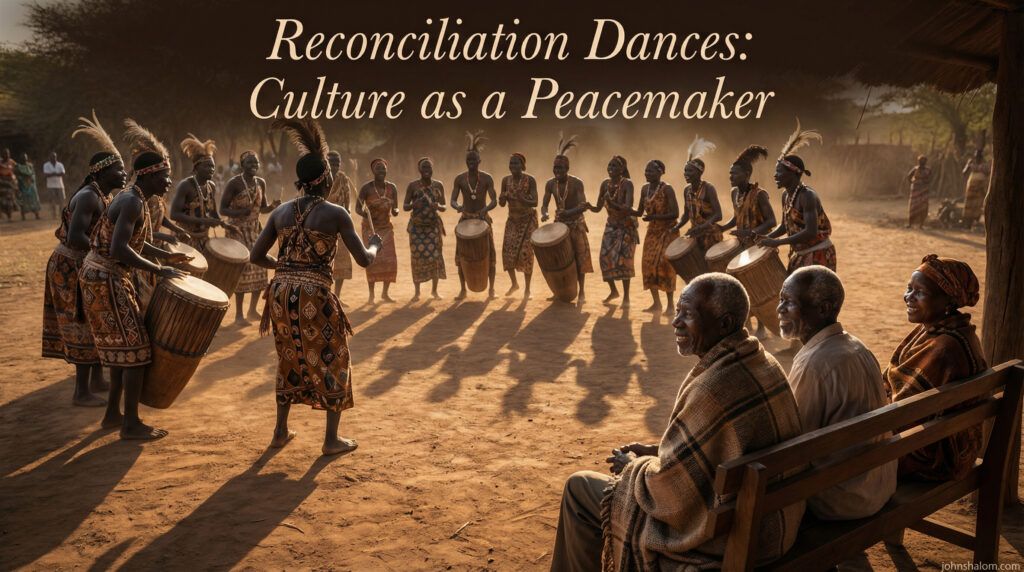
I once watched two rival clans that had agreed to reconcile. At first, they met like strangers. People stood in small groups, whispering, watching each other from the side of the eye.
Then the drums began.
At the start, the dance was stiff. Some people moved only because they had to. Their shoulders were tight, their steps careful. But as the rhythm grew stronger, something changed. One person shouted. Another laughed. Someone made a funny move on purpose, and the crowd roared. The circle widened. Hands reached out.
By the end, you could no longer tell who had been on which side. The same dust covered everyone’s feet. The same sweat ran on different faces. Enemies had moved together long enough for their bodies to remember a forgotten truth: we are still one people.
The meetings had written the agreement. The dance had written it into the body.
Why Culture Works Where Politics Stumbles
Culture works because it is shared.
You can disagree about borders, land, and power, but you cannot deny the drumbeat you grew up with.
You can belong to different clans, but you still know the same song.
You can speak different political slogans, but your feet still remember the same pattern from childhood.
My mother used to say, “A drumbeat has no tribe.” She meant that once the drum speaks, the human heart responds before the mind remembers its grudges. Rhythm walks past the guard at the gate of suspicion.
Politics often lives in the head. Culture lives in the bones. After conflict, peace needs both, but culture reaches deeper.
Inside a Reconciliation Dance
Reconciliation dances differ from tribe to tribe, but many share common elements.
- A visible symbol of peace
Sometimes a white bull is brought. Sometimes a spear is laid down. Sometimes elders carry a branch, a gourd, or a simple rope that used to divide but now is tied together. - A shared circle
People do not stand in separate lines facing each other like enemies. They form a circle. In a circle, no one is above another. You see every face. You move in the same direction. - Call and response songs
One group starts a song. The other answers. The leader calls, the crowd responds. Slowly, the words of the song become a new agreement: we are tired of fighting, we want to live, we want our children to grow old. - Movement that forces closeness
In a reconciliation dance, you cannot stand far away and still be part of it. The dance pulls people closer. Elbows touch. Shoulders bump. Eyes meet. At first it feels strange. Then it feels normal. Finally, it feels necessary. - A shared meal or drink
Often the dance ends with eating or drinking from the same pot or gourd. That moment says, “If I wanted you dead, I would not share this with you.” That trust is stronger than many political speeches. - Humor as a Secret Healer
Reconciliation dances are serious, but they are also very human. Where there are drums and people, there will be mistakes, surprises, and laughter.
I remember one event where an elder jumped so high during the dance that his wrapper nearly fell. He caught it just in time, but not before the whole crowd exploded in laughter. For a moment, no one was “enemy” or “victim.” Everyone was just human, laughing until their sides hurt.
That laughter did something powerful. It broke the stiffness. It reminded people that even elders can look foolish. It brought everyone down to the same level.
Sometimes a young person will try a new move, slip, and land in the dust. People laugh, help him up, and the dance continues. Even this small moment carries a lesson: in peace, we fall together and rise together.
Humor is not disrespect during reconciliation. It is medicine. It loosens the knot of bitterness so the thread of trust can pass through.
You might also like: The Ultimate Guide to Political Journalism: Ethics, Challenges, and Impact in the Modern World
Culture, War, and My Brother’s Memory
In 1989, my elder brother died in the Nasir battle. War swallowed him the way floods swallow a house by the river. For our family, grief arrived and refused to leave.
Years later, as I watched reconciliation dances in different places, I often asked myself a painful question: how many lives could have been saved if culture had been used earlier?
What if rivals had danced before they picked up guns?
What if elders had called for drums instead of bullets?
What if youth had stamped the dust with their feet instead of with shells?
Of course, wars are complex. They involve politics, foreign interests, past wounds, and greed. Dance alone cannot stop all that. But I still believe this: if people had stayed closer to their reconciliation rituals, some fires might never have grown so large.
My brother’s grave is part of the price we paid for peace that came too late and culture that was not used enough. His memory pushes me to say: reconciliation is not decoration. It is survival.
Reconciliation Dances in Diaspora
War, study, and work have pushed many Africans into diaspora. You now find Nuer in Norway, Dinka in Dallas, Bari in Brisbane. Identity travels with them, and so do conflicts. Old quarrels can cross oceans inside people’s hearts.
In some diaspora communities, families still use dance as medicine. After a serious quarrel, relatives gather in a community hall or even a small living room. Someone plays a drum or even just claps. People begin to dance a traditional step. At first, they may be shy. It feels strange to dance village steps in a European city or an American suburb.
But soon the same thing happens: stiff bodies soften, heavy hearts lighten, and words that were too hard to say become easier after the dance.
I have seen short clips of diaspora cultural nights where youth, who speak English better than their tribal language, still join the old dances. In that moment, the dance is not only about entertainment. It is about healing. It is about saying, “We are still one people, even here.”
The Danger of Losing These Rituals
Modern life threatens reconciliation dances.
- Urbanization pulls people away from villages where rituals are still strong.
- Churches, mosques, and modern politics sometimes treat traditional rituals with suspicion, as if they cannot live side by side with faith.
- Young people may prefer nightclubs, phones, and foreign music, and see traditional dances as “old-fashioned.”
If we lose these rituals completely, we lose a powerful tool for healing. We will be left with courts and guns, but without drums and circles. We will argue in meetings but never sweat together.
A nation that keeps only peace documents and forgets peace rituals is like a body with a brain but no heart. It can think, but it cannot feel.
Keeping the Drumbeat Alive
If reconciliation dances are to remain a living medicine, families and communities can take simple steps.
- Teach the dances before there is conflict
Do not wait for war. Teach children their cultural dances while life is still peaceful. That way, when conflict comes, the tools for healing are already familiar. - Combine faith and culture wisely
Many families are Christian or Muslim and fear that traditional rituals will clash with their beliefs. But not every cultural practice is evil. Some carry pure values such as forgiveness, unity, and shared life. Elders and faith leaders can work together to keep what is good and remove what is harmful. - Use dance in local peace meetings
When community leaders call people to settle disputes over land, cattle, or politics, they can include a dance after the talks. The sequence can be: listen, speak, agree, then dance. The dance becomes the seal of the agreement. - Document and record
Youth who know how to use phones and cameras can record reconciliation dances, interview elders about their meaning, and share them with others. This helps preserve the practice and reminds people that culture can heal, not only entertain. - Create small “reconciliation dances” at home
Families can borrow the principle even without a full public ritual. After a serious quarrel, they may eat together, sing together, or even dance a short step in the compound. It might sound funny, but sometimes the body needs to join the heart in saying, “We are at peace again.” - Reconciliation Dances and National Peace
Peace talks in hotels and foreign capitals are important. They can stop open fighting and create space for healing. But they are not enough.
Real peace must reach:
- The cattle camp, where youth hold guns and grudges.
- The market, where traders from different tribes meet daily.
- The home, where mothers and fathers tell stories that either fuel hatred or plant peace.
Reconciliation dances can help at all these levels. They are public signs that people are tired of revenge. They are living reminders that enemies share the same dust, the same sky, and often the same ancestors.
Imagine a nation where every major peace agreement is followed not only by speeches and photos, but also by national days of dance, song, and shared meals. The whole population would feel, not just hear, that a new chapter has begun. Children would remember the day not only as “the day leaders signed,” but as “the day we danced with those we once feared.”
Conclusion: If We Want Peace, We Must Keep Dancing
Reconciliation is hard work. Revenge is easier. Silence is easier. Moving away is easier. Coming together again, after blood and loss, feels almost impossible.
That is why culture matters. It gives us tools that are older than our most recent quarrel. Drums, songs, steps, shared dust, shared sweat, shared laughter, shared food.
When words fail, feet can still speak.
When papers tear, songs can still rise.
When weapons fall silent, drums can help hearts fall silent too.
If we want peace that survives beyond signatures, we must protect and practice the rituals that turn enemies into dancers and strangers into relatives again.
Peace agreements are useful pens.
Peaceful people are living letters.
Reconciliation dances help write those letters into the body, so that even when papers are lost, the memory remains in the bones.
If we want true peace, we must keep the drumbeat alive. We must keep dancing.
If you would like to know more about my path as a writer, including the struggles, lessons, and small signs of progress along the way, you can read the full story on my Wealthy Affiliate blog here: https://my.wealthyaffiliate.com/johnmaluth/blog
Reflection Questions
- Have you ever seen culture, through dance, song, or ritual, heal conflict more effectively than words?
- Why do you think humor often appears during reconciliation ceremonies, and how does it help people relax and trust again?
- What does it mean to you that “a drumbeat has no tribe” when you think about peace between groups?
- How could local or national leaders use cultural practices like reconciliation dances alongside formal peace talks?
- In your family or community, what small “reconciliation dance” or shared ritual could you create to mend broken relationships?
FAQS
Q1: Are reconciliation dances only for traditional or rural communities?
A: No. Reconciliation dances began in traditional settings, but their principles can be used anywhere. Even in towns or diaspora communities, families and groups can use shared music, movement, and meals to heal after conflict. The form may change, but the idea is the same: let the body join the work of peace.
Q2: Do reconciliation dances contradict religious beliefs?
A: It depends on the specific practice, but many elements of reconciliation dances match basic faith values, such as forgiveness, unity, and shared life. Families and faith leaders can work together to keep what is clean and remove what clashes with their beliefs. The goal is not to worship culture, but to use culture as a tool that serves peace.
Q3: Can dance alone solve deep conflicts like war or tribal violence?
A: Dance alone is not enough. Conflicts also need justice, truth, fair agreements, and real change in behavior. But reconciliation dances can support these efforts by softening hearts, rebuilding trust, and reminding people of their shared identity. They are one part of a larger peace effort, not a magic solution.
Q4: What if young people feel ashamed of traditional dances or see them as “old-fashioned”?
A: That is common, especially in cities and diaspora. One way to help is to explain the meaning behind the dances, not only the moves. Show how they have healed past conflicts. Invite youth to record, remix, or combine traditional elements with modern music in respectful ways. When they see that culture is powerful, not just old, their pride often returns.
Q5: How can ordinary people, not just leaders, use culture to support peace?
A: Ordinary people can start small. They can join or organise cultural days that bring different groups together. They can support elders who lead reconciliation rituals. They can choose to sing songs of unity, not hatred, and teach children dances that celebrate friendship instead of revenge. Every shared drumbeat, song, or step is a small investment in a more peaceful future.