TL; DR:
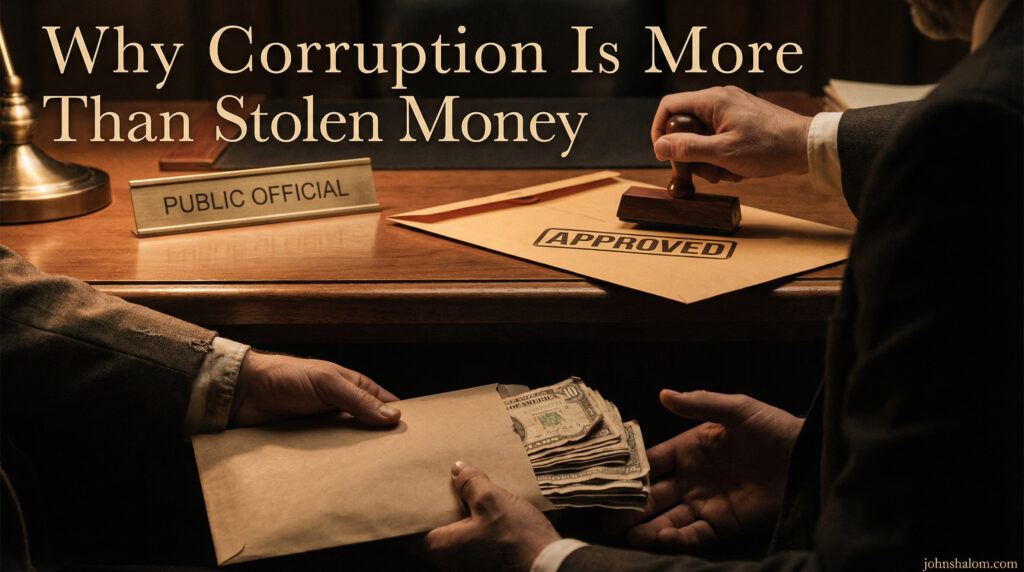
Corruption is not only about missing money or inflated contracts. It is a deeper sickness that damages trust, destroys fairness, and betrays the sacrifices that built a nation. When leaders steal resources, they do not just delay roads and hospitals, they teach citizens that honesty is foolish and effort is useless. When ordinary people join in small acts of cheating, they quietly help that sickness spread. The true cost of corruption is measured in broken trust, wasted talent, and young people who stop believing in their country. The answer begins with integrity at the smallest level, from the family table to the office desk, until honesty once again becomes more normal than theft.
Introduction: Corruption Beyond Cash
1.1 Money is only the surface
When people hear the word “corruption,” they usually think of money. Briefcases full of cash, ghost workers on payrolls, inflated projects that exist only on paper. These things are real, and they hurt.
But if we stop there, we miss the deeper wound. Money can be counted, but trust cannot. A stolen budget is terrible, yet a stolen future is worse. Corruption drains pockets, but it also drains belief. It whispers to citizens, “Nothing will ever change,” until people stop trying to build anything better.
As I grew up, I slowly saw that corruption is not just what moves through bank accounts. It is what moves through hearts.
1.2 The day I met “I am tired”
I still remember standing in a government office line for six hours. The sun moved, the shadows moved, but the line hardly moved. When I finally reached the front, the officer looked at me and said, “Come back tomorrow. Today I am tired.”
Everyone around me laughed, but it was a bitter laugh. He was not tired of working. He was tired of serving. That moment stayed with me. It showed me corruption in a different form. No money exchanged hands, yet something important was stolen: time, dignity, and a sense of fairness.
That is what this article is about. Corruption beyond the wallet.
What Corruption Really Is
2.1 Corruption as broken trust
Corruption is the breaking of trust for personal advantage.
You trust a leader to use public resources for the good of all. He uses them for himself.
You trust a teacher to mark exams fairly. She demands gifts before passing students.
You trust a police officer to protect you. He stops you on the road and asks for “tea” before letting you go.
Each of these may look different, but they share one root: betrayal. Corruption breaks the invisible agreements that hold communities together.
2.2 Corruption as twisted responsibility
Responsibility is a gift. When you are given an office, a desk, a stamp, or even a uniform, you are given a chance to serve others. Corruption twists that gift into a weapon.
The officer who says, “Come tomorrow,” without reason is not just lazy. He is corrupting the purpose of his work.
The contractor who uses cheap cement for a school is not only cutting costs. He is corrupting the duty to protect children.
This kind of corruption does not always appear in audit reports, but it appears in broken lives.
Everyday Corruption: The Small Cracks In The Wall
3.1 It is not only “big men”
It is easy to blame “big men” and “top people.” We see photos of luxury cars and foreign trips and say, “They are the corrupt ones.”
But corruption is also very local.
It is the teacher who hints, “If you bring something small, your marks will improve.”
It is the policeman at a checkpoint who stops cars not for safety, but for small bribes.
It is the health worker who sells free medicine that was meant for the poor.
These are the daily cracks in the wall. If we only curse national leaders and ignore these cracks, the house will still fall.
3.2 Corruption inside families
Corruption does not begin in parliament. It begins at home.
When parents lie to cover up a child’s fault, they are teaching that manipulation is better than truth.
When a father gives all opportunities to one child and ignores the others without reason, he is teaching unfairness as a way of life.
When a mother secretly hides the best portion of food for her favorite child, she is writing an early lesson in favoritism.
My mother used to say, “If you cheat your brother out of bread today, do not be surprised when you cheat your community out of justice tomorrow.” She linked small lies with future crimes. She was right.
The Humor Of Corruption – And Its Pain
4.1 “Creative budgeting”
Some corruption stories are so absurd that you almost have to laugh.
I once heard of a man who reported that his government car had been stolen. Later, people saw him using the same car as a taxi to earn private money. When they challenged him, he smiled and said, “It is not stealing. It is creative budgeting.”
Everyone laughed, but inside they were angry. That is the strange face of corruption. On the outside, comedy. On the inside, betrayal.
4.2 Jokes as a safety valve
In many countries, people joke about corruption because they feel powerless in front of it. Humor becomes a way to survive the frustration. You hear jokes like:
“Here, money does not talk. It whispers secretly.”
“Our projects are invisible because they are shy of the public.”
These jokes make people laugh, but they also carry truth. They are like small pressure valves letting steam out of a cooker that is ready to explode.
The Invisible Costs You Cannot See On A Budget Sheet
5.1 Lost roads, lost hope
It is easy to point at an unfinished road or an empty clinic and say, “Corruption did this.” That is true. But the deeper cost is in people’s hearts.
When farmers watch the same road promised again and again but never completed, they stop believing in any promise.
When mothers reach a clinic with no medicine, they stop trusting any health message.
When young people see only relatives of officials getting jobs, they stop believing in education.
This is how corruption kills hope. Not only with missing money, but with repeated disappointment.
5.2 The wound in young hearts
Imagine a student who studies hard, wakes up early, reads at night by a smoky lamp, and dreams of serving the country. Then, at the gate of opportunity, someone says, “If you want this job, you must pay or know the right person.”
What happens inside that young heart?
Some give up and say, “Why try?”
Some decide, “Next time I will also cheat. That is how the world works.”
In that moment, the country loses more than one job. It loses a citizen’s faith in fairness. That wound is deeper than any missing document.
5.3 When investors walk away
Corruption also chases away people who could bring jobs, training, and resources. Investors and partners may not complain loudly. They simply leave.
They see bribes at every step, unclear rules, and leaders who treat public money like a family wallet. Then they pack their bags and say, “Too risky.”
The nation then loses factories, farms, and businesses that could have changed thousands of lives. That loss does not appear in the budget. It appears in empty pockets and idle hands.
You might also like: The Ultimate Guide to Political Journalism: Ethics, Challenges, and Impact in the Modern World
Corruption As Betrayal Of Sacrifice
6.1 My brother in 1989
In 1989, my elder brother died in the Nasir battle. He did not die to protect luxury cars or foreign accounts. He died believing that freedom would bring dignity, justice, and opportunity to ordinary people.
He was buried in the soil of war, while dreamers spoke of a better future.
Years later, when I see corruption stealing that future, I feel something deeper than anger at stolen money. I feel that his sacrifice, and the sacrifice of many others, is being disrespected.
6.2 From liberation struggles to daily frustration
Many nations have similar stories. People fought, bled, and died to create a new country. But after independence, corruption arrived quietly, like a visitor who never plans to leave.
Suddenly, the “big men” who once spoke of justice spend more time protecting their wealth than protecting their people. Citizens who once celebrated freedom now stand in long lines for services that never come.
When corruption spreads, it says to the dead: “Thank you for your sacrifice. We will now use it for our comfort.” That is why corruption is not just theft. It is betrayal.
When Corruption Becomes Culture
7.1 “That is just how things work here”
The most dangerous stage is not when corruption starts. It is when people stop being shocked by it.
When citizens begin to say, “This is normal,” then corruption has moved from crime to culture. It no longer hides. It wears local clothes and smiles in public.
People then tell each other:
“You cannot get anything done here without paying something.”
“If you want justice, you must know someone.”
Once these sentences become common, it becomes harder to resist. The stream is flowing in the wrong direction, and anyone who swims against it looks foolish.
7.2 The problem with admiring thieves
Another danger is when the corrupt are admired.
People say, “He is clever. Look how rich he is.”
They admire the big house, the cars, the parties, but ignore the stolen origin of these things.
My father used to say, “If you laugh at theft today, tomorrow it will steal you.” He meant that when you celebrate the corrupt, you are actually welcoming your own suffering. The same system that steals from others will one day steal from you too.
The Spiritual Side: Corruption of the Heart
8.1 Small lies, big harvest
Corruption does not begin with millions of dollars. It begins with small lies that no one challenges.
Borrowing money and never paying back.
Arriving late and marking yourself present.
Claiming travel you never did.
Each small act shapes the heart. After a while, the person no longer feels any shame. At that point, bigger crimes become easier. The soil is ready for a bigger harvest of dishonesty.
8.2 Public religion, private theft
In many societies, people mention God in speeches, put Bible verses or Qur’an verses on office walls, and attend religious meetings faithfully. Yet corruption still grows.
This creates another wound. Young people look at leaders who pray loudly in public and steal quietly in private. They begin to think God is either powerless or a joke.
When public faith and private practice do not match, corruption is not only in the budget. It is also in the reputation of faith itself.
The Antidote: Integrity In Ordinary Clothes
9.1 Integrity as a daily choice
The good news is that corruption is not the only thing that multiplies. Integrity can multiply too.
Integrity is not perfection. It is the choice to be honest, even when no one is watching. It is the choice to return extra change, to keep promises, to resist illegal shortcuts.
A shopkeeper who gives fair change
A driver who refuses to pay at illegal checkpoints
A clerk who processes documents without asking for “tea”
These people may look small, but they are soldiers in a quiet war against corruption.
9.2 Families as schools of honesty
If corruption begins at home, then so does integrity. Families can:
- Share food fairly, even when it is little.
- Refuse to lie for their children in school or at work.
- Praise honesty, even when it brings loss or punishment.
Children who grow up in such homes learn that truth is more valuable than quick gain. One day, they will carry that lesson into offices, markets, and government.
9.3 Communities, churches, and mosques
Churches, mosques, and community groups can do more than preach sermons against corruption. They can:
- Manage their own money transparently.
- Elect leaders based on character, not tribe or gifts.
- Support whistleblowers instead of isolating them.
When communities model honesty in their own small budgets, they gain the moral right to speak against corruption in bigger budgets.
9.4 Leaders who want to change
Leaders who truly want to fight corruption must begin with themselves.
Publish what you earn and how you use it.
Refuse “gifts” that come with expectations.
Protect honest staff instead of rewarding loyal thieves.
One clean leader may not fix a whole system, but he or she can start a new story. Citizens will see the difference. Young people will notice.
Conclusion: From Stolen Money To Stolen Futures
Corruption is more than stolen money. It is stolen trust, stolen time, stolen chances, and stolen futures. It weakens families, poisons institutions, and mocks the sacrifices of those who fought for freedom.
If we continue to see corruption only as a money problem, we will keep chasing missing funds while ignoring the deeper wounds. We must see it as a moral disease that starts in small choices and grows into national crises.
The battle against corruption will not be won only in courts and commissions. It will be won at kitchen tables, in classrooms, at checkpoints, in offices, and in hearts that decide, “I will not join this game.”
Every time someone chooses honesty over cheating, service over selfishness, and fairness over favoritism, they are quietly rebuilding what corruption tried to destroy. Step by step, choice by choice, a different future becomes possible.
Not a perfect country, but a cleaner one.
Not a land without mistakes, but a land where theft is no longer normal.
Not a nation without struggle, but a nation where integrity is no longer the exception.
That work does not belong only to “them” at the top. It belongs to all of us.
If you would like to know more about my path as a writer, including the struggles, lessons, and small signs of progress along the way, you can read the full story on my Wealthy Affiliate blog here: https://my.wealthyaffiliate.com/johnmaluth/blog
FAQS
- In what ways is corruption more than just stolen money?
Corruption is more than missing funds because it destroys trust, fairness, and hope. It damages how citizens see their leaders, how children see their future, and how communities relate to each other. It turns public offices into private shops and teaches people that effort and honesty do not matter. - How does everyday corruption affect ordinary people’s lives?
Everyday corruption shows up in long lines, delayed services, unsafe buildings, missing medicine, and unfair exams. It wastes people’s time, drains their energy, and quietly tells them that the system is against them unless they pay or know someone. Over time, this creates anger, apathy, and a sense of helplessness. - What is the danger when corruption becomes “normal culture”?
When people begin to say, “That is just how things work here,” corruption has shifted from a crime to a habit. At that point, citizens stop resisting and start copying. The corrupt are admired instead of challenged, and young people grow up thinking dishonesty is the only way to survive. This is when a nation’s future is most at risk. - How can ordinary citizens fight corruption in small ways?
Ordinary citizens can resist corruption by refusing to pay or demand bribes, speaking truth even when it costs, keeping their own promises, and supporting honest officials. They can teach their children fairness at home and support institutions that practice transparency. Small acts of integrity, repeated by many people, slowly change what is considered normal. - Why is integrity called the antidote to corruption?
Integrity is the antidote because it directly opposes the root of corruption, which is dishonesty and selfish gain. While laws can punish some actions, only integrity can prevent them from happening in the first place. A society where many people choose honesty in daily life becomes harder for corruption to control, no matter how strong the temptation or pressure.