TL; DR:
Statues honour people from a distance, but they freeze them into symbols that cannot speak, laugh, doubt, or repent. Autobiographies, and honest life stories in any form, let us sit close and listen to how a person actually lived, failed, changed, and grew. Statues inspire awe but often create distance. Stories invite identification, empathy, and action. They turn heroes from stone figures into older brothers and sisters who walked the same rough road we walk now. Nations that only build statues remember faces. Nations that encourage autobiographies remember journeys, choices, and lessons that can still shape the future.
Introduction: Stone Heroes And Living Stories
1.1 The problem with stone
When you walk through many capitals, you see statues everywhere. Soldiers with raised fists. Leaders pointing to the horizon. Thinkers frozen with a hand under the chin. They are meant to inspire respect. They say, “This person mattered.”
Yet something is missing. The statue does not tell you about the sleepless nights before a big decision. It does not tell you how many times that leader wanted to give up. It does not confess the foolish mistakes or the secret fears that made the person human.
You may pass the statue every day and still know almost nothing about the life behind it.
1.2 The gift of autobiography
Now compare that to an autobiography, or even a long honest interview. Suddenly the stone begins to breathe. The hero becomes a child again, afraid of the dark. The general becomes a young recruit who once failed basic training. The politician becomes a confused student who almost dropped out.
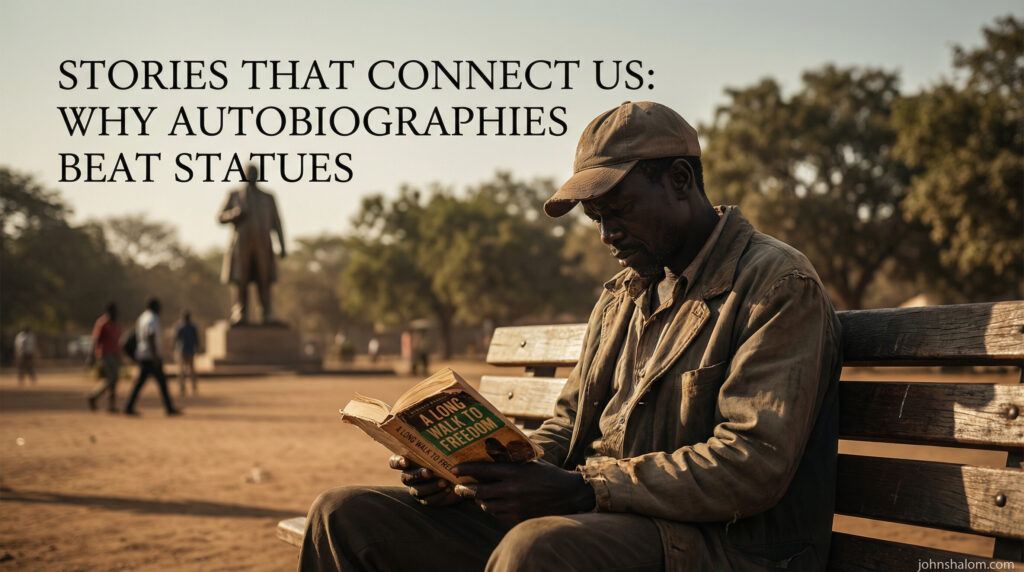
Autobiographies allow us to sit down with a life and listen. We hear the voice, not just see the pose. We touch the doubts, not only the slogans. That is why autobiographies beat statues. They give us stories that connect, not just images that stand and stare.
Statues Freeze, Stories Flow
2.1 One moment versus the whole journey
A statue captures one moment, usually at the peak of success. The victory, the final speech, the heroic pose. It is like taking a single photo and saying, “This is the whole story.”
But a human life is not one photo. It is thousands of scenes, many of them messy, confusing, and unflattering. Autobiographies invite us to walk through these scenes. We see the small decisions that led to the big moment that later became a statue.
The boy who once feared speaking in class becomes the national orator.
The girl who once walked barefoot to school becomes a minister of education.
The young fighter who once panicked in his first battle becomes a decorated commander.
Statues hide the process. Stories reveal it.
2.2 How stories help ordinary people
When ordinary people look at statues, they may feel impressed, but also distant. The hero seems too big, too perfect, too far from daily struggle. A young person may think, “I could never be like that.”
When they read an autobiography, they learn how often that same hero failed, cried, or almost quit. They see that greatness did not appear in one jump. It grew slowly through small acts of courage, repeated over years.
Statues inspire awe. Stories inspire action. Awe makes you look up. Action makes you stand up.
Humor The Statues Cannot Tell
3.1 Human mistakes that teach more than slogans
Statues never laugh. They never blush. They never confess.
Autobiographies, if they are honest, are full of humor. Leaders admit they walked into the wrong hall and gave a speech to the wrong audience. Generals confess that their first time on a horse ended with them in the mud. Pastors remember sermons that put half the congregation to sleep.
I remember preaching once and mixing up two Bible stories in front of the whole church. People smiled kindly. Later we laughed about it together. If that moment was carved in stone, it would look like shame. Written in a story, it becomes a lesson in humility and growth.
3.2 Laughter as connection
Humor is not just entertainment. It is a bridge. When a great person shares a funny failure, they step down from the pedestal and sit with us on the bench. We recognize ourselves in them.
A statue says, “Look how high I stand.”
An autobiography says, “Look how many times I fell before I stood.”
That difference matters, especially for young people searching for models they can actually imitate.
You might also like: How to Write Your Life Story: A Complete Guide to Autobiography Writing
My Brother’s Legacy: Beyond a Possible Statue
4.1 Sacrifice larger than stone
When my elder brother died in the 1989 Nasir battle, I often wondered how he would be remembered. His sacrifice was real. He gave his life so that others might live with dignity and freedom.
Maybe one day someone will propose a monument for him or for those who died with him. A statue could honour his courage. It could remind visitors that a price was paid for the flag that flies above them.
Yet a statue would never tell future generations about his loud laughter, his stubbornness, his jokes during cattle herding, or the way he teased me during chores. It would not tell them how he feared for our parents or how he comforted us on hard days.
4.2 Story as living remembrance
Only stories can carry that.
His life is not just a line in a history book, “died in battle.” It is a series of scenes burned into my memory. His voice, his steps, his arguments, his dreams.
When I speak or write about him, I keep him alive in a way stone cannot. New listeners and readers meet not only “a fallen soldier,” but an older brother who once chased cows, made mistakes, loved his family, and chose to fight for something larger than himself.
Stories give the dead permission to keep teaching the living.
Stories As Bridges Between Generations
5.1 Grandparents and the unwritten books
Before people write autobiographies, they tell stories. Around fires. In kitchens. Under trees. In crowded buses. Many grandparents will never publish a book, but their lives are full of chapters.
A grandfather who walked through three famines has more to say about resilience than many textbooks. A grandmother who raised ten children on almost nothing is a living lecture on economics and faith.
If we only build statues to “big” figures and ignore these smaller stories, we lose most of our national library without even noticing.
5.2 Families as story archives
Families that encourage sharing life stories are quietly building an invisible archive.
Children who know how their parents met, how their grandparents survived war, and how earlier generations dealt with injustice stand on a stronger foundation. They know they come from people who suffered and still sang.
A statue in the town square may impress them once a month. A story at the dinner table shapes them every day.
Statues Without Stories: The Risk Of Empty Symbols
6.1 “Who is that man on the horse?”
Have you ever stood in front of a statue and asked, “Who is this?” The plaque gives a name, maybe some dates, and a short description. Yet you still feel like you are looking at a stranger.
Without stories, statues become puzzles. People walk past them while staring at phones. Children climb on them without knowing whose head they are sitting on. Leaders lay wreaths once a year, but no one truly connects.
6.2 Symbols that lose their meaning
Every nation needs symbols. Flags, anthems, monuments. Yet symbols without story become empty. People may salute, sing, or march, but their hearts stay far away.
Autobiographies, memoirs, oral histories, and honest documentaries refill those symbols with meaning. They explain why this person matters, what they suffered, and what they believed.
If the only thing we invest in is stone, our memory will be hard and cold. If we invest in stories, our memory will be warm, detailed, and alive.
Autobiographies As Tools For Personal Growth
7.1 Learning from the path, not just the destination
When you read a good autobiography, you do not only meet the author. You also meet yourself.
You see their mistakes and suddenly recognize your own.
You watch their slow change and feel hope for your own.
You witness their courage and feel a small call in your heart: “Stand up, try again.”
Statues mostly say, “This person succeeded.” Autobiographies explain how. They talk about shame, regret, fear, and second chances.
For young people trying to find purpose, this is priceless. They realise that greatness is not the absence of failure. It is the habit of standing up again and again.
7.2 Writing as healing
Autobiography is not only for readers. It also heals writers.
When a person sits down to tell their story, they are forced to face their own life honestly. They see patterns, sins, blessings, and turning points they never fully faced before. They name their wounds and victories.
For survivors of war, abuse, or displacement, writing can be a way to put chaos into order. Not to erase pain, but to give it structure and meaning.
In that sense, the pen sometimes heals more deeply than a monument.
Nations That Encourage Stories Are Safer
8.1 Stories against lies
Where there are no stories, propaganda spreads easily. Leaders can rewrite history in two speeches if nobody wrote down their own version of events.
Autobiographies, diaries, letters, and long interviews act as shields against lies. They preserve personal witness. They allow future generations to cross-check.
When ten people from different sides of a conflict write their honest memories, truth has a better chance to survive than if only one official version remains.
8.2 Stories against hero worship
Statues can tempt nations into hero worship. They present leaders as perfect saviours who never erred. That is dangerous. A country that believes in superhuman leaders is more likely to excuse oppression and repeat old mistakes.
Autobiographies that admit weaknesses and failures remind us that every leader is a human being with limits. This encourages citizens to be responsible rather than passive. It says, “Do not wait for a statue to save you. Learn from this life and take your own part in building the future.”
Technology, AI, And The New Story Age
9.1 Stories travelling farther than stone
In the digital age, stories travel farther than ever before. A memoir written in a small village can now reach readers in cities across the world. A recorded oral story can be shared with grandchildren on another continent.
Statues, in contrast, stand in one place and wait. Stories move. They cross oceans, languages, and cultures. They allow one person’s experience to become food for many minds and hearts.
9.2 The danger of fake stories
However, the rise of technology also brings fake stories and artificial voices. Machines can now generate words that sound like someone’s life without having lived a single day of that life.
This makes sincere autobiographies even more important. Real scars, real tears, real laughter, real names. Honest life stories act as anchors in a sea of artificial noise.
They remind us that while tools change, human experience remains the central source of wisdom.
My Mother’s Wisdom On Stories
10.1 “The stories you leave are bigger than the food you eat”
My mother used to say, “The stories you leave are bigger than the food you eat.” At first I did not understand. Food felt very important. Stories felt like evening entertainment.
Later I realised what she meant.
Food sustains the body for a day. Stories sustain minds and hearts for generations. Food disappears from the plate. Stories multiply with each retelling.
10.2 Statues, food, and memory
Today, when I think about statues and autobiographies, her words return. Statues are like a picture of a meal. Autobiographies are like a recipe and a conversation around the table.
The picture may impress you, but it will never feed you. The recipe and the conversation can feed you again and again, in your own kitchen, in your own life.
That is why I believe autobiographies beat statues. They are not just about honour. They are about nourishment.
Conclusion: Write Lives, Not Only Raise Stone
Statues have their place. They help us remember names and mark important events. They can be symbols of courage, sacrifice, and victory.
But if we only raise stone and never write stories, we lose the most important part of our heroes: their humanity. Their doubts, jokes, tears, and wrong turns. The small acts of faith and courage that no sculptor can carve, but any honest writer can capture.
Stories connect us. They turn distant legends into older brothers and sisters who walked before us on the same rough road. They teach us that greatness is not perfection but perseverance. They remind us that every life, not only famous ones, carries lessons worth sharing.
So, as families and nations, let us not only build statues in public squares. Let us also encourage journals, memoirs, oral histories, and honest autobiographies. Let us visit the libraries that walk on two legs, our elders and our peers, and listen while they can still speak.
One day, when our own time is over, it will not be the stone that truly carries us forward. It will be the stories we leave behind.
If you would like to know more about my path as a writer, including the struggles, lessons, and small signs of progress along the way, you can read the full story on my Wealthy Affiliate blog here: https://my.wealthyaffiliate.com/johnmaluth/blog
FAQS
Q1: Why are autobiographies more powerful than statues?
A: Autobiographies show the full journey, including failures, doubts, and small decisions that shaped a person’s life. Statues usually show only one moment of triumph. While statues inspire respect from a distance, autobiographies create connection by revealing the human side that people can learn from and imitate.
Q2: Can statues still be useful if we also have stories?
A: Yes. Statues can act as reminders that point people toward the deeper stories behind them. They mark important lives and events. But their real value increases when people also read or hear the life stories, so the symbol on the pedestal is supported by understanding in the heart.
Q3: How can families encourage storytelling without writing full books?
A: Families can set times to share memories during meals, trips, or special days. They can record elders on audio or video, keep simple notebooks of important events, or encourage children to ask questions about the past. Even small notes and recordings become building blocks for future autobiographies.
Q4: What makes a personal story more powerful than a public image?
A: Personal stories include weakness, humor, fear, change, and growth. These details show how a person became who they are. Public images focus on success and strength. People grow more when they see the struggle behind the success, not only the polished image.
Q5: How can nations support autobiographies and life stories?
A: Nations can support local writers, create community archives, encourage schools to assign family history projects, and give space in media to personal testimonies from different backgrounds. They can fund libraries and cultural centres that collect memoirs and oral histories. In this way, many voices, not only those who receive statues, help shape the national memory.