
TL;DR:
Modern capitalism isn’t just an economy—it’s a mindset. These reflections uncover the unseen forces shaping how we live and think.
I often think about how the world has changed since my childhood days by the Sobat River. I was born into a world where people’s worth wasn’t measured in money, followers, or possessions — it was measured in how much they gave to others. Our community didn’t have salaries or shopping malls, but we had something far more valuable: connection.
When one family built a hut, every neighbor helped. When someone lost a loved one, everyone mourned together. When we had little food, the village still found a way to share. There was no “mine” or “yours” — it was always “ours.” That was the spirit that raised me.
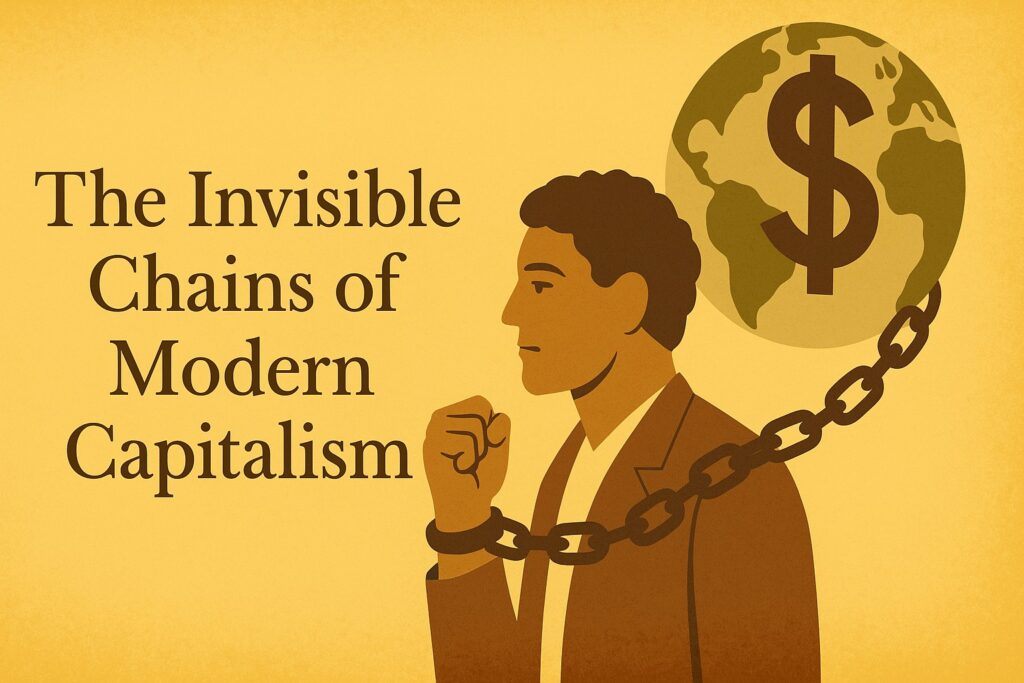
Years later, I would come to live in cities, study technology, and publish books online. I entered a new system — one that spoke of freedom, opportunity, and ambition. It’s called capitalism. And yes, it works. It creates innovation, opens doors, and rewards those who work hard. But beneath its bright surface, it also hides something darker — invisible chains that quietly bind our hearts and minds.
I’ve lived on both sides — the communal and the capitalist. And from what I’ve seen, these chains are real. Let’s look at them closely, one by one.
FAQs: The Invisible Chains of Modern Capitalism
1. What does “invisible chains” mean in capitalism?
It refers to unseen systems—like debt, consumerism, and social pressure—that control behavior while appearing to promote freedom.
2. How does capitalism affect individual freedom?
By tying success to consumption, it creates cycles where people work harder but feel less fulfilled.
3. Is capitalism entirely negative?
No. It has driven innovation and growth, but without ethics and equality, it can deepen social and moral inequality.
4. How can individuals break free from these “chains”?
Through conscious living—simplifying, choosing purpose over profit, and supporting fair, sustainable systems.
5. Why discuss capitalism from a moral or spiritual lens?
Because economics isn’t just numbers—it’s about people, choices, and values that shape the soul of society.
1. The Chain of Productivity
Capitalism tells us that time is money. That’s why people now move faster than their shadows, chasing deadlines, deals, and digital approval. Productivity has become the new religion, and success its god.
When I was a boy, productivity had a different meaning. We worked when the sun told us to, and we rested when the moon rose. There were no clocks — only seasons. The rains told us when to plant, and the birds told us when to harvest. If the crops failed, we didn’t blame the market — we looked to each other for help.
Now, I live in a world that praises “grind culture.” If you take a break, you risk being labeled lazy. People sleep with their phones under pillows, wake up to screens, and fall asleep to them again. The rhythm of life has been replaced by the rhythm of notifications.
Sometimes, even I fall into that trap. When I spend days without writing a new article, designing a website, or updating Panmal’s digital content, I feel that whisper of guilt: “You’re not doing enough.” That voice doesn’t come from nature. It comes from a system that equates our value with output.
Back home, work had meaning because it was connected to life. Here, work often feels endless — a cycle with no harvest. The danger is simple: when productivity becomes identity, humanity becomes secondary.
2. The Chain of Debt and Desire
The second chain is built on temptation. Capitalism doesn’t just sell products; it sells emotions. It whispers, “You’ll be happier when you get this.” And so, people chase happiness through things.
When I was young, we didn’t have money in our hands, but we had cattle — living wealth. Yet those cows weren’t symbols of greed. They represented community. We shared milk freely, lent bulls for plowing, and slaughtered one for celebrations. Ownership didn’t divide us; it united us.
In contrast, modern capitalism rewards hoarding and debt. We borrow for lifestyles we can’t maintain. We compare our houses, cars, and gadgets — forgetting that joy is not something we can buy.
I remember my first smartphone. I bought it because everyone else had one. It was shiny and powerful, a window to the world. But soon, it became a mirror — reflecting my need for validation. Each ping demanded attention. Each update pulled me deeper into a digital loop. It connected me globally but disconnected me spiritually.
Debt keeps the capitalist machine turning. You don’t need chains when you have credit. People become lifelong workers not because they love their jobs, but because they owe their lives to bills and loans.
My village elders used to say, “A man who owes cattle loses sleep even when the cows are silent.” That proverb has never been more true.
3. The Chain of Comparison
Back home, comparison was simple. We compared who could tell the funniest story or who caught the biggest fish. It was friendly, not destructive. We knew that every person had a unique path.
But today’s world thrives on comparison. We scroll through pictures of perfect homes, perfect bodies, perfect lives. Each swipe tells us who we’re not. Capitalism turns comparison into a market. Every post you see online is selling something — even if it’s just an image of success.
I’ve felt it too. I’ve looked at other authors with bigger audiences, wealthier backgrounds, or more polished websites and thought, “Maybe I’m behind.” But that mindset is poison. It kills gratitude. It blinds you to your own blessings.
In communal life, your neighbor’s success was your success. When one family prospered, the whole village benefited. But capitalism isolates achievement. It says, “You win alone.”
The truth is, no one wins alone. Even in the digital world, the algorithms of success still rely on people — on trust, loyalty, and shared stories. The day we forget that is the day we stop being human.
As we say in South Sudan, “No tree grows tall without the wind’s help.”
4. The Chain of Disconnection
Perhaps the most painful chain of all is disconnection.
Capitalism has connected the world technologically but disconnected it emotionally. We can message someone across the ocean in seconds but don’t know our neighbor’s name. Communities that once gathered around fire now gather around screens. Families share houses but not conversations.
I remember evenings in my village — children chasing fireflies, elders telling stories under the stars, mothers pounding sorghum while laughing together. The rhythm of life was collective. Everyone belonged somewhere.
Now, in cities, belonging is rare. People live behind walls and passwords. Relationships are transactional, friendships are filtered, and time is monetized. We say “I’m busy” as a badge of honor, not realizing it’s a confession of disconnection.
Even in my own work, I feel this tension. I spend hours building websites and writing articles meant to connect people, yet I often sit alone behind a glowing screen. The irony is heavy.
Disconnection breeds loneliness — a silent epidemic of modern life. And loneliness is profitable. The more disconnected we feel, the more we consume — entertainment, gadgets, courses, even therapy — all promising to fill the void.
But back home, the cure was simple: presence. Just being together healed half the pain.
5. The Chain of Fear
Fear is capitalism’s final and most invisible weapon. It’s not fear of war or famine anymore — it’s fear of irrelevance.
We fear being left behind, losing followers, missing opportunities, or not earning enough. Fear fuels the race. It’s what keeps people working late, scrolling endlessly, and doubting their worth.
I know this fear. When my website traffic drops or engagement slows, I feel that sting. It’s as if my voice is fading. But then I remember — when I was ten, I faced real fear. Bullets flew over my head, and I survived by hiding near the riverbank. That kind of fear teaches you what truly matters.
Today’s fears are mental cages — created not by danger, but by comparison and competition. They keep us moving but never arriving.
My people used to say, “Even the lion sleeps when it’s full.” In capitalism, no one ever feels full — and that’s exactly how the system stays alive.
Reclaiming Our Humanity
After all this, you might think I’m against capitalism. I’m not. I use it every day — it powers my websites, publishes my books, and helps me reach readers across continents. Capitalism has given me a global voice. But that doesn’t mean I must surrender my soul to it.
The challenge is not to destroy capitalism, but to humanize it. To bring back the values we lost — community, compassion, and purpose. To build systems that serve people, not just profits.
That’s why I founded Panmal Foundation. It stands on two words — “Pan” meaning Home in Dinka, and “Mal” meaning Peace in Nuer. Together, they mean A Peaceful Home for All. It’s our way of proving that business can coexist with belonging, that profit can align with purpose.
Meaning, as I’ve learned, is not something the market can sell. It’s something people create together.
So yes, capitalism may be the air we breathe today — but community must remain the ground we stand on. If we forget that, our progress will only deepen our poverty — not material poverty, but moral and spiritual emptiness.
The Way Forward
What comes after these chains is not a new “ism” — it’s a new consciousness. A way of living that blends innovation with integrity, ambition with empathy, and wealth with wisdom.
Maybe that’s what Africa, with its deep communal roots, can teach the world — that true progress isn’t measured by GDP but by GHC: Genuine Human Connection.
I still carry the rhythm of Sobat in me — the sound of laughter, the songs at harvest, the peace of a meal shared freely. Those memories remind me that humanity was never meant to live alone or compete endlessly. We were meant to build, share, and grow together.
If modern capitalism has invisible chains, community is the key that unlocks them.
Related Reads
- The Individual: Finding Meaning in Modern Work
- The Tribe: How African Wisdom Can Heal Modern Isolation
- The Country: Building Peace Beyond Politics
- The World: Why Purpose Still Matters in the Digital Age
John Monyjok Maluth
Author | Coach | Teacher
🌍 Website: www.johnshalom.com
📧 Email: maluthabiel@gmail.com
📞 Phone: +211 927 145 394
This essay really struck me — not as a rejection of capitalism, but as a call to remember what it means to be human within it. The contrast between communal life by the Sobat River and the hyper-individualism of modern cities highlights something profound: capitalism’s greatest success has been material progress, but its deepest cost has been emotional and spiritual disconnection.
I think your framing of these “chains” is especially powerful because it doesn’t demonize the system — it exposes the mindset it cultivates. Productivity, comparison, and fear have become virtues disguised as necessities. Yet, reading this reminded me that the antidote isn’t withdrawal but reconnection — reclaiming the communal wisdom that once defined our sense of belonging. The idea of measuring progress by “GHC: Genuine Human Connection” feels like the kind of metric the world desperately needs right now.
Ashley, your reflection captures the heart of it perfectly. Capitalism itself isn’t the villain, but the mindset of separation it breeds that slowly erodes our humanity. I love how you put it: the antidote isn’t withdrawal but reconnection.
That’s exactly what I hoped to convey through the Sobat River story, which is about how life made more sense when “we” mattered more than “I.”
Do you think modern society can rediscover that communal rhythm without losing the innovation that capitalism brought us?
John