TL; DR:
Long before children hear about constitutions and parliaments, they learn politics in the kitchen. The way families share food, argue, forgive, joke, and make decisions becomes their first school of citizenship. A healthy “kitchen parliament” teaches listening, fairness, compromise, responsibility, and respect.
A broken one trains future citizens in shouting, blame, and selfishness. If we want better public leaders and stronger nations, we must pay attention to the small debates around the cooking pot, because that is where values are first tested and quietly passed on.
Introduction: Where Politics Really Begins
1.1 The kitchen as the first public space
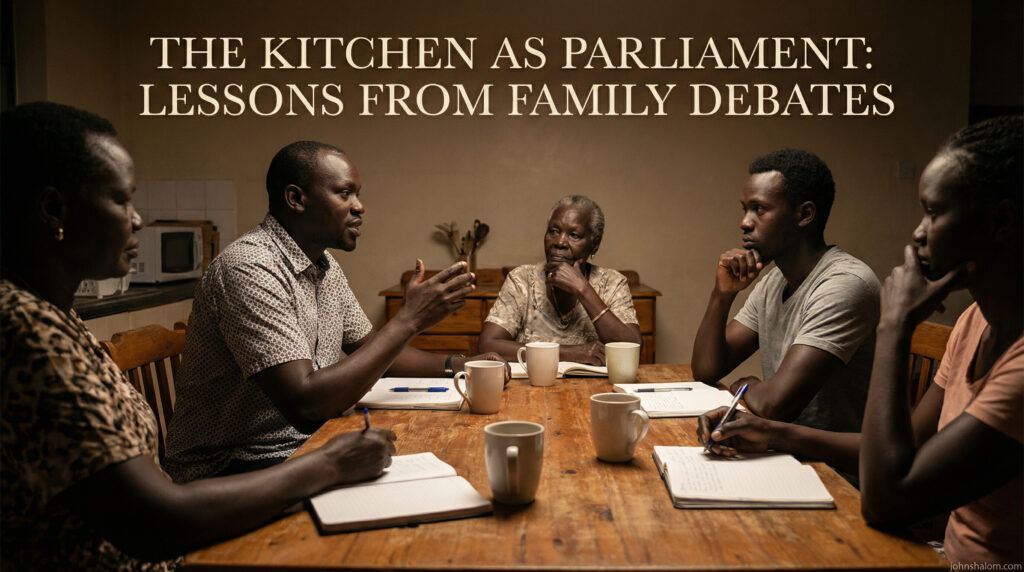
For many of us, the kitchen or cooking place is the first place we see power in action. It is where food is prepared, rules are enforced, and debates rise with the steam.
In my childhood home, we did not have microphones, flags, or cameras. We had firewood, pots, plates, and people with strong opinions. Arguments over chores, food, or visitors were not just private matters. They were lessons in power, justice, and belonging.
Long before I knew the words “parliament” or “policy,” I already understood what it meant to feel heard, to feel ignored, to lose an argument, and to accept a decision because an elder had spoken. That was political training, even if nobody called it by that name.
1.2 Why family debates matter for nations
We sometimes pretend that politics begins when a person turns eighteen and is allowed to vote. In reality, political behaviour starts when a child is old enough to grab the larger piece of meat and see what happens.
If the home rewards selfishness, the child learns that the strong always win.
If the home rewards fairness, the child learns that justice matters.
If the home punishes questions, the child learns that authority must never be challenged.
If the home welcomes respectful questions, the child learns that power can be questioned without destroying relationships.
By the time that child walks into a polling station or runs for office, the real training has already happened around the cooking fire.
Early Lessons in Power, Fairness, and Voice
2.1 The first fights over food
It often begins with something small. Who gets the drumstick? Who chooses the best piece of fish? Who drinks from the bigger cup? To adults, these may look like small quarrels. To children, they are serious debates about justice.
I still remember one meal where my siblings and I argued for ten minutes about who deserved the “best” piece. One sister argued that she was older, so she should get it. Another claimed that she had worked harder that day, so she deserved a reward. I tried my own clever explanation, which I have now forgotten.
Looking back, I realize we were not simply greedy. We were learning:
Who counts in this house?
What is considered fair?
On what basis are decisions made?
When a parent handled such debates wisely, we walked away feeling heard, even if we did not get what we wanted. When they handled them poorly, we walked away feeling cheated. Those feelings did not stay at home. They shaped how we later viewed chiefs, pastors, teachers, and presidents.
2.2 The right to speak, even with “noise”
In many families, children try to speak but are quickly told, “Keep quiet, adults are talking.” There are moments when this is necessary. But if a child never gets a chance to speak in small family debates, how will they ever learn to speak in larger public debates?
In our kitchen parliament, people spoke with or without wisdom. Some had good arguments. Others just had loud voices. But my parents tried, at least sometimes, to let each person say something before giving the final decision.
Those moments taught us that voice matters. Even if your idea is not chosen, being heard gives you dignity. A nation that silences children at home often grows into a country that silences citizens in public.
Humor as the Kitchen’s Peace Agreement
3.1 Laughing instead of breaking
Family debates can easily turn bitter, especially when everyone is tired and hungry. Humor acts like a small fire extinguisher. It does not erase the conflict, but it stops the flames from burning the whole house.
Once, my sister claimed she should get more beans because she was “preparing to be tall.” My brother replied, “Then I should get more too, I am preparing to be a chief.” Everyone laughed, including my parents. The beans were still shared, but the tension was gone.
That moment taught me something national leaders often forget: you can argue and still remain family. Humor keeps that door open.
3.2 When jokes fail and when they heal
Humor is not magic. A bad joke at the wrong time can add pain. Mocking someone, especially in front of others, can leave scars. But gentle humor, used with love, can ease shame and soften pride.
I remember spilling soup all over the floor once. I was expecting a loud rebuke. Instead, my mother said, “At least now even the ants can eat with us.” We all laughed. After that, I was more careful with the pot, not because I feared punishment, but because love and humor had reached my heart.
You might also like: The Ultimate Guide to Political Journalism: Ethics, Challenges, and Impact in the Modern World
Families that learn to laugh at mistakes without destroying dignity produce citizens who can handle conflict with less violence and more creativity.
The Art of Listening: When Silence Wins the Debate
4.1 A father’s quiet lesson
In any parliament, real listening is rare. In families it can be just as scarce, because everyone is tired and everyone believes they are right.
One evening, we were arguing over chores. Each person tried to defend why they had done less work than the others. Voices rose. Hands waved. Nobody listened. My father kept quiet through the whole storm.
After a long silence, he finally said, “Since none of you want to listen, tomorrow I will do all the work myself.”
We all stopped. The idea of our father doing everything while we watched felt shameful. His quiet statement hit us harder than a long lecture. The next day, everyone worked a little harder.
That was listening and leadership combined. He let us talk enough to hear our own foolishness. Then he spoke a single sentence that changed the whole atmosphere. In that moment he modeled something many public leaders lack: the strength to be silent first and then speak in a way that guides, not just dominates.
4.2 Listening as respect
Children learn early whether their opinion matters. If parents constantly interrupt, dismiss, or mock their ideas, they learn that their words are useless. Later, these same children may grow into citizens who either never speak up or shout so loudly that they refuse to listen to anyone else.
A healthy kitchen parliament teaches:
• I can speak without fear.
• I must also listen when others speak.
• My idea is not always the best.
These are exactly the skills good citizens and good leaders need.
Conflict, Compromise, and Shared Pots
5.1 Nobody gets everything, everyone gets something
Compromise is not a soft word; it is hard work. It means accepting that you will not always win, even when you are sure you are right. The kitchen teaches this better than many law schools.
If one child washed the dishes, another fetched water. If one got the drumstick, another got more soup. If one was excused from a chore for being sick, others picked up the slack. We did not always like it, but we learned that living together means adjusting expectations.
A nation where no one is willing to compromise quickly becomes a battlefield of egos. Families that practice compromise, on the other hand, quietly train future negotiators, mediators, and leaders who understand that peace is worth small personal sacrifices.
5.2 Learning to lose well
Another lesson the kitchen parliament teaches is how to lose without breaking relationships.
When you do not get what you wanted, do you sulk all evening? Do you refuse to eat? Do you insult those who disagreed with you? Or do you accept the decision, even if you disagree, and continue as part of the family?
Children who never learn to lose well at home may later become adults who cannot accept election results, work decisions, or community judgments. Learning to lose gracefully at the family table prepares the heart to handle bigger disappointments later.
Kitchens That Crush and Kitchens That Build
6.1 When the kitchen becomes a dictatorship
Not every kitchen parliament is healthy. In some homes, one voice always dominates, often through fear. Debate is not allowed. Questions are punished. Mistakes lead to insults or violence.
Children raised in such kitchens learn dangerous lessons:
• Power is only for the strongest.
• The one who shouts the loudest is always right.
• Truth does not matter; obedience is everything.
These children may later submit blindly to unjust leaders or become harsh leaders themselves. The nation pays the price for what was modeled at the cooking fire.
6.2 When the kitchen builds strong citizens
In other homes, authority and love live together. Parents still lead, but they listen. They correct, but they also explain. They say “no” often, but they also say “let’s discuss this.”
In such places, children learn:
• Leaders can be firm and kind.
• Rules are not random; they aim at fairness and safety.
• Questions are allowed if asked with respect.
These children grow into citizens who can respect authority without becoming blind followers, and who can question leaders without burning the whole house down.
Lessons for National Leaders From the Kitchen
7.1 Argue hard, then eat together
In our family, we could argue loudly and still share food from the same pot. The quarrel did not cancel the relationship.
Imagine if national leaders did the same. They might disagree sharply in parliament, but afterward sit together at the same table, sharing a meal. They would remember what many families know: we may stand on different sides of a debate, but we still belong to the same house called a country.
When leaders treat opponents as permanent enemies, they are acting like children who refuse to sit and eat after a family argument. No nation can survive long in that climate.
7.2 Summarizing with wisdom, not ego
My mother was the informal Speaker of our kitchen parliament. She let everyone speak, then ended arguments with a short summary that usually contained a proverb or a simple truth.
After one heated argument over chores, she ended by saying, “A house where everyone wins every argument will collapse. A house where everyone shares will stand.”
That line settled the matter better than any detailed rule book. She reminded us that the goal was not for each person to win, but for the house itself to survive.
National leaders need the same reminder. The goal of politics is not for one party, tribe, or region to win every time. The goal is for the whole nation to stand.
Turning Your Kitchen Into a Healthy “Parliament”
8.1 Invite conversation, not just commands
Parents and guardians can build better future citizens by turning meals and kitchen moments into gentle training times.
Some simple steps:
- Ask children what they think about small family decisions.
- Give everyone a chance to speak during disagreements, even if briefly.
- Explain the reasons behind certain decisions when possible.
This does not remove authority, but it adds understanding. Children feel less like subjects and more like family members with a voice.
8.2 Use humor wisely
Keep joking part of family life, especially during tense debates. Let everyone feel safe to laugh, including at themselves. But avoid jokes that humiliate or target one person unfairly. Humor should heal pride, not crush the spirit.
8.3 Model apology and change
If a parent or elder realizes they were unfair, a simple apology becomes a powerful political lesson.
A child who hears, “I was wrong yesterday; I should have listened more,” learns that power can admit mistakes. Later, that child will be more likely to accept responsibility in public life instead of always blaming others.
8.4 Connect family debates to wider citizenship
As children grow older, parents can link kitchen debates to community and national life.
For example:
• When discussing chores, talk about how shared responsibilities also apply to schools, churches, and neighborhoods.
• When settling an argument, relate it to how peace must be kept between tribes and political parties.
• When talking about fairness, mention how the same principles apply to public resources and laws.
This helps children see that the way they behave at home is the first step toward how they will behave as citizens.
Conclusion: From Cooking Fire to Constitution
The kitchen may look small compared to a national assembly building, but its influence is deep and long. Around the pot and the plates, children learn:
• Who has power and how it is used.
• Whether questions are allowed or punished.
• How conflicts are handled, with fists or with words.
• Whether humor is welcome or fear rules the day.
• Whether decisions aim at fairness or protect only the strong.
By the time those children sit in classrooms, join youth groups, enter workplaces, or step into public offices, their political habits have already taken shape.
If we want strong, fair, and peaceful nations, we cannot ignore the kitchen parliament. We must strengthen it. Families that practice listening, fairness, compromise, humor, and shared responsibility are not just “raising children.” They are training future citizens, judges, teachers, officers, and presidents.
The story of a nation’s democracy begins long before the first constitution. It begins when a child speaks up near the cooking fire and someone decides whether to listen or to silence. It begins when parents choose whether to share the last piece fairly or keep it secretly. It begins, quietly, in the place where food is cooked and lives are shaped.
If you would like to know more about my path as a writer, including the struggles, lessons, and small signs of progress along the way, you can read the full story on my Wealthy Affiliate blog here: https://my.wealthyaffiliate.com/johnmaluth/blog
FAQS
- Why do family debates matter for national politics?
Family debates matter because they are the first place children learn how power works. At home they see how decisions are made, who gets heard, and how conflicts are resolved. These lessons shape how they later behave as citizens and leaders. If families model fairness, listening, and compromise, they prepare people who can build better public systems. - How does humor change the outcome of conflicts in families or nations?
Humor can reduce tension and remind people that relationships are more important than winning arguments. In families, a well-timed joke can turn anger into shared laughter. In nations, leaders who use gentle humor instead of constant insult can keep debate strong without turning opponents into enemies. Humor, when used with respect, helps people stay human while they disagree. - In what ways do families act as the first parliaments for children?
Families are the first parliaments because they handle the same issues in smaller form: resource sharing, rule-making, discipline, listening, and conflict resolution. Children watch parents and elders negotiate chores, food, and rules. That daily “parliament” teaches them how decisions are reached, who has authority, and whether they themselves have a voice. - What leadership lessons from parents or elders can apply to national politics?
Parents and elders who listen before speaking, admit mistakes, share fairly, and avoid violence give strong leadership lessons. Their example shows that real authority does not need constant shouting or fear. National leaders can learn to listen carefully, choose words wisely, seek compromise, and keep the wellbeing of the entire “house” or country above personal pride. - How might nations look different if leaders treated citizens like parents treat children at the kitchen table?
If leaders treated citizens with the same care good parents show at the table, nations would be more just and peaceful. Leaders would argue, but still remember that everyone must share the same “meal” of national resources. They would correct without humiliating, plan for the weakest as well as the strongest, and remember that their decisions shape real families, not just statistics. The country would feel more like a shared home than a battlefield.