TL; DR:
Human beings are born into families, clans, and tribes before they ever hold a passport. That first belonging is not evil. It gives language, stories, and protection. The problem comes when tribal loyalty becomes a weapon against other groups, or when tribe matters more than truth, justice, or the common good.
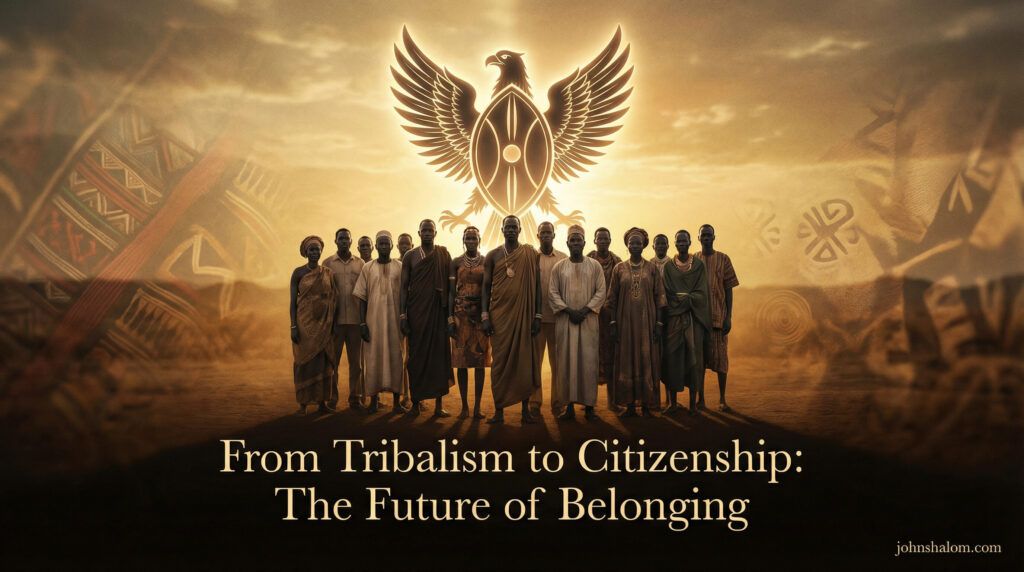
Citizenship is a wider form of belonging, where people share rights and duties under a common law. The future of belonging is not to erase tribe, but to put it in the right place. We need people who are rooted in their culture, yet able to think and act as responsible citizens of a country and, ultimately, of humanity. That journey begins inside each person and inside each home, long before elections or peace talks.
Introduction: Where Do I Truly Belong?
1.1 From cattle camp to passport office
If you grew up like I did, along rivers and in villages where everyone knew your clan name, you did not ask, “What is my tribe?” You simply knew. Your language, your dances, your cattle, your jokes, your way of greeting elders all came from that first identity.
Later, you might stand in a city office holding a national ID form or a passport application. Suddenly, another layer of belonging appears: citizen of a new country, with borders drawn on maps far away from your childhood cattle camp.
This tension between local tribe and national citizenship is real in many African countries, including South Sudan. It raises hard questions: Who am I first? Who gets my loyalty when interests clash? Is there a way to belong to both my people and my country without betraying either?
1.2 Why this question matters for our future
When tribal loyalty controls jobs, justice, and security, whole nations can be held hostage by clan interests. When citizenship is only a paper ID, not a lived identity, public life turns into a competition between tribes, not service to the common good.
If we want a different future, we must ask what kind of belonging we are teaching at home, in schools, in churches, and in our own hearts.
What Is Tribalism, Really?
2.1 The good gift of tribe
Tribe, in its healthy form, is about:
- Shared language and stories.
- Shared responsibility for one another.
- Respect for elders and customs.
- A sense of place and history.
These are not small things. When war or displacement comes, it is often our people who shelter us. When we lose our way, it is often old stories and songs that remind us who we are.
2.2 When tribe turns into tribalism
Tribalism is what happens when good loyalty becomes narrow and harmful. Signs of tribalism include:
- Believing your group is always right and better than others.
- Protecting members of your group even when they are clearly wrong.
- Using tribe as the main reason to give jobs, contracts, or justice.
- Treating other groups as less human or less deserving.
At that point, tribe stops being a home and becomes a prison. It traps both those inside and those outside.
What Is Citizenship?
3.1 Belonging under a shared law
Citizenship means more than holding a document. It is a kind of belonging that comes with both rights and duties. A citizen:
- Shares a legal identity with others in the country.
- Has certain rights, such as protection, fair trial, and participation.
- Has duties, such as obeying just laws, paying taxes, and serving the community.
Citizenship says: “We may be from different tribes, but we agree to live under one set of rules. We all matter.”
3.2 From blood ties to shared responsibility
Tribal belonging is often based on blood and ancestry. Citizenship is based on shared commitment.
In a healthy nation, citizens look at neighbours from other groups and still say, “These are my people too. Their safety and dignity matter to me.” This does not erase local identities; it adds a wider circle around them.
The Trouble When Tribalism Rules Public Life
4.1 Jobs for “our people” only
When tribalism controls public offices:
- Jobs go to relatives or clans, not to those with skills.
- Contracts go to loyal groups, not to those who can deliver good work.
- Those from “wrong” groups are blocked, no matter how qualified they are.
This weakens institutions. A ministry or company filled by narrow loyalty cannot serve a whole nation well. It becomes a private property of a group, not a public service.
4.2 Law as a tool, not a shield
In a tribalised state, laws become tools for some, not shields for all.
- A person from a powerful group may feel safe to break rules.
- A person from a weaker group may fear that justice is impossible.
When people stop believing that the law protects everyone, they run back to tribe for safety. The country remains permanently fragile.
4.3 Violence and revenge cycles
If one group harms another and there is no fair, trusted system of accountability, people turn to revenge. Children grow up hearing stories of “what they did to us,” and are trained to repeat the cycle.
Only strong citizenship, where wrongdoers are held accountable no matter their group, can slowly break this pattern.
Keeping the Good of Tribe While Growing Citizenship
5.1 Honour your roots without worshipping them
There is no need to be ashamed of your tribe. God placed you in a particular people with a history and culture. Honour that gift. Learn your language. Respect elders. Preserve wise customs.
The problem comes when tribe becomes the highest authority, even above God, truth, and justice. We need a clear order:
- God and shared humanity.
- Conscience and truth.
- Family and tribe.
- Nation and world.
When we get that order right, we can love our tribe deeply without harming others.
5.2 Teach children layered belonging
Children can be taught that they belong at several levels:
- Family: “This is our home and our story.”
- Tribe or community: “These are our traditions and elders.”
- Nation: “This is our shared country; we all have rights and duties here.”
- Humanity: “All people, whatever their tribe or colour, are made in God’s image.”
This layered belonging is stronger than tribalism, because it does not depend on one identity alone.
5.3 Use tribal strength to serve the nation
Tribes often have strong networks of trust and cooperation. Instead of using those networks only for private gain, they can be used to:
- Promote peace with neighbouring groups.
- Support fair elections and reject incitement.
- Encourage youth to serve the nation, not only the clan.
A healthy tribe asks: “How can our people be known for truth, service, and peace in this country?”
The Inner Shift: From “My People Only” to “My People and Our Country”
6.1 The heart battle inside each of us
Moving from tribalism to citizenship does not start in parliament. It starts in small thoughts and choices:
- When you hire, do you first ask about tribe or about character and competence.
- When a person from “your” group does wrong, do you excuse them or seek justice.
- When someone from another group suffers, do you feel nothing or do you care.
These inner answers show whether citizenship lives in us or only on our ID cards.
6.2 Faith and the bigger family
For those who follow Christ, there is an extra layer: the family of believers from every tribe and nation. Scripture reminds us that, in Christ, dividing walls are broken.
This does not erase culture. It adds a deeper unity. A Christian from another tribe is not a stranger. He or she is family. That truth, if taken seriously, reshapes how we see politics, business, and daily life.
Practical Steps Toward Healthier Citizenship
7.1 Watch your words about other groups
Start by changing how you speak at home, in public transport, and online. Avoid:
- Jokes that dehumanise other tribes.
- Stories that paint whole groups as evil or stupid.
- Rumours that stir fear and hatred.
Choose instead:
- To tell stories of cooperation and kindness across groups.
- To correct unfair generalisations when you hear them.
- To remember that within every group, there are peace seekers and trouble makers.
7.2 Build friendships beyond your group
Many fears disappear when you have real friends from other communities.
- Share meals.
- Work on common projects.
- Listen to each other’s childhood stories and pain.
These simple acts build a kind of belonging that tribal propaganda cannot easily break.
7.3 Demand citizenship from leaders
Citizens have the right and duty to expect leaders to govern for all, not only for their group. This means:
- Asking hard questions about appointments and resource distribution.
- Supporting leaders who show fairness, even if they are not from your tribe.
- Refusing to vote or cheer for those who openly use ethnic hatred as a tool.
7.4 Teach civic values at home and in church
We often leave civic education to schools and NGOs. But sermons, youth groups, and family devotions can also speak about:
- Truthfulness in public life.
- Respect for law and property.
- Care for the poor, regardless of tribe.
- Prayer for the whole country, not only for “our side.”
This connects faith with citizenship in a clear way.
The Future of Belonging: From River Village to Global City
8.1 Identities will continue to multiply
A child born today may grow up in a village, move to a capital city, study abroad, and work online with people around the world. Their sense of belonging will not be simple.
We can either fear this or prepare for it. If we train children to be secure in who they are, yet open to others, they can carry their culture into new spaces without losing themselves or despising others.
8.2 M = {B, D²} and the next generation
Meaning comes from being and repeated doing. For the future of belonging:
Being: Help young people know who they are in God, in their family story, and as citizens.
Doing²: Guide them into repeated acts of honesty, service, and cross-tribal friendship.
These actions, repeated over years, will shape a different kind of citizen, one who can hold both tribal roots and national responsibility in the same heart.
Conclusion: A Wider Circle of “Us”
We do not need to choose between loving our tribe and loving our country or humanity. The real choice is between narrow loyalty that harms others and deep loyalty that seeks the good of all.
From tribalism to citizenship is a journey of expanding the word “us.” At first, “us” means only my family and clan. Then it grows to include neighbours, city, nation, and even people who look and speak very differently from me.
You and I may not control borders or constitutions, but we can control how we belong. We can decide that our identity will not be used as a weapon. We can raise children who know both their clan name and their duty as citizens. We can follow Christ in loving across lines that politicians like to use for division.
The future of belonging begins wherever someone says, “I will honour my roots and still see every human being as part of a larger ‘we’ that God cares about.”
If you would like to know more about my path as a writer, including the struggles, lessons, and small signs of progress along the way, you can read the full story on my Wealthy Affiliate blog here: https://my.wealthyaffiliate.com/johnmaluth/blog
FAQS
Q1: Is tribe itself a problem?
A: No. Tribe can be a gift that gives language, history, and support. The problem is tribalism, where loyalty to the group becomes more important than truth, justice, and the dignity of others.
Q2: Can I be proud of my tribe and still be a good citizen?
A: Yes. You can celebrate your culture while also respecting the rights of other groups and putting the common good of the nation above narrow interests when they clash.
Q3: How can I teach my children to move beyond tribalism?
A: Teach them to value their roots, but also expose them to other groups through friendships, stories, and service. Watch your words about other tribes and model respect, fairness, and empathy at home.
Q4: What can churches and faith groups do in this area?
A: They can preach and practice unity across ethnic lines, show equal care to all members, address prejudice directly, and teach that all people are made in God’s image and are neighbours worth loving.
Q5: What if my community is already deeply divided along tribal lines?
A: Start small. Build a few honest relationships across lines, refuse hateful talk, and support local efforts for reconciliation and fair treatment. Change may be slow, but every honest bridge you build weakens the walls of fear and hatred.