TL; DR:
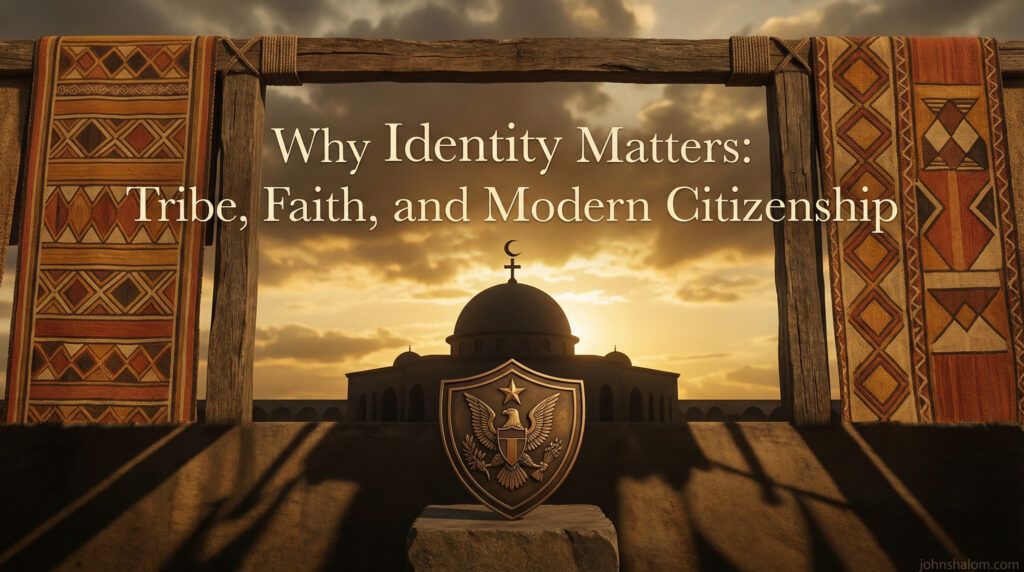
Identity is not a small thing. It shapes how you see yourself, who you trust, and what you are willing to fight for. Many of us carry several identities at once: family, clan, tribe, faith, and national passport. None of these is automatically bad. The trouble comes when one identity, usually tribe, is used against others or placed above truth and justice.
Faith can heal identity by reminding us that we belong to God first, and that every human being carries His image. Modern citizenship adds another layer, asking us to care about the common good beyond our clan. When you understand and order these identities well, you can be rooted in your people, grounded in your faith, and still live as a fair and responsible citizen in today’s world.
Introduction: Who Am I, Really?
1.1 The question behind many conflicts
As a boy along the Sobat River, I did not sit under trees asking, “Who am I?” I simply knew. I knew my father’s name, my mother’s clan, our stories, and our enemies. Identity was like the air. It was there, even when we did not talk about it.
Years later, in Juba or on an online form, I would see boxes like “Nationality, Religion, Ethnicity.” Suddenly the question became sharper. Am I first my clan, my tribe, my church, or my country. Where does my deepest loyalty lie when these pull in different directions.
Many of our conflicts in South Sudan and elsewhere are not only about land, oil, or power. They are also about identity. Who counts as “us.” Who is “them.” Who owns this place.
1.2 Why identity matters for ordinary life
Identity is not only about war and politics. It affects:
- Whom you marry.
- Whom you trust in business.
- Whom you hire or support.
- How you treat strangers, refugees, or minorities.
If we do not understand identity, others can use it to control us. If we do understand it, we can choose to live with more wisdom and less fear.
Layers of Identity: Family, Tribe, Faith, Country
2.1 Family as the first name we carry
Before tribe or passport, there is the family. Your parents’ story, their struggles, and their values shape how you see the world.
Family teaches you:
- Whether you feel wanted or unwanted.
- How to handle trust and betrayal.
- How to think about money, work, and education.
This is your first layer of identity.
2.2 Tribe and community: the bigger circle
Tribe adds language, songs, cattle marks, dances, proverbs, and shared pain. For me, stories about our people and neighbours shaped my early picture of who was safe and who was dangerous.
Healthy tribe:
- Protects the weak.
- Keeps memory and wisdom.
- Shares resources in times of need.
Unhealthy tribalism:
- Teaches you to hate others without knowing them.
- Protects wrongdoers if they are “our people.”
- Makes tribe more important than truth.
2.3 Faith: identity before God
Faith answers questions that tribe cannot answer fully:
- Why do I exist.
- What happens after death.
- What is right and wrong, beyond custom.
In Christ, we receive a new name: children of God. This identity cuts across tribe and nation. A believer from another tribe is no longer just “them.” They are brother or sister.
2.4 Modern citizenship: belonging under one law
Citizenship adds another layer. It says:
- We share a country with common laws.
- We have rights that must be respected.
- We have duties to others we may never meet.
You can be Dinka, Nuer, Shilluk, Bari, or any other people, and still be a South Sudanese citizen called to care about the whole nation, not only your section.
When Identity Hurts Instead of Helps
3.1 When tribe becomes a cage
Tribe becomes dangerous when it does at least three things:
- Tells you others are less human.
- Tells you to support your person even when they are wrong.
- Tells you that only your group deserves jobs, land, or security.
At that point, identity stops giving life and starts stealing it. You live in fear, always counting how many of “ours” are in each office or camp, instead of asking who is best for the work.
3.2 When faith is misused as a weapon
Faith can also be twisted. When we use God’s name to:
- Justify violence against others.
- Cover corruption by religious talk.
- Divide believers by tribe in the same church.
Then we are not only damaging people, we are damaging their picture of God. That kind of identity does deep harm and passes pain to the next generation.
3.3 When citizenship is only on paper
Citizenship hurts when it is promised but not protected. For example:
- Some citizens are treated like guests in their own country.
- Some groups are ignored in service delivery.
- The law is applied differently depending on who you are.
In such a setting, people run back to tribe for safety. The national identity becomes thin and weak.
You might also like: Creative Nonfiction Series: What It Is and Its Importance for You
Identity Healed and Ordered by Faith
4.1 God as the first source of identity
Faith in Christ teaches that your deepest identity is not your tribe or job, but your place before God. You are created in His image, fallen in sin, loved through the cross, and called to live as His child.
This has two important results:
- You can respect yourself without despising others.
- You can honour your culture without making it an idol.
4.2 The right order of loyalties
We get into trouble when we reverse the order of our loyalties. A healthier order looks like this:
- God and shared humanity.
- Conscience shaped by truth.
- Family and tribe.
- Nation and the wider world.
When God and shared humanity come first, you cannot support cruelty against another tribe and still feel comfortable. When conscience comes before clan, you cannot protect a corrupt relative just because he is “one of us.”
4.3 The church as a training ground for new identity
Local churches that mix tribes and languages are powerful schools of identity. When believers:
- Worship together across ethnic lines.
- Share resources across communities.
- Stand together against injustice, even when it comes from “their own.”
They are teaching a deep lesson. They are showing that in Christ, there is a new way to belong.
Growing Into Modern Citizenship Without Losing Roots
5.1 You do not have to choose either tribe or country
Many people feel they must pick one: either be a “true son of the soil” or a “national person.” In truth, you can be both, if you place each identity in its proper place.
You can:
- Love your language and customs.
- Still defend the rights of another group when they are abused.
- Still expect fair treatment for all citizens, not only your own.
5.2 What a healthy citizen looks like
A healthy citizen who understands identity:
- Knows their roots and history.
- Refuses to hate others because of their roots.
- Votes according to character and vision, not only tribe.
- Uses tribe to spread peace, not fear.
5.3 My own journey with names and belonging
In my own life, I have carried many names and locations, from Wiyual to John, from Sobat River to Juba, from village paths to online platforms. At times I felt divided, as if each new name betrayed the old one.
Only when I saw that identity can have layers did it make sense. I could still honour the village boy who chased mudfish and feared bullets, while also stepping into roles as writer, citizen, and believer speaking to a wider world. The key is to keep Christ as the centre and let other identities take their rightful place around Him.
Simple Practices to Hold Tribe, Faith, and Citizenship Together
6.1 Watch your words about other groups
Your tongue is a small but powerful tool of identity. Decide that you will:
- Refuse to spread hateful jokes or rumours.
- Correct yourself when you generalise an entire group.
- Tell at least some stories of kindness across tribal lines.
Children and younger people around you are listening.
6.2 Pray and think beyond your own group
In personal prayers and church gatherings, include:
- Other tribes and regions by name.
- Leaders you did not vote for.
- Refugees, minorities, and those your group may fear.
This stretches your heart and reminds you that God’s concern is larger than your local circle.
6.3 Build at least one real friendship outside your community
Identity becomes less scary when it has a human face.
- Share meals with people from other groups.
- Ask about their childhood, joys, and pains.
- Be ready to share your own story honestly.
You may disagree on many things, but you will find common humanity underneath.
6.4 Teach children layered belonging
With children, do not only teach clan names. Also teach:
- Basic national history and symbols.
- Shared values like honesty, respect, and service.
- The idea that God cares for all peoples, not only “ours.”
Use stories, songs, and simple lessons to make this real.
Conclusion: Identity as a Gift to Steward, Not a Weapon to Use
Identity is a powerful gift. Tribe, faith, and citizenship each add something important to who you are. The danger is not in having many identities. The danger is in using them badly.
When tribe becomes an excuse for injustice, it harms both us and others. When faith is used to crush people instead of lift them, it lies about God. When citizenship is ignored until election day, the country stays weak.
You and I cannot fix every problem in our nations. But we can decide how we carry our own identity. We can choose to be people who are deeply rooted in our culture, clearly anchored in Christ, and honestly committed to the common good of all citizens.
When more people make that choice, belonging becomes less about fear and more about shared responsibility. Identity stops being a battlefield and becomes a bridge.
If you would like to know more about my path as a writer, including the struggles, lessons, and small signs of progress along the way, you can read the full story on my Wealthy Affiliate blog here: https://my.wealthyaffiliate.com/johnmaluth/blog
FAQS
Q1: Is it wrong to be proud of my tribe?
A: No. It is good to value your tribe’s language, history, and wisdom. It becomes a problem only when that pride leads you to despise or mistreat others or to protect your group when it does wrong.
Q2: How can I balance loyalty to my tribe and to my country?
A: Put God and basic human dignity first. Then let both tribe and country sit under that higher loyalty. Support what is fair and just, even if it hurts your group’s narrow interests in the short term.
Q3: What can I do if my community is very tribal in its thinking?
A: Start with your own words and actions. Refuse hateful talk, build friendships across groups, and teach your children different values. Support leaders and churches that model unity and fairness. Change may be slow, but it often begins with a few people.
Q4: How does faith help heal identity conflicts?
A: Faith in Christ reminds us that all people are made in God’s image and that believers from every tribe belong to one body. This truth pushes us to forgive, to seek justice for all, and to see former enemies as possible brothers and sisters.
Q5: Can modern citizenship erase my culture?
A: It does not have to. Healthy citizenship allows you to keep your culture while respecting others and sharing responsibility for the country. You do not need to lose your roots to care for the wider nation.