
TL;DR:
This article by John Monyjok Maluth explores the meanings of kakistocracy and kleptocracy — rule by the worst and rule by thieves — using personal experiences from South Sudan and African proverbs. It reflects on how leadership failures grow from moral decay, showing how autocracy, oligarchy, theocracy, and other systems affect ordinary lives. Through vivid storytelling, John calls for moral renewal, citizen responsibility, and servant leadership, reminding readers that true power exists where people sleep in peace.
Growing up along the Sobat River, I learned early that leadership is both a privilege and a test. In our small village, we had no grand palaces or parliaments, but we understood order. Every boy herding cattle knew his role. Every elder carried wisdom that guided the young. Even the cows respected the whistle of the herdsman. But as I grew older and moved beyond those grasslands, I realized the wider world had more complex herds — and some of the shepherds were hyenas in disguise.
That realization led me to words I never heard in my village days: kakistocracy, kleptocracy, and a dozen other fancy terms that describe how humans govern — or misgovern — one another. These words sound academic, but their meanings are lived realities across many nations, including ours. They describe what happens when power loses its purpose and when leadership turns from service to self-interest.
Let’s unpack them together, not from the dictionary, but from life itself.
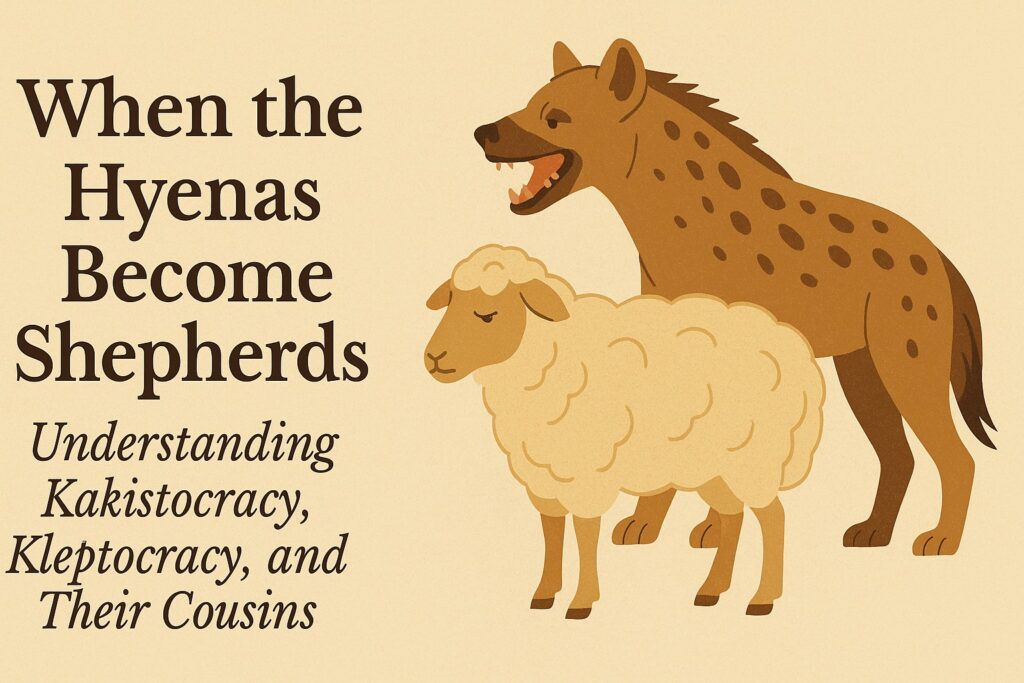
FAQs: When the Hyenas Become Shepherds: Understanding Kakistocracy, Kleptocracy, and Their Cousins
1. What is a kakistocracy?
It’s a government led by the least qualified or most corrupt—where incompetence and greed replace vision and integrity.
2. How does a kleptocracy differ from a kakistocracy?
A kleptocracy is ruled by thieves who exploit power for personal gain, while a kakistocracy is led by the worst, often both corrupt and foolish.
3. What are the “cousins” of these systems?
Other corrupt forms include oligarchy (rule by the rich), plutocracy (power by wealth), and autocracy (rule by one without accountability).
4. How do such governments sustain themselves?
Through fear, propaganda, and control of resources—keeping citizens dependent, divided, and disillusioned.
5. What can people do to resist these systems?
By staying informed, uniting around shared values, demanding accountability, and choosing leaders who serve, not exploit.
Kakistocracy: When the Worst Lead the Rest
Kakistocracy comes from two Greek words: kakistos (worst) and kratos (rule). In simple terms, it means rule by the worst — the least qualified, most selfish, or most corrupt people in society.
I saw my first kakistocracy not in a government building, but in a small community meeting back home. The elders had gathered to choose a youth leader for a local cattle camp. There was a young man, bright and responsible, who everyone knew could lead well. But he had no relatives among the elders. Another man, loud and boastful, had friends and favors to trade. Guess who got chosen? The loud one.
Within weeks, chaos reigned. Fights broke out, cows were lost, and trust evaporated. The camp became divided. That was a small-scale kakistocracy — rule by the worst, born not of evil alone, but of ignorance and favoritism.
When this pattern scales up to nations, it becomes devastating. The worst rise to power because they are willing to do what the good will not: lie, bribe, intimidate, flatter, and manipulate. The best stand aside, disgusted by the mud of politics, and before long the mud becomes quicksand for everyone.
An African proverb says, “When there is no enemy within, the enemy outside can do no harm.” But in a kakistocracy, the enemy is already inside — wearing a suit and holding a flag.
Kleptocracy: When Thieves Build the Palace
Kleptocracy means “rule by thieves.” It’s a system where leaders use their positions to steal — not only money, but hope.
I saw glimpses of this when I was working on community projects years ago. We once received materials for a small literacy program in a rural area. Before they reached the learners, several boxes “disappeared.” Later, I learned that some local officials had diverted them to their relatives’ private schools. It wasn’t millions of dollars — just books and pencils. But that act told a story. Corruption begins small, but it eats big.
In a kleptocracy, theft is not the exception; it’s the rule. Public funds become private accounts. Development projects become slogans. Roads are built on paper, while the real ones remain muddy paths.
One of my favorite proverbs says, “The man who marries a beautiful woman and the farmer who grows corn by the roadside have the same problem.” Everyone wants a share. In a kleptocracy, public resources are like that roadside corn — everyone with power stops to take some.
Kleptocracy doesn’t just steal wealth; it steals destiny. It tells the young that honesty is foolish and that success is measured by how well you can cheat without being caught. That’s how nations die, not from poverty, but from moral decay.
Autocracy: When One Man’s Word Becomes the Law
Autocracy is rule by one person with absolute power. No debate, no dissent, just decree.
Now, there are moments when strong leadership is necessary — especially in times of crisis. But absolute power, as history shows, rarely stops at doing good. It keeps going until it consumes everything in its path.
I once knew a teacher who ran his classroom like an autocrat. He believed discipline meant silence. The students feared him so much that even when he made mistakes on the blackboard, no one dared correct him. One day, he misspelled a word that stayed wrong in every student’s notebook. Power without humility multiplies error.
That’s what autocracy does to nations. It silences wisdom, punishes truth, and rewards flattery. And when fear becomes the national language, progress becomes impossible.
Oligarchy and Plutocracy: When the Few Feast While the Many Starve
An oligarchy is rule by a small group of elites. A plutocracy is rule by the rich. They often overlap — the rich become the rulers, and the rulers become richer.
I saw this dynamic when I first came to a city after years in the village. There were neighborhoods with paved roads, constant electricity, and water on tap — and others just a few kilometers away where people walked miles for a bucket of muddy water. Two worlds, one city. That’s what happens when wealth becomes the ticket to influence.
You might also like: The Complete Guide to Theology: Faith, Reason, and Modern Interpretations
A plutocracy doesn’t announce itself with guns; it hides behind bank accounts and board meetings. It whispers in policy rooms, buys elections, and shapes media narratives. It’s polite corruption — the kind that wears perfume.
African elders say, “The same sun that melts the wax hardens the clay.” In a plutocracy, policies that empower the rich often crush the poor. The sun shines, but not equally.
Theocracy: When Religion Wears the Crown
A theocracy is rule by religious leaders who claim divine authority. Now, as a man of faith, I understand the beauty and power of belief. But when faith becomes a political tool, it can wound more than it heals.
In 2005, I attended a meeting where pastors discussed politics. One elder said, “We need a God-fearing leader.” Another replied, “We already have one — the problem is, he fears God but not the people.” That line stuck with me. True godliness should make a leader humble, not untouchable.
Theocracy goes wrong when it confuses divine purpose with personal ambition. When leaders claim they alone hear from heaven, everyone else becomes a sinner for questioning them.
Faith should guide a nation’s values, not silence its citizens. As Proverbs reminds us, “In the multitude of counselors, there is safety.”
Technocracy and Bureaucracy: When Rules Replace Relationships
A technocracy is rule by experts. A bureaucracy is rule by officials and procedures. Both can be good — when balanced with humanity.
But I’ve seen how systems built to help people can forget people entirely. At one office where I once worked, a young mother came to ask for assistance. She had all the required documents except one minor form. The officer said, “Come back next week.” She burst into tears. That’s bureaucracy without compassion — order without understanding.
Technocracy can also go wrong when numbers matter more than names. You can’t measure the human spirit in statistics. Data should serve people, not the other way around.
In our African sense, community has always been the heart of governance. We say, “A person is a person through other people.” Bureaucracy forgets that.
Gerontocracy and Meritocracy: The Old and the Capable
A gerontocracy is rule by the elderly. It values experience, but sometimes fears change. A meritocracy is rule by those with talent and achievement — people who earn leadership through effort, not inheritance.
In our villages, age commands respect, and rightly so. Elders carry stories that shape the tribe. But when elders refuse to pass the torch, youth lose motivation. I once met a young man who said, “Why should I dream? The chairs are already occupied.” That’s what happens when wisdom turns into monopoly.
Yet, meritocracy isn’t perfect either. Talent without empathy becomes arrogance. Skill without humility divides. The best leaders blend wisdom with ability, age with openness.
African wisdom reminds us, “What an old man can see sitting down, a young man cannot see standing up.” But let’s add — what the young can do standing up, the old may no longer reach. We need both.
Democracy: The Ideal That Must Be Protected
Democracy means “rule by the people.” It’s supposed to be the most balanced system — where everyone’s voice matters. But even democracy can be corrupted if citizens fall asleep.
Elections alone don’t make democracy; participation does. Speaking truth, voting wisely, paying taxes honestly, holding leaders accountable — these are the real ballots.
I’ve seen people complain about bad governance while selling their votes for a meal. I’ve seen educated citizens stay home on election day because “nothing will change.” That’s how democracy dies — not by force, but by fatigue.
In the end, democracy survives only where citizens understand that freedom is not free.
As one of my favorite proverbs says, “No matter how far an eagle flies, it will still come down to look for food.” No matter how developed a nation becomes, it must return to its moral roots if it wants to thrive.
Idiocracy: The Tragic Joke That Can Become Real
There’s a satirical term called idiocracy — rule by idiots. It was meant to be a joke, but some days, it feels prophetic.
When social media influencers shape policy more than experts, when lies spread faster than truth, when entertainment replaces education — that’s idiocracy creeping in.
You might also like: The Ultimate Guide to Political Journalism: Ethics, Challenges, and Impact in the Modern World
We laugh at it, but it’s serious. Ignorance has never been funny. A society that rewards foolishness soon becomes foolish itself.
So What Do We Do?
The question isn’t which system we have, but what kind of people we are. Even the best system collapses when the citizens themselves are dishonest. And even the worst system can improve when the people rise above it.
I believe South Sudan — and Africa as a whole — stands at a crossroads between kakistocracy and meritocracy, between kleptocracy and democracy. The choice is not made by constitutions alone, but by conscience.
When I look back on my journey from the Sobat River to this digital world, I realize leadership is not about position. It’s about influence, honesty, and service. Every home, every school, every church, every business is a small government. If we lead well there, the nation will follow.
An old proverb says, “No matter how hot your anger is, it cannot cook yams.” Emotion won’t fix our countries — only action, guided by wisdom, will.
So let’s study these ocracies not just to name our problems, but to learn from them. Let’s choose leaders with character over charm, vision over volume, and service over self-interest. Let’s rebuild nations where power serves people, not the other way around.
Because in the end, the real test of leadership is simple: do the people sleep in peace?
This was such a powerful and eye-opening article! I really liked how you used African proverbs and real-life stories to explain big ideas like kakistocracy and kleptocracy in a way that’s easy to understand. The message about leadership being a form of service, not self-interest, truly stands out.
I do have a question… What do you think is the first small step ordinary people can take to help bring honest leadership back to their communities?
Thank you, Jenny. Your question goes straight to the heart. Growing up by the Sobat River, I saw how real change often began when one person chose to act differently, to speak truth even when silence felt safer. Honest leadership doesn’t start in offices or campaigns. It starts in our homes, in how we treat others and what we allow.
If each of us guards integrity like we guard food in famine, the dishonest will soon have no ground to stand on. As we say back home, the same sun that melts the wax hardens the clay.
John