TL; DR:
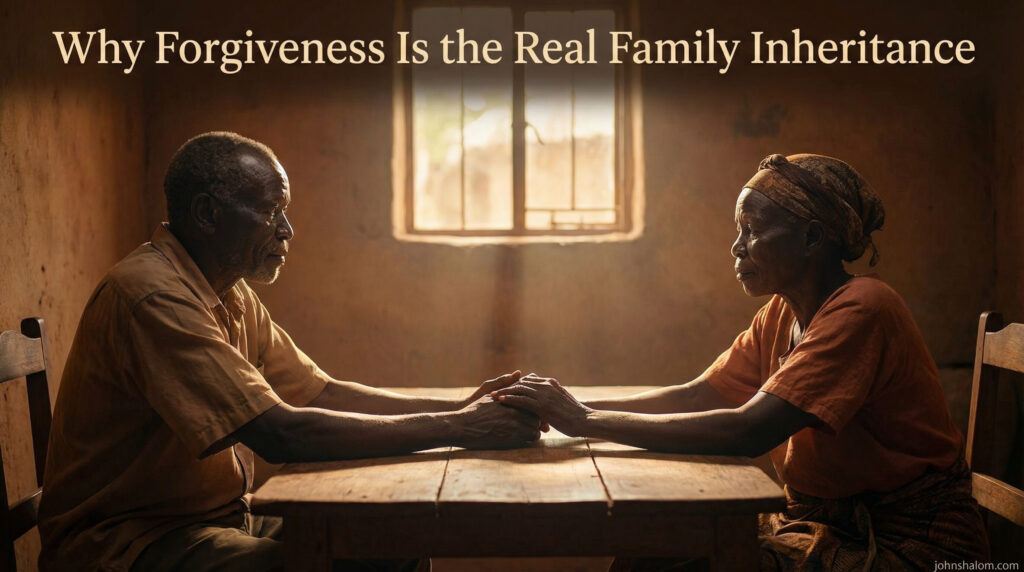
Family inheritance is not only land, cattle, houses, or businesses. The most important thing families pass down is the habit of forgiveness. Property can be lost, divided, or even used to break families apart. Forgiveness does the opposite. It repairs relationships, heals old wounds, and teaches children that love is stronger than pride. When parents and grandparents practice forgiveness openly, they hand their children an invisible inheritance that lasts longer than money. Families that learn to forgive become safer, kinder, and more united, even when they are poor in material things.
Introduction: What Families Really Leave Behind
Every family leaves something behind. Some leave farms, plots of land, or city houses. Others leave nothing material at all. But whether rich or poor, every family leaves patterns. Patterns of how they speak. How they fight. How they reconcile or refuse to reconcile.
Those patterns become the true inheritance.
I have seen families that had almost no property, but they had peace. They laughed easily, forgave quickly, and stood together when trouble came. I have also seen families with land, cattle, and businesses, yet they lived like enemies sharing a fence.
It became clear to me: without forgiveness, even the best inheritance turns sour. With forgiveness, even a small hut can feel like a palace.
1.1 Why we underestimate forgiveness
People do not boast about forgiveness in the same way they boast about wealth. No one calls a meeting and says, “My father left us a large estate of patience and mercy.” We prefer to talk about titles, documents, and numbers.
Forgiveness looks soft. Property looks strong. But in real life, the opposite is often true. Land can disappear after one bad legal case. Cattle can die in one drought. Money can vanish in one bad deal.
The habit of forgiveness, once planted, keeps producing peace again and again. It is quiet, but it keeps the family alive.
Inheritance Beyond Property
2.1 When land and cattle become weapons
In many communities, the reading of a will is not a peaceful moment. It is a battlefield. Brothers who grew up sharing one plate suddenly become rivals over one plot of land. Sisters who once shared clothes become enemies over a cow.
I have watched cousins stop greeting each other for years because of a disputed border line. I have heard of uncles who refused to attend a nephew’s wedding because of old inheritance quarrels.
The property was meant to bless the next generation. Instead it became a weapon that cut the family into pieces.
2.2 Forgiveness as wealth that multiplies
Forgiveness works differently.
You do not divide forgiveness into small plots. You practice it, and as you practice, it grows. A child who watches parents forgive each other learns to forgive siblings. Siblings who forgive one another learn to forgive their future spouses.
Forgiveness multiplies itself. It spreads like a good rumour. It makes room in the family for failure, weakness, and change. That is why it is more powerful than any piece of land.
Humor In Family Fights
3.1 The stolen bread and the wise mother
Quarrels at home can be ugly. They can also be funny, especially when we look back.
I remember one time when we argued over the last piece of bread. You would think we were dividing an entire kingdom. Voices rose. Accusations flew. Each of us gave long speeches about fairness.
My mother listened for a while and then shook her head. She took the bread, ate it in front of us, and said, “Now it belongs to me.”
Silence. Then laughter.
In that moment, the tension broke. We could have carried that quarrel for days. Instead, her small act and humor cut the argument into pieces. That was forgiveness in action, even though she never used the word.
3.2 Laughter as a bridge to mercy
Humor does not replace forgiveness, but it opens the door.
It reminds us that we are not enemies in a war. We are family members fighting over small things. A joke at the right time can turn a heavy quarrel into a light memory. That makes it easier to say, “I am sorry,” and, “I forgive you.”
Families that never laugh together struggle to forgive. Everything feels serious, sharp, and final. Families that can laugh, even during conflict, have a better chance of finding their way back to each other.
Forgiveness As Daily Practice
4.1 The small cuts that need quick healing
Big betrayals are serious, but most family pain comes from small cuts. Harsh words. Broken promises. Unfair decisions. Shouting when a gentle answer would have been enough.
If these small wounds are not treated, they build up. A comment from ten years ago remains alive in the heart. A small anger from childhood becomes a volcano in adulthood.
Forgiveness as daily practice means we do not let wounds grow without care. We talk. We apologise. We listen. We admit when we were wrong. We let others admit their wrongs without humiliating them.
4.2 Short accounts, short grudges
Some families keep long accounts. They remember every insult, every wrong, every mistake.
“You did this in 1994.”
“You said that in 2007.”
“You forgot my birthday in 2013.”
These long accounts poison love.
Families that inherit forgiveness learn to keep short accounts. They still feel pain, but they do not feed it. They ask, “Can we settle this now before it becomes bigger?”
Short accounts do not mean pretending nothing happened. They mean dealing with issues early so they do not become monsters.
The Cost Of Unforgiveness
5.1 The silent house
Unforgiveness does not always shout. Sometimes it is quiet. A house where people do not talk can be more painful than a house that argues and then reconciles.
There are homes where siblings only greet each other with cold nods. Parents and adult children share walls but not words. Every meal is a silent protest. No one calls it unforgiveness, but that is what it is.
The cost is huge. Children grow up learning that pride is more important than peace. They copy what they see. One day they will repeat the same pattern with their own spouses and children.
5.2 When grudges travel through generations
Unforgiveness can travel.
A grandfather quarrels with his brother. They never reconcile. Their children grow up hearing one side of the story. They inherit the anger. They refuse to mix with their cousins. Then the grandchildren inherit it too, even though they were not alive when the original conflict started.
At that point, nobody even remembers the full story. They just know, “We do not talk to that part of the family.”
This is how unforgiveness becomes a dark inheritance. It passes from one generation to the next like a disease. Forgiveness is the only medicine that can break that chain.
You might also like: Creative Nonfiction Series: What It Is and Its Importance for You
My Brother’s Death And The Thread Of Forgiveness
6.1 Pain that could have divided us
When my elder brother died in the 1989 Nasir battle, the pain was heavy. Death does not only take a body. It shakes families.
In such moments, anger looks for a target. Someone to blame. A leader. A tribe. A neighbour. Even another family member. It would have been easy for grief to turn us against each other.
But in our house, we somehow chose another way. We gave room for each person to grieve differently. We forgave the sharp words spoken during sorrow. We forgave the silence when someone could not find words at all.
That forgiveness did not remove the pain. It allowed us to carry it together instead of letting it tear us apart.
6.2 Honouring the dead with peace
When I think of my brother today, I realise something else.
If his death had become the seed of endless hatred inside our family, we would have added more tragedy to tragedy. Instead, forgiveness helped us turn his memory into a quiet source of strength.
Families honour their dead best when they refuse to use their names as fuel for new grudges. Forgiveness becomes a way of saying, “Your life and your sacrifice will not be used to create more hate.”
Forgiveness As True Wealth
7.1 What thieves cannot steal
Thieves can take money. Fire can destroy houses. Floods can wash away fields. War can scatter families.
But no thief can steal the habit of forgiveness from your heart. No storm can erase the lessons you passed on about mercy.
A family that has learned to forgive will know how to rebuild after disaster. They may argue in the process, but they can return to each other. That is real wealth.
7.2 Rich poor families, poor rich families
I have seen poor families who owned almost nothing but had peace. They fought, yes, but they always found their way back. They knew how to apologise. They knew how to hug again after shouting. They joked about yesterday’s quarrel instead of treating it like a permanent war.
I have also seen rich families with nice houses and good cars where no one truly trusts anyone. Every conversation hides a suspicion. Every gathering hides a wound.
If you compare the two, you begin to see: peace at home is a richer inheritance than property without love.
How To Pass Forgiveness To The Next Generation
8.1 Parents as first teachers
Children learn how to forgive by watching how adults forgive.
If parents never say, “I am sorry,” the child learns that apology is weakness. If parents apologise, even to their children, the child learns that apology is part of love.
If spouses insult each other and never reconcile, children learn that grudges are normal. If spouses disagree but then talk, reconcile, and maybe even joke about it later, children learn that conflict is survivable.
This is how forgiveness becomes an inheritance. Not through speeches, but through daily practice.
8.2 Siblings as training partners
Siblings quarrel. It is almost guaranteed.
One steals the other’s food. Another breaks a precious item. A third tells a secret that should have stayed hidden.
These quarrels are not only problems. They are also training.
Parents can use those moments to teach forgiveness. Instead of only shouting, they can guide.
“Tell her why you are hurt.”
“Listen to him without interrupting.”
“Now apologise honestly.”
“Now forgive and move on. You will still be brother and sister tomorrow.”
Over time, those small lessons build adults who know how to repair relationships instead of running away from every wound.
8.3 When your own parents did not pass this inheritance
Some people grew up in homes where forgiveness was rare. Apologies never came. Grudges lasted for years.
If that is your story, you still have a choice. You can pass the same pattern on, or you can break it.
Breaking it is not easy. It feels like swimming against a strong river. But the first person in a family who chooses a new way becomes a pioneer.
You can decide, “The inheritance of bitterness stops with me. I will not pass it to my children. I will pass forgiveness instead.”
Faith And Forgiveness In Families
9.1 The God who forgives
For many families, faith is the deepest reason for forgiveness. They know a God who forgives them. That becomes the standard for how they are called to forgive one another.
When a family prays, “Forgive us as we forgive others,” and they mean it, the prayer slowly shapes their behaviour.
Forgiveness does not become a feeling only. It becomes obedience. It becomes a response to grace already received.
9.2 Simple rituals of reconciliation
Faith can also provide rituals that help forgiveness become visible.
A shared prayer after a quarrel.
A meal eaten together after apologies.
A reading of a passage that reminds everyone of mercy.
These small rituals act like family peace agreements. They mark the moment when anger gives way to a new beginning.
Families, Tribes, And Nations
10.1 When family grudges grow into tribal hatred
What happens inside families does not stay small.
A child who grows up in a house where grudges never end learns that revenge is normal. That child later joins a tribe that also carries old anger. The personal and the tribal feed each other.
This is how clan conflicts survive for generations. People who never learned forgiveness at home find it very hard to apply it in politics, business, or community life.
10.2 Forgiveness as national inheritance
On the other hand, families that practice forgiveness raise citizens who can break cycles of revenge.
A young man who forgave a sibling over a goat will find it a little easier to forgive a neighbour over a piece of land. A leader who learned to apologise at home will find it more natural to apologise in public when wrong.
A nation that wants peace cannot rely on documents alone. It needs families that pass on forgiveness as part of their identity. That is how a country slowly becomes safer for everyone.
Simple Steps To Begin Today
If you want forgiveness to be your family inheritance, you do not need a big ceremony. You can start with small steps.
- Decide to keep short accounts. When something hurts you, deal with it. Do not bury it for ten years.
- Use gentle humor in quarrels, the way my mother did with the last piece of bread. Let laughter cool the heat so forgiveness can enter.
- Practice saying, “I am sorry,” especially as an adult. Children are watching.
- Choose at least one old grudge to release. You may not fix everything, but you can stop feeding it.
- Talk openly with your family about the kind of inheritance you want to leave: not only property, but peace.
Conclusion: The Will You Write With Your Life
One day, every one of us will leave something behind. Some will leave official wills with signatures and stamps. Others will leave nothing written at all.
But all of us will leave a trail of how we treated one another. That trail will either teach our children bitterness or show them forgiveness.
Land is useful. Cattle are useful. Money can help. But if you had to choose only one wealth to pass on, let it be this: the habit of forgiving and being forgiven.
That is the inheritance that keeps families together after funerals, after disagreements, after disappointments. It is the treasure that does not rust and cannot be stolen.
In the end, forgiveness is the quiet sentence written at the bottom of the family story: “We hurt each other. We chose to heal. And because we healed, love survived.”
If you would like to know more about my path as a writer, including the struggles, lessons, and small signs of progress along the way, you can read the full story on my Wealthy Affiliate blog here: https://my.wealthyaffiliate.com/johnmaluth/blog
FAQS
Q1: Why is forgiveness more important than property in family inheritance?
A: Property is limited and can easily cause conflict. It can be lost, sold, or stolen. Forgiveness, once learned, keeps repairing relationships again and again. It protects families from being destroyed by quarrels over that same property. A family that knows how to forgive can survive loss, poverty, and even betrayal. That makes forgiveness a deeper and longer lasting inheritance than land or wealth.
Q2: Does forgiveness mean forgetting what happened or pretending it did not hurt?
A: No. Real forgiveness is honest. It looks at the wrong clearly, names the hurt, and sometimes sets new boundaries. Forgiveness means choosing not to let bitterness rule your heart or your behaviour. You may remember the event, but you decide not to use it as a weapon again and again.
Q3: What if I am ready to forgive, but the other person is not sorry?
A: Forgiveness has two sides. One side is internal, between you and God, and inside your own heart. You can release hatred even if the other person refuses to apologise. That protects your own soul. The second side is reconciliation, which needs both people. If the other person is not ready, you may not have full reconciliation yet, but you can still choose not to be poisoned by bitterness while you wait or while you keep a wise distance.
Q4: How can I teach my children to value forgiveness as inheritance?
A: Children learn mainly by watching. Let them see you apologise when you are wrong, even as a parent. Let them see you reconcile after quarrels. Tell them stories of how previous generations forgave and stayed together. Use simple words like, “In this family, we fight, but we also forgive. That is who we are.” Over time, that message becomes part of their identity.
Q5: What if my family history is full of grudges and broken relationships? Is it too late?
A: It is painful, but it is not too late to begin a new chapter. You may not be able to repair every old break, but you can choose how you live from now on. Start with one relationship where a small step is possible. Offer an apology. Accept one. Refuse to pass old hatred to the younger ones. In doing so, you become the turning point, the one who shifts the family inheritance from bitterness to forgiveness.
Reflection Questions
- What “inheritance” of forgiveness have you received from your parents or grandparents?
- Have you seen families torn apart over property or grudges, and what lessons did that teach you?
- How can humor help families forgive more easily during quarrels?
- What daily practices of forgiveness could strengthen your own family relationships?
- If you could leave one inheritance for your children, would forgiveness be at the top of your list, and why?