TL;DR
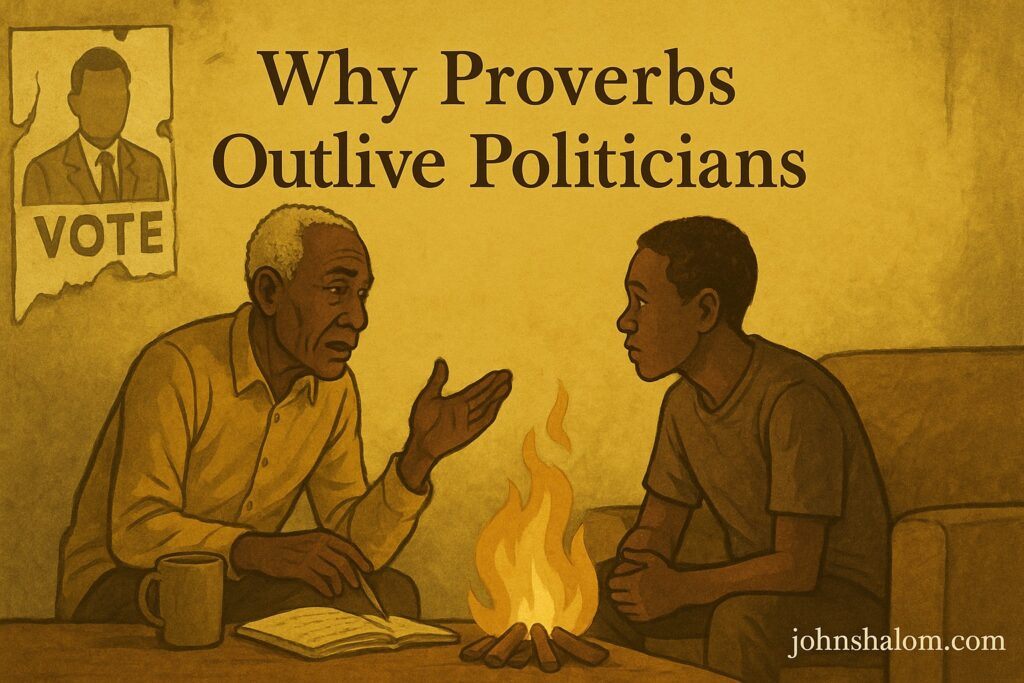
Politicians rise and fall like seasons. Their faces fill posters, their voices flood radios, and their promises fill rallies. Then they disappear. Proverbs move more quietly. They travel in grandmothers’ mouths, in cattle camps and tea stalls, in schoolyards and funerals.
Growing up along the Sobat River, I forgot the names of many ministers, but I still remember proverbs my mother, father, and elders quoted when we were hungry, afraid, or hopeful. Proverbs outlive politicians because they speak to the soul, not to the ballot box. They guide ordinary people every day, while politicians often visit their lives only during campaign time.
Posters Fade, Proverbs Remain
I grew up in a world where politicians were mainly voices on the radio and names in other people’s mouths. Sometimes they arrived in planes or convoys. Sometimes their portraits appeared on walls and on the few newspapers that reached us. They felt distant and temporary.
Proverbs, on the other hand, lived inside our daily life. They were spoken when we woke up and when we slept. They came with food, with stories, with discipline, with jokes. My mother did not quote from constitutions. She quoted from proverbs.
One season, a local politician visited our area promising change. People stood in the sun for hours waiting for him. He arrived with a convoy, spoke loudly about roads and schools, shook hands, then left. Years later, I struggle to remember his name. But I still hear my mother’s voice in my head saying, “The tree that forgets its roots will fall with the wind.” For her, that was not about botany. It was about people who forget where they come from when power visits them.
That is the difference. Politicians fight to write their names on posters. Proverbs write themselves on hearts.
The Short Life of Political Promises
Politicians live on promises. They promise roads, schools, jobs, electricity, and sometimes even “peace in our time” as if it can be packed in a briefcase. I have sat through speeches where words sounded like miracles. Yet after elections, many of those promises vanished faster than morning mist on the Sobat.
I remember one election season when I was already older and living in town. Songs played on the radio day and night. Youths wore T-shirts with smiling faces of candidates. People lined up under the hot sun to vote. Months later, the same people queued for water, for fuel, for food, and for hope.
In a tea place one morning, I heard a man say, “Politicians plant words, but they never water them.” The whole table laughed. The sentence was simple but sharp. It cut straight to the truth. Political words often fall to the ground without roots. Nobody tends them after the voting day.
By contrast, proverbs never need campaigns. No one prints T-shirts saying, “Vote for this proverb.” They survive because people keep using them. When a proverb helps you see your situation clearly, you do not need a rally to remember it.
Proverbs as Everyday Teachers
Proverbs do not depend on parties, flags, or ministries. They live in conversations, arguments, and warnings.
My mother often told us, “A goat owned by many dies of hunger.” As a boy, I thought she was simply teaching us about livestock management. Later, when I started working with organisations and watching governments struggle, I understood the deeper layer. When everybody claims responsibility and nobody truly takes it, the goat dies. The project fails. The country suffers.
My father had his own set of proverbs. When we argued as children about who should do which task, he would say, “The hand that refuses to carry the load will carry the blame.” That was his way of teaching us that work avoided today becomes shame tomorrow.
In school and in the community, elders used proverbs to make us think without shouting. When a boy started behaving proudly after getting a little money or education, someone would quietly say, “The drum that makes the loudest noise is often empty.” No long lecture, just one line. Everyone understood.
You might also like: How to Write Your Life Story: A Complete Guide to Autobiography Writing
These sayings became my first teachers in leadership, responsibility, and character. Long before I read books on management or theology, proverbs were shaping my mind.
Humor That Cuts Through Lies
One reason proverbs outlive politicians is humor. People remember what makes them laugh.
Imagine a politician standing in front of a crowd trying to explain corruption in a long, complicated speech. For twenty minutes he circles around the subject, afraid to name names. Then an elder at the back of the crowd quietly says, “The hyena cannot guard the meat.” Everyone laughs. Conversation shifts. In one short line, the elder has said what the politician could not say in twenty pages.
In my own life, I have seen how proverbs cut through lies politely. Sometimes, when a leader promises too much, people do not insult him. They simply whisper a proverb to each other and smile. The proverb says what everyone is thinking without creating open conflict.
As a writer, when I use proverbs in my articles, readers often tell me those are the lines that stayed with them. A proverb presses truth into memory with a little salt of humor.
My Brother’s Lesson That Outlived Politicians
Before my elder brother Biel died in the 1989 Nasir battle, he loved using proverbs in our playful quarrels. One of his favorites was, “The one who throws stones into the market forgets his mother is there.”
At first, I took it as a funny line. He used it when I acted carelessly, picking fights or making sharp comments without thinking. Later, as war deepened and I saw how violence always returned home, the meaning grew heavier. Conflict has a way of coming back to the thrower. We think we are just attacking “the enemy,” but our own people are standing in that same market.
Decades later, I remember that proverb and my brother’s face as clearly as if it were yesterday. But if you ask me to list the politicians from that era, I will struggle. Some signed decrees that shaped my life. Yet their speeches and slogans have faded from my memory. My brother’s proverb-laced lesson did not.
That is another reason proverbs outlive politicians. They are tied to people we truly loved and respected. We remember the proverb because we remember the person who lived it.
Why Proverbs Survive Generations
Proverbs are portable. They need no newspaper, radio, or internet connection. They travel in mouths and memories.
During displacement, many families lost documents, photos, and property. Political posters stayed in towns, on walls that would later crack or burn. But proverbs walked with refugees. A grandmother could carry an entire library of wisdom inside her head and heart.
I have seen this in my own writing journey. When I quote a proverb in an article, even educated readers with many degrees respond to it. They may forget the statistics I share, but they rarely forget the proverb. It connects past and present, village and city, elder and youth.
A politician’s career might last five years. A proverb can last five hundred. Politicians try to control people with authority and fear. Proverbs guide people with wisdom and humor. Authority expires. Wisdom continues.
The Real Voice of the People
Proverbs are a quiet form of democracy. They are created by ordinary people, tested in daily life, and corrected over generations. No president signs them into law. No parliament votes them in. Yet they govern how people think about justice, leadership, family, and community.
I have attended meetings where someone used a proverb to challenge a leader without open rebellion. A single line from an elder carried more weight than the official speech. That is because proverbs belong to everyone. They are the people’s shared property.
When trust in leaders collapses, people still trust their proverbs. They still say, “The stranger may see the road, but the owner knows the holes.” Or, “The one who eats alone, dies alone.” These lines carry more moral authority than campaign slogans, because they were born from real experience, not election strategy.
No politician can fully censor proverbs. If one saying is banned in public, it reappears as a joke, a song, or a story. That is how people keep their conscience alive when systems betray them.
Living With Proverbs in My Own Work
As a writer and a pro-humanity voice, I have come to rely more on proverbs than on quotes from powerful people. Presidents resign, die, or fall out of favor. Laws are changed or ignored. But the moral truths inside proverbs stay relevant.
When I write about war, corruption, or national identity, I often remember a proverb first before any academic theory. I think of lines I heard as a boy in Dhuoreding, Mayom, or Nasir, spoken by people who never saw a university gate but understood human nature better than many experts.
Proverbs remind me that I am not writing only for this week’s headlines. I am writing for the same ordinary people who have survived for generations with nothing but God, each other, and shared wisdom. If my writing cannot stand next to a proverb and still be useful, then it is too weak.
In the end, politicians will keep coming and going. New names will replace old ones. But somewhere, a grandmother will still sit under a tree, watching children play, and quietly say, “The child who listens to the elders builds a house that does not fall.” That sentence will shape more futures than most political manifestos.
If you would like to know more about my path as a writer, including the struggles, lessons, and small signs of progress along the way, you can read the full story on my Wealthy Affiliate blog here: https://my.wealthyaffiliate.com/johnmaluth/blog
Reflection Questions
- What proverb from your childhood still guides you today more than any politician’s promise?
- Why do you think humor makes proverbs more powerful teachers than long formal speeches?
- How have proverbs in your family or culture preserved wisdom that politics could not protect or promote?
- Can you remember a time when a single proverb explained a political failure better than long analysis did?
- If today’s leaders were truly willing to listen, which proverb from your people would you share with them, and why?
FAQS
- Why do proverbs last longer than political slogans?
Proverbs are rooted in real-life experience, not just in campaigns. They are tested over time, passed through families, and used in daily decisions. Political slogans are designed to win short-term support, so they fade once the election ends.
- Are proverbs always wiser than politicians?
Not every proverb is perfect, and not every politician is foolish. But in many societies, proverbs have a better track record of guiding ordinary people through hardship than political speeches do. They compress lessons learned from many lives, not just one leader’s opinion.
- How can young people keep proverbs alive in a digital age?
They can quote proverbs in conversations, songs, stories, posts, and even jokes. They can ask elders for meanings, use them in writing and teaching, and show how these old lines still apply to modern issues. The medium can change, but the wisdom can stay.
- Can proverbs also be misused in politics?
Yes. Some leaders misuse proverbs to justify injustice or silence questions. That is why proverbs must be balanced with conscience and truth. A saying repeated by power is not automatically right; people must test it against reality and moral sense.
- How can I start using proverbs to think about politics more clearly?
When you hear a promise or see a policy, pause and ask yourself: “Which proverb speaks to this situation?” The right proverb can help you see motives, risks, and patterns that long speeches hide. It becomes a simple tool to judge words by deeds and appearances by fruit.
{ “@context”: “https://schema.org”, “@type”: “FAQPage”, “mainEntity”: [ { “@type”: “Question”, “name”: “Why do proverbs last longer than political slogans?”, “acceptedAnswer”: { “@type”: “Answer”, “text”: “Proverbs are rooted in real-life experience, not just in campaigns. They are tested over time, passed through families, and used in daily decisions. Political slogans are designed to win short-term support, so they fade once the election ends.” } }, { “@type”: “Question”, “name”: “Are proverbs always wiser than politicians?”, “acceptedAnswer”: { “@type”: “Answer”, “text”: “Not every proverb is perfect, and not every politician is foolish. But in many societies, proverbs have a better track record of guiding ordinary people through hardship than political speeches do. They compress lessons learned from many lives, not just one leader’s opinion.” } }, { “@type”: “Question”, “name”: “How can young people keep proverbs alive in a digital age?”, “acceptedAnswer”: { “@type”: “Answer”, “text”: “They can quote proverbs in conversations, songs, stories, posts, and even jokes. They can ask elders for meanings, use them in writing and teaching, and show how these old lines still apply to modern issues. The medium can change, but the wisdom can stay.” } }, { “@type”: “Question”, “name”: “Can proverbs also be misused in politics?”, “acceptedAnswer”: { “@type”: “Answer”, “text”: “Yes. Some leaders misuse proverbs to justify injustice or silence questions. That is why proverbs must be balanced with conscience and truth. A saying repeated by power is not automatically right; people must test it against reality and moral sense.” } }, { “@type”: “Question”, “name”: “How can I start using proverbs to think about politics more clearly?”, “acceptedAnswer”: { “@type”: “Answer”, “text”: “When you hear a promise or see a policy, pause and ask yourself: “Which proverb speaks to this situation?” The right proverb can help you see motives, risks, and patterns that long speeches hide. It becomes a simple tool to judge words by deeds and appearances by fruit.” } } ] }