TL; DR
Many people think marriage is built on big moments like weddings and anniversaries, but real strength in a relationship grows in small, daily words. I have watched couples along the Sobat River survive war, hunger, and displacement, not because they were perfect, but because they kept talking to each other when life pressed them from every side.
A simple “How was your day?” or “I am worried about this” can hold more power than a suitcase of gifts. When a husband and wife stop talking honestly, they slowly become strangers under the same roof. Marriage is a daily dialogue that needs honest questions, patient listening, shared humor, and courage during conflict.
Marriage Lives in the Small Words
Some people believe marriage is held together by the big ceremonies. The white dress, the church, the feast, the photos. Those things are beautiful, but they are not the real building materials of a marriage.
I grew up in villages where weddings could shake the whole community. Cows were slaughtered, songs filled the air, relatives traveled long distances. Yet I also saw some of those same couples fall apart slowly over the years. The wedding was loud, but the daily conversations became silent.
On the other hand, I watched older couples who never had a fancy ceremony, who had no photos on the wall, but who sat together in the evenings talking in quiet tones about children, cattle, crops, and worries. Those marriages looked simple from the outside. Inside, they were held together by a steady stream of small words.
Marriage lives in moments like:
“How are you really doing today?”
“Did that thing I said yesterday hurt you?”
“What are we planning for our future?”
These small questions become the daily food of a relationship. Without them, even a big wedding cannot keep a marriage alive for long.
The Myth of the Grand Gesture
Movies and songs often celebrate grand gestures. A man arrives with flowers, a woman writes a long romantic message, somebody plans a surprise trip. These moments can be sweet, but they are like dessert. Dessert cannot replace breakfast, lunch, and supper.
I remember meeting a man who spoke proudly about the big gift he gave his wife every anniversary. A phone, a dress, sometimes even a foreign trip. People admired him. But when someone asked him, “What is her favorite color?” he paused and smiled awkwardly. He did not know.
His problem was not that he did not love his wife. His problem was that he did not walk with her daily through conversation. He knew how to buy big things once a year, but he did not know how to sit down, ask simple questions, and listen.
I think of my own life as a writer and coach. I can write long messages about love and family, but if I cannot sit down with my own family and ask, “What is happening in your heart today?” then my words are empty. Grand gestures look impressive, but daily dialogue builds trust.
Gifts without conversations are like icing without cake. They look nice for a moment, but there is nothing to really feed the soul.
Humor in Everyday Talk
Marriage dialogue is not only serious or deep. Some of the most important bonds are formed through shared laughter.
I still remember how, as a child, we used to listen to older couples arguing playfully over small things. One evening, two people spent almost an hour debating whether tea tastes better with milk or without. The children became referees. Voices rose, hands moved, faces were serious, but everyone knew this was friendly fire. Eventually, they all laughed, and the story became a family joke repeated for years.
In my own life, I have experienced how humor releases tension. Life in South Sudan has not been easy. War, hunger, uncertainty, and sudden loss can make the atmosphere in a home very heavy. If a couple never laughs together, the weight can feel unbearable.
I remember one relative who, after hearing about my writing and the conflicts in Adong, said to me on the phone, “Why are you not coming to join us in this fight?” Before I could respond, he added, with a half laugh, “No, do not come. Stay where you are. Fight the good fight with the pen.”
You might also like: Creative Nonfiction Series: What It Is and Its Importance for You
We both laughed. That simple joking statement carried something serious. He was saying, “I see your role. Do not abandon it.” Humor gave us a bridge to talk about heavy topics without collapsing. In marriage, the same thing happens.
A silly joke in the kitchen, a playful comment when someone mispronounces a word in a second language, a shared memory of something embarrassing, all these moments become small stitches that hold the fabric together when life pulls it apart.
Listening as Love
Dialogue is not just about talking. It is also about listening with full attention. Many marriages do not fail because couples stop using words, but because they stop hearing one another.
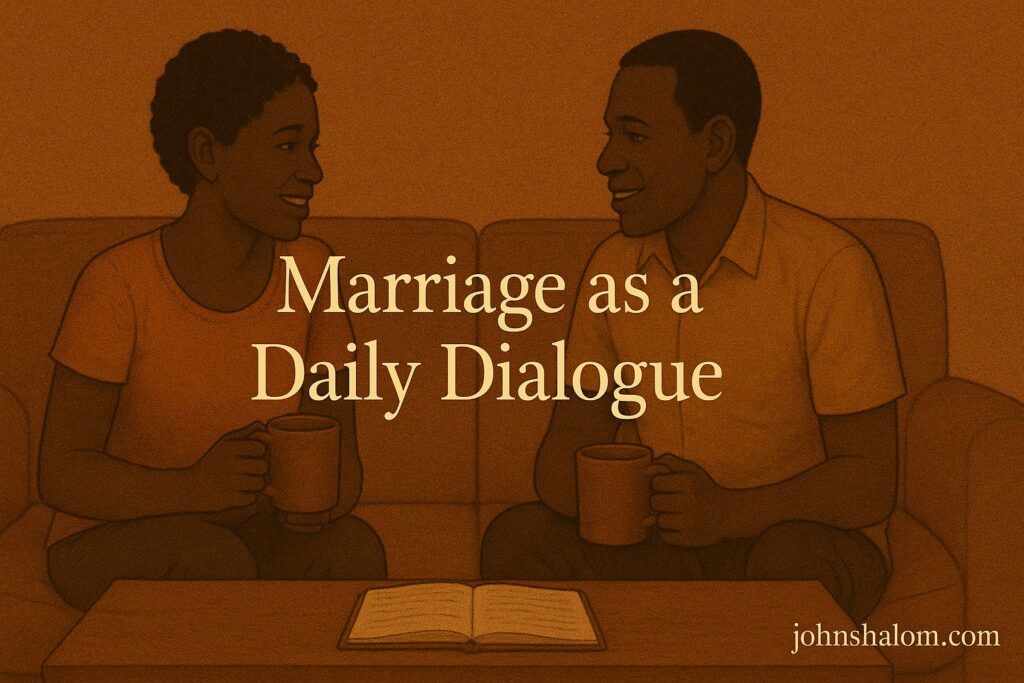
I think of the modern picture many of us know. One spouse comes home tired, starts talking about a difficult day, and the other sits with a phone in hand, giving small nods, saying, “Hmm, yes, I see,” while eyes stay on the screen. Words are moving, but hearts are not connecting. That is not dialogue. That is background noise.
My mother used to say, “Two mouths make noise, but two ears make peace.” She was right. I watched her listen to my father when he worried about cattle, conflict, or the future of the family. Sometimes she did not have answers. She just listened with her whole face, her whole body. I did not have language for it then, but I could see how that kind of listening calmed the house.
As a man who spends many hours writing or working with technology, I also know my own weakness. It is easy to stay inside my thoughts, my screens, my plans, and forget to give the people around me full attention. But people do not live on food and shelter alone. They also live on being heard.
In marriage, sometimes the greatest act of love is to put down the phone, close the laptop, turn your body toward your spouse, and say, “I am here. Tell me what is going on.” No advice yet, no solutions, just presence and ears.
Conflict as Honest Conversation
Disagreements are part of every real marriage. Two people with different histories, temperaments, and needs cannot walk together for years without stepping on each other’s toes. The question is not whether conflict will come, but how couples handle it.
I have seen two reactions. One is shouting without listening. The other is silence that turns into emotional distance. A slammed door may feel powerful for a moment, but it solves nothing. A cold quiet that lasts for days can be even more dangerous, because it freezes the relationship while pretending to be peaceful.
I once heard a wife tell her husband, “I do not need you to fix me, I need you to hear me.” Those words stayed with me. They describe what many people really want in conflict. We are not always looking for a solution in the first five minutes. We are looking for someone who takes our feelings seriously.
In my country, we have seen what happens when disagreements are not handled as conversations. Communities go to war. Instead of talking, people take up arms. In marriage, the weapons look different, but the pattern can be similar. People attack with words, or withdraw without explanation.
When conflict is treated as dialogue, the approach changes. A husband might say, “When you said that, I felt hurt,” instead of, “You always do this.” A wife might say, “I am afraid of this decision,” instead of, “You never listen.” The words are still honest, but they invite a response instead of a defense.
Conflict handled as conversation can deepen understanding. Conflict hidden behind silence slowly kills affection.
My Brother’s Lesson on Grief and Dialogue
When my elder brother Biel died in the 1989 Nasir battle, our whole world shook. Death in war is not clean and organised. Sometimes there is no body brought home, no clear goodbye. Only news, rumors, and long nights of wondering what really happened.
I was young, but I remember watching how different couples in our community carried their grief. Some shut down. Husband and wife stopped talking about their pain. They moved like two tired shadows in the same compound. Children felt the heaviness but did not know its name.
Other couples kept talking, even when their voices broke. I saw husbands and wives sit outside in the evening, speak softly about the son or brother they had lost, argue a bit about what should have been done, cry, then sit in silence together. The sadness did not disappear, but it became shared.
Those homes felt different. The loss was still there, but there was also a sense of “we.” We are sad. We are angry. We do not understand why this happened, but we are not leaving each other alone with the pain.
That season taught me something about marriage and dialogue. The strongest marriages are not the ones without tears or sharp words. They are the ones where husband and wife refuse to stop talking when life hurts most. Dialogue turns loss into shared survival. Silence in marriage, especially in seasons of grief, is more dangerous than shouting.
Marriage as a Daily Practice
Marriage is not mainly built in wedding vows. It is built in daily words.
Everyday phrases like “Thank you for doing that,” “I am sorry, I was too harsh,” “I missed you today,” or “Can we talk about our plans?” may sound small, but they are the bricks that form a lasting home.
In my own journey, I think of marriage as a daily workshop for my character. It tests my ability to listen, to apologise, to stay present even when my mind wants to escape into work or dreams. It reminds me that love is not only a feeling, but also a practice.
My personal philosophy, M = {B, D²}, speaks to this. Being and Doing. Marriage exposes who we are on the inside, then invites us to act in a way that matches the love we claim to carry. Our Being is tested in those quiet moments at home. Our Doing shows up in the words we choose, the questions we ask, the jokes we share, the apologies we offer.
You do not need perfect language or big education to build a strong marriage. You need a willing tongue and a humble heart, ready to speak and ready to hear. Presence in speech becomes presence in love.
If you would like to know more about my path as a writer, including the struggles, lessons, and small signs of progress along the way, you can read the full story on my Wealthy Affiliate blog here: https://my.wealthyaffiliate.com/johnmaluth/blog
Reflection Questions
- What simple daily questions or phrases keep your marriage or close relationships alive right now?
- Think of a funny conversation you shared with a spouse or friend. How did that moment of laughter change the atmosphere between you?
- When was the last time you felt truly heard in a conversation? What did the other person do that made you feel safe and respected?
- In your own experience, how can conflict be turned into a constructive conversation instead of a long and painful silence?
- If marriage is a daily dialogue, which words do you need to say more often: “Thank you,” “I am sorry,” “I am listening,” or “How do you feel?”
FAQs
- Why do small daily conversations matter more than occasional big romantic gestures?
Small daily conversations create a steady flow of connection and understanding. Big romantic gestures are enjoyable, but without regular dialogue they cannot repair distance or confusion that grows in silence.
- What if one spouse is talkative and the other is quiet?
Different personalities are normal. The key is not equal amounts of talking, but mutual willingness. The talkative partner can learn to pause and ask questions, and the quieter partner can practice sharing a little more each day, even in simple sentences.
- How can couples improve listening in their marriage?
They can agree on simple habits, such as putting phones away during important talks, making eye contact, repeating what they heard to check understanding, and avoiding quick advice unless it is asked for. Listening is a skill that can be trained.
- What should couples do when conflict keeps repeating around the same issue?
They can set a calm time to talk only about that issue, not in the middle of anger. They can ask, “What is this really about for you?” and consider inviting a trusted counselor, elder, or mentor to help them see patterns they cannot see alone.
- How can couples keep dialogue alive in hard seasons like grief, unemployment, or illness?
They can agree not to suffer in silence. Even simple sentences like “I am scared,” “I feel tired,” or “I do not know what to do” can open space for comfort and prayer. Honest words, shared regularly, prevent isolation and strengthen the sense that they are facing the storm together.
{ “@context”: “https://schema.org”, “@type”: “FAQPage”, “mainEntity”: [ { “@type”: “Question”, “name”: “Why do small daily conversations matter more than occasional big romantic gestures?”, “acceptedAnswer”: { “@type”: “Answer”, “text”: “Small daily conversations create a steady flow of connection and understanding. Big romantic gestures are enjoyable, but without regular dialogue they cannot repair distance or confusion that grows in silence.” } }, { “@type”: “Question”, “name”: “What if one spouse is talkative and the other is quiet?”, “acceptedAnswer”: { “@type”: “Answer”, “text”: “Different personalities are normal. The key is not equal amounts of talking, but mutual willingness. The talkative partner can learn to pause and ask questions, and the quieter partner can practice sharing a little more each day, even in simple sentences.” } }, { “@type”: “Question”, “name”: “How can couples improve listening in their marriage?”, “acceptedAnswer”: { “@type”: “Answer”, “text”: “They can agree on simple habits, such as putting phones away during important talks, making eye contact, repeating what they heard to check understanding, and avoiding quick advice unless it is asked for. Listening is a skill that can be trained.” } }, { “@type”: “Question”, “name”: “What should couples do when conflict keeps repeating around the same issue?”, “acceptedAnswer”: { “@type”: “Answer”, “text”: “They can set a calm time to talk only about that issue, not in the middle of anger. They can ask, “What is this really about for you?” and consider inviting a trusted counselor, elder, or mentor to help them see patterns they cannot see alone.” } }, { “@type”: “Question”, “name”: “How can couples keep dialogue alive in hard seasons like grief, unemployment, or illness?”, “acceptedAnswer”: { “@type”: “Answer”, “text”: “They can agree not to suffer in silence. Even simple sentences like “I am scared,” “I feel tired,” or “I do not know what to do” can open space for comfort and prayer. Honest words, shared regularly, prevent isolation and strengthen the sense that they are facing the storm together.” } } ] }