
TL; DR:
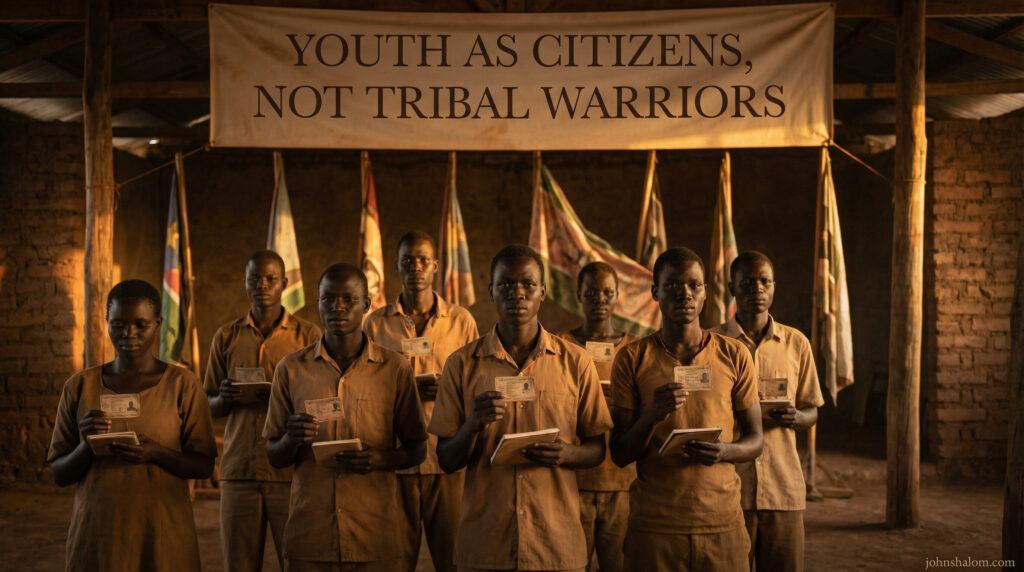
Young people in South Sudan and many other countries stand at a turning point. They can either continue old tribal battles that started long before they were born, or they can choose a higher identity as citizens who build nations instead of destroying them. Tribal loyalty is not evil by itself; it gives belonging, language, and culture. But when it becomes a weapon, it turns youth into fuel for conflicts that only benefit a few powerful people. Citizenship offers a wider identity that includes all tribes under one shared future.
The energy of youth is precious. It can carry guns, or it can carry books, tools, and ideas. It can guard old grudges, or it can build new bridges. The difference lies in how young people see themselves: as warriors fighting for yesterday’s wounds, or as citizens working for tomorrow’s children. If youth choose citizenship, nations can heal. If they cling to tribal wars, nations will remain trapped in circles of loss.
This article argues that youth must learn to honor their tribes, but not be imprisoned by them. Humor, education, work, faith, and cross-tribal friendships can all help young people grow into responsible citizens. The question every young person must answer is simple and serious: when the next generation looks back at your life, will they inherit peace or conflict from you?
The Crossroad Facing This Generation
Every generation is handed a story. For many young South Sudanese and Africans, that story includes war, displacement, broken agreements, and deep tribal wounds. Children grow up hearing about which group killed whom, which clan betrayed which, and which name belongs to “us” or to “them.”
By the time youth reach adulthood, they stand at a crossroad. One path says, “Continue the story. Fight for your tribe. Maintain the cycle.” The other path says, “Change the story. Become a citizen. Fight for justice, peace, and opportunity for all.”
It sounds simple on paper, yet in life it is not. Tribal stories are soaked in blood and pain. Citizenship sounds abstract next to a clan that paid school fees, sheltered you in war, or fed you in famine. No wonder many young people feel torn. They ask themselves:
Am I betraying my ancestors if I choose peace with other tribes?
Am I weak if I refuse to fight?
Can I love my tribe and still stand for a united nation?
These are honest questions. Ignoring them does not help. Facing them is the first step toward a better future.
The Seduction And Trap Of Tribal Loyalty
Tribal loyalty feels natural because it begins before memory. Your first lullabies, your first jokes, your first stories are from your people. You learn which names are “ours,” which songs are “ours,” which cattle brands are “ours.” This gives pride and safety. You belong.
But along with pride, there is often a whispered list of enemies. Children are told who “we” do not trust, who “we” do not marry, who “we” will never forget. Sometimes this is taught with anger, sometimes with quiet warnings:
“Remember what they did to us.”
“Never trust that group.”
“One day, we will pay them back.”
This is where loyalty changes from protection into prison. The tribe becomes a narrow room. You are allowed to be brave, but only in one direction. You are allowed to be kind, but only to your own. You are allowed to dream, but only inside tribal borders.
I once heard a young man say, “I must fight because my grandfather fought.” It sounded loyal, but it was also tragic. If every grandson must repeat every grandfather’s war, then no generation will ever be free. The pain becomes an inheritance, like handing down a gun instead of a book.
Healthy tribal pride says, “I know who I am and where I come from.” Toxic tribalism says, “Because of where I come from, I must hate where you come from.” That shift is where youth lose their future.
Citizenship As A Bigger Identity
Citizenship does not cancel tribe. It completes it. To be a citizen means you belong to a wider circle: the nation, the law, and the shared future of all who live within its borders.
A citizen asks questions like:
Are schools safe for all children, not just mine?
Are roads open for all traders, not just my clan?
Does justice protect everyone, not only my political group?
Citizenship stretches the heart. It teaches you to care about a child who does not share your language. It challenges you to think beyond your cattle camp, your payam, your county. It says, “Your tribe is your family, but your nation is your home.”
My mother’s wisdom captures this clearly: “A cow may belong to one family, but the road it walks on belongs to all.” The animal is private property, but the path is shared. In the same way, your tribe is your special identity, but the country is your shared responsibility.
You might also like: The Ultimate Guide to Political Journalism: Ethics, Challenges, and Impact in the Modern World
Humor In Tribal Rivalries
Tribal rivalries can be deadly, but they can also be absurd. Humor, when used wisely, can cool down hot pride before it catches fire.
I remember two men arguing about whose cattle were stronger. One insisted his cows could walk for weeks without water. The other replied, “Your cows are thin because they are always walking.” The crowd laughed. For a moment, the edge of rivalry became a joke, not a knife.
Laughter does not solve injustice, but it can loosen the tight knot of anger. When youth from different tribes can joke with each other, play football together, tease each other about accents and dancing styles, they are already pushing back against the idea that “the other” is a permanent enemy.
Humor is dangerous when it insults and dehumanizes. It is healing when it reminds us that we are all ridiculous, all human, all capable of falling while trying to look strong.
How Leaders Use Tribal Warriors
Tribal warriors do not appear from nowhere. Often, they are recruited, trained, and emotionally manipulated by leaders who benefit from division.
A politician might say, “Your tribe has suffered. Follow me and I will protect you.” These words may sound comforting, especially to youth who feel forgotten. But the hidden message is often, “Fight my enemies for me. Die for my position. Kill for my contract.”
When youth see themselves only as tribal warriors, they become easy tools. They are given guns, drugs, slogans, and songs of war. They are promised rewards that rarely arrive. When they die, the leaders who sent them keep their own children safe in foreign schools.
This is the painful truth: tribal warriors are often brave, but their bravery is abused. Instead of fighting poverty, corruption, and injustice, they fight other poor people who just happen to speak a different tongue.
Youth As Builders, Not Bullets
The same courage that takes a young man to the front line can take him into a classroom, a workshop, a farm, or a business. The same fire that pushes a young woman to shout angry slogans can push her to organize peace dialogues, teach children, or start a small enterprise.
Youth are not naturally destructive. They are naturally energetic. The question is where that energy is directed.
A young person who sees himself as a citizen says:
“I can be a teacher who reaches children from all tribes.”
“I can be a nurse who treats every patient the same.”
“I can be a journalist who tells the truth, even when it exposes my own group.”
“I can be an entrepreneur who employs people based on skill, not surname.”
These roles may not look as dramatic as holding a gun, but they build something that lasts. A classroom, a clinic, a shop and a fair media house hold a nation together more strongly than any temporary military victory.
My Brother’s Sacrifice And The Question It Raises
When my elder brother died in the 1989 Nasir battle, he was a young man with a future, gifts, and dreams. He did not die for a single clan; he died believing in a wider freedom. His blood joined the blood of many others who wanted dignity, justice, and a better life for their people.
But freedom is fragile. It can be wasted. If youth turn that hard-won freedom into new tribal wars, they insult the dead. They take a sacrifice meant for unity and spend it on division.
Sometimes I ask myself: if my brother could stand before the youth today, what would he say? I doubt he would say, “Continue every old hatred.” I suspect he would say, “Do not let my death be an excuse for more death. Turn my sacrifice into schools, roads that serve everyone, and a nation where no child has to die in another Nasir.”
His story reminds me that the true way to honor the dead is not to repeat their wars but to finish the work they hoped for: a country where fighting is no longer needed.
Reshaping Identity: From Bloodline To Common Good
Youth do not have to reject their tribes to become citizens. They simply need to rearrange priorities.
First, you can say, “I am human.”
Second, “I am South Sudanese” or “I am part of this nation.”
Third, “I belong to this tribe, this clan, this family.”
When the order is reversed, trouble begins. If tribe comes before shared humanity and nation, then any insult to your group feels bigger than the law. Any joke from “the other side” feels like a declaration of war. Any political dispute becomes a tribal crisis instead of a policy disagreement.
Citizenship invites youth to ask new questions:
Is this decision good only for my group, or good for the whole country?
Will this action make life safer for all children, or only for children who speak my language?
Am I standing for justice, or just for my own people’s advantage?
When youth start asking such questions, they move from being tribal warriors to becoming guardians of the common good.
Practical Steps For Youth Who Want To Be Citizens
Big ideas only matter if they turn into daily habits. Here are simple ways youth can practice citizenship:
- Build friendships across tribes
Study, work, and play with people from different backgrounds. Let real names and real faces replace rumors and stereotypes. - Refuse hate speech
When elders or peers speak with poison about another group, ask calm questions. Say, “Not all of them are like that. I have a friend from there.” Gently push back against sweeping accusations. - Use social media wisely
Do not share unverified stories that inflame tribal anger. Use your voice to highlight positive examples, fair criticism, and calls for unity. - Choose service, not just slogans
Volunteer with organizations that serve mixed communities. Teach, mentor, or support activities that bring different groups together. - Learn national history, not only tribal history
Know your own people’s story, but also study how other groups have suffered, contributed, and sacrificed. This widens the heart and sharpens judgment. - Let faith or moral values guide identity
If you are a person of faith, remember that God is not the god of one tribe alone. If you are not religious, let basic human principles guide you: fairness, compassion, honesty.
Citizenship grows when youth practice these habits, not just when they recite national slogans.
The Role Of Families, Elders, And Institutions
Youth cannot do this alone. Families, elders, schools, and religious leaders all play a part in moving young people from tribal warriors to citizens.
Parents can drop stories that glorify revenge and instead share stories that honor those who made peace. Elders can use their authority to calm tensions instead of fueling them. Teachers can show equal respect to all students, regardless of background, so children learn fairness early.
Churches, mosques, and cultural centers can preach and practice messages that honor tribe while rejecting hatred. Governments can create policies that reward merit, discourage corruption, and protect all citizens equally.
When these structures fail, youth still have choices, but the struggle is heavier. When they work well, youth find it easier to choose citizenship, because the adults around them are walking the same road.
Humor, Music, And Football As Hidden Bridges
It may sound small, but everyday culture can build a sense of shared citizenship faster than long meetings.
Music mixes languages and tribes in one song. Football teams bring players from many backgrounds onto one side. Comedy shows joke about all groups, not to insult them, but to show that everyone is human and imperfect.
When youth sing together, play together, and laugh together, they discover they have more in common than they thought. These shared joys can become a starting point for deeper conversations about peace, justice, and national identity.
It is hard to kill someone you recently played football with, shared a joke with, or sung alongside at a concert. Culture can soften hearts where speeches fail.
Choosing What The Next Generation Inherits
Every young person will one day become an elder, even if they cannot imagine it now. One day, a child will look up and ask, “What did your generation do when you had the chance?”
If youth today choose tribal wars, they will pass down scars, fear, and stories of revenge. Their grandchildren will inherit the duty to continue the fight, just as they did. The wheel will keep turning, grinding new names into the dust.
If youth choose citizenship, they will pass down something different: stories of courage without hatred, pride without violence, and identity that includes rather than excludes. Their grandchildren will inherit not only surnames and cattle brands, but schools, functioning hospitals, fair courts, and a history that is painful, yes, but also healing.
The choice is not easy, but it is real. And it belongs to this generation of youth more than to anyone else.
If you would like to know more about my path as a writer, including the struggles, lessons, and small signs of progress along the way, you can read the full story on my Wealthy Affiliate blog here: https://my.wealthyaffiliate.com/johnmaluth/blog
FAQS
- How do tribal loyalties influence the choices of young people today?
Tribal loyalties shape how youth see friends and enemies, where they feel safe, and whom they trust. From childhood, many are taught stories of past conflicts that can turn into pressure to “stand with the tribe” even when that means supporting injustice or violence. This influence can push youth toward defending group interests at the expense of national unity and their own future. - What does it actually mean to be a “citizen” instead of just a member of a tribe?
Being a citizen means caring about the rights, safety, and dignity of all people in the country, not only those who share your language or clan. A citizen thinks about laws, institutions, education, and justice that serve everyone. Tribal identity remains important, but it is placed inside a wider responsibility to the whole nation. - How can humor help ease tribal tensions rather than fuel them?
Humor can ease tension when it makes everyone laugh at shared human weakness, instead of attacking one group as inferior. Jokes that show the foolish side of pride or exaggerate rivalry in a friendly way can reduce fear and hostility. However, when humor mocks or dehumanizes, it deepens division, so the intention and tone matter greatly. - What real opportunities exist for youth to become builders instead of warriors?
Youth can pursue education, vocational skills, entrepreneurship, teaching, health work, arts, journalism, and peacebuilding programs that serve mixed communities. They can join or create initiatives that improve local services, support dialogue between groups, or provide jobs and training. Each of these roles uses the strength and energy of youth for construction instead of destruction. - If future generations inherit my choices, what can I do now so they inherit peace and not conflict?
You can refuse to participate in hate speech or revenge, build friendships across tribal lines, work honestly in whatever job you do, and support leaders who serve all citizens fairly. You can also tell younger relatives stories that honor those who chose peace, not only those who chose war. Every decision, from how you speak to how you act, becomes part of the inheritance you leave to those who come after you.

Excellent article, this made some very fine reading to get my morning started with a large hot chocolate.
Thanks for reading and leaving this honest review/feedback, Michael. Keep reading, keep commenting, like, and share the stories. More is yet to come!
Very interesting indeed.
“honor their tribes, but not be imprisoned by them”
I am sure this is a major challenge in your culture. How exactly do they accomplish this without upsetting others around them?
Youth today are easy to shape as their minds grow. One wrong move can influence them for better or worse.
I really enjoyed this read.
Thank you a lot for reading and leaving a comment, Mike. Thanks for the critical thinking behind this question. I think it takes self-discovery and discipline for one to accept defeat for the benefit of the whole. No accepting defeat or compromise is what drives people to conflict they don’t need. Again, thanks a lot for reading!