
The way China and Africa work together is changing, and the change is practical. For many years, cooperation was often described through large loans for big projects. Today, both sides are moving toward a model that centers on investment, joint operation, and infrastructure that must work and earn.
This shift became visible after the 2024 Forum on China-Africa Cooperation summit in Beijing, where African leaders and Chinese officials agreed to prioritize investment over debt, and it is now showing up in revived railways, expanded ports, energy links, and market openings such as the zero-tariff treatment China began on May 1, 2026 for imports from 53 African countries with diplomatic ties.
I am John Monyjok Maluth, a China-Africa Scholar who studies how China-Africa relations shape real life for communities, governments, and independent professionals. I write from Juba and work with clients worldwide across technology, writing, and language services. This guide explains the new investment model in plain terms, without invented numbers, and shows how digital nomads, remote workers, online learners, and independent professionals can understand it, work with it, and build services around it.
Key Takeaways
- The China-Africa model is moving from loan-financed construction to equity investment, operation, and maintenance.
- Zero-tariff access for 53 African countries since May 2026 is accelerating trade and demand for logistics, standards, and documentation.
- Kenya’s railway revival after a six-year stall is a clear example of the new model in action.
- Governments that focus on local jobs, skills transfer, and value addition will gain more from the shift.
- Remote professionals can support this transition through translation, technical support, writing, and publishing services.
TL;DR
China and Africa are shifting from debt-led projects to investment-led infrastructure that must perform. This means more joint ventures, more focus on operating existing assets, and more market access for African goods. For remote workers and service providers, the opportunity lies in helping firms and governments communicate clearly, document work professionally, and keep systems secure and operational.
Why The Investment Model Changed
Governments in Africa faced two pressures at once. They needed roads, rail, power, and ports to move goods and connect people, but they also needed to manage public finances in a world where interest rates rose and global aid budgets shrank. China faced its own pressure. After building a large portfolio of overseas projects, it needed those projects to perform and to show long-term returns. The meeting point was a shift in language and practice at the 2024 Beijing summit: less focus on new sovereign debt, more focus on investment that sustains the level of building while ensuring assets operate.
This is a government-centered choice. A government that borrows to build must repay whether the railway moves or not. A government that invites investment shares risk and aligns incentives around performance. If a port does not work, an investor loses. If it does work, both sides gain from fees, jobs, and taxes. For a pro-humanity approach, this is preferable because it links external cooperation to public results rather than to paperwork.
The shift also reflects lessons learned. Many early projects were built quickly but maintenance and local skills lagged. Today, African ministries are asking for operation contracts, training centers, and local content that keeps money and knowledge in the country. China, which needs stable supply chains for clean energy minerals and agricultural products, has an interest in reliable African logistics. The new model is therefore not charity. It is a practical exchange: Africa offers market and resources, China offers capital and construction capacity, and both sides seek infrastructure that functions daily.
For South Sudan, this matters directly. Our national development plan cannot rely on aid alone. It needs infrastructure that lowers the cost of moving sesame, gum arabic, honey, fish, livestock, and eventually manufactured goods to regional markets. An investment model that ties a road or storage facility to its use is more useful than a loan that builds a road that then deteriorates for lack of maintenance.
What The New Infrastructure Focus Looks Like In Practice
The new focus has four visible features.
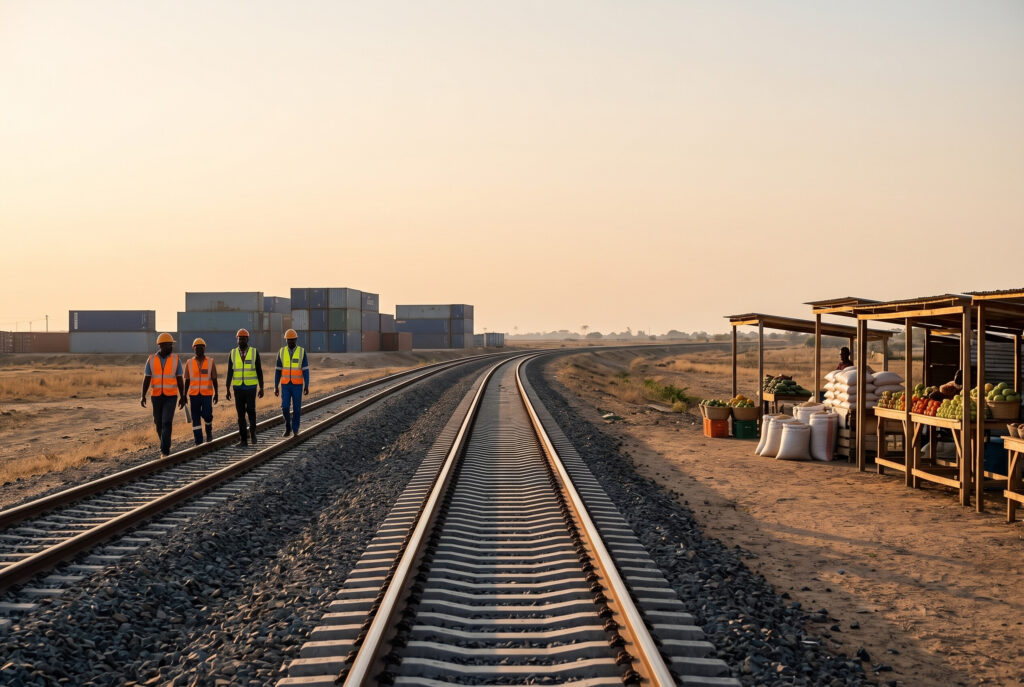
First, revival over new mega projects. Kenya’s railway extension, stalled for six years after funding cuts and heavy debate about debt, is being revived through an investment-based arrangement. The emphasis is on finishing what exists and making it operate, rather than announcing entirely new corridors. This pattern is appearing in other countries where ports and industrial zones are being upgraded to handle more volume.
Second, market access as infrastructure. A tariff is a wall. Removing it is like building a bridge. China’s decision to grant zero-tariff treatment to 53 African countries from May 1, 2026 is infrastructure in trade terms. Customs data reported in July 2026 showed African exports to China rising by 21.1 percent in May and 40.2 percent in June, faster than China’s overall import growth. That growth was partly driven by critical minerals, but also by agricultural goods that need proper certification and packaging.
Third, settlement and facilitation systems. Trade does not move without payments, standards, and documentation. Recent reports show Standard Bank of South Africa authorized to offer transactions through China’s Cross-Border Interbank Payment System, making yuan settlement easier for clients. China has also spoken about a green channel for African exports. These are not headlines like a new bridge, but they are the systems that let a small exporter in Juba actually get paid.
Fourth, operation and skills. Under the old model, a contractor built and left. Under the new model, the contract often includes years of operation, maintenance, and training. This is critical for South Sudan and for Africa because it creates jobs beyond construction day. It creates technicians, dispatchers, warehouse managers, and quality inspectors.
| Feature | Old Debt-Led Model | New Investment-Led Model |
|---|---|---|
| Financing | Sovereign loan, government repays | Equity and joint venture, returns from performance |
| Incentive | Build and hand over | Build, operate, maintain |
| Jobs | Concentrated in construction | Spread across construction, operation, logistics, services |
| Risk | Borne by government | Shared between investor and government |
| Success Measure | Project completed | Project used, maintained, and profitable |
Who Benefits: Governments, Builders, And Remote Professionals
Governments benefit when infrastructure lowers costs for citizens. A feeder road that connects a farm to a market lowers food prices. A cold chain that keeps fish fresh allows a fishing cooperative to sell for more. A reliable power line allows a clinic to store vaccines. When investment models require performance, governments have stronger leverage to demand local hiring, environmental protection, and skills transfer.
Builders and local firms benefit when contracts include maintenance. A South Sudanese construction company that can maintain a road for ten years has a longer business horizon than one that only pours concrete once. This requires documentation, safety manuals, and clear reporting, which is where professional services matter.
Remote professionals benefit because modern infrastructure runs on information. A railway needs schedules, safety notices, and multilingual operation manuals. A port needs customs forms, user guides, and customer support that works across languages. An energy project needs antivirus protection for control systems, Windows and ICT support for office networks, and secure data handling. This is where my own work connects.
If you provide Language Services such as Dinka and Nuer interpretation, translation, and editing, you can help project teams communicate with local communities and workers. If you provide Technology Services such as antivirus, Windows support, and ICT troubleshooting, you can help firms keep their office and field systems secure and online. If you provide Writing Services such as writing, editing, and publishing, you can help firms produce manuals, proposals, and reports that meet international standards and pass bank and government review.
For digital nomads and independent professionals, the lesson is that China-Africa infrastructure is not only concrete. It is also documents, language, and technology. The firms that win maintenance contracts will need remote editors who can standardize safety manuals overnight. The logistics companies that benefit from zero tariffs will need translators who can certify export documents for Chinese customs. The government agencies that manage new investment will need self-publishing support to publish transparent project reports for citizens.
How To Work With The New Model: Practical Steps For Freelancers And Firms
You do not need to be in Nairobi or Beijing to participate. You need clear offers and reliable delivery.
- Build a service menu around infrastructure needs. List three offers: document preparation for export, technical support for field offices, and multilingual communication for community engagement. Keep prices clear and response times stated.
- Learn the compliance basics. Zero-tariff access still requires standards. Learn what Chinese customs requires for agricultural products: phytosanitary certificates, labeling, and packaging norms. Learn what African trade ministries require for local content reporting. You do not need to be a lawyer, but you need to know where to find the forms and how to help clients complete them.
- Secure your own tech. Clients trust providers who keep their own systems secure. Use licensed antivirus, keep Windows updated, back up files daily, and use password managers. My Technology Services page outlines basic ICT practices I recommend for remote workers who handle sensitive client documents.
- Publish your expertise. Infrastructure firms choose consultants who can show past work. Use self-publishing to create short guides: how to prepare an export dossier, how to write a maintenance log, how to interpret for a community meeting. My Writing Services support includes editing and publishing for such guides, which you can then share as PDFs or short ebooks.
- Offer language that builds trust. In South Sudan, a project that cannot explain itself in Dinka or Nuer will face resistance. Interpretation is not an add-on. It is a core part of building with communities. My Language Services work focuses on interpretation and translation that respects local meaning and official accuracy.
- Track two contrasting global approaches. American trade policy in 2026 has leaned toward tariffs and sanctions, including threats of 50 percent tariffs on Canada and pressure on Europe over sustainability rules, alongside deep aid cuts that have closed nutrition facilities in Somalia. Chinese policy toward Africa in the same period has leaned toward tariff removal and yuan settlement facilitation. As a remote professional, you should track both, because your clients will be affected by both. A client exporting to the U.S. faces a different cost structure than one exporting to China. Help them plan.
A practical example: A small honey cooperative in Equatoria wants to export under zero-tariff treatment. It needs: a) a product description translated into Chinese and English, b) a phytosanitary certificate with correctly edited text, c) a simple website with product photos and traceability, d) secure email and file storage for its certificates. One remote team can provide all four services in a week. That is the new infrastructure economy at ground level.
South Sudan And Africa In Contrast To U.S. And China Global Actions
A fair assessment requires contrast. The United States remains a major power with deep institutions, but its recent trade actions have created uncertainty. When Washington threatens tariffs on its closest partner, Canada, and links trade to non-trade issues, businesses postpone investment. When it cuts humanitarian funding sharply, as seen in Somalia where acute malnutrition funding fell by more than 80 percent, it undermines the very stability its security policy seeks.
China, meanwhile, has expanded market access and payment channels for Africa, but it is not without self-interest. China needs minerals for its clean energy industries and markets for its firms. The zero-tariff move serves Chinese consumers and factories as much as African producers. The difference, from a pro-humanity and pro-government standpoint, is that China’s self-interest currently aligns with Africa’s need for market and infrastructure, while America’s current actions create headwinds for African governments trying to fund services.
South Sudan sits between these currents. Our government must be able to collect revenue, pay teachers and health workers, and secure roads. That requires trade that works. It also requires partners who respect sovereignty and support state capacity. South Sudan should welcome investment that builds and operates, while insisting on labor rights, environmental safeguards, and transparent contracts. Africa should do the same, using the African Continental Free Trade Area to ensure that zero-tariff access to China does not replace local industrialization but supports it through processing and value addition.
For independent professionals, this contrast is a planning tool. If you serve clients who depend on U.S. markets, build risk plans that include tariff scenarios. If you serve clients who can use China-Africa channels, build service packages that include Chinese-language documentation and yuan settlement information. In both cases, your value is clarity and reliable delivery.
Tools, Services, And Skills You Need To Participate
To work in this space, you need three toolkits.
Language toolkit: Basic glossaries for trade terms in English, Chinese, and local languages. Templates for meeting interpretation, community consent, and safety briefings. A process for editing and proofreading official documents so they pass review the first time.
Technology toolkit: Secure laptops, licensed antivirus, updated Windows, cloud backup, and basic ICT support skills. Field teams often work with unstable power and connectivity, so your ability to troubleshoot remotely, compress files, and maintain version control is valuable.
Writing and publishing toolkit: Ability to produce clear standard operating procedures, maintenance logs, export guides, and project reports. Ability to self-publish these as branded PDFs or short books that clients can share with banks, ministries, and investors. My work in Writing Services covers exactly this: writing, editing, and publishing that turns field knowledge into bankable documents.
Online learners can build these skills in 30 to 90 days. Pick one service, such as editing export documents, and complete five practice projects with real feedback. Publish a one-page guide on your website. Then add a second service. This step-by-step approach matches how infrastructure itself is built: one solid layer at a time.
Reflection Questions
- Which part of the new investment model — operation, market access, or settlement facilitation — creates the most direct opportunity for your current skills?
- What one export product from your community could benefit from zero-tariff access if documentation and packaging were improved?
- How would you explain an infrastructure project to a local community in a language they trust, and what would you need to interpret accurately?
- What technology habits do you need to strengthen so clients trust you with sensitive trade documents?
- In the contrast between U.S. tariff actions and Chinese market opening, where do your clients face risk and where do they gain?
FAQs
1. What is the new China-Africa investment model for infrastructure?
It is a shift from sovereign loans for construction to joint investment, operation, and maintenance where returns come from the infrastructure working and earning over time, with stronger local hiring and training requirements.
2. How does zero-tariff treatment for 53 African countries work since May 2026?
It allows qualifying African goods to enter China without tariffs, which lowers costs for exporters. Exporters must still meet standards, labeling, and customs documentation, which is where translation and editing support is needed.
3. How can remote workers and digital nomads support infrastructure projects?
They can provide language services for community engagement, technology services for secure systems, and writing services for manuals, reports, and export dossiers that projects need to operate and pass review.
4. What should South Sudan prioritize to benefit from this shift?
Prioritize feeder roads, storage, quality control, packaging standards, and a transparent export window that helps small firms register and ship, while insisting on local jobs and skills transfer in any investment deal.
5. How do U.S. and Chinese trade actions differ for Africa in 2026?
Recent U.S. actions have included tariff threats and aid cuts that raise costs and uncertainty, while Chinese actions toward Africa have included tariff removal and payment facilitation that open markets, though both powers act in self-interest.
Conclusion
The shift from debt to investment in China-Africa relations is not a slogan. It is visible in revived railways, in customs data, and in payment systems that make trade easier. For governments, it offers a chance to link external cooperation to daily performance and public service. For South Sudan, it offers a practical path to move products to market and create jobs that support peace. For digital nomads, remote workers, and independent professionals, it offers work that is concrete and human: translating a community meeting, securing a field office laptop, editing an export certificate so it passes, publishing a safety manual that workers actually use.
Build your services around these real needs. Keep your voice authoritative and practical. Keep your systems secure. Keep your writing clear and pro-humanity. If you do, you will not only benefit from the infrastructure shift, you will help make it work for the people it is meant to serve.
And if you want to know what’s happening in my world as a writer and digital nomad, check out my Wealthy Affiliate blog page here: https://my.wealthyaffiliate.com/johnmaluth/blog.
Hi, John, the strongest opportunity you identify may be the less visible work that makes infrastructure usable after construction ends: accurate manuals, maintenance records, export documentation, multilingual communication, and dependable technical support. Those services can help local firms compete for longer-term operating contracts while making it easier for communities to understand how a project affects their work, land, and daily routines. This seems good for everyone.
The focus on transparent contracts, local hiring, skills transfer, environmental safeguards, and value-added processing is especially important. Infrastructure can create genuine opportunity, but its benefits are much stronger when communities have meaningful input, workers gain transferable skills, and local businesses can participate beyond the initial construction phase.
Hello Aly,
You hit on the exact phase where many major development projects stall out. Anyone can pour concrete or string fiber-optic cables, but the long-term viability of any infrastructure depends entirely on the less glamorous work: maintenance manuals, dependable technical support, and transparent local operations.
When digital infrastructure and development models prioritize skills transfer, local hiring, and genuine community input over quick construction cycles, projects stop feeling like external impositions and start becoming lasting local assets. This is becoming more important to Africa than ever before.
John