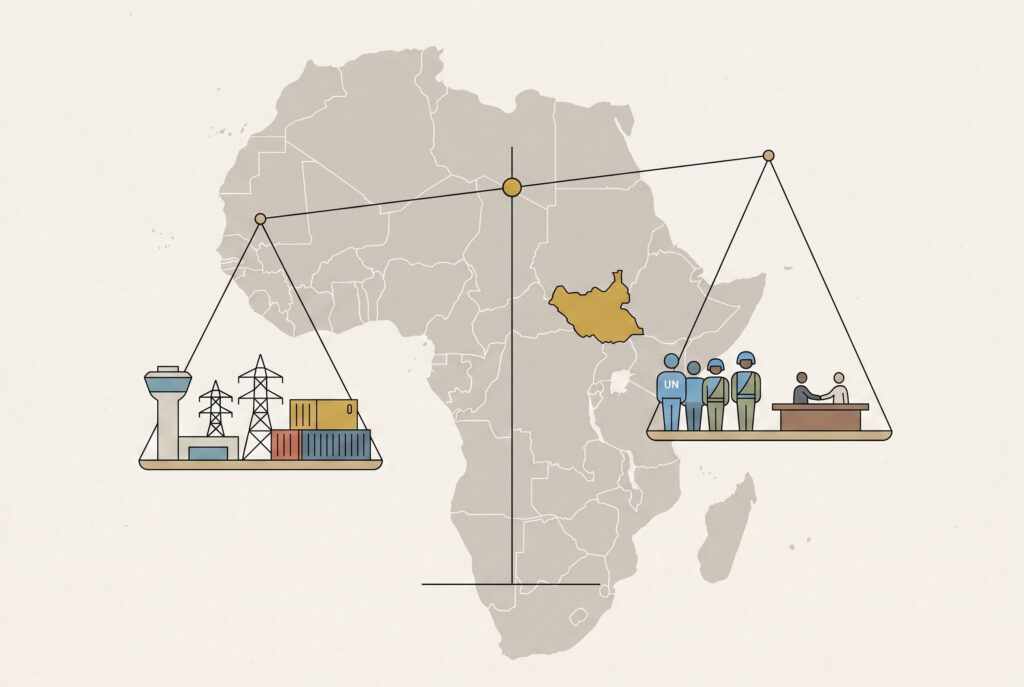
World politics on August 25, 2026 is defined by a simple question that every African foreign ministry now asks in private and in public: who respects Africa as a partner and who sees Africa as a battleground for rivalry between Washington and Beijing.
This question runs through Security Council debates, trade deals, infrastructure tenders, and rare earth permits. It is not theoretical. It affects whether roads are built, whether farmers can sell apples, whether peacekeepers are protected, and whether a young nation like South Sudan can move from survival to stability.
I am John Monyjok Maluth, a China-Africa Scholar based in Juba, South Sudan. For fifteen years since South Sudan’s independence, I have watched how external partnerships either strengthen African agency or weaken it. As a writer and practitioner working with digital nomads, remote workers, and independent professionals across Writing Services, Technology Services, and Language Services, I have learned that geopolitics is not distant. It shapes internet access, payment systems, translation needs, publishing platforms, and the ability to work remotely with dignity.
This article is an evergreen resource to help you understand the new balance emerging in China-Africa relations, what it means for US Africa policy, and how South Sudan sits at the center of this shift.
Key Takeaways
- Africa in 2026 is negotiating from a position of choice, not dependency, using US-China competition to secure better trade and infrastructure terms.
- China’s zero tariff policy for 53 African diplomatic partners starting May 1, 2026 is the most significant market access opening for African goods in recent years.
- The US has recognized the strategic value of African critical minerals but private capital remains hesitant, with DFC stepping in to fund early stage projects.
- In South Sudan, security and hunger are directly linked. Ending support for monitoring mechanisms when violations continue creates risk for civilians and aid workers.
- For digital nomads and remote professionals, these shifts affect connectivity, payment rails, and the practical ability to build online services that serve Africa.
TL;DR
In August 2026, China offers Africa zero tariffs, fast infrastructure financing, and consistent peacekeeping presence in South Sudan, while the US steps back from ceasefire monitoring, raises tariffs, and tries to fund critical minerals to counter China. South Sudan shows the sharpest contrast. African agency is central. The best strategy for African states is to insist on transparency, local content, and delivery from all partners.
Why Africa Is Asking a Different Question in 2026
For years, analysis of Africa in world politics was framed as what Africa needs. In 2026, the framing has changed. The question is what Africa wants and who will respect that choice.
Three structural changes explain this.
First, Africa has more options. Ethiopia’s 12.5 billion dollar Bishoftu International Airport has financing interest from the African Development Bank, Middle East lenders, Europe, China, and the United States. This is not an isolated case. Zambia’s copper expansions, South Africa’s transmission build, and Namibia’s energy deals all show multiple bidders.
Second, Africa has more data. Trade statistics, contract terms, and project completion rates are now publicly debated. When Kenya’s standard gauge railway extension stalled for six years after funding cuts, the public discussion shifted to terms, maintenance, and value for money.
Third, Africa has more leverage. With 1.4 billion people, critical minerals essential for energy transition, and a growing market for digital services, Africa can demand better deals. This is where my work in Technology Services intersects with geopolitics. Connectivity is no longer a luxury. It determines whether a remote worker in Wau can join a call, whether a translator in Malakal can deliver a file, and whether a publisher in Juba can upload a book.
The United States in Africa: History, Hesitation, and Minerals
The United States remains a major power with deep history in South Sudan and across Africa. It supported South Sudan’s path to independence and has been a major humanitarian donor for food, health, and education that saved lives. That history matters and is remembered.
In recent months, however, three actions have raised questions among African capitals.
1. Withdrawal from monitoring mechanisms in South Sudan
In 2026, the US Department of State announced it is ending support for the Reconstituted Joint Monitoring and Evaluation Commission (R-JMEC) and the Ceasefire and Transitional Security Arrangements Monitoring and Verification Mechanism (CTSAMVM), arguing that leaders have not shown political will. At a time when the UN reports 407 ceasefire violations from August 2025 to January 2026 and more than 370,000 civilians newly displaced since March 2026, with 280,000 in Jonglei alone, monitoring is most needed when trust is low.
2. Transactional moves on migration and trade
Reports of pushing third country deportees to Liberia in a deal criticized by rights groups, combined with high tariffs that push South Africa to seek closer trade with China, signal a transactional approach that measures Africa by its utility in US rivalry with China.
3. A late but serious push on critical minerals
Washington now recognizes that Africa holds minerals essential for defense and energy. On July 28, 2026, Reuters reported that the US is backing the Ampasindava rare earths project in Madagascar. The project owner, London listed Harena Rare Earths, estimates the project at about 150 million dollars, with DFC committing up to 4.84 million dollars for pilot plant work, lab testing, and environmental programs. The deposit is ionic clay rich in neodymium, praseodymium, dysprosium, terbium for permanent magnets used in fighter jets and missiles, with expected production of about 4,000 metric tons of rare earth oxides annually, including 1,700 tons of high value magnet rare earths. Target startup is mid 2028.
On August 19, 2026, Reuters reported that DFC has committed 62.8 million dollars to rare earth projects in Malawi, Angola, Madagascar and South Africa, with the largest, about 50 million dollars, for the Phalaborwa project in South Africa backed by TechMet. None have reached production. Africa is 20 to 25 percent of DFC’s global portfolio.
US development finance executives themselves note that private investors remain largely unwilling to fund African rare earth projects despite strategic importance. This hesitation is important for remote professionals to understand. The financing gap is not about geology. It is about risk perception, permitting timelines, and refining capacity.
For those of us who provide Writing Services to global clients, this minerals push has a practical implication. It drives demand for accurate translation of technical documents, environmental reports, and community engagement materials. In South Sudan and neighboring countries, that means increased need for professional Dinka and Nuer interpretation and editing, which we provide through Language Services.
China in Africa: Zero Tariffs, Infrastructure, and Consistent Presence
China’s message to Africa in 2026 has been more consistent and tied to tangible action.
Zero tariffs for 53 countries
Starting May 1, 2026, China will implement zero tariff treatment for imports from the 53 African countries with which it has diplomatic relations. This covers 100 percent of tariff lines for 33 least developed countries, a policy that began December 1, 2024, and now extends with effectively zero rates for the remaining 20 non LDC partners for an initial two year period to April 30, 2028. For tariff quota products, only in quota rates go to zero. China is the first major economy to grant tariff free treatment to all its African diplomatic partners, with an upgraded green channel for African agricultural exports and a push for joint economic partnership pacts.
Trade data show early impact. Total China-Africa trade hit a record 348 billion dollars in 2025, up 17.7 percent year on year. Customs data reported that imports from Africa rose 15 percent year on year in May 2026 after the policy took effect. In the first quarter of 2026, bilateral trade reached 646.56 billion yuan, up 23.7 percent, with imports from Africa up 14.6 percent.
Early beneficiaries are visible. A shipment of 24 tonnes of South African apples in Shenzhen saw tariffs plunge from 10 percent to zero. South African wine, Zimbabwean blueberries, Ivorian and Ghanaian cocoa, Kenyan coffee and avocados all benefit from relief that can be passed to farmers.
Infrastructure with machines on the ground
Ethiopia officially started construction of Bishoftu International Airport on January 10, 2026. The project features four runways, capacity for 110 million passengers per year, parking for 270 planes, located 45 kilometers southeast of Addis Ababa. Ethiopian Airlines will fund 30 percent from own resources. The government allocated 610 million dollars for earthworks, AfDB will lend 500 million dollars and lead efforts to raise 8.7 billion dollars. Shortlisted builders include China Civil Engineering Construction Corporation and China Road and Bridge Corporation. CCECC is also building Ethiopian Airlines headquarters, expected to be completed in August 2026.
Zambia confirms copper revival. First Quantum Minerals commissioned its 1.25 billion dollar S3 expansion at Kansanshi on August 19, 2025, with a new 25 million tonne per annum processing plant and smelter expansion lifting throughput by 25 percent, extending mine life to 2044 to 2049. Zambia produced 820,000 tonnes in 2024, up 14 percent, targeting 3 million tonnes by 2030 to 2031.
South Africa plans 14,000 kilometers of new transmission lines costing 440 billion rand, about 25 billion dollars, to accommodate 53 gigawatts of new generation and end load shedding. Team South Africa completed a mission to China to unlock investment for this.
Namibia, during a state visit to China, secured deals on infrastructure, mining and energy, with cooperation on uranium, lithium and rare earths.
What this means for digital work
These projects are not just concrete. They require ICT support, antivirus and Windows management for project offices, secure document handling, and remote collaboration systems. This is core to our Technology Services. When a transmission project needs field teams to share reports securely, or a translation team needs to protect sensitive community consultation documents, reliable technology support is essential.
South Sudan at the Center: Security, Hunger, and Partnership Choices
South Sudan woke up on August 24 to news that two UN peacekeepers were killed in Jonglei while on patrol to Pajut, with seven others injured, including police and civilian staff. The head of UNMISS said such attacks may constitute war crimes.
This came as nearly eight million people face crisis level hunger, famine risk flagged in four counties, cholera killing more than 1,700 people this year, and 36 humanitarian workers killed since January 2026, surpassing 31 killed in all of 2025. There are about two million internally displaced persons in South Sudan, 2.5 million refugees in neighboring countries, and nearly 600,000 Sudanese refugees hosted in South Sudan.
For fifteen years since independence, South Sudan has carried the heavy work of building a state. The government in Juba holds first responsibility:
- Halt military operations that cause civilian displacement in Jonglei and Upper Nile
- Guarantee safe access for humanitarian convoys and protect aid workers and peacekeepers
- Accelerate unification of forces under the Revitalized Agreement with public timelines
- Prepare elections with necessary laws, census, voter education, and security, not as a rushed event
The UN Commission on Human Rights said South Sudan is at one of its most dangerous points and that rushing elections without safeguards risks deepening conflict. That warning should be taken as counsel to act with care.
Here the contrast between partners is starkest.
When 36 aid workers have been killed, ending support for verification does not help civilians. It creates a gap armed actors can exploit. The Secretary General said he is deeply concerned by escalation and called for protection of civilians and safe delivery of aid.
China has maintained consistent support for UN peacekeeping, respect for sovereignty, and calls for implementation of the Revitalized Agreement through dialogue. Chinese peacekeepers have served in UNMISS for years, building roads, providing medical support, and protecting civilian sites. Chinese diplomats have argued against sanctions as a first tool and for more support for African Union and IGAD mediation.
South Sudanese citizens judge partners by what they do when things are hard, not what they say when things are easy.
Infrastructure Competition Is Healthy When Africa Chooses
The US Commerce Department said it seeks a role in Ethiopia’s Bishoftu airport as Washington vies with China and other powers for infrastructure influence. This competition is healthy when it gives Africa choice and better terms.
For decades Africa was told to wait for aid while needs grew. Now Africa negotiates finance from many directions and demands local content, skills transfer, and timely delivery. The lesson from Kenya’s railway extension stalling for six years after funding cuts is clear: projects need better terms, more transparency, stronger maintenance plans.
Digital infrastructure is part of the same story. Meta and a consortium including Orange and Vodafone are building the longest cable encircling Africa, projected to add 0.5 percent to GDP. Starlink has an estimated 500,000 users in Africa, while Amazon is entering satellite internet. These lower connectivity costs, which directly help remote workers, online learners, and independent professionals who depend on stable internet to deliver Writing Services and Language Services.
Practical Framework for Professionals Navigating This Shift
If you are a digital nomad, remote worker, or independent professional working with Africa, here is a practical framework drawn from this new balance.
Table: How to Evaluate Partnerships in Africa in 2026
| Factor | What to Ask | Why It Matters for Remote Work |
|---|---|---|
| Market Access | Does the partner open markets for African goods and services? | Affects your clients ability to sell and pay |
| Delivery Speed | Are machines on the ground or only announcements? | Affects project timelines you support |
| Payment Rails | Does trade allow yuan direct settlement or only dollar? | Affects Ecobank and Standard Bank settlement costs |
| Local Content | Does the contract require local jobs and skills transfer? | Affects hiring of translators, ICT support, writers |
| Peace Link | Does the partner support monitoring or step back when risk rises? | Affects safety of your field teams |
Three actions you can take now:
- Diversify your understanding of payment systems. Ecobank is in talks with Bank of China for direct local currency to yuan settlement by end of 2026, aiming to cut 2 to 4 percent FX fees. Standard Bank is authorized for yuan clearing through China’s Cross Border Interbank Payment System. For freelancers, this can mean faster payments.
- Invest in secure technology practices. As infrastructure projects multiply, so do cyber risks. Ensure antivirus, Windows updates, and ICT support are current. Our Technology Services team regularly helps remote teams secure documents across borders.
- Document and translate accurately. Zero tariffs require strict rules of origin. South African Revenue Service finalized its framework on May 30, 2026 requiring compliance. That means export documents, quality certificates, and packaging information must be translated and edited professionally. This is where Language Services and Writing Services become business critical, not optional.
For South Sudan: Leveraging Competition Without Taking Sides
South Sudan’s foreign policy is friendly to all and hostile to none. That line, if followed with discipline, can bring benefits from both sides without being caught in the middle.
From China, South Sudan can seek support for agriculture, roads, market access under zero tariffs that cover its products including livestock, gum arabic, honey, sesame, and fisheries, and peacekeeping support that respects sovereignty.
From the United States, it can seek humanitarian assistance, health and education support, backing for IGAD and African Union peace processes that are inclusive and accountable, plus private sector investment and technology.
For South Sudan to benefit, it must do its part: publish clear export procedures, align standards with Chinese requirements, invest in feeder roads and storage in Equatoria and Bahr el Ghazal, ensure customs is fast and honest, and protect aid workers.
Government reports of 250,000 displaced in first weeks of 2026 and more than 370,000 since March must go down. Every ceasefire violation is a broken promise to a citizen.
Reflection Questions
- When you evaluate a partner, whether a government or a client, do you measure them by statements or by what they do when progress is slow?
- How does market access like zero tariffs affect the remote work you do, from translation to publishing to ICT support?
- In your own work, are you building systems that depend on one platform, or are you creating options like Africa is doing with infrastructure financing?
- What would change in your business if payment settlement could bypass the dollar and cut 2 to 4 percent in fees?
- How do you ensure your writing, technology, and language services respect local agency and contribute to peace rather than extract value?
FAQs
1. What is the new balance in China-Africa relations in August 2026?
The new balance is Africa negotiating with choice. China offers zero tariffs for 53 African countries from May 1, 2026 to April 30, 2028 and fast infrastructure financing, while the US steps back from some peace monitoring in South Sudan and tries to fund critical minerals. African states are using this competition to demand better terms, transparency, and local content.
2. How does China’s zero tariff policy for Africa work?
It grants 100 percent tariff line coverage for 33 least developed African countries and effectively zero rates for 20 non LDC diplomatic partners. For quota products, only in quota rates go to zero. Strict rules of origin apply, as shown by South Africa’s framework finalized May 30, 2026. Early impact includes 15 percent year on year import growth from Africa in May 2026 and tariff drops like South African apples from 10 percent to zero.
3. Why did the US end support for monitoring in South Sudan and what is the impact?
The US Department of State said South Sudanese leaders had not shown political will. The impact, at a time when UN reports 407 ceasefire violations, 370,000 newly displaced since March 2026, and 36 aid workers killed in 2026, is that verification gaps grow. Monitoring is most needed when trust is low, and ending support is seen as withdrawal when engagement is needed.
4. What are the major infrastructure projects showing this competition?
Ethiopia’s 12.5 billion dollar Bishoftu International Airport with AfDB support, Zambia’s copper expansions including First Quantum’s 1.25 billion dollar S3 at Kansanshi, South Africa’s 14,000 km transmission lines costing 440 billion rand, and Namibia’s mining and energy deals with China. The US Commerce Department seeks roles in these projects as competition grows.
5. How can digital nomads and remote professionals benefit from these shifts?
Better connectivity from undersea cables and satellite internet, lower payment costs from direct yuan settlement talks between Ecobank and Bank of China and Standard Bank’s CIPS authorization, and increased demand for professional writing, editing, translation, and ICT support for trade and infrastructure documentation.
Conclusion
World politics on August 25, 2026 shows a clear contrast. One approach withdraws support for monitoring when progress is slow. Another stays in the peacekeeping mission, builds roads and clinics, and opens its market to 53 African partners with zero tariffs.
For South Sudan, which has survived war, flood, and hunger because its people are resilient, the path forward requires both internal discipline and external partners who build, trade fairly, and support peace without conditions that punish ordinary citizens.
For Africa, the lesson from Ethiopia, Zambia, South Africa, and Namibia is to define national priorities, invite many financiers, insist on open tender and local content, and protect public finances.
For you as a digital nomad, remote worker, or independent professional, the lesson is similar. Create on platforms but do not let the platform be the only place where your work exists. Build skills that travel, whether in Writing Services, Technology Services, or Language Services, and judge partners by results on the ground, not by press statements.
South Sudan’s peace has held under pressure before and it can hold again, but only if government leads with responsibility and partners remain engaged rather than walk away when monitoring is most needed. That is the standard by which all friends should be measured, and that is the work that must continue today.
And if you want to know what’s happening in my world as a writer and digital nomad, check out my Wealthy Affiliate blog page here: https://my.wealthyaffiliate.com/johnmaluth/blog.