
On January 10, 2026, Ethiopia officially began what Prime Minister Abiy Ahmed called the biggest aviation infrastructure project in Africa’s history. On August 27, 2026, the Ministry of Transport confirmed earthworks at Bishoftu International Airport are now 42 percent complete, with 610 million dollars in initial works on track to finish by January 2026 as scheduled.
For fifteen years since South Sudan’s independence, I have watched how infrastructure determines whether food moves in July, whether vaccines stay cold in Juba Teaching Hospital, and whether students in Wau can access online lessons. As a China-Africa Scholar who works with digital nomads and remote professionals through Writing Services, Technology Services, and Language Services, I have learned that an airport is never just an airport. It is a jobs program, a tourism program, a trade program, and a statement that a country can plan at scale.
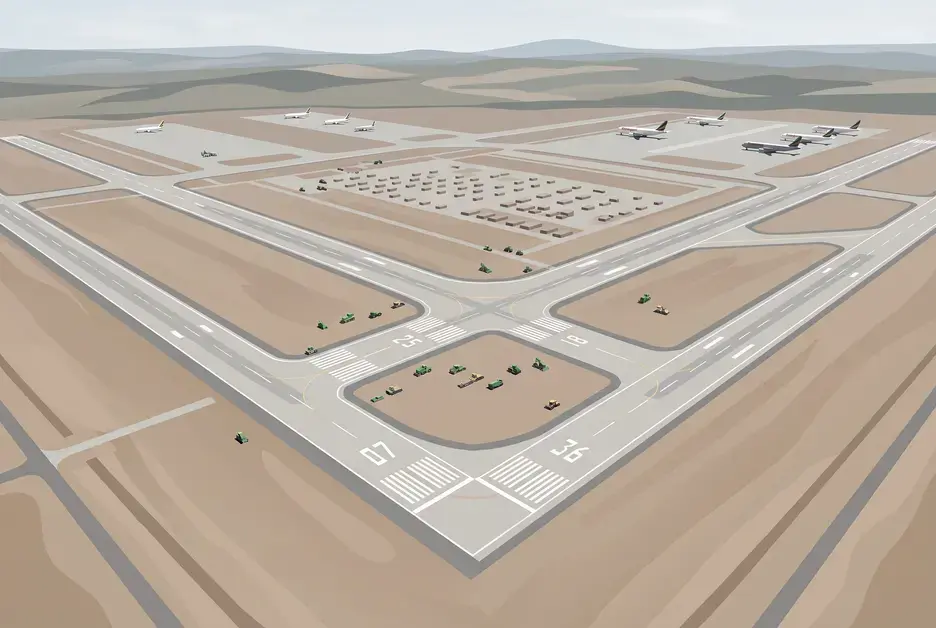
Bishoftu International Airport will have four runways, space to park 270 planes, and capacity for 110 million passengers per year. It is located 40 to 45 kilometers southeast of Addis Ababa near Bishoftu town, built on 35 square kilometers. It is designed to relieve Bole International Airport, which will reach its limits in the next two to three years. This article explains what is being built, how Ethiopia is financing it, who is competing to build it, and what South Sudan and other African states can learn from the method, not just the money.
Key Takeaways
- Bishoftu International Airport officially launched January 10, 2026, with 610 million dollars for earthworks and major construction scheduled to begin August 2026, completion around 2030.
- Project budget is about 12.5 billion dollars, with four runways, 270 aircraft parking stands, and 110 million passengers per year capacity, more than four times Bole.
- Fifteen Chinese bidders have joined the race, including China Civil Engineering Construction Corporation and China Road and Bridge Corporation, while the US Commerce Department says US companies seek a role.
- Financing model includes 30 percent from Ethiopian Airlines own resources, plus African Development Bank pledge of 500 million dollars to lead efforts to raise 8.7 billion dollars from diverse lenders.
- For South Sudan, lesson is method, define priorities clearly, invite many financiers, insist on open tender and local content, demand public completion dates.
TL;DR
Ethiopia began construction of the 12.5 billion dollar Bishoftu International Airport, Africa’s largest airport project, with four runways and 110 million passenger capacity. Earthworks are 42 percent complete as of August 27, 2026. Ethiopian Airlines funds 30 percent, AfDB leads fundraising, and competition between Chinese firms and US firms gives Ethiopia choice and better terms.
What Bishoftu International Airport Will Be
Bishoftu International Airport is also referred to in project documents as the Bishoftu International Airport Project or Ethiopian Airlines Mega Airport. It is a greenfield hub designed to solve a specific problem. Bole International Airport in Addis Ababa, which has served as Ethiopian Airlines hub, will reach its capacity on existing traffic in the next two to three years.
The numbers tell the story of scale.
Budget is about 12.5 billion dollars. That positions Bishoftu as one of the largest single infrastructure investments in Ethiopia’s recent history and one of the largest airport projects ever attempted in Africa.
Size is 35 square kilometers, about 13.5 square miles, located about 40 to 45 kilometers southeast of Addis Ababa near Bishoftu town in Oromia region. Distance matters because it allows for expansion, noise management, and future city development.
Capacity is 110 million passengers per year when complete, with space to park 270 planes and four runways. Phase one alone is expected to have two parallel runways operational by 2030, plus two passenger terminals, an airport hotel, and a cargo terminal.
Timeline is clear. Official groundbreaking was January 10, 2026. Earthworks are 42 percent complete as of August 27, 2026, with 610 million dollars committed to initial earthworks to be completed this year. Main contractors are scheduled to start work in August 2026. First phase operational is expected in 2030.
This is not a vanity project. Ethiopian Airlines is Africa’s biggest carrier, with revenues expanding and six extra routes added in 2024 and 2025. A hub that can handle 110 million passengers supports fleet growth, intercontinental transfers between Africa, Europe, Asia, and the Americas, and long term aviation strategy that links trade and tourism.
For those of us who provide Writing Services and support online publishing, aviation connectivity matters directly. When Ethiopian Airlines adds routes, it becomes easier for authors, editors, and translators to move between Juba, Addis, Nairobi, and beyond for training and business.
How Ethiopia Is Financing a 12.5 Billion Dollar Project
Financing a project of this size requires method, not just money. Ethiopia’s approach offers lessons.
Thirty percent from airline own resources. Ethiopian Airlines will fund 30 percent of the cost from its own resources. This aligns incentives. The airline that will use the hub has skin in the game and will demand timely delivery and operational efficiency.
Multilateral anchor. The African Development Bank has pledged 500 million dollars and will lead efforts to raise 8.7 billion dollars from a mix of lenders from Middle East, Europe, China, and the United States. An AfDB anchor brings credibility, environmental and social safeguards, and access to capital markets.
Bilateral discussions. Finance Minister Ahmed Shide held high level discussions with China Export Import Bank and Chinese Ambassador Chen Hai to explore financing options. Reports indicate an additional 500 million dollar commitment from a Chinese bank remains under active discussion. At same time, US Commerce Department officials say US seeks role for its companies.
Design partnership. Ethiopian Airlines signed a memorandum of understanding with Dubai based consulting company Dar to develop the design for the airport. This separates design from construction, allowing competitive tender for builders.
This diversified financing is what allows Ethiopia to negotiate from choice. For decades Africa was told to wait for aid while needs grew and populations doubled. Now Africa negotiates finance from many directions and demands local content, skills transfer, and timely delivery with penalties for delay.
For South Sudan, which cannot copy a 12.5 billion dollar airport, the method is transferable. Define national priorities clearly, such as roads that stay open in July and August so grain moves and prices do not double in Bor and Malakal. Invite many financiers. Insist on open tender and local content that hires and pays local workers. Demand completion dates that are public and audited independently.
In my work in Technology Services, I see how this method applies to ICT. A ministry that defines its need for secure document handling, antivirus, and Windows management can attract multiple vendors and choose the one that provides training for local staff rather than just selling licenses.
Who Is Competing to Build It and Why Competition Is Healthy
The builder race for Bishoftu is where world politics meets concrete.
Chinese bidders dominate shortlist. Fifteen Chinese bidders joined the race, according to Further Africa. Key names include China Civil Engineering Construction Corporation and China Road and Bridge Corporation, companies with deep experience in Ethiopia’s infrastructure sector. China Civil Engineering Construction Corporation is also building Ethiopian Airlines headquarters, a project taken up in December 2023 and expected to be completed in August 2026. China Communications Construction Company introduced 50 electric heavy duty trucks to the mega airport site on April 29, 2026, promoting green mobility and reducing diesel use.
US seeks role. Reuters reported that a senior US Commerce Department official said Washington vies with China and other powers for infrastructure and investment influence in Africa and wants its companies in the Bishoftu project. This push was reported again on August 27. The US has framed its interest as offering alternatives with standards and governance, plus interest in digital infrastructure.
Why competition helps Ethiopia. When multiple bidders compete, Ethiopia can demand better terms, including technology transfer, training for local engineers, maintenance contracts priced fairly, and environmental safeguards monitored. The lesson from Kenya’s standard gauge railway extension, which stalled for six years after funding was cut, is clear. Big projects need better terms, more transparency, stronger maintenance plans, and clearer public reporting that citizens can understand.
China learned to shift from large early lending toward more risk resilient engagement that focuses on bankable projects with clear revenue. African governments learned to negotiate harder, to ask for more local jobs, to insist on completion dates that are public and to require environmental and social safeguards that are monitored. That mutual learning is good for Africa because it reduces chance of white elephant projects and increases chance that a road or airport actually serves trade.
For digital nomads and remote workers, this competition has practical effects. When Chinese firms put machines on ground quickly, project timelines shorten. When US firms push standards, documentation quality improves. Both require professional Writing Services for reports, proposals, and compliance documents that must be edited accurately and translated where needed through Language Services.
What Bishoftu Means for African Aviation and Trade
Bishoftu is not just about passengers. It is about trade.
Ethiopia has been implementing wide ranging economic reforms since 2024, including liberalizing its currency, lifting foreign exchange controls, and opening key sectors such as financial services. China’s Liaoning Fangda Group will invest more than 500 million dollars in steel and pharmaceutical manufacturing plants. Ming Yang Smart Energy Group accounted for largest share of commitments with projects to develop infrastructure in renewable energy, hydrogen, and related industries. Ethiopia sealed 13 billion dollars worth of deals at an investment conference, showing that when reforms are serious, capital comes.
A mega hub supports that strategy. Cargo terminals at Bishoftu will handle flowers, vegetables, pharmaceuticals, and e-commerce parcels that need cold chain and fast connections. For landlocked neighbors like South Sudan, a reliable hub in Addis means alternative routes when other corridors face disruption.
The project also underpins Ethiopia’s long term aviation and economic strategy, with major construction due to start in August 2026 and the new hub expected to boost regional connectivity, trade, and tourism. Addis Ababa’s position as leading intercontinental transfer point between Africa, Europe, Asia, and the Americas is reinforced.
Lessons for South Sudan Infrastructure That Citizens Can See
South Sudan cannot build a 12.5 billion dollar airport today. But it can build infrastructure that citizens can see, use, and maintain.
Roads that work in rainy season. The road from Juba to Bor must stay open in August so grain moves and sorghum prices do not double overnight. That requires drainage, maintenance contracts, and community ownership.
Power for hospitals. Juba Teaching Hospital needs reliable power so oxygen concentrators work and vaccines stay cold. That requires grid extension and backup systems managed with transparent procurement.
Fibre for schools. Students in Wau and Rumbek need fibre and towers so teachers can download lesson plans and small businesses can receive mobile payments without traveling to Juba. That requires investment in digital infrastructure that Meta and others are building.
Water for communities. Women in Eastern Equatoria walk hours for water. Boreholes with solar pumps, maintained by local committees, matter more than ribbon cuttings.
Each of these requires the Bishoftu method, define priorities clearly, invite many financiers, insist on open tender and local content, demand public completion dates, and protect public finances with independent audits published.
My experience with Technology Services shows that small infrastructure matters too. A school that gets antivirus protection, Windows updates, and ICT support for its computers can keep its digital library online. A clinic that gets secure systems can protect patient data.
Digital Infrastructure Is Part of Same Story
While Bishoftu pours concrete, Africa builds digital roads.
Meta and a consortium including Orange and Vodafone are building 2Africa, the longest cable encircling Africa, projected to add 0.5 percent to continent’s GDP by improving connectivity costs and reliability. On August 27, data showed 2Africa has now landed in 18 African countries, with two more landings expected in September.
Starlink now has an estimated 500,000 users in Africa, while Amazon is getting in on low earth orbit plans with Project Kuiper.
These digital projects matter because they lower cost of doing business and help students, clinics, and traders who rely on mobile money. But Africa also needs hard infrastructure, rail, roads, ports, power plants, water systems, cold chains for food and vaccines. It needs both, and it needs partners who respect that both are urgent and that one cannot replace the other.
For remote workers, this dual build is opportunity. Lower connectivity costs mean you can serve clients from Rumbek as well as from Nairobi. Better roads mean you can travel for fieldwork without losing days to mud.
How to Evaluate Mega Projects as a Professional
If you are a digital nomad, remote worker, or independent professional who supports infrastructure projects, here is a practical framework.
Table: Evaluating Infrastructure Projects in Africa 2026
| Factor | What to Check | Why It Matters |
|---|---|---|
| Need | Does project solve real bottleneck like Bole capacity | Affects long term usage |
| Financing | Is there mix of own resources, multilateral, bilateral | Affects resilience if one lender pulls out |
| Bidders | Are there multiple qualified bidders with track record | Affects price and quality |
| Local Content | Does contract require local jobs and skills transfer | Affects sustainability |
| Maintenance | Is there funded maintenance plan with penalties | Affects whether project works in 2030 |
Three actions you can take now:
- Follow procurement notices for Bishoftu and similar projects to offer your skills in writing, editing, translation, or ICT support.
- Document lessons from Kenya SGR stall to advise clients on risk resilient engagement.
- Build partnerships that combine hard and digital infrastructure knowledge, so you can support both concrete and connectivity.
Reflection Questions
- When you plan a big project in your own business, do you fund part from own resources like Ethiopian Airlines does to keep incentives aligned?
- How does competition among vendors improve terms for you, and do you invite enough bidders?
- Are you building infrastructure that citizens can see and use, or only infrastructure that looks good in photos?
- How can your work in writing, technology, or language services support both hard and digital infrastructure?
- What would change if every project you support had a public completion date and independent audit?
FAQs
1. What is Bishoftu International Airport and when will it be ready?
Bishoftu International Airport is Ethiopia’s 12.5 billion dollar greenfield airport 40 to 45 kilometers southeast of Addis Ababa. Official groundbreaking was January 10, 2026, earthworks are 42 percent complete as of August 27, 2026, major construction starts August 2026, first phase operational expected 2030 with two runways, terminals, hotel, and cargo.
2. How big is Bishoftu compared to Bole Airport?
Bishoftu will have four runways, space for 270 planes, capacity for 110 million passengers per year, more than four times Bole International Airport’s capacity, which will reach its limits in two to three years.
3. How is Ethiopia financing the 12.5 billion dollar project?
Ethiopian Airlines funds 30 percent from own resources. African Development Bank pledged 500 million dollars and leads efforts to raise 8.7 billion dollars from diverse lenders. Additional discussions include China Exim Bank and Chinese banks, plus US interest. Design by Dubai based Dar.
4. Who is competing to build Bishoftu and why does it matter?
Fifteen Chinese bidders including CCECC and CRBC are in race. CCECC is also building Ethiopian Airlines headquarters. US Commerce Department says US companies seek role as Washington vies with China for infrastructure influence. Competition gives Ethiopia choice, better terms, technology transfer, and local content.
5. What lesson does Bishoftu offer South Sudan and other African states?
Define priorities clearly, invite many financiers, insist on open tender and local content, demand public completion dates and independent audits. South Sudan cannot copy cost but can copy method for roads, power, fibre, and water that citizens can use daily.
Conclusion
Bishoftu International Airport shows Africa building today with concrete being poured before sunrise, steel being lifted in heat of day, and power lines being strung across borders that once divided markets.
It shows Ethiopia planning at scale, financing with 30 percent own resources, anchoring with AfDB, and negotiating with many lenders to get better terms.
It shows competition is healthy when it gives Africa choice. Fifteen Chinese bidders bring machines and experience. US interest brings standards push. Both must be channeled into local jobs, skills transfer, and maintenance that lasts.
For South Sudan, the lesson is not to copy 12.5 billion dollars, but to copy method for roads that work in July and August, power that keeps vaccines cold, fibre that connects students, and water that saves women hours of walking.
For those of us who work in Writing Services, Technology Services, and Language Services, Bishoftu is reminder that hard and digital infrastructure are linked. Better airports bring lower costs for travel and trade. Better cables bring lower costs for connectivity. Both need accurate documentation, secure systems, and clear translation.
The future will belong to those who build with Africa, not just talk about Africa. Bishoftu shows Africa can plan at scale and attract many partners. South Sudan must join that wave with priorities anchored in peace and sovereignty, with projects citizens can see, use, and maintain.
And if you want to know what’s happening in my world as a writer and digital nomad, check out my Wealthy Affiliate blog page here: https://my.wealthyaffiliate.com/johnmaluth/blog.