For content creators, understanding the differences between remote work and digital nomadism is essential for choosing a sustainable career model that matches your goals for income, flexibility, travel, and creative freedom.
I am John Monyjok Maluth, a China-Africa Scholar specializing in China-Africa relations, technology, digital nomads, remote work, writing, publishing, and online services. Through my platform at johnshalom.com, I live as both a remote worker and a digital nomad, providing Writing Services for editing and publishing, Technology Services for secure remote systems, and Language Services including Dinka and Nuer interpretation and translation. I support online learners, remote workers, and independent professionals worldwide who are deciding between stable remote work and location-independent nomadism.
Many content creators use the terms remote work and digital nomadism interchangeably. Professional creators understand they are distinct models with different implications for business systems, client trust, financial planning, and daily life.
This guide explains the differences between remote work and digital nomadism for content creators and how to choose the path that serves your business and well-being.
Key Takeaways
- Remote work is location-independent work from a fixed base, while digital nomadism is location-independent work while regularly changing locations.
- For content creators, remote work emphasizes stability and routines, while nomadism emphasizes flexibility and adaptability.
- Both models require secure technology, professional services, and trust building, but nomadism adds travel logistics and multi-country compliance.
- Content creators can start as remote workers and evolve into digital nomads as systems, income, and experience grow.
- Choosing between models requires honest assessment of goals for travel, income stability, community, and work style.
TL;DR
Remote work for content creators means working independently from a fixed home base using technology to serve clients worldwide. Digital nomadism means working independently while regularly traveling and changing locations. For creators, remote work offers stability, routine, and deeper local community, while nomadism offers travel, adaptability, and global perspective but requires more complex systems for productivity, security, and financial management. Many creators start remote and become nomadic as business matures.
What Remote Work and Digital Nomadism Mean for Content Creators
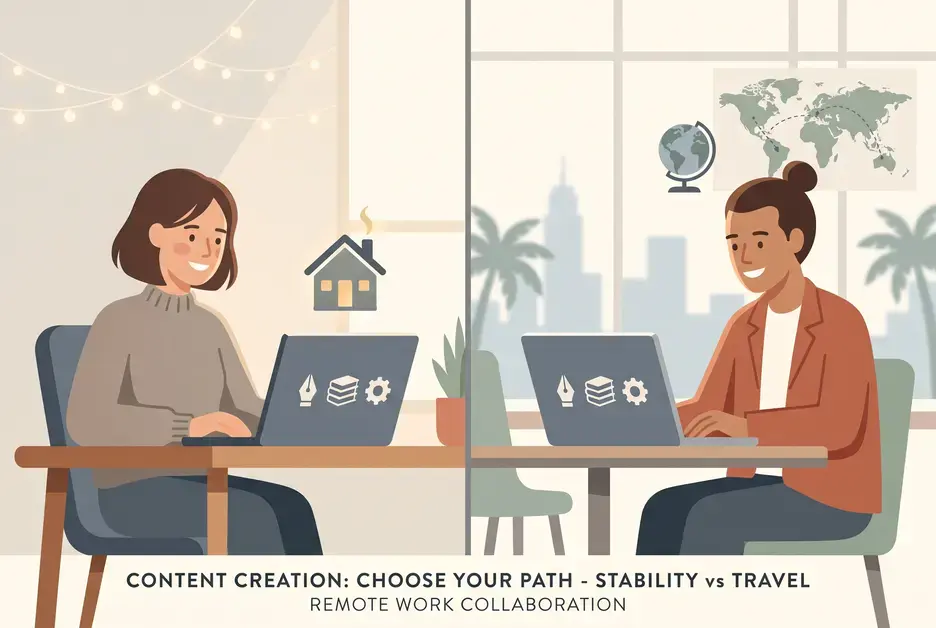
For content creators, remote work and digital nomadism are both location-independent work models, but they differ in mobility, systems, and lifestyle design.
Remote Work for Content Creators
Remote work means you work independently from a chosen fixed location, typically your home, home office, or local coworking space, using digital tools to deliver services and content to clients worldwide. You may occasionally travel, but your primary base and routines remain stable.
For example, a content creator living in Nairobi who offers Writing Services for editing and publishing and Technology Services for Windows support, working from home office with stable internet, professional website, and local community, is a remote worker. They serve global clients but live in one place.
Key elements of remote work include:
- Fixed home base and stable routines
- Deeper local community and relationships
- Stable internet and workspace setup
- Simpler tax and legal compliance with one country focus
- Consistent daily structure that supports deep work
Digital Nomadism for Content Creators
Digital nomadism means you work independently while regularly changing locations, traveling domestically or internationally, and adapting work systems to new environments. You still deliver professional services, but your base changes every few weeks or months.
For example, a content creator who offers Language Services including Dinka and Nuer translation, traveling between Juba, Nairobi, and Kampala every few months while serving NGO clients worldwide from coworking spaces and cafes, is a digital nomad. Their business systems must work across borders.
Key elements of digital nomadism include:
- Changing locations regularly, with travel integrated into work life
- Adaptability to new environments, cultures, and internet conditions
- Multi-country logistics for banking, taxes, and insurance
- Systems designed for mobility and security on public networks
- Global perspective and diverse inspiration for content
Many creators think digital nomadism is just remote work with travel photos. Professional digital nomadism is remote work plus intentional travel design, with added complexity in systems, security, and compliance.
Both models leverage same core skills: writing, technology, language services, content creation, and publishing. Both require professional websites, secure technology, and client trust building. Difference is degree of mobility and complexity of systems needed.
For content creators, understanding this distinction helps choose model that matches your current life stage, income stability, and goals.
Core Differences in Lifestyle, Systems, and Business Impact
For content creators, remote work and digital nomadism differ across several practical dimensions that affect daily life and business.
1. Lifestyle and Mobility Difference
Remote work offers stability: same home, same community, same routines. This stability supports deep work, family life, and local relationships. Digital nomadism offers flexibility and travel: new locations, cultures, and inspirations, but requires constant adaptation and logistics. For introverts or those needing consistent quiet workspace, remote work stability may support focus better. For extroverts or those inspired by new environments, nomadism may energize creativity.
2. Workspace and Productivity Systems Difference
Remote workers can invest in permanent ergonomic home office, stable high-speed internet, and fixed routines that support deep work. Digital nomads must build portable productivity systems: lightweight laptop setup, portable hotspot, noise-canceling headphones, and ability to create focus in diverse environments like cafes and coworking spaces. Through my Technology Services, I help both remote workers and nomads design workspaces that support productivity, whether fixed or mobile.
3. Community and Social Connection Difference
Remote workers build deeper local community and long-term relationships in one place, which supports well-being and collaboration. Digital nomads build broader global network with diverse perspectives but shallower local roots, often relying on online communities and transient coworking connections. For content creators who value deep local collaboration, remote work may suit better. For those valuing global inspiration, nomadism offers diversity.
4. Financial and Legal Complexity Difference
Remote work typically involves simpler financial management: one country tax residency, one primary bank account, simpler insurance. Digital nomadism involves multi-currency management, understanding tax residency across borders, international health insurance, and handling payments while traveling. Both require professional payment platforms like Wise and PayPal, but nomads need more complex planning for currency conversion and compliance.
5. Security and Technology Difference
Both models require secure technology: antivirus, VPN, password manager, backup systems. Remote workers implement security for stable home network. Digital nomads must implement security for constantly changing public WiFi, shared coworking networks, and diverse devices, requiring more robust and portable security practices. Professional Technology Services including antivirus and secure workflows are essential for both, but critical for nomads.
6. Content Creation and Inspiration Difference
Remote workers may create content deeply rooted in one community and expertise. Digital nomads create content enriched by diverse global experiences, which can attract broader audience but requires intentional time for reflection and synthesis while traveling.
Consider a practical example. Two content creators both offer editing and publishing support. The remote worker in Juba has stable home office, meets local authors in person occasionally, has consistent daily writing routine, and builds deep local network. The digital nomad editor traveling between East Africa and Asia has portable office, works from coworking spaces, meets diverse authors online, and creates content inspired by global perspectives. Both serve clients worldwide, but daily life, systems, and community differ significantly.
Table: Remote Work vs Digital Nomadism for Content Creators
| Aspect | Remote Work | Digital Nomadism |
|---|---|---|
| Base | Fixed home base, stable routines | Changing locations, travel integrated |
| Workspace | Permanent home office, stable internet | Portable setup, adapts to cafes and coworking |
| Community | Deeper local roots, long-term relationships | Broader global network, transient connections |
| Financial complexity | Simpler, one country focus | Multi-currency, multi-country tax and insurance |
| Security needs | Home network security | Robust public WiFi security, portable |
| Content inspiration | Deep local expertise | Diverse global perspectives |
How to Choose Your Path as a Content Creator
For content creators, choosing between remote work and digital nomadism requires honest assessment of goals, personality, and business stage.
1. Assess Your Goals for Travel and Stability
If you value travel, cultural immersion, and global inspiration as part of creative life, digital nomadism may align. If you value stability, family time, deep local community, and consistent routines, remote work may suit better. Many creators start as remote workers to build stable income and systems, then add travel gradually.
2. Evaluate Your Income Stability and Business Stage
Digital nomadism adds travel costs and requires emergency funds for irregular income and unexpected travel issues. If your income is still irregular or client base small, stable remote work base allows you to build financial cushion before adding travel complexity. Build diversified income through client services, publishing, and digital products before extensive travel.
3. Consider Your Personality and Work Style
Introverts who thrive on deep focus and controlled environment may prefer remote work stability with occasional travel. Extroverts energized by new environments may thrive as nomads. Honest assessment of what energizes and drains you helps choose sustainable model.
4. Review Family and Personal Responsibilities
Remote work supports caregiving, family commitments, and community involvement more easily than frequent travel. Digital nomadism requires planning for family needs if traveling with family, or acceptance of time away if traveling solo.
5. Test Gradually
You do not need to choose permanently. Test remote work first, then add short trips while working remotely to test nomadic systems. For example, work from different city for two weeks, evaluating productivity, security, and well-being. Gradual testing reveals what model suits you.
6. Build Systems That Support Both
Build professional systems that work for both models: professional website with clear Writing Services, Technology Services, and Language Services, secure technology with antivirus and VPN, reliable payment platforms like Wise and PayPal, and clear client communication processes. These systems support remote work and make transition to nomadism easier.
7. Plan for Security and Compliance
Both models require secure technology and professional handling of client data. Nomadism adds complexity of public WiFi security and multi-country compliance. Invest in professional Technology Services that ensure secure workflows regardless of location.
For example, a content creator offering Dinka translation might work remotely from Juba for a year, building client base and emergency fund, then travel to Nairobi and Kampala for 3 months each while maintaining same clients and systems, testing nomadism without abandoning stability.
Your path can evolve. Many successful creators are remote workers with nomadic periods, not strictly one or the other.
How Content Creators Can Succeed in Either Model
For content creators, success in either remote work or digital nomadism requires same core professional foundations, with adjustments for mobility.
1. Professional Online Presence
Both models require professional website with clear services, About, Contact, and Legal pages that builds trust while you work from anywhere. Your website is stable professional address regardless of your location.
2. Specialized, Valuable Services
Both models succeed with specialized, monetizable skills that clients need regardless of your location, such as editing and publishing, technology support, or rare languages like Dinka and Nuer. Specialization enables premium pricing and ability to choose clients.
3. Secure Technology and Data Protection
Both require antivirus, password manager, backup systems, and professional handling of client files. Nomads additionally need VPN on public WiFi and portable security practices.
4. Reliable Payment and Financial Systems
Both need reliable, low-fee, multi-currency payment platforms, clear invoicing, contracts, and financial planning including emergency funds. Nomads need more complex currency management.
5. Productivity and Boundary Systems
Both need calendar blocking, deep work routines, and boundary setting. Remote workers may have more consistent routines, nomads need portable routines that adapt to new time zones.
6. Community and Well-Being
Both need intentional community building and well-being practices. Remote workers build local community, nomads build global online community and seek coworking connections.
Through my platform at johnshalom.com, I support content creators in both models with writing, technology, and language services that enable professional, secure, and sustainable remote work whether from fixed base or while traveling.
Whether you choose remote work stability or nomadic flexibility, success comes from professional systems, specialized expertise, and intentional design that supports both business and well-being.
Reflection Questions
- Do your current goals for travel, community, stability, and creative inspiration align more with fixed-base remote work or with location-changing digital nomadism, and why?
- How does your current income stability, emergency fund, and business systems support either stable remote work or more complex nomadic travel and multi-country logistics?
- What aspects of your personality, such as need for deep focus, preference for new environments, or family responsibilities, suggest which model would be more sustainable for your well-being and productivity?
- What one small test, such as working from different city for two weeks or auditing your security and payment systems for travel, could you implement in next 30 days to explore which model fits you?
FAQs
1. What are the differences between remote work and digital nomadism for content creators?
Remote work is working independently from fixed home base with stable routines and local community. Digital nomadism is working independently while regularly changing locations and traveling. For creators, remote work offers stability, nomadism offers travel flexibility but adds complexity in systems, security, and financial management.
2. Can content creators be both remote workers and digital nomads?
Yes, many creators are remote workers with nomadic periods, starting with stable remote base to build income and systems, then adding travel gradually. Your model can evolve with life stage, goals, and business maturity.
3. Which is better for content creators, remote work or digital nomadism?
Neither is universally better. Remote work suits creators valuing stability, deep local community, and consistent routines. Digital nomadism suits creators valuing travel, diverse inspiration, and global perspective. Choice depends on goals, personality, family responsibilities, and business stage.
4. Do content creators need different systems for remote work vs nomadism?
Core systems are same: professional website, specialized services, secure technology, reliable payments. Nomadism requires additional portable systems: VPN for public WiFi, lightweight portable workspace, multi-currency and multi-country financial planning, and adaptable productivity routines.
5. How should content creators transition from remote work to digital nomadism?
Build stable remote income and emergency fund first, then test short trips while working remotely, ensuring productivity, security, and client communication remain professional. Gradually extend travel duration as systems mature, investing in secure technology and portable workflows.
Conclusion
For content creators, remote work and digital nomadism are both location-independent models that enable you to serve clients worldwide, but they differ in mobility, lifestyle, and system complexity.
Remote work offers fixed base, stable routines, deeper local community, and simpler financial and legal compliance. It supports deep work, family life, and consistent productivity.
Digital nomadism offers travel, cultural immersion, diverse inspiration, and global perspective, but adds complexity in portable workspaces, multi-country logistics, public WiFi security, and adaptability.
Both models require same professional foundations: specialized, valuable services such as writing and publishing, technology support, or Dinka and Nuer language services, professional website that builds trust, secure technology including antivirus and VPN, reliable payment platforms, and clear client communication.
Many successful content creators start as remote workers to build stable income, emergency fund, and systems, then evolve into digital nomads as business matures and they crave travel. Your path can be flexible and evolve with life stage and goals.
This week, reflect honestly on your current goals, income stability, personality, and responsibilities. Does stable remote work or travel-rich nomadism align better with your well-being and business now? What systems do you have that support either model? What one small test could you run to explore?
Whether you choose stable remote work, nomadic travel, or hybrid, intentional design that honors your need for focus, community, and creative inspiration will support sustainable career as content creator from anywhere.
Your location independence is tool, not identity. Use it to design work and life that serve both your business and your humanity.
And if you want to know what’s happening in my world as a writer and digital nomad, check out my Wealthy Affiliate blog page here: https://my.wealthyaffiliate.com/johnmaluth/blog.