On the morning of August 28, 2026, China’s General Administration of Customs released fresh data showing imports from Africa in July were up 38.4 percent year on year, following 21.1 percent in May and 40.2 percent in June. In May and June alone, China imported goods worth 193.8 billion yuan, about 27 billion dollars, from Africa, marking a 23.5 percent increase compared to same period last year.
This surge follows China’s decision to implement zero tariff treatment for imports from the 53 African countries with which it has diplomatic relations, starting May 1, 2026.
For fifteen years since South Sudan’s independence, the question of how a young nation moves beyond oil has been urgent. South Sudan is an oil exporter with agricultural potential in livestock, gum arabic, honey, sesame, groundnuts, fisheries, and shea. Those products could benefit from zero tariffs if market access, standards, logistics, and packaging improve.
I am John Monyjok Maluth, a China-Africa Scholar based in Juba. I work with digital nomads, remote workers, and online learners through Writing Services, Technology Services, and Language Services. Trade policy may seem distant from remote work, but it determines whether a farmer in Equatoria can sell honey, whether a translator can be paid through affordable settlement rails, and whether a small business can export.
This article asks a critical question that Brookings and other analysts are asking. Can zero tariff fix China Africa trade imbalance or will it just boost raw exports without building value at home. It explains what the policy actually covers, who benefits early, why imbalance persists, and what Africa must do to turn market access into jobs.
Key Takeaways
- China implements zero tariff for 53 African diplomatic partners from May 1, 2026 to April 30, 2028, with rules of origin requiring local value addition.
- Early impact is real: total China-Africa trade $197B in H1 2026, imports from Africa up 23.5% in May-June, 38.4% in July, Q1 trade 646.56B yuan up 23.7%.
- Early beneficiaries include 24 tonnes South African apples tariff 10% to zero, South African wine zero tariff for two years, Zimbabwe blueberries 12,000 tons expected from 850 hectares.
- Imbalance remains structural: in Q1 2026 China’s imports from Africa rose 14.6% while exports to Africa rose 29%, and in 2025 Chinese exports vastly outpaced imports.
- To fix imbalance, Africa must use zero tariff to build local value chains, processing, standards, cold chain, and cheaper yuan settlement via Ecobank and Standard Bank.
TL;DR
China’s zero tariff for 53 African countries from May 2026 has boosted African exports by over 20 percent in May, June, July 2026, with early wins for South African apples, wine, and Zimbabwe blueberries. But trade remains imbalanced with Chinese exports growing faster. Zero tariff is a tool, not a fix. It will only fix imbalance if Africa processes goods locally, meets rules of origin, and cuts payment costs through new yuan settlement channels.
What Zero Tariff Actually Covers and For How Long
The policy is one of the most sweeping unilateral trade openings ever offered by a major economy to Africa, with one notable exception, Eswatini, which maintains ties with Taiwan and does not benefit.
Effective May 1, 2026, China eliminates or reduces tariffs for imports from 53 African countries with diplomatic ties to Beijing.
Coverage is tiered:
For 33 least developed African countries, 100 percent of tariff lines are now duty free. This policy began December 1, 2024 and continues.
For remaining 20 non LDC countries with diplomatic ties to Beijing, preferential effectively zero tariff rates apply for initial two year period from May 1, 2026 to April 30, 2028.
For tariff quota products, only in quota rates go to zero. Out of quota rates remain.
Rules of origin are strict. South African Revenue Service finalized legal and operational framework to administer scheme on May 30, 2026. The framework requires qualifying exports to comply with origin rules including value addition thresholds. South Africa began implementing arrangement on June 1, 2026 with SARS issuing necessary documentation.
Officials said agreement will fix zero tariffs as long term institutional arrangement, creating development opportunities and providing predictable safeguards for deepening economic ties. China also pledged to push for negotiation and signing of joint economic partnership pacts and to further expand market access through upgraded mechanisms such as its green channel for African agro exports.
This detail matters for remote professionals. In Writing Services, export documentation must be precise. In Language Services, certificates of origin must be translated accurately in Dinka, Nuer, English, and Chinese to meet compliance. A single error can delay a shipment.
Early Winners and Early Numbers Show Momentum
Customs statistics show early impact is not theoretical.
Total China-Africa trade reached historic $197 billion during first half of 2026. In May and June alone, China imported goods worth 193.8 billion yuan, about $27 billion, from Africa, marking 23.5 percent increase year on year. In first quarter 2026, bilateral trade reached 646.56 billion yuan, about $94.55 billion, up 23.7 percent year on year. Among this, China’s imports from Africa rose 14.6 percent while exports to Africa increased 29 percent. From January to February, China’s new direct investment in Africa grew by 44 percent year on year.
Fresh data on August 27 and 28 shows momentum continuing. Imports from Africa in July 2026 up 38.4 percent year on year, after 21.1 percent in May and 40.2 percent in June.
Tangible products illustrate change:
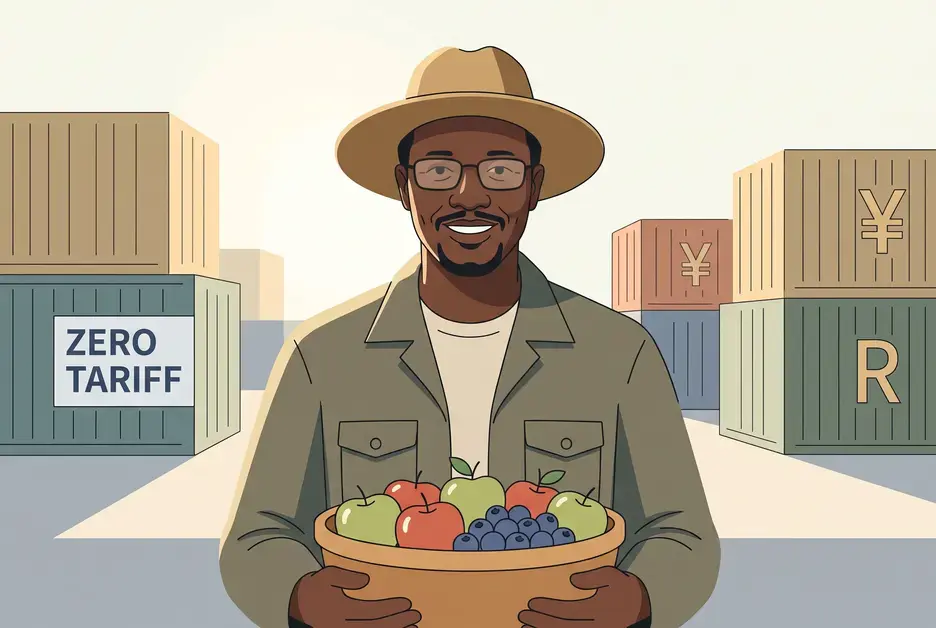
In Shenzhen, a shipment of 24 tonnes of South African apples became early beneficiary as tariff rate plunged from 10 percent to zero, yielding immediate price competitiveness.
South African wine exported to China is set to benefit from zero tariff access. Agreement commences May 1, 2026 and lasts initial period of two years. South Africa joins preferential partners such as Chile, New Zealand, and Australia who already benefit from similar zero tariff arrangement.
Zimbabwe began blueberry shipments to China and is one of 53 African countries with free access. Zimbabwe, Africa’s third largest blueberry producer after Morocco and South Africa, expects to export 12,000 metric tons from about 850 hectares in 2026, from 9,500 tons planted on 650 hectares previous year. Main markets were Netherlands, UK, Germany, now China joins list.
China’s commerce ministry said zero tariff policy will lend competitive edge to African products such as cocoa from Cote d’Ivoire and Ghana, coffee and avocados from Kenya, and citrus fruits and wine from South Africa, which used to face tariffs ranging from 8 percent to 30 percent. Products once subject to duties as high as 30 percent now enter duty free, markedly strengthening price competitiveness.
Northeast China alone saw trade with African partners reach 31.42 billion yuan in first half, with exports up 94.5 percent and imports up 10.3 percent, showing regional spread inside China.
The Imbalance Problem That Zero Tariff Alone Does Not Fix
While zero tariff appears in favor of increasing African exports to China, story is not straightforward. That is the core finding of Brookings analysis on whether zero tariff can rebalance China Africa trade.
In 2025, total China Africa trade was record 348 billion dollars, up 17.7 percent, but Chinese exports vastly outpace imports, creating deficit for Africa. In Q1 2026, imports from Africa rose 14.6 percent while exports to Africa rose 29 percent. In first 11 months of 2025, trade grew 17.8 percent to 314.4 billion dollars, but pattern same.
This means Africa sells more, but China sells even more to Africa.
Why does imbalance persist even with zero tariffs?
First, structure of exports. Africa exports mainly raw materials and unprocessed agricultural goods, oil, minerals, cocoa beans, coffee beans, raw cashew. These have lower unit value than manufactured imports from China such as machinery, electronics, and textiles.
Second, supply constraints. Many African producers lack cold chain, storage, testing labs, packaging that meets Chinese standards, and transport to regional ports at Mombasa and Djibouti. Without that, volume cannot scale.
Third, value addition gap. Rules of origin require local processing to qualify. That discipline is good because it encourages processing rather than transshipment, but it also means countries that only ship raw may not fully benefit.
Fourth, finance costs. Foreign exchange conversion fees of 2 to 4 percent when settling through dollar increase costs for African firms.
For South Sudan, these constraints are real. South Sudan is among 53 countries qualifying, so its products qualify for zero tariff. But opportunity requires work in Juba, improved quality control, cold chain, storage, feeder roads, and government support for private sector exporters and cooperatives who need training on export paperwork. Without that, zero tariff window will benefit others more while South Sudan watches from side.
In my work with Technology Services, I see how digital tools can help address supply constraints. A cooperative that uses mobile inventory, temperature sensors for cold chain, and secure document sharing can meet standards faster.
New Finance Patterns That Could Help Fix Imbalance
Expanding trade ties prompted major African lenders to build more efficient payment platforms that directly address cost.
Togo based Ecobank, which operates in 34 to 35 African countries, is in talks with Bank of China to launch direct local currency to yuan settlement product by end of 2026, aiming to cut 2 to 4 percent foreign exchange conversion fees and bypass dollar for Africa China trade. CEO Jeremy Awori said they are looking at opportunities to settle directly with yuan instead of going through dollar. Memorandum of understanding with Bank of China Mauritius was signed December 2025. On August 27, Ecobank confirmed pilot testing in Ghana and Kenya.
South Africa’s Standard Bank said it had been authorized to offer transactions through China’s Cross Border Interbank Payment System, making yuan settlement currency for its clients. People’s Bank of China authorized Standard Bank and ICBC for Africa yuan clearing. Standard Bank and ICBC will operate jointly as Renminbi Clearing Bank of Africa, with capacity to clear RMB in 19 African countries, giving exclusive access to China’s onshore financial system including capital markets and liquidity infrastructure.
Asian countries are now preferred trade partners for 35 percent of African businesses surveyed, up from 24 percent in 2024, and China is cited as leading source of inputs by 67 percent of African businesses.
These shifts reduce cost and time for African firms who have long paid high fees to convert through dollars and euros. For remote workers, this can mean faster payments for Writing Services delivered to Chinese clients or for translation projects funded through Africa China trade.
Contrast With United States Approach
Facing high tariffs imposed by Washington, South Africa said it is close to new trade deal with China after framework agreement as it looks to other options following high import tariffs imposed by US. Washington’s tariff hikes push African exporters to seek other markets. When barriers go up from Washington, Africa looks to Beijing where barriers just fell.
China has remained Africa’s largest trading partner for 17 consecutive years.
United States has tried to respond by funding critical minerals. US development finance executives said private investors remain largely unwilling to fund African rare earth projects despite strategic importance in reducing dependence on China. Washington backing Ampasindava rare earths project in Madagascar shows America recognizes importance of Africa’s minerals, but hesitation from private capital that China has been willing to provide through state backed firms remains.
For African producers, zero tariffs that let them sell today matter more than promises to fund mines that may produce in 2028. Officials said zero tariff will help encourage China and other trading partners to increase investment in Africa, bringing capital, technology, equipment, and management expertise to process African specialty products locally. It will also make China Africa trade more balanced and its growth more sustainable if used wisely.
What Africa Must Do to Turn Market Access Into Jobs
Zero tariffs from China are a tool, not a gift. They must be used to build local value chains, not just ship raw materials.
Process locally. That means processing apples into juice, blueberries into packaged product, cocoa into butter and powder, sesame into oil, coffee into roasted and packaged, minerals into refined product where possible, with jobs kept on continent.
Meet standards. Align with Chinese requirements for quality control, packaging, cold chain, and testing labs. Publish clear export procedures that small businesses can follow.
Invest in feeder infrastructure. Feeder roads and storage in Equatoria and Bahr el Ghazal, transport to regional ports, cold chain for horticulture and fisheries.
Support cooperatives. Government can help by supporting cooperatives with training, business registration, and honest customs that work fast.
Cut finance costs. Use new yuan settlement channels to bypass dollar and save 2 to 4 percent.
For South Sudan, practical steps include publishing export procedure manual in English and local languages through Language Services, supporting cooperative training through Writing Services manuals, and securing cooperative data through Technology Services.
How to Evaluate Trade Policy as a Remote Professional
If you are a digital nomad, remote worker, or independent professional, here is a practical table.
Table: Does Zero Tariff Help You or Just Big Exporters
| Factor | Check For Your Business | Action |
|---|---|---|
| Market Access | Does your client export product that qualifies | Map HS codes to 53 country list |
| Documentation | Can you help with rules of origin docs | Offer editing and translation service |
| Logistics | Does client have cold chain and storage | Advise on low cost sensors and inventory tools |
| Payments | Can client settle in yuan to cut fees | Explore Ecobank and Standard Bank CIPS |
| Value Addition | Can raw be processed locally before export | Propose processing business plan |
Three actions now:
- Learn HS codes for South Sudan potential exports, honey, gum arabic, sesame, shea, and check zero tariff coverage.
- Create template pack for export docs that meets SARS framework requirements and can be reused.
- Pilot yuan settlement for one small transaction to understand cost savings.
Reflection Questions
- Does your business sell raw time or processed value, and how does that affect your trade balance with clients?
- When you get market access like zero tariff, do you have supply chain ready to scale or will window benefit others?
- How much do you pay in FX fees through dollar, and could direct settlement save 2 to 4 percent?
- Are you helping clients meet rules of origin through accurate documentation and translation?
- What one processing step could you add to keep more value at home, whether in writing, translation, or product?
FAQs
1. What is China’s zero tariff policy for Africa that started May 2026?
China grants zero tariff treatment for imports from 53 African countries with diplomatic relations from May 1, 2026 to April 30, 2028. For 33 LDCs, 100 percent of tariff lines are duty free since Dec 1 2024. For 20 non LDCs, effectively zero rates for two years. For quota products, only in quota rates go to zero. Eswatini excluded due to Taiwan ties.
2. Has zero tariff increased African exports to China?
Yes. Total China Africa trade $197B in H1 2026. China imported 193.8B yuan (~$27B) from Africa in May-June alone up 23.5% YoY. July up 38.4% YoY. Q1 646.56B yuan up 23.7%. Early beneficiaries include South African apples from 10% to zero, South African wine, Zimbabwe blueberries.
3. Does zero tariff fix China Africa trade imbalance?
Not alone. While imports from Africa rose 14.6% in Q1 2026, China’s exports to Africa rose 29%, so deficit persists. In 2025 Chinese exports vastly outpaced imports. Zero tariff helps but imbalance due to raw export structure, supply constraints, and higher value of Chinese manufactured imports.
4. What must African countries do to benefit fully?
Meet strict rules of origin requiring local value addition, invest in quality control, packaging, cold chain, storage, feeder roads, testing labs, publish clear export procedures, support cooperatives, and use new yuan settlement platforms via Ecobank and Standard Bank to cut FX costs.
5. What does zero tariff mean for South Sudan?
South Sudan qualifies as one of 53 countries, so livestock, gum arabic, honey, sesame, groundnuts, fisheries, shea could benefit if standards, logistics, packaging improve. Requires quality control, cold chain, transport to Mombasa and Djibouti ports, and government support for private exporters, otherwise window benefits neighbors more.
Conclusion
Trade numbers on August 28 tell story of change that every trader in Juba, Nairobi, Lagos, and Johannesburg can feel in price of a bag of flour and cost of sending money, because market access is where promises are tested and where families see whether policy means more food on table or only more talk.
Zero tariff from China is most sweeping unilateral trade opening ever offered by major economy to continent. It has injected fresh momentum, with 197 billion dollars total trade in first half 2026 and surge of 21.1 percent, 40.2 percent, and 38.4 percent in May, June, July.
Early winners are tangible, 24 tonnes South African apples in Shenzhen, wine with two year zero tariff, blueberries from Zimbabwe joining Dutch, UK, German markets to add China.
But imbalance remains. When Chinese exports to Africa grow 29 percent while imports from Africa grow 14.6 percent, deficit widens. Zero tariff will not fix imbalance if Africa only ships raw materials.
The lesson is to use competition wisely and build value at home. Process apples into juice, blueberries into packaged product, cocoa into butter and powder, sesame into oil, minerals into refined product where possible, with jobs kept on continent.
For South Sudan, lesson is to diversify beyond oil and use every open door to create jobs for youth who need work now. Government can help by publishing clear export procedures, aligning standards with Chinese requirements, supporting cooperatives with training, investing in feeder roads and storage in Equatoria and Bahr el Ghazal, and ensuring customs work fast and honest.
Business will follow market access, reliable partners, and lower costs. That is why zero tariffs matter, and why Africa must use them with discipline to build prosperity that stays home and feeds families, not just trade statistics.
For those of us in Writing Services, Technology Services, and Language Services, this is opportunity to provide accurate documentation, secure systems, and clear translation that help African products meet origin rules and reach new markets with dignity.
And if you want to know what’s happening in my world as a writer and digital nomad, check out my Wealthy Affiliate blog page here: https://my.wealthyaffiliate.com/johnmaluth/blog.