
Families and communities are not held together solely by financial wealth, elaborate ceremonies, or genetic inheritance. They are sustained by the quiet, repeated actions that people practice daily without heavy deliberation.
Small daily habits such as gathering for evening tea, sharing light jokes, telling stories at night, or offering simple prayers before rest create an invisible bond that holds households together. These micro-habits anchor individuals during times of displacement, economic hardship, and rapid social change.
Growing up along the Sobat River, I did not fully understand that our modest evening gatherings were establishing an enduring foundation inside us. Later, after experiencing civil conflict, physical displacement, and extensive travel across international academic networks, I recognized that those simple routines served as an unbreakable link to my heritage.
In an era dominated by rapid digital distractions and fragmented attention, small traditions quietly remind us of where we belong, who stands beside us, and what values keep our communities secure.
Key Takeaways
- Micro-Habits Build Macro-Stability: Repeated household routines build emotional security and strengthen the social fabric of local communities.
- Global Societal Models Offer Distinct Paths: Western markets emphasize individual entertainment, China utilizes state-directed collective harmony, while African societies rely on family-centered moral responsibility and sovereign community resilience.
- Consistency Exceeds Material Wealth: Simple rituals like sharing warm water with sugar create stronger long-term family unity than occasional expensive events.
- Humor Neutralizes Embarrassment: Family teasing and inside jokes teach young people resilience, allowing them to recover from personal failures without losing self-worth.
- Digital Resistance Starts at Home: Establishing screen-free family routines protects human connection against rising isolation in modern society.
TL;DR
Small traditions serve as the foundational building blocks of family unity, emotional well-being, and national resilience. Rather than relying on expensive celebrations or complex plans, households can create lasting bonds through daily micro-habits like evening tea, shared meals, storytelling, and screen-free conversations. While Western media promotes individual consumption and China relies on centralized state direction, African families build sovereign strength from the ground up through ethical citizenship, shared humor, and faithful family routines.
Why Small Traditions Matter More Than We Think
Tea Without Tea: My Mother’s Unshakable Rule
When I was a boy along the Sobat River, my mother enforced an unyielding rule. No matter how demanding the day had been, how tired we felt, or how scarce our resources were, our family gathered in the evening for tea. The beverage itself was often symbolic. Sometimes we enjoyed proper tea leaves; many times we drank hot water mixed with a small spoonful of sugar. On particularly lean days, even sugar was absent, leaving us with plain warm water or thin broth.
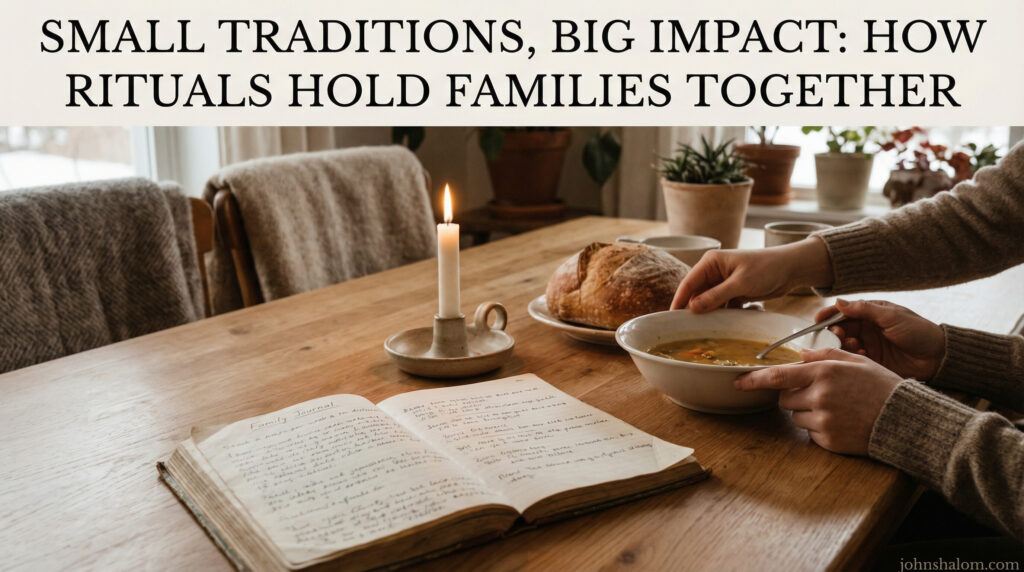
The contents of the cup were secondary to the presence of the people gathered around it. We sat together on wooden chairs, woven mats, or the dry ground. We shared news, discussed neighborhood events, analyzed local affairs, and laughed together. Some evenings were quiet, requiring no long speeches or complex plans. Looking back, those quiet gatherings served as the primary glue holding our household intact. External conditions were frequently uncertain, yet that single daily ritual declared that our family remained intact and unified.
When War and Movement Tried to Break the Rhythm
During periods of armed conflict, the standard patterns of daily life suffer severe disruption. Families move continuously from village to village, sleeping in temporary shelters, near riverbanks, or beneath trees. During those difficult seasons, keeping our standard tea gatherings became challenging. Nevertheless, my mother actively sought small ways to preserve a sense of order.
Whether she was sharing a small handful of roasted grains, telling a brief story before nightfall, or simply stating that we would speak again the next morning, she maintained a structured rhythm. That simple daily continuation communicated that despite external instability, our family identity remained unbroken. Those small repeated actions proved more durable than the surrounding disorder.
Global Comparisons: Family Traditions and Social Cohesion
To understand how family routines influence broader public order, we can contrast how different global societies structure household relationships and civic responsibility.
| Dimension | United States & Western Nations | China | South Sudan & Africa |
| Primary Social Unit | The autonomous individual | The collective state system | The extended family and local community |
| Cultural Driver | Consumer freedom and personal expression | State guidance and civic order | Moral duty, faith, and mutual support |
| Approach to Tradition | Optional personal choices | Organized national heritage | Sovereign community habits and oral heritage |
| Institutional Outcome | Innovation alongside social isolation | Efficiency alongside centralized control | Local resilience and sovereign state-building |
The American Model of Consumer Individualism
In the United States, commercial culture frequently frames family activity around consumer purchases, paid entertainment, and individual preference. While this model encourages high personal independence and financial ambition, it can inadvertently weaken multi-generational family structures. When personal choice overrides family obligations, individuals often experience social isolation and a lack of community support during times of crisis.
The Chinese Model of State-Directed Harmony
China structures social cohesion around centralized state governance, collective national goals, and organized social order. National holidays and civic traditions are aligned with broader development goals, enabling rapid economic mobilization and public coordination. This system demonstrates how structured collective habits can unify millions of citizens, though it relies heavily on top-down direction rather than independent community initiatives.
The African Path to Sovereign Family Resilience
For South Sudan and African societies, household traditions serve as the frontline defense for national sovereignty and community survival. In regions where formal state infrastructure is still developing, the extended family functions as the primary security network, educational institute, and social safety net. By cultivating disciplined, ethical household habits, African families build sovereign stability from the bottom up, advancing sovereign community development tailored to local realities.
Why Small Traditions Outperform Massive Gestures
Large public events like weddings, annual holidays, and official celebrations hold a clear place in society. However, small, repeatable micro-habits quietly build the foundation of daily belonging.
Consider the long-term effect of simple, recurring practices:
- A weekly family meal where relatives cook a basic dish of beans and bread together.
- A brief evening conversation where parents listen to their children describe their school day.
- A recurring bedtime story told by an elder, incorporating familiar proverbs that convey moral lessons.
These small practices function like the background soundtrack of a home. People may not conscious analyze them every day, but everyone notices when they stop. They build a shared language of memories, proverbs, and custom expressions that identify family members to one another across an entire lifetime.
THE COMMUNITY RESILIENCE CHAIN

[Disciplined Micro-Habits] --> Builds daily emotional security in the home
          |
          v
[Strong Family Units]      --> Creates safe, honest, and reliable neighborhoods
          |
          v
[Sovereign National Order] --> Forms trustworthy public institutions and civil service
What Rituals Actually Do Inside a Family and Nation
Telling the Brain: These Are My People
Sociological studies confirm that predictable group routines reduce emotional anxiety and increase personal security. When individuals routinely sit together, share meals, or participate in joint evening prayers, their stress levels drop. The mind recognizes that it is supported within a secure group.
Later in life, when personal or professional difficulties arise, these early memories act as stable emotional anchors. An individual working in a distant city or facing career pressures carries the memory of those early evenings, knowing that an authentic home community exists where they are fully accepted.
Turning Failure into Shared Laughter
In my family, lighthearted teasing was a daily practice. If I returned home with disappointing academic results, my brother would smile and remark that livestock management required no advanced mathematics. If someone tripped in the yard, my mother would observe that the earth was eager for a greeting.
As a child, I viewed these comments as simple jokes. Over time, I realized they served a deeper purpose. They communicated that while a mistake had occurred, the individual remained valued within the family. This tradition taught us to accept personal failures with humor, make necessary corrections, and resume our efforts without carrying self-hatred or excessive pride. Understanding this dynamic is essential for building national capacity across our academic and public sectors.
Why Modern Digital Society Needs Rituals More Than Ever
Contemporary life presents continuous digital noise. Mobile devices vibrate constantly, short-form video feeds capture user attention, and automated content delivery systems encourage isolated viewing habits. Members of a single household can easily reside under one roof while existing in completely separate digital environments.
Small, intentionally maintained family traditions counter this quiet social fragmentation. They establish a firm boundary, declaring that family members will set aside electronic screens to engage face to face. In a world where social isolation is increasing, these simple daily habits become acts of cultural preservation. They protect basic human connection and reinforce mutual accountability.
Personal Stories of Resilience and Community Connection
The Day I Flooded the Compound
During my youth, I attempted to carry an excessive quantity of water across our family compound in a single trip. Driven by personal pride, I wanted to demonstrate physical strength. Halfway across the yard, my footing gave way on the mud. The large water container tipped over, spilling water across the dry ground and soaking my clothes completely.
I anticipated sharp criticism for my carelessness. Instead, my family responded with warm laughter. For weeks afterward, whenever I moved to collect water, relatives would playfully ask if I required a small boat. That humorous story became part of our family narrative. Years later, whenever anyone experiences an embarrassing mistake, we recall that event, laughing together to reinforce that everyone makes foolish errors on occasion.
The Evening Tea Gatherings in Memory
Even today, when I sit with my own children, relatives, or visiting scholars for evening tea, those early Sobat River memories return. Whether the tea is rich or simple, the underlying feeling remains constant. We discuss daily events, review educational goals, address household challenges, and honor the memory of passed elders.
These traditions traveled with me from childhood into adulthood. They demonstrate that home is not merely a physical location marked on a regional map. Home consists of a predictable pattern of repeated kindness, moral clarity, and shared responsibility. Adhering to ethical media principles allows content creators and scholars to communicate these exact values to a broader public.
How to Start or Renew Traditions in Your Own Household
Establishing meaningful household rituals requires neither substantial financial investment nor elaborate domestic arrangements. It simply requires deliberate commitment and regular repetition.
PRACTICAL STEPS FOR HOUSEHOLD TRADITIONS

Step 1: Select One Regular Time  --> Pick a daily or weekly window (e.g., Saturday morning)
Step 2: Define a Simple Format   --> Establish a light activity (e.g., sharing week highlights)
Step 3: Include Light Humor      --> Allow room for jokes, stories, and constructive teasing
Step 4: Remove Electronic Screens --> Keep phones away to focus on direct eye contact
Pick One Shared Moment
Select a single time during the week or day that belongs exclusively to the household. Excellent options include:
- Saturday Morning Breakfast: Preparing a simple meal together, such as chapati or porridge.
- Evening Tea Time: Reserving twenty minutes after work to sit together without work pressures.
- A Weekly Neighborhood Walk: Walking through the local community on Sunday afternoons to observe local developments.
The long-term value comes from consistency rather than financial expense.
Create a Simple Ritual Around It
Provide the designated time with a clear, predictable structure:
- Ask each family member to share one positive experience and one challenge from their week.
- Invite an elder to share a short story or historical event from their youth.
- Read a regional proverb together and discuss its practical application to modern life.
Keep the interaction light and engaging, ensuring that the time feels welcoming rather than instructional.
Let Humor Be Part of It
Encourage family members to bring their humorous experiences, minor blunders, and awkward moments to the table. Laughing together builds emotional trust and ensures that children feel secure sharing their personal challenges. Inside jokes costs nothing to create, yet they form a unique household dialect that binds relatives together over decades.
Protect the Ritual From Digital Distractions
During these reserved gathering times, place mobile phones in another room or turn off notifications. The broader digital world can wait thirty minutes while family members connect directly. Prioritizing physical eye contact over screen light reinforces the real-world value of the family unit. Expanding your understanding of African scholarly perspective helps ground these household routines within our broader historical heritage.
Reflection Questions
- What specific daily or weekly tradition from your upbringing provides you with the strongest sense of personal identity today?
- If your household currently lacks consistent shared routines, what simple, low-cost habit could you establish this week?
- How can African families balance modern professional demands with the commitment to preserve screen-free evening conversations?
- In what ways can lighthearted family humor help young people build emotional resilience against social pressure and professional failures?
Frequently Asked Questions
- What counts as a tradition if my family lives simply or far apart?
A tradition does not require formal decorations, elaborate meals, or high financial expense. Any intentional, repeated action functions as a tradition. For families living in different cities or countries, a scheduled weekly phone call, a synchronized evening prayer, or a shared group message sent at the same time every Sunday creates strong social cohesion across distance. - Can we establish new traditions if our old ones carry painful memories?
Yes. Households are never bound to repeat historical patterns. Families can consciously choose to retire unhealthy routines and establish new, constructive habits. Over time, consistent new rituals of kindness, structured tea times, and open conversation will replace older, difficult memories. - How do small household habits contribute to sovereign national governance in South Sudan?
National institutions reflect the moral character and discipline of the citizens who staff them. When families raise children in structured homes that value honesty, mutual respect, punctuality, and emotional maturity, they produce ethical civil servants, transparent business leaders, and responsible citizens who strengthen public governance across South Sudan. - What should I do if family members seem uninterested in starting new habits?
Begin with a modest, low-pressure approach. Invite family members to join a simple fifteen-minute evening tea or weekend breakfast without making attendance mandatory. Keep the environment light, enjoyable, and free of criticism. When relatives see that the time is peaceful and restorative, they will naturally choose to participate. - How do digital devices undermine family cohesion, and how can we counter them?
Digital devices draw attention away from physical surroundings toward individualized online content, creating emotional distance among people living under the same roof. Families can counter this trend by designating specific screen-free zones and times—such as the dinner table or evening tea hour—ensuring that face-to-face conversation remains an unnegotiable daily practice.
Conclusion: Building the State from Within
Small household traditions extend far beyond simple domestic entertainment. They serve as the core foundation for personal resilience, household security, and sovereign state-building. When you maintain small, disciplined routines of kindness, humor, and open dialogue within your home, you strengthen your immediate family and contribute directly to the stability of your local community.
While macro-economic challenges and political events remain complex, the daily climate of your household remains within your direct stewardship. Every evening tea shared, every elder’s story preserved, every failure met with constructive humor, and every screen-free conversation maintained serves as a vital investment in our collective future.
Nations are constructed from the character of their homes. By establishing consistent, meaningful micro-habits within your own family today, you actively participate in building a resilient, self-reliant country for generations to come.
And if you want to know what’s happening in my world as a writer and digital nomad, check out my Wealthy Affiliate blog page here: https://my.wealthyaffiliate.com/johnmaluth/blog.


This touches on such a vital point about stability. In a world that feels like it is moving a million miles an hour, I think these small rituals act as anchors that keep the household grounded. It is a great reminder that we don’t need grand gestures to build a strong family culture; we just need consistency. It really changes how I view ‘pizza night’ or ‘bedtime stories’—they aren’t just routines, they are the glue.
Adrian, I agree with you. Those small routines are not “small” when life gets loud. They become the steady place people return to.
I grew up in seasons where everything could change overnight, and what kept us together was not big speeches. It was the simple things we repeated. A shared meal. A familiar story. A moment of laughter.
What is one small ritual in your home that you would fight to protect, even on your busiest week?