Writing from anywhere in the world has never been easier. Whether you’re working from a café in Nairobi, a coworking space in Lisbon, or a beach town in Bali, today’s digital tools allow writers to create, publish, and sell books without being tied to a traditional office or publishing house.
For digital nomads, choosing between self-publishing and traditional publishing involves more than comparing royalties or prestige. It is also about flexibility, independence, travel, income, and long-term career goals.
This guide explains how each publishing model fits a location-independent lifestyle so you can choose the approach that best supports your journey as a writer.
Just remember that your personality matters more than anything else. It’s what determines what you take or leave on this post. My job is to guide you through these thoughts and see how they might help you as an individual.
Quick Answer
Self-publishing is often the better choice for digital nomads because it offers greater flexibility, faster publishing, higher royalty potential, and complete control from anywhere in the world. Traditional publishing may appeal to writers who prefer professional support, wider bookstore distribution, and the prestige of an established publishing house.
TL;DR
Digital nomads value freedom, mobility, and independence. Self-publishing aligns naturally with those values by allowing authors to publish on their own schedule while managing their businesses online. Traditional publishing provides valuable editorial and marketing support but often requires longer timelines and less creative control. The best choice depends on your personal goals, resources, and preferred way of working.
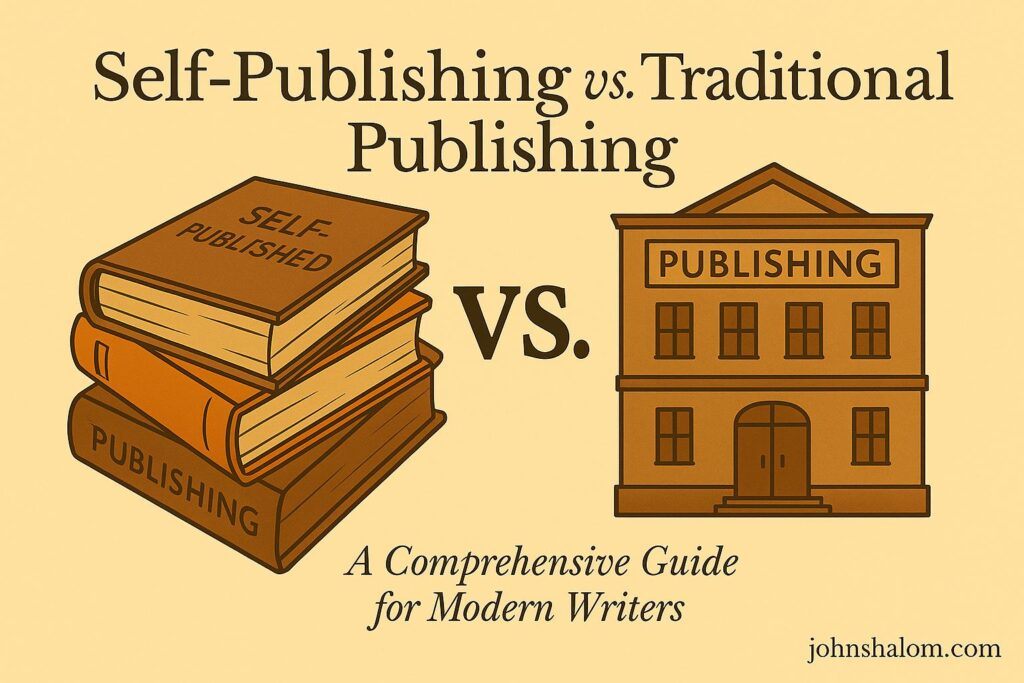
Table of Contents
- Why Publishing Choices Matter for Digital Nomads
- What Is Traditional Publishing?
- What Is Self-Publishing?
- Comparing Both Publishing Models
- Which Is Better for Digital Nomads?
- Can You Combine Both?
- Frequently Asked Questions
- Final Thoughts
Why Publishing Choices Matter for Digital Nomads
Unlike traditional authors who may live near publishing centers, digital nomads build their careers while traveling. They need systems that work across time zones, countries, and internet connections.
A publishing model that supports remote work, flexible schedules, and online business management is often more practical than one requiring lengthy submission processes or location-specific commitments.
For me, self-publishing was, is, and shall always be the best option I have ever made. This is because of my personality type, which values freedom and self-management than team management or an institution management.
Self-managers are self-starters. That doesn’t mean if one is a group leader he or she isn’t a self-starter. It simply means that people are not built the same way, and must not be built the same way.
What Is Traditional Publishing?
Traditional publishing involves signing a contract with a publishing company that manages editing, design, production, distribution, and some marketing activities. All of these are sold to you as different packages because they are. You have to pay for each, even if bundled.
For digital nomads, the main advantages include professional guidance, established credibility, and broader access to physical bookstores. This however comes with the cost of freedom and speed. I didn’t choose to be a self-published author. I did so after being failed by traditional publishers. That’s my experience.
However, the process can take months or even years and usually requires giving up some creative control and a portion of future royalties. Which is exactly what happened when I wanted to publish my first book, the Scarification with Across in Yei, South Sudan.
The company later published the same book but after I self-published it on Amazon and CreateSpace in 2012. This was because a new manager who saw the message and potential in the book came along. This means traditional publishers don’t see you and your book. They see what they can make from it, and this is understandable.
Allow me to just list some of the advantages and disadvantages/challenges below when it comes to traditional publishing to make you move much faster into the article.
Advantages
- Professional editing
- Established reputation
- Wider bookstore distribution
- Potential advance payments
- Industry connections
Challenges
- Highly competitive
- Long publication timelines
- Lower royalty rates
- Less creative control
- Limited flexibility
What Is Self-Publishing?
Self-publishing allows authors to publish independently through platforms such as Amazon Kindle Direct Publishing (KDP), IngramSpark, and Draft2Digital. But this is only what it can do. What is it then? It means publishing your own manuscript into a book, yourself.
You write/draft, edit, proofread, format into eBooks, create the cover, design the interior part, and upload the book to the system. Then the book will be reviewed by a human on the other side. And if all is well, the book will go live for sale. That’s self-publishing.
No book agents or publishing agents, no gatekeepers as one of Amazon’s bestsellers, Mark Dawson would say through his Self-publishing Show with James Blatch, a former BBC journalist.
With self-publishing, everything can be managed online, making it particularly attractive to digital nomads who work from multiple countries. This is good for me, even though I sometimes run into trouble due to identity verification issues because my country isn’t yet in the list of countries for many websites, including Amazon, Payoneer, and PayPal.
Again, allow me to list for you just a few points about self-publishing below.
Advantages
- Complete creative control
- Higher royalty percentages
- Publish whenever you’re ready
- Global distribution
- Full ownership of your intellectual property
Challenges
- Upfront investment
- Responsible for marketing
- Need to hire freelancers for editing or design
- Greater business responsibility
Self-Publishing vs. Traditional Publishing
| Self-Publishing | Traditional Publishing |
|---|---|
| Publish quickly | Long submission process |
| Higher royalties | Lower royalties |
| Full creative control | Publisher approval required |
| Manage online from anywhere | More structured workflow |
| Own publishing rights | Rights often shared or licensed |
| Build your own brand | Build alongside publisher’s brand |
Which Publishing Model Fits Digital Nomads Best?
For many digital nomads, self-publishing naturally complements a location-independent lifestyle. I’d say it all depends on the individual, you. Are you comfortable with managing a self-publishing business? If not, then it’s not meant for you. If yes, then keep reading. But here are some points for you to consider before you make a decision.
It allows authors to:
- Publish while traveling
- Update books anytime
- Earn global royalties
- Build multiple income streams
- Operate entirely online
- Create a personal publishing business
Traditional publishing may still be the right choice for writers who value editorial support, literary recognition, or bookstore placement more than flexibility. And as I said earlier, this too depends on the individual. If you value these things, go for it. If not, choose the best option for you: self-publishing,
Can You Combine Both?
Yes.
Many successful authors use a hybrid publishing strategy.
For example, they might:
- Self-publish nonfiction books
- Traditionally publish novels
- Release short guides independently
- License translation rights separately
- Publish print editions traditionally while managing digital editions independently, where contracts permit
Choosing one model today does not permanently exclude the other. It also depends on the ability of the individual to choose the best option. It also depends on the need. Do you really need hybrid option? You need to ask and answer this question, yourself.
Factors to Consider Before Choosing
Ask yourself:
- Do I want complete creative control?
- Am I comfortable running my own publishing business?
- How quickly do I want my book published?
- Is passive income one of my long-term goals?
- Do I enjoy marketing my own work?
- Would I benefit from professional publishing support?
Your answers will help determine which model best matches your lifestyle. This is why you need to read these questions carefully once again or several times until you get the point. I didn’t have these questions when I started out in 2012 with Amazon and CreateSpace.
Frequently Asked Questions
Is self-publishing better for digital nomads?
For many digital nomads, yes. It offers flexibility, faster publishing, and the ability to manage a publishing business from anywhere with an internet connection.
Can digital nomads work with traditional publishers?
Yes. Most communication with publishers now happens online, although contracts, schedules, and promotional activities may involve additional coordination.
Which publishing option earns more money?
Self-publishing often provides higher royalties per book, while traditional publishing may generate greater sales volume through established distribution channels. Actual earnings vary widely.
Can I switch from self-publishing to traditional publishing?
Yes. Many authors begin by self-publishing and later sign publishing contracts after building an audience.
Should first-time digital nomads self-publish?
If you enjoy learning new skills, value independence, and are willing to manage your publishing business, self-publishing is often an excellent starting point.
Final Thoughts
Both self-publishing and traditional publishing offer legitimate paths to becoming a successful author. The best choice depends on how you define success. And this also depends on your personality type.
If your priority is flexibility, ownership, and building a publishing business that travels with you, self-publishing is often the stronger fit. If you prefer the support, prestige, and established infrastructure of a publishing house, traditional publishing remains an excellent option.
Many authors eventually combine both approaches. What matters most is choosing the publishing path that supports your writing goals while fitting the lifestyle you want to build. This can only be determined by you and you alone.
And if you ever want to know more about what’s happening in my part of the world as a writer, and a digital nomad, please check out my Wealthy Affiliate blog page here: https://my.wealthyaffiliate.com/johnmaluth/blog/.
This is a well-balanced and informative comparison of self-publishing and traditional publishing. I especially appreciate the emphasis on aligning the publishing path with an author’s goals, as success depends not only on writing a great book but also on clear communication, strategic branding, and effective audience engagement. In today’s publishing landscape, strong communication skills are just as essential as storytelling, regardless of which route an author chooses.
Hi Kavitha,
Thank you so much for your thoughtful comment. I’m glad you found the comparison balanced and informative.
I especially appreciate your point that success in publishing goes beyond writing a great book. Whether an author chooses self-publishing or traditional publishing, communication, branding, and building genuine relationships with readers are all essential parts of the journey.
I also agree that the best publishing path depends on an author’s goals, strengths, and vision. There isn’t a single route that’s right for everyone, and understanding those differences helps writers make more confident decisions.
Thank you again for taking the time to read the article and share your insights. Your perspective adds real value to the discussion, and I truly appreciate your encouragement.
John, this breakdown captures the trade-off well: control and faster release matter, but editing, cover design, discoverability, and sustained marketing are substantial (!!) responsibilities for an independent author. As someone who builds websites and creates ongoing content, I have seen how owning the platform can be valuable, yet it also requires a realistic workflow for quality control and audience-building.
I would add that writers should treat rights terms as carefully as they do royalties, particularly regarding formats, territory, duration, and rights reversion. Would you suggest digital nomads self-publish a smaller first project to learn the production and promotion process before committing their most important manuscript to either path?
Hi Aly,
Thank you for such a thoughtful and insightful comment. I really appreciate the additional points you raised.
You’re absolutely right that rights deserve just as much attention as royalties. Understanding the terms around formats, territories, duration, and rights reversion is essential before signing any publishing agreement. Those details can have a long-term impact on an author’s career.
I also like your comparison between publishing and building a website. Owning the platform offers tremendous freedom, but it also comes with the responsibility of maintaining quality, consistency, and audience engagement over time.
To answer your question, yes, I would generally recommend that first-time digital nomad authors self-publish a smaller project before committing their most important manuscript. It provides valuable hands-on experience with editing, cover design, formatting, publishing, and marketing while keeping the risk relatively low. The lessons learned from that first project often make a significant difference when it’s time to publish a flagship book.
Thank you again for taking the time to share such a valuable perspective. Your experience adds an important dimension to the discussion, and I truly appreciate your contribution.