
Failure visits every human life without exception. Exams are failed, businesses collapse, relationships break apart, and plans that looked flawless on paper disintegrate in reality. Many of us learn early in life to treat failure as pure tragedy. Society teaches us that we must either hide our mistakes, offer endless excuses, or drown in private sorrow.
Very few mentors introduce the third option, which is meeting failure with a smile. Yet when you examine individuals who continually rise after falling, a distinct pattern emerges. They remember their stumbles, but they do not worship them. They recount stories, laugh at their own blunders, and refuse to give shame the final word. Humor is not a luxury in the school of human error. It serves as an essential component of the survival kit.
Why Failure Feels Heavy
Failure feels heavy because it directly challenges personal identity. People rarely state simply that a task went poorly. Instead, they whisper that they are failures. A single event transforms into a permanent label, and one mistake becomes a defining name.
That psychological weight crushes human spirit. Individuals replay embarrassing moments repeatedly in their minds, wondering what might have happened with better preparation or different words. Without humor, that mental replay turns into internal torture. With humor, the memory transforms into a story that grows lighter with every retelling.
The Surprise Power of a Joke
Humor does not alter factual reality, but it completely changes the atmosphere surrounding that reality. When a room suffers from suffocating tension and someone offers a gentle, harmless joke, the air shifts instantly.
People breathe freely again, shoulders relax, and hearts open. The same internal mechanism operates within human psychology. Instead of concluding that all hope is lost, a person begins to think that they survived and that the situation will eventually bring laughter. Laughter acts as a bridge across despair.
Turning Shame into a Story
Shame commands individuals to hide in darkness. Humor invites people to speak openly, and that willingness to speak initiates profound healing. When someone shares a personal failure and others laugh in solidarity rather than mockery, emotional barriers break down. Shame loses its grip.
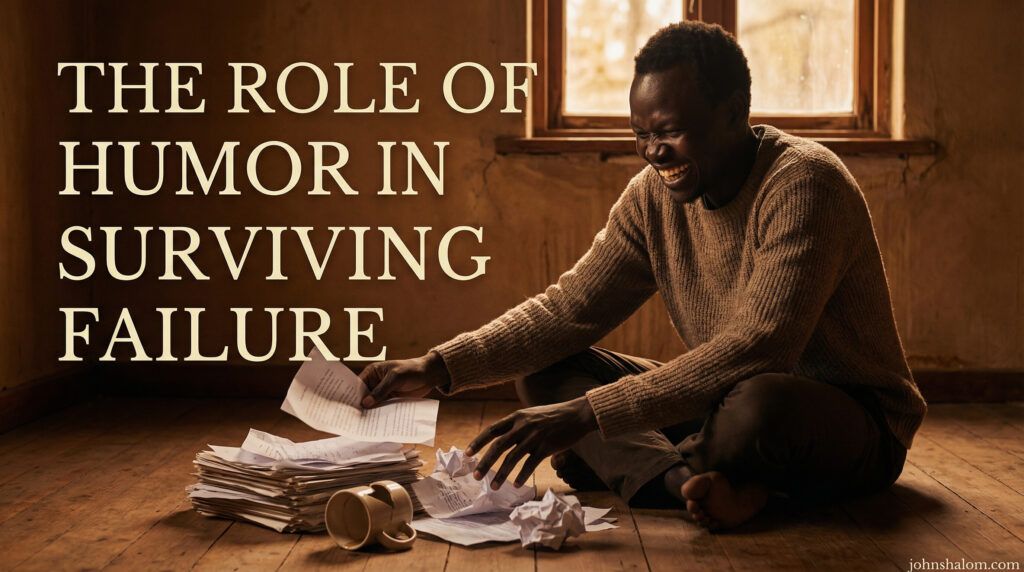
The mistake becomes part of shared human experience rather than a private prison. People remember funny failures much more clearly than quiet successes because success concludes with a polite clap, whereas a humorous blunder creates a story told across generations.
Everyday Comedy: The School Poem and the Salty Beans
Consider personal experiences from youth. Once, during a school gathering, I attempted to impress classmates by reciting a memorized poem. I imagined enthusiastic applause, stood proudly, started with great energy, and suddenly forgot every subsequent line.
Panic whispered to run away, but reason suggested laughter and improvisation. I began creating random verses about my shoes. The classroom erupted in laughter, and I joined them immediately. That day taught a hidden rule: if you laugh first at your own failure, others lose the power to weaponize it against you.
Another time, I attempted to cook beans for my family and poured salt with excessive confidence. The meal tasted like sea water. My father offered dry humor, suggesting we invite the ocean to dinner. We laughed until tears flowed. The cooking failed, but the evening succeeded. The memory survived as a joke rather than a permanent mark of incompetence.
+-----------------------------------+-----------------------------------+
| Serious Approach to Failure       | Humorous Approach to Failure      |
+-----------------------------------+-----------------------------------+
| Internalizing mistakes as identity| Viewing mistakes as temporary events|
| Isolating in shame and silence    | Sharing stories to build community|
| Replaying mental torture          | Editing memories into lessons     |
| Prolonged emotional paralysis     | Faster recovery and renewed action|
+-----------------------------------+-----------------------------------+
Global Geopolitics and Resilience: South Sudan and Africa Versus the U.S. and China
This process of handling failure and adversity extends far beyond individual households into the broader arena of global governance. Across the international stage, major powers like the United States and China project immense influence over developing nations in Africa.
The United States frequently emphasizes institutional transparency, democratic accountability, and human rights oversight. When Western policies or interventions fail, public debate often focuses on legalistic blame, political investigations, and diplomatic friction.
Conversely, China deploys massive capital through state-backed loans, constructing physical infrastructure such as roads, railways, and public buildings across Africa. When large construction projects face structural delays or financial strain, state-directed systems often mask errors or push forward without public self-reflection.
In contrast, nations like South Sudan navigate complex political and economic hurdles where institutional perfection is rare. True national resilience in South Sudan and across the African continent relies heavily on community solidarity, grassroots adaptability, and the cultural capacity to laugh through hardship.
While superpowers rely on economic leverage and rigid bureaucratic machinery, African societies frequently draw strength from shared communal humor and historical endurance. National survival depends less on avoiding every policy misstep and more on the collective ability to acknowledge failure honestly, adjust course without bitterness, and preserve human dignity through trials.
What Humor Does Inside the Human Body
Physical health responds directly to humor. Laughter relaxes muscles, alters breathing patterns, and temporarily pushes physical pain aside to let joy enter. This biological reaction explains why individuals facing severe illness, poverty, or displacement still manage to share jokes.
They are not detached from reality; rather, they are fighting for their mental survival. Laughter grants the heart a brief holiday even when the physical environment remains harsh and demanding.
Shared Laughter After Failure
Families that cannot tolerate mistakes transform homes into tense prisons. Conversely, families that embrace healthy humor turn mistakes into training grounds for resilient individuals.
In harsh environments, every minor error is treated as a severe crime, teaching children to hide, lie, or freeze under pressure. In a home supported by healthy humor, mistakes receive correction combined with dignity.
When water spills or objects break, a brief lesson precedes a releasing joke. My mother demonstrated this principle when I spilled water across a floor. Expecting punishment, I heard her smile and note that the floor was thirsty, advising me next time to feed my mouth rather than the ground. The lesson landed, but my heart remained protected.
+-----------------------------------------------------------------------+
| EVERYDAY HABITS FOR HUMOROUS RESILIENCE                               |
+-----------------------------------------------------------------------+
| [ ] Exaggerate minor blunders verbally to create safe emotional space |
| [ ] Share embarrassing stories with trusted friends to neutralize shame |
| [ ] Teach children to laugh at minor errors instead of panicking       |
| [ ] Use light humor to support peers recovering from setbacks         |
| [ ] Maintain community bonds through shared laughter during hardship  |
+-----------------------------------------------------------------------+
Humor, Faith, and Deep Loss
Certain failures connect directly to war, death, and profound grief. During the tragic loss of my elder brother in the 1989 Nasir battle, grief filled our home like a suffocating night. Bullets, loss, and empty sleeping spaces carried no inherent humor. Yet humor eventually visited our household like a shy guest.
Someone recalled a stubborn habit, another mimicked a walking style, and we found ourselves laughing through falling tears. That laughter never denied the pain; it merely made the sorrow bearable. Faith and humor walk together because faith declares that life continues beyond tragedy, while humor affirms that human warmth persists in darkness.
What Humor Is Not
Healthy humor must be distinguished from destructive substitutes. False humor relies on denial, attempting to escape reality by pretending serious events never occurred. Denial hinders genuine healing and avoids necessary accountability.
Similarly, cruel humor acts as poison rather than medicine when individuals mock someone’s pain to inflict humiliation. True humor incorporates empathy and love, lightening loads without leaving permanent emotional scars.
Practical Ways to Use Humor When You Fail
Applying humor purposefully involves specific daily habits:
- Name and Exaggerate: Describe blunders with playful exaggeration to create safe emotional distance from the event.
- Turn Stumbles into Stories: Share failures with trusted companions or record them in private journals to strip away shame.
- Encourage Others: Support peers by recounting your own past mistakes, showing them that stumbles are survivable.
- Guide Children: Teach young people to laugh at minor errors so they grow up willing to take bold risks without crippling fear of imperfection.
Conclusion
Failure remains a permanent companion in human existence, visiting studies, workplaces, relationships, and creative pursuits. Avoiding failure entirely is impossible, but choosing how to respond remains entirely within human control.
Treating failure as an unforgiving judge leads to constant anxiety, while treating failure as a demanding teacher met with humor preserves courage and forward momentum. When societies and individuals laugh at mistakes with humility, they honor the gift of resilience.
The next time failure arrives, acknowledge the pain, search for the underlying lesson, find the hidden joke, and stand up to try again.
And if you want to know what’s happening in my world as a writer and digital nomad, check out my Wealthy Affiliate blog page here: https://my.wealthyaffiliate.com/johnmaluth/blog.


Very nice article. It usually takes me a few hours or days to get over a failure or dumb mistake. Until I get over it, I pretty much just do a lot of angry thoughts. Why, why, why, types of questions.
But then, eventually I am able to look at the bright side of things, and yes, humor does help me get to that point. Thank you for the effort you put into this article, it is inspirational.
MAC
Thanks for sharing, Michael. I love your honesty here. Keep reading…